MVNO and MNO: Who Owns What
Introduction about the MVNO and MNO Relationship
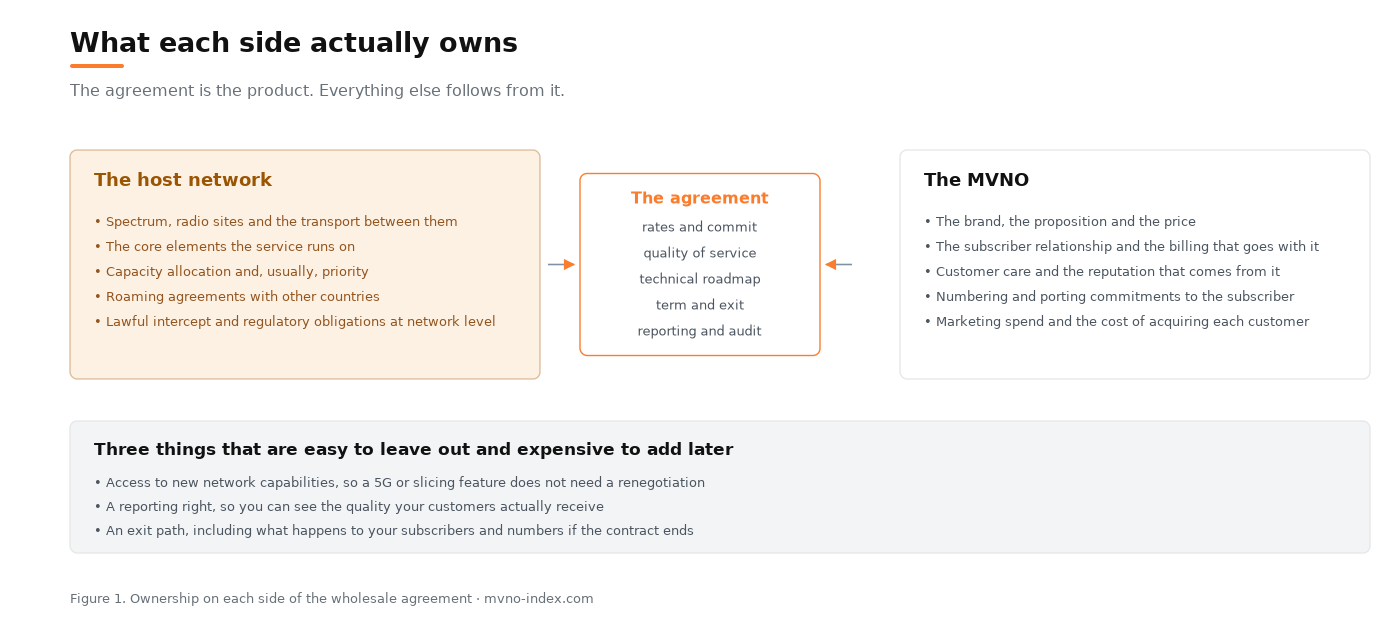
An MVNO and its host MNO divide one business in two. The mobile network operator owns the spectrum, the radio sites, the core elements and the capacity; the MVNO owns the brand, the price, the subscriber relationship and the cost of winning each customer. Everything in between is the wholesale agreement, and that agreement is the real product: rates and commitment, quality of service, access to new capabilities, reporting rights, term and exit.
The relationship between a mobile virtual network operator and a mobile network operator connects a retail mobile proposition to the network access needed to deliver it. The MNO operates radio access and supplies the agreed wholesale services. The MVNO develops its customer offer and performs the responsibilities assigned to it under the chosen operating model.
The agreement determines much more than the price of data. It affects available services, launch timing, customer support, technical control and the ability to change the business later. A good host relationship begins with a clear service scope and a realistic business case, then continues through active commercial and operational management.
On this page
- History and Evolution of Host Network Relationships
- Core Utility and Functionality of the Relationship
- What is the Host Relationship Used For?
- Key Functions of the Host Agreement
- Technical Integration and Data Model
- Integration with Other Systems
- Technical Data Model and Key Interfaces
- Relationship Ownership for MVNOs and IoT Companies
- Why Manage the MNO Relationship Directly?
- Advantages and Disadvantages of a Direct MNO Relationship
- Organizational Impact of the Host Relationship
- Redundancy and High Availability
- Impact of 4G and 5G and Future Networks
- The Relationship in 4G Services
- The Relationship in 5G Services
- Long Term Partnership Planning
- Frequently Asked Questions about MVNO and MNO Relationships
- Summary
History and Evolution of Host Network Relationships
MVNO arrangements developed as a way for mobile brands to serve particular customer groups using another operator's radio network. Over time, operating models expanded from relatively simple resale to arrangements where an MVNO controls substantial core and business-system capabilities. The division of responsibilities has become more varied than the labels light or full MVNO alone can describe.
Data-heavy products, international connectivity and enterprise services have added further requirements. A brand may want specific roaming, device or network features rather than generic access. The MVNE and MVNA role comparison helps explain where intermediaries fit, but the host agreement remains the practical authority for the services actually available.
Core Utility and Functionality of the Relationship
Who owns what, and what follows from it
| Aspect | The host network | The MVNO |
|---|---|---|
| Spectrum and radio sites | Owns them | Buys access to them |
| Capacity and priority | Allocates it | Negotiates for it |
| Core and network functions | Operates them | May run some, depending on type |
| The brand and the price | Not involved | Owns both entirely |
| The subscriber relationship | Does not hold it | Holds it, and the reputation with it |
| Numbering and porting | Technical execution | The promise to the subscriber |
| New network capabilities | Decides what is offered | Decides whether it can be sold |
What is the Host Relationship Used For?
The relationship gives the MVNO access to defined network services under commercial terms. Depending on the arrangement, these may include voice, messaging, data, roaming and selected advanced features. Each service needs an explicit scope, technical delivery method and charging basis. Access to one capability should not be inferred from the availability of another.
The MNO gains a route to customers or markets that the MVNO can serve effectively. The MVNO gains network reach without building a nationwide radio network. These interests can align, but they do not eliminate commercial differences. Agree how the relationship will handle changes in traffic, customer mix and required features before those changes become urgent.
Key Functions of the Host Agreement
Service definition establishes what the MVNO can sell. Coverage, access technologies, supported devices, voice capabilities and roaming should be described at the level needed for the target product. A general statement of national coverage is insufficient for a business whose customers depend on indoor service at specific sites or on a particular device capability.
Commercial terms establish how charges are calculated and when commitments apply. These may include usage rates, recurring fees, minimum spend, volume tiers and security requirements. Model them together. A lower data rate can be outweighed by a commitment that the business cannot reach during launch or by charges outside the main rate card.
Operational terms establish how incidents, changes and disputes are handled. The MVNO needs access to useful evidence and a route to people who can investigate the host network. Retail customers will usually contact the brand they bought from, so the wholesale escalation process must support the promises that brand makes to them.
Technical Integration and Data Model
Integration with Other Systems
The integration scope depends on which party operates subscriber management, core functions, billing and provisioning. An MVNE may supply some of these capabilities. Create a responsibility map for the complete customer journey, from ordering a SIM to activating service and resolving a failed call. Every transition between organisations needs an owner.
Usage and charging records must reach the systems responsible for billing and reconciliation. Agree delivery timing, correction procedures and identifiers. Delayed roaming records can affect spending controls and customer balances. A near-real-time retail promise should be tested against the actual timing of the wholesale information, not against a generic interface description.
Treat the right to see your own service quality as a commercial term, not a technical nicety. Without agreed reporting you are left arguing about a customer experience you cannot measure, against a party that can.
Network changes also need coordination. A host may change access support, routing or maintenance schedules in ways that affect the MVNO's product. Establish a change-notification process and representative testing. The core network overview provides context for identifying dependencies that may sit outside the MVNO's direct control.
Technical Data Model and Key Interfaces
Keep a common view of subscriptions, SIM identifiers, service entitlements and relevant status changes. The host and MVNO may use different internal identifiers, so mapping must be reliable. A support investigation becomes slow when neither party can connect a retail account to the network record that experienced the problem.
Ownership on each side of the wholesale agreement.
Specify interface behaviour for activation, suspension, restoration and cancellation. An accepted request may still be awaiting execution. The MVNO needs to know the final outcome and how to handle a retry safely. Test partial failure, including a service that becomes active while the retail system believes activation failed.
Reporting should distinguish radio access problems, core service failures and retail-platform issues. The goal is to identify the affected customer journey, not simply assign blame. Require enough diagnostic information to narrow the problem and agree how sensitive network data can be shared appropriately during investigations.
Relationship Ownership for MVNOs and IoT Companies
Three clauses that cost nothing now and a great deal later.
| Clause | Without it | With it |
|---|---|---|
| Access to new capabilities | Every new feature is a renegotiation | A defined route to adopt what the host launches |
| A reporting right | You argue about quality you cannot measure | You hold evidence your customers can see too |
| An exit path | Your subscribers are hostage to the contract | A timetable, and your numbers come with you |
Why Manage the MNO Relationship Directly?
A direct relationship can offer clearer commercial engagement and greater influence over a sufficiently substantial opportunity. It can also bring integration work, financial commitments and operational responsibilities that a smaller brand is not ready to carry. Compare direct access with an MVNA or MVNE arrangement using the complete business case.
For an IoT provider, the decision depends on geography, device requirements and fleet lifetime. A domestic host agreement may be attractive for a concentrated deployment, while an international service may need additional partners. Verify the permitted usage and roaming arrangements for the intended countries rather than assuming that a global marketing claim covers permanent device deployment everywhere.
Advantages and Disadvantages of a Focused MVNO Strategy
Advantages
-
Direct engagement can make commercial requirements easier to discuss with the party controlling radio access and wholesale service delivery. It may support a tailored service scope or a clearer roadmap for a large, credible opportunity. The practical benefit depends on the agreement and the host's willingness and ability to support the requirements.
-
A direct arrangement can also simplify some escalation and reconciliation paths. Fewer commercial layers may make it easier to understand charges and service restrictions. That does not guarantee a lower total cost, because the MVNO may need to fund capabilities that an intermediary would otherwise provide across several customers.
Disadvantages
-
Minimum commitments and launch dependencies can create risk before revenue is established. A delayed integration does not necessarily pause every contractual charge. Negotiate the relationship between commercial start dates, technical acceptance and committed volumes so the business understands its exposure if launch takes longer than planned.
-
Dependency on one host can limit flexibility. Features, pricing changes and migration options may depend on that relationship. Moving customers can involve SIM, profile, numbering and system changes, depending on the architecture. Evaluate exit feasibility before signing, including the data, assistance and time needed to transfer service without avoidable disruption.
Organizational Impact of the Host Relationship
Assign a commercial owner and an operational owner, with a shared view of priorities. Commercial reviews should cover actual traffic, commitments, product performance and planned changes. Operational reviews should examine incidents, recurring faults and upcoming maintenance. A relationship managed only at contract renewal is unlikely to resolve developing problems early.
Sales and marketing need approved product facts. Coverage, roaming and feature claims should match the contracted service and tested experience. A host's retail offer may include capabilities that are not available under the MVNO's wholesale agreement. Copying the host's consumer claims can therefore create a gap between what the brand sells and what it delivers.
Finance should reconcile wholesale invoices against available usage and contract terms. Analyse cost by product and customer segment, including exceptional usage and minimum-spend effects. A tariff that looked profitable under an average traffic assumption may perform differently when the actual customer base develops. Feed those findings into product and contract reviews.
Before selecting a host, submit a clear forecast and service specification. Include target customers, expected usage, required features and launch dependencies. Ask for a complete proposal rather than a single attractive unit price. The wholesale agreement guide is a useful starting point for the commercial discussion.
Redundancy and High Availability
The host's resilience is only one part of the MVNO service. The brand's provisioning, billing, customer channels and any external core functions also need recovery arrangements. Map the dependencies and identify which party restores each service. A host network that remains available cannot compensate for an unavailable subscription database elsewhere in the chain.
Set service measurements that reflect the product. General network availability may not describe activation success, voice registration or roaming performance. Agree how incidents are detected, reported and escalated, including what evidence supports service credits or other remedies. Contractual remedies help accountability but do not replace an operational recovery plan.
Using more than one network can improve some forms of resilience, but it requires a supported technical and commercial design. A second agreement does not automatically allow every existing SIM or device to switch immediately. Test the actual switching or migration mechanism and identify shared dependencies that could affect both arrangements at once.
Impact of 4G and 5G and Future Networks
The Relationship in 4G Services
LTE access is only part of a complete mobile proposition. Voice, messaging, device configuration and roaming require their own support. Confirm the intended VoLTE and other service paths, particularly where legacy networks are being retired. A working data connection is not proof that the full customer service is ready.
The Relationship in 5G Services
5G availability under a wholesale contract may differ by deployment mode, device, service and location. Advanced capabilities such as slicing or network APIs require explicit support and commercial rights. Ask what is available now, how it is activated and what the MVNO can measure before building a product around it.
Long Term Partnership Planning
Include a regular process for reviewing network evolution and product requirements. Preserve flexibility through clear change terms, useful data access and a realistic exit plan. Future-generation promises should be converted into specific deliverables when they become available, rather than used as a substitute for current service evidence.
Frequently Asked Questions about MVNO and MNO Relationships
Does every MVNO need a direct MNO contract?
No. An MVNO can obtain access through an intermediary such as an MVNA or a provider combining several roles. The important point is to understand the contractual chain and which party is accountable for each service.
Does a full MVNO own the radio network?
No. The term generally indicates greater control of core and operational capabilities. Radio access is still obtained through the host arrangement, and the exact division of functions should be documented
Is the lowest data rate the best offer?
Not necessarily. Minimum commitments, platform costs, roaming, feature access and operational support can change the total economics. Compare complete proposals using the same realistic traffic and customer-growth assumptions.
Can an MVNO sell every service the host sells?
Only where the wholesale agreement and implementation support it. Retail and wholesale portfolios can differ. Verify each important feature, supported device condition and activation process before including it in the MVNO's offer.
Who handles customer complaints?
The retail brand normally manages the customer relationship under its operating model, while underlying faults may require host investigation. Agree evidence sharing and escalation procedures so customers are not left between organisations with no clear owner.
Can an MVNO change host easily?
Migration complexity depends on SIMs, profiles, numbering, core ownership and system integration. Establish the practical steps and contractual assistance before signing. Do not assume that changing a commercial agreement alone moves existing subscribers.
What should a host selection trial prove?
Test activation, voice, messaging, data and the relevant roaming and recovery scenarios on representative devices. Verify the associated billing records and support process. Technical success and commercial reconciliation should both be part of acceptance.
Summary
The MVNO and MNO relationship defines the access, economics and operating boundaries of a mobile service. Clear responsibilities and tested capabilities make the agreement useful beyond launch and help the partners handle growth and change.
Compare host and intermediary options through the MVNO Index provider directory. Request proposals against one documented service scope, then evaluate complete cost, operational evidence and migration flexibility before committing.
Subjects about how to start your own MVNO