IoT ARPU: Cents per Device, Years per Asset
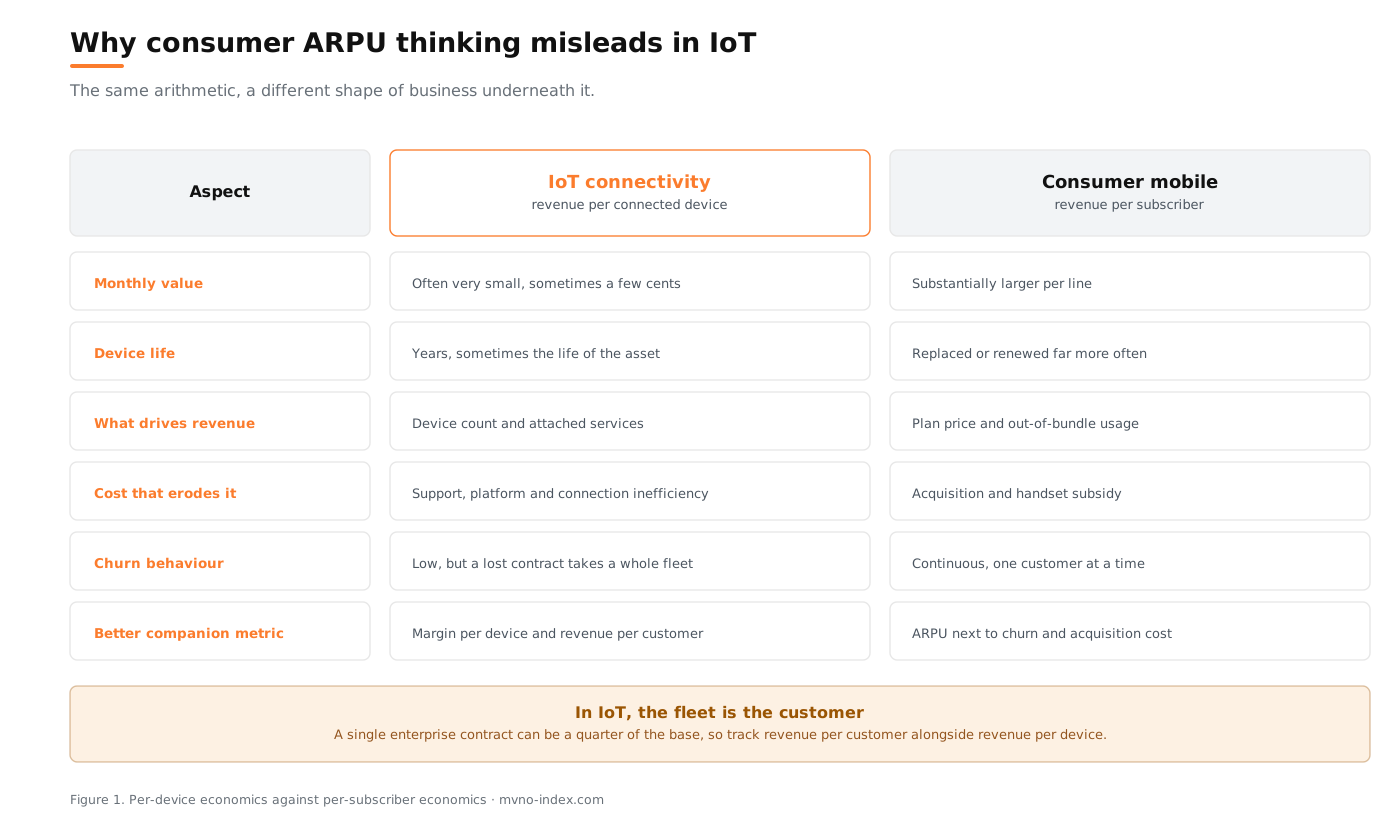
IoT ARPU is revenue divided by connected devices, and while the arithmetic matches consumer mobile the business underneath does not. A device may earn cents a month, stay connected for the working life of the asset it sits in, and never churn on its own, because the customer is the account rather than the device. The useful companions are contribution per device, which support cost erodes quickly, and revenue per account, because losing one contract removes thousands of connections at once.
Average revenue per user, or ARPU, measures revenue per defined unit over a specified period. In an Internet of Things business, that unit may be a connected device, an active SIM, a deployed asset or a customer account. The chosen denominator changes the meaning of the number, so an IoT provider should name it explicitly before comparing performance.
IoT ARPU is useful when it explains how a fleet earns revenue throughout its working life. A low monthly connectivity charge can support an attractive business if devices remain deployed for years and require little support. A higher charge can produce disappointing returns if installation, replacements and manual intervention consume the revenue. Evaluate the whole service alongside the average.
On this page
- History and Evolution of IoT ARPU
- Core Utility and Functionality of IoT ARPU
- What is IoT ARPU Used For?
- Key Functions of IoT ARPU Analysis
- Technical Integration and Data Model
- Integration with Other Systems
- Technical Data Model and Key Calculations
- ARPU Management for IoT Companies and MVNOs
- Why Take Control of IoT Revenue Reporting?
History and Evolution of IoT ARPU
Machine-to-machine connectivity often began with a charge for a SIM and its traffic. As connected products developed, providers added device management, private connectivity, dashboards and application services. The commercial unit became less obvious. A customer might buy one managed fleet service rather than thousands of independently priced mobile subscriptions.
Long deployment cycles also distinguish IoT from consumer mobile. Devices can sit in storage, undergo factory testing, operate intermittently and eventually be retired. Revenue and cost do not begin and end at the same point in every contract. A useful IoT device strategy connects those lifecycle stages to the commercial model.
Core Utility and Functionality of IoT ARPU
Per-device economics against per-subscriber economics
| Aspect | IoT connectivity | Consumer mobile |
|---|---|---|
| Revenue per unit per month | Often cents | Substantially more |
| Expected life | The life of the asset, often years | Renewed or replaced far sooner |
| What grows revenue | Device count and attached services | Price, mix and out-of-bundle usage |
| What erodes margin | Support, platform fees and signalling | Acquisition cost and handset subsidy |
| Churn shape | Rare, but a whole fleet at once | Continuous, one customer at a time |
| Who the customer is | The account, not the device | The subscriber holding the SIM |
What is IoT ARPU Used For?
IoT ARPU supports pricing, forecasting and portfolio analysis. It helps a connectivity provider compare device groups and helps a managed-service business understand recurring revenue density. It can also reveal whether a growing fleet is producing the expected revenue or merely increasing the number of provisioned SIMs shown on an operations dashboard.
A simple monthly calculation divides eligible monthly revenue by the average eligible device or connection base. Suppose a provider earns an illustrative EUR 24,000 from an average of 12,000 billable connections. Monthly revenue per connection is EUR 2. The example describes the calculation only; it does not establish an appropriate price for a particular IoT service.
Key Functions of IoT Revenue Analysis
Define the device population carefully. Provisioned, shipped, activated, connected and billable are different states. A tracker that sends one message each month can still be an active, paying device. A SIM used during manufacturing might generate traffic without being part of the commercial deployed fleet. Treat each state according to the contract and reporting policy.
Separate connectivity revenue from hardware, installation and application revenue where possible. A large hardware delivery can make a monthly average jump even though recurring service performance is unchanged. Report total account value as well, particularly when the customer buys a combined solution. Both views can be useful as long as their scope is clear.
Where that separation is allowed to fall is partly an accounting question. IFRS 15 governs how revenue from a contract with a customer is recognised, so a hardware delivery and a monthly connectivity charge are not simply two columns you may arrange as you wish.
Measure items by activation date, device type, geography and use case. A fleet installed three years ago may have a different support burden from a new deployment. Comparing cohorts helps explain whether revenue changes result from pricing, device growth, dormant stock or the mix of services being sold. It also makes lifetime planning more credible.
Technical Integration and Data Model
Integration with Other Systems
Revenue analysis connects the connectivity management platform, billing, device inventory and customer contract records. For a managed solution, it may also need installation and support data. The IoT device management environment helps explain what is actually deployed, while billing identifies which devices and services are chargeable under the agreement.
Use stable identifiers for the commercial asset and its connectivity components. Replacing a SIM should not necessarily create a new asset. A device with two connections may produce two connection charges but only one application subscription. Keep those relationships explicit so revenue per asset and revenue per connection can be calculated without accidental duplication.
Wholesale records are equally important. A device can incur signalling, roaming, activation or minimum monthly costs even when its data volume is small. Match those charges to the relevant customer and service period where feasible. Otherwise an apparently profitable low-data fleet may be subsidised by other accounts without anyone noticing.
Signalling cost is the line that most often surprises an IoT business. The GSMA publishes connection efficiency guidelines for exactly this reason: a fleet that reconnects too eagerly generates network load that someone pays for, and the contract decides whether that someone is you.
Technical Data Model and Key Calculations
Useful fields include customer account, asset identifier, SIM identifier, country, tariff, lifecycle state, activation date and retirement date. Store the effective dates of price changes and contract amendments. Preserve historical states rather than overwriting them, because a device that is active today may have been held in inventory during the month being analysed.
The same arithmetic, a different shape of business underneath it.
For contracts with an account fee plus a device fee, show both levels. An illustrative EUR 500 monthly account fee and EUR 1 for each of 1,000 devices produces EUR 1,500 monthly revenue, or EUR 1.50 per device. If the same account grows to 2,000 devices at unchanged terms, revenue becomes EUR 2,500 and the per-device average becomes EUR 1.25.
That falling average does not by itself mean the contract has worsened. Total recurring revenue increased, and the fixed fee is spread across more devices. The correct next step is to examine incremental cost and support demand. This is why per-device ARPU should sit beside account revenue, contribution and deployment growth in the same commercial review.
ARPU Management for IoT Companies and MVNOs
Where the margin on a low-revenue device actually goes
| Cost line | Why it hurts more at low revenue |
|---|---|
| A single support contact | Can exceed a year of revenue for that device |
| Badly behaved firmware | Signalling load is charged, or becomes a dispute |
| A SIM swap or a site visit | Physical handling dwarfs the connectivity price |
| Platform licence per device | Scales with the fleet, not with revenue |
| Roaming on the wrong network | A rate meant for people, applied to a sensor |
Why Take Control of IoT Revenue Reporting?
An IoT provider needs visibility into the economics of each contract. Customer-specific bundles, pooled data and long service periods make a single tariff sheet insufficient. Obtain the underlying usage and billing records from connectivity partners, and agree how disputed charges can be investigated. Reporting access should be part of supplier selection rather than a later custom development request.
An MVNO expanding into IoT should establish a separate measurement policy before adding devices to its consumer subscriber dashboard. IoT connection counts can grow quickly while revenue per connection remains small. That can make the combined ARPU look weaker even when the IoT portfolio is meeting its own business case and delivering useful recurring contribution.
Advantages and Disadvantages of IoT ARPU Management
Advantages
- A consistent device revenue measure helps compare deployment plans. It shows the effect of delayed activation, discounted launch periods and changes in the proportion of dormant devices. Commercial teams can then discuss concrete actions with customers, such as activating purchased stock, consolidating tariffs or adding a service that reduces operating effort.
- ARPU reporting also improves supplier negotiations. A documented device lifecycle and traffic profile allow providers to quote more accurately. Ask for separate prices for testing, inventory, active service, suspension and retirement where those stages matter. A seemingly low active-device rate may be less attractive once the costs of unused stock are included.
Disadvantages
- Device averages can obscure account concentration. Thousands of connections may belong to one customer whose renewal has a large effect on revenue. They can also conceal expensive exceptions, such as a small number of devices roaming in costly destinations. Review the distribution of costs and revenues, not only the portfolio average.
- ARPU is particularly easy to misuse for lifetime connectivity offers. Cash collected upfront is not automatically monthly service revenue, and a promised service period is not the same as proven customer lifetime. Forecast future connectivity, support and replacement obligations separately. Have finance apply the appropriate revenue recognition policy rather than treating the entire payment as recurring monthly performance.
Organizational Impact of IoT ARPU Management
Commercial teams should agree the billable lifecycle with operations before a contract is signed. If sales promises free storage while a wholesale supplier charges for every provisioned SIM, the mismatch begins before deployment. Factory testing allowances and suspension rules deserve the same attention as the headline data price.
Customer support needs account context. Repeated troubleshooting on a low-value device can consume its contribution quickly, but the right response may be a product fix that benefits the entire fleet. Track support causes and resolution effort by device model and deployment cohort. Use the evidence to improve onboarding and reduce recurring problems.
Product management should connect added services to measurable customer outcomes. A private connection, device diagnostics or a managed update service may justify an additional charge if it removes work or reduces disruption. Avoid adding fees simply to raise the metric. A clear service description and demonstrated benefit make renewal more likely.
When evaluating a platform, request a demonstration using a mixed fleet. Include a device in inventory, one with seasonal usage, a replacement SIM and an account with pooled data. Require an explanation of the resulting invoice and revenue report. This practical test is more revealing than a generic presentation about handling millions of devices.
Redundancy and High Availability
IoT billing data may arrive from several networks and at different times. Delayed records can affect usage allowances and account profitability. Establish completeness checks and identify provisional results. A month should not appear unusually profitable simply because a roaming feed has not yet arrived or because a supplier file failed to load.
Retain recoverable histories of device states, tariff changes and usage adjustments. Test whether a restored platform can reproduce an invoice after a SIM replacement or contract amendment. Where customers depend on spending limits, clarify how late usage affects those controls. A commercial alert based on delayed information cannot guarantee an immediate stop to all charges.
Impact of 4G and 5G and Future Networks on IoT ARPU
Revenue Models for 4G IoT
LTE-based services support a wide range of devices with very different traffic patterns. A small telemetry message and a continuous video stream should not share a business case simply because both use cellular access. Price and forecast against the workload, coverage requirements, support needs and wholesale terms of the intended device population.
Revenue Models for 5G IoT
5G can support additional enterprise use cases, but a technology label does not establish willingness to pay. Identify the specific performance or operational requirement, verify device and network support, and price the complete service. Some customers value managed installation or dependable diagnostics more than an increase in access speed.
Long Term Device Economics
Devices may outlast a tariff, network generation or supplier relationship. Include migration, profile management and physical replacement assumptions in the lifecycle business case. Compare offers using the full expected deployment period, with realistic uncertainty. A small monthly revenue difference can be outweighed by the cost of visiting thousands of installed assets.
Frequently Asked Questions IoT ARPU
What does the user mean in IoT ARPU?
It is the unit defined by the business, often a billable connection or device. An account-based measure is also useful for enterprise services. Label the metric clearly so readers know whether one customer with many devices counts once or many times.
Is low IoT ARPU always a problem?
No. Low revenue per device can work when service costs and support effort are low and retention is strong. Assess contribution, deployment lifetime and account economics before comparing the figure with consumer mobile subscriptions.
Should dormant devices be counted?
Use the agreed reporting definition and distinguish lifecycle states. A dormant but billable device differs from unbilled inventory. Publishing both billable and deployed-device views can help explain commercial performance without hiding inactive stock.
How should hardware revenue be handled?
Show it separately from recurring connectivity and application revenue where practical. A combined account view can still be useful, but make the components visible. Otherwise a hardware shipment may look like sustainable recurring growth when it is a one-time event.
Can ARPU decline as a customer expands?
Yes. A fixed account fee spread across more devices can lower average revenue per device while total revenue rises. Check incremental costs and contractual discounts before interpreting the decline as weaker performance.
What can increase IoT customer value?
Useful additions include device diagnostics, managed connectivity, application integration and services that reduce field visits. Validate the customer benefit and delivery cost. An added feature has commercial value only if customers adopt it and the provider can support it reliably.
What should an IoT billing provider prove?
Ask for accurate lifecycle billing, pooled allowance handling, historical records and reconciliation to wholesale charges. Test delayed usage, replacement devices and contract changes. Require exports that allow your finance team to verify the results independently.
Summary
IoT ARPU becomes useful when the revenue scope and device population are explicit. Read it alongside account value, lifecycle costs and contribution to understand whether growth is commercially healthy. A larger fleet is valuable when it produces sustainable revenue with manageable operating effort.
Document your device lifecycle and compare complete proposals through the MVNO Index solution provider directory. Request pricing and a billing demonstration based on your actual deployment pattern before selecting an IoT connectivity partner.
Subjects about how to start your own MVNO