Prepaid and Postpaid MVNOs: How Both Models Work
A prepaid mobile virtual network operator (MVNO) takes payment before the service is used; a postpaid MVNO bills after the billing cycle. Both rent capacity from a host network rather than owning radio infrastructure, so coverage is usually identical. What changes is who carries the payment risk, how customers are won and kept, and which systems you need: real-time charging for prepaid, rating and invoicing for postpaid.
A prepaid MVNO charges customers before they use the service; a postpaid MVNO bills them afterwards. Both rent network capacity from a host operator instead of owning radio infrastructure, so the network underneath is often identical. The billing model is what changes the customer relationship, the risk profile, and the economics of the business.
Here we explain both models from three angles: how they work, what they mean for customers, and what they mean for the operator running them. It is written to be market-neutral. Rules on identity registration, roaming, credit expiry, and consumer protection differ per country, so local details should be checked against the national regulator
On this page
MVNO fundamentals
An MVNO sells mobile service under its own brand while the radio network belongs to someone else. The billing model sits on top of this structure, so it helps to understand the structure first.
The parties involved
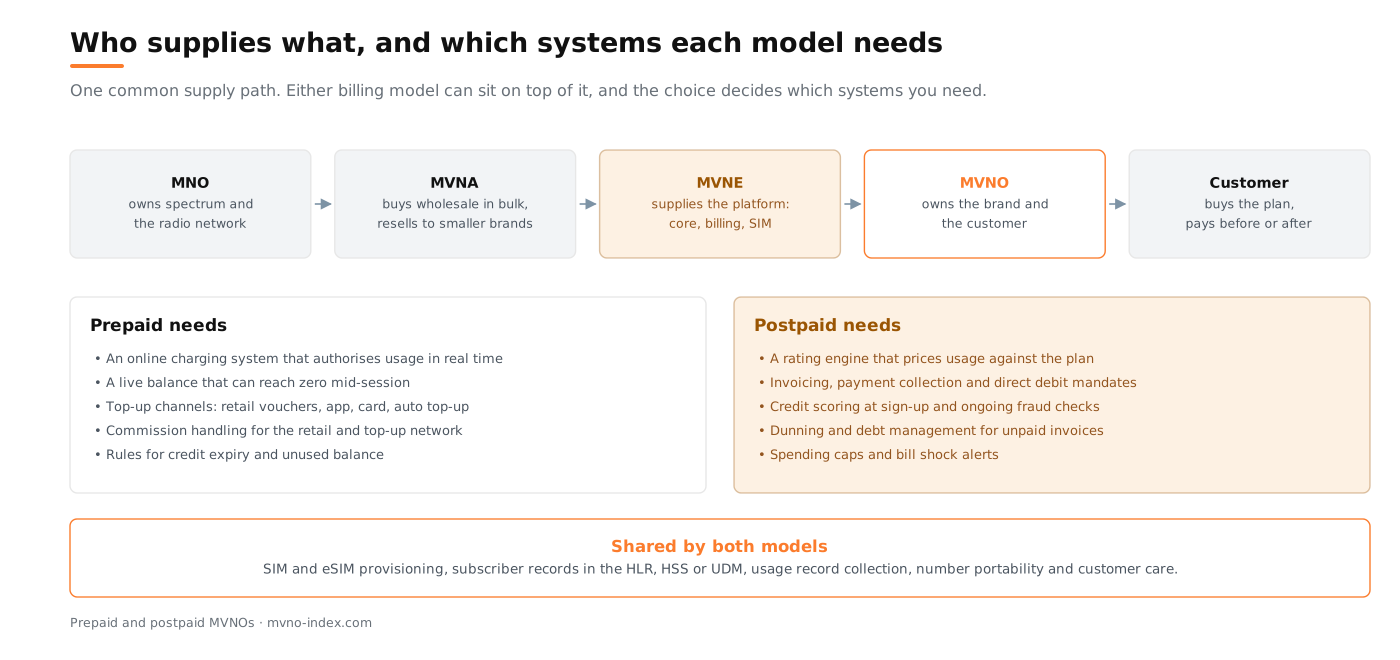
- MNO (mobile network operator): owns spectrum licences and the radio access network. Sells wholesale access to MVNOs under a wholesale agreement.
- MVNO (mobile virtual network operator): owns the brand and the customer relationship. Buys capacity from the MNO and resells it.
- MVNE (mobile virtual network enabler): provides the technical platform an MVNO needs, such as core network functions, billing, provisioning, and SIM or eSIM management.
- MVNA (mobile virtual network aggregator): buys wholesale capacity from an MNO in bulk and resells it to smaller MVNOs, often combined with enabler services. The differences between MVNO, MVNE and MVNA are set out separately.
MVNO types by depth of infrastructure
| Type | What the MVNO owns | Control over products | Typical fit |
|---|---|---|---|
| Branded reseller | Brand, marketing, sales | Low: products set largely by host | Retailers, brands testing the market |
| Light MVNO | Brand, customer care, often billing | Medium | Most new entrants |
| Full (thick) MVNO | Own core network elements, HLR/HSS or UDM, SIM issuance | High: own tariffs, services, roaming deals | Larger players, B2B and IoT specialists |
Definitions of these tiers vary between sources and markets. Treat the table as a common way of grouping, not a formal standard. The five types of MVNO and the twenty business models are covered in full elsewhere.
Where prepaid and postpaid fit in
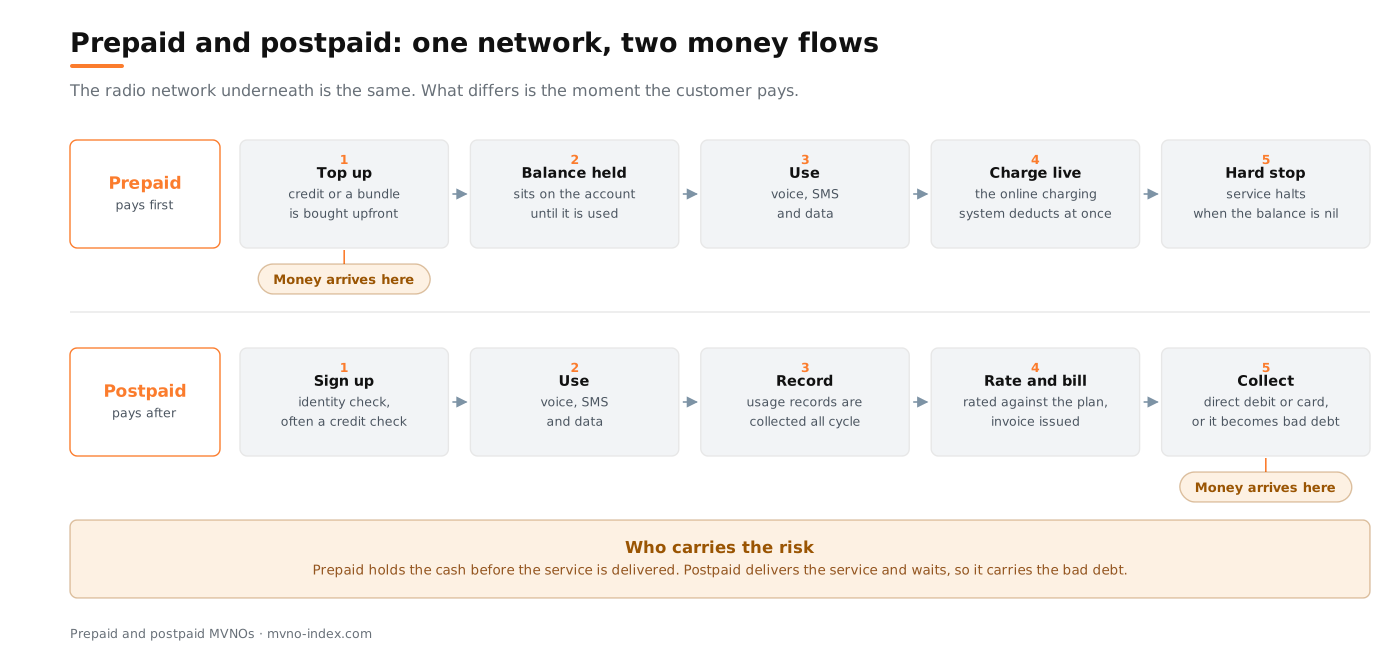
Any of these MVNO types can run prepaid, postpaid, or both. The choice mainly affects the billing and charging system, credit risk, payment collection, and how customers are acquired and retained. Prepaid relies on real-time charging so that usage stops when credit runs out. Postpaid relies on usage records that are rated and invoiced after the billing period.
Prepaid MVNOs explained
A prepaid mobile virtual network operator (MVNO) collects payment first and lets the customer consume service until the credit or bundle is used up. There is no bill afterwards, so there is no credit risk for the operator.
How a prepaid MVNO works
- The customer buys a SIM or eSIM, online or at a retail point.
- Where required, the customer completes identity registration.
- The customer tops up credit or buys a bundle (for example, a set amount of data and minutes for 30 days).
- Usage is deducted in real time by an online charging system.
- When credit or the bundle runs out, service stops or drops to pay-as-you-go rates until the next top-up.
Prepaid product options
- Pay as you go: credit is deducted per minute, SMS, or MB used.
- Bundles: fixed allowances for a fixed period, renewed manually or automatically.
- Auto-renewing prepaid: a bundle renews automatically from a stored payment method. This feels like a subscription but is still paid in advance.
- Data-only and travel SIMs: aimed at tablets, routers, IoT, or visitors.
- Second-line or niche SIMs: aimed at specific communities, such as international calling for diaspora customers.
Prepaid economics
- Revenue: the margin between wholesale cost and retail price, plus add-ons and, in some markets, unused or expired credit.
- Acquisition: often through retail distribution and top-up networks, where retailers earn commission, or through low-cost digital channels such as your own webshop.
- Cash flow: money arrives before the service is consumed, which helps working capital.
- Main challenge: churn. With no contract, customers can leave at any moment, and many prepaid SIMs go inactive. Keeping the active base growing requires constant acquisition and retention effort.
PostPaid MVNOs explained
A prepaid mobile virtual network operator (MVNO) collects payment first and lets the customer consume service until the credit or bundle is used up. There is no bill afterwards, so there is no credit risk for the operator.
How a postpaid MVNO works
- The customer signs up for a plan, usually online, by phone, or in a store.
- The operator verifies identity and often runs a credit check.
- The customer agrees to a contract term or a monthly rolling subscription.
- Usage is recorded during the month and rated against the plan.
- An invoice is issued and collected, typically by direct debit or card.
PostPaid product options
- SIM-only monthly: a fixed monthly fee with an allowance, often cancellable monthly.
- Fixed-term SIM-only: a lower monthly price in exchange for a 12 or 24 month commitment.
- Handset plans: a phone paid in instalments together with the service plan.
- Family or multi-line plans: shared allowances or discounts across several SIMs on one account.
- Business plans: account management, pooled data, and consolidated invoicing. Telecom expense management is often part of the offer here.
Postpaid economics
- Revenue: monthly recurring fees, out-of-bundle usage, add-ons, and in some cases handset margin or financing income.
- Customer value: postpaid customers generally spend more per month and stay longer than prepaid customers, though the size of the gap varies by market.
- Costs: credit checks, invoicing, payment collection, and debt management. Handset plans also tie up capital, which is a line your financial plan has to carry.
- Main challenge: bad debt and fraud. Since service comes before payment, some customers will not pay, and subscription fraud can be costly.
Prepaid and Postpaid compared
The two models share the same network foundation and differ mainly in who carries the payment risk and how long the customer is tied in.
| Aspect | Prepaid MVNO | Postpaid MVNO |
|---|---|---|
| Payment timing | Before use | After use, per billing cycle |
| Credit check | Usually none | Often required |
| Identity registration | Required in many countries | Required |
| Contract | Usually none | Fixed term or monthly rolling |
| Spending control | Hard stop when credit runs out | Possible bill shock, unless capped |
| Operator credit risk | None | Bad debt and fraud exposure |
| Charging system | Real-time (online) charging | Offline rating and invoicing, often with real-time controls |
| Typical revenue per user | Lower | Higher |
| Typical churn | Higher | Lower |
| Handset financing | Rare | Common at some operators |
| Main sales channels | Retail, top-up networks, online | Online, stores, telesales |
| Cash flow | Paid upfront | Paid in arrears |
The revenue and churn rows describe general tendencies, not fixed rules. Specific figures depend heavily on the market and the operator.
Hybrid models
The line between the two has blurred in many markets:
- Auto-renewing prepaid: paid in advance, but renews automatically like a subscription.
- Monthly rolling SIM-only: technically postpaid, but with no long commitment and a fixed price, so it feels close to prepaid.
- Hybrid or controlled plans: a fixed monthly fee billed in advance with a hard spending cap, plus the option to top up beyond it.
- Prepaid-to-postpaid migration: some operators move loyal prepaid customers to postpaid plans to raise customer value.
When comparing MVNOs, it is therefore more useful to look at actual terms (commitment, payment timing, spending caps) than at the label alone.
Customer perspective
Prepaid suits customers who value control and flexibility; postpaid suits customers who value convenience, higher allowances, and extras.
Prepaid: pros and cons
Pros
- No credit check and usually no contract
- Full spending control, no unexpected bills
- Easy to switch, test, or keep as a second line
- Often lower prices for light and moderate use
Cons
- Service stops when credit runs out, unless auto top-up is set
- Credit or bundles may expire if unused
- Fewer perks, such as handset deals or bundled streaming
- Support is often digital only
Postpaid: pros and cons
Pros
- Uninterrupted service, no need to top up
- Often larger allowances, family plans, and extras
- Handset financing available at some operators
- Sometimes better support or loyalty benefits
Cons
- Credit check may be required
- Possible contract lock-in and early termination fees
- Risk of bill shock from out-of-bundle usage
- Harder to leave quickly
Who each model suits
| Customer type | Better fit | Why |
|---|---|---|
| Light or occasional user | Prepaid | Pays only for what is used |
| Budget-conscious household | Prepaid or monthly SIM-only | Fixed costs, no surprises |
| Student or young customer | Prepaid | No credit history needed |
| Visitor or short-term resident | Prepaid | No contract, quick activation |
| Second line or data-only device | Prepaid | Low commitment |
| Heavy data user | Postpaid or large prepaid bundle | Larger allowances |
| Family with several lines | Postpaid | Shared plans and discounts |
| Customer wanting a new phone on instalments | Postpaid | Handset financing |
| Business user | Postpaid | Invoicing and account management |
Operator perspective
Prepaid is usually the faster and lower-risk way to launch an MVNO; postpaid is usually the path to higher customer value. Many MVNOs start with prepaid and add postpaid once the brand, systems, and risk controls are mature. Which of the two you start with also shapes the build versus buy decision.
Business model differences
| Area | Prepaid | Postpaid |
|---|---|---|
| Launch complexity | Lower: no credit checks or invoicing | Higher: credit scoring, invoicing, collections |
| Capital needs | Lower | Higher, especially with handset financing |
| Distribution | Retail and top-up partners, online | Online, stores, partners, telesales |
| Revenue predictability | Lower: depends on top-up behaviour | Higher: recurring monthly fees |
| Risk | Churn, inactive SIMs, misuse of anonymous SIMs where allowed | Bad debt, subscription fraud |
| Retention tools | Bonus credit, loyalty rewards, auto top-up | Contract terms, bundles, device upgrades |
Key metrics to WATCH
| Metric | What it measures | Applies to |
|---|---|---|
| ARPU | Average revenue per user, usually per month | Both |
| Active base | Share of SIMs with recent activity or top-ups, since registered SIM counts overstate the real base | Prepaid |
| Churn rate | Monthly share of customers leaving | Both |
| CAC | Customer acquisition cost, including retail commission | Both |
| Customer lifetime value | Expected margin over the customer’s lifetime, set against CAC | Both |
| Top-up frequency and value | How often customers load credit, and how much | Prepaid |
| Bad debt ratio | Share of invoiced revenue that is never collected | Postpaid |
| Wholesale cost per GB and per minute | The core input cost under every plan you sell | Both |
How "active" is defined (for example, activity in the last 30 or 90 days) differs between operators. That makes prepaid subscriber numbers hard to compare across companies.
RegulationS to check per market
- Identity registration and KYC for prepaid SIMs
- Number portability rules and timelines
- Consumer protection on contracts, cancellation, and early termination fees
- Rules on credit expiry and refund of unused balance
- Spending caps and bill shock notifications
- Roaming regulation, such as the EU Roam like at home rules and their fair use provisions
- Data retention and lawful interception obligations
These rules differ significantly by country and change over time. Check them with the national regulator before launching or comparing offers.
Technical and network considerations
Coverage is normally the same as the host network, but the quality and features a customer gets depend on the wholesale agreement, not on whether the plan is prepaid or postpaid.
Coverage and quality
- Coverage: MVNO customers use the host’s towers, so geographic coverage usually matches the host network.
- Prioritization: some wholesale agreements give MVNO traffic lower priority than the host’s own customers during congestion. In some markets this applies to prepaid tiers in particular.
- Speed caps: some plans cap download speeds, regardless of the network’s capability.
- Feature access: 5G, VoLTE, VoWiFi, and certain roaming partners may or may not be included. Access depends on the agreement and on the MVNE platform.
Charging and billing systems
- Prepaid depends on an online charging system (OCS) that authorizes usage in real time and stops it when the balance runs out.
- Postpaid depends on rating and invoicing based on usage records, combined with real-time controls for spending caps and fraud detection.
- Modern convergent charging platforms handle both models in one system, which makes hybrid products easier to build.
- Both models sit on the same BSS for products, orders, customers and invoices.
Roaming
- Roaming access often depends on the host operator’s roaming agreements, unless a full MVNO has its own.
- Prepaid roaming is sometimes more limited, such as fewer destinations or data only.
- Within the EU, Roam like at home applies to prepaid and postpaid customers. Providers may apply fair use limits on data, and the calculation can differ for prepaid. Verify the current rules on the European Commission website.
Number portability
Customers can usually port numbers in both directions, between prepaid and postpaid and between providers. Processes and timelines are set by national rules.
Frequently Asked Questions
What is a postpaid mobile virtual network operator?
A postpaid mobile virtual network operator is an MVNO that bills after the service has been used. The customer signs up, usually after an identity and credit check, uses the service during the billing cycle, and receives an invoice at the end of it. The operator is extending credit, which brings higher revenue per customer and longer tenure, but also bad debt and fraud exposure.
What is a prepaid mobile virtual network operator?
A prepaid mobile virtual network operator is an MVNO that is paid before the service is used. The customer buys credit or a bundle, an online charging system deducts usage in real time, and service stops when the balance reaches zero. There is no bill and no contract, so the operator carries no credit risk, and the customer cannot run up an unexpected bill.
Is a prepaid MVNO the same as a network operator’s own prepaid brand?
Not always. Many network operators run their own low-cost sub-brands (flanker brands). These look like MVNOs to consumers but are owned by the network operator. A true MVNO is an independent company buying wholesale access.
Is the network quality worse on an MVNO?
Coverage is usually the same. Speeds and priority during congestion can differ, depending on the wholesale agreement. There are some case known where the MNO trottles the MVNO network to a lower speed, which is of course illigal and forbidden by law. As an MVNO it might be difficult to proof, but there are expert companies available who can help you.
Can I switch from prepaid to postpaid and keep my number?
In most markets with number portability, yes, both within one provider and between providers.
Why do postpaid MVNOs run credit checks?
Because they deliver the service before they get paid. The credit check reduces the risk of unpaid bills.
Can a prepaid plan be cheaper than a postpaid plan with the same allowance?
Yes, often, but not always. Compare price per month, commitment, and what happens when the allowance runs out.
Does prepaid credit expire?
It depends on the provider and on local rules. Some let credit roll over, others expire it after a set period. In the past a lot of MNOs and MVNOs let it expire but now a days this is not used to much anymore.
Is a monthly SIM-only plan prepaid or postpaid?
Usually postpaid, since it is billed per month and often after use. In practice, it is often close to prepaid because there is no long contract.
Can one MVNO offer both prepaid and postpaid?
Yes. Many MVNOs offer both, often on a convergent charging platform.
Which model is more profitable for an MVNO?
Postpaid usually brings higher revenue per user and lower churn, but with higher operating costs and credit risk. Prepaid is simpler and cheaper to run but depends on high volumes and good retention.
Summary
Prepaid is paid before the service is used, postpaid after it. That single difference is the most important part.
- The network is usually the same. Coverage comes from the host operator. Speed, priority and feature access come from the wholesale agreement, not from the billing model.
- The risk sits in different places. Prepaid holds the cash before delivering, and risks churn and inactive SIMs. Postpaid earns more per customer over a longer life, and risks bad debt and fraud.
- The systems differ. Prepaid needs real-time charging that can stop a session at zero. Postpaid needs rating, invoicing and collections. A convergent platform runs both.
- The labels are blurring. Auto-renewing prepaid and monthly rolling SIM-only sit in between, so compare commitment, payment timing and spending caps rather than the word on the box.
- The usual path is prepaid first. Many MVNOs add postpaid once the brand, the systems and the risk controls are mature enough to carry credit.
Which model to run is a question about your customers and your balance sheet, not about your network. The rules that decide what you may offer, from identity registration to credit expiry, differ per country and should be checked with the national regulator before you launch.
Subjects about how to start your own MVNO