MVNO ARPU, and How to Make It Mean Something
ARPU is average revenue per user: the revenue in scope for a period divided by the average number of subscribers in that period. The figure only means something next to its definition, because whether wholesale revenue counts, whether handset sales count and whether a dormant SIM is still a subscriber each move it. For an MVNO, ARPU read next to churn and acquisition cost says far more than ARPU on its own.
Average revenue per user, usually shortened to ARPU, describes the revenue a mobile virtual network operator earns per customer or connection over a defined period. It helps an MVNO understand what its subscriber base is worth commercially. The calculation looks simple, but its usefulness depends on how revenue, active subscribers and the reporting period are defined.
For an MVNO, the objective is to grow sustainable customer value. A higher ARPU can accompany stronger margins, but it can also conceal expensive roaming, heavy data consumption or the loss of lower spending customers. Use ARPU alongside wholesale costs, retention and acquisition spending when deciding which products to sell and which partners to select.
On this page
- History and Evolution of MVNO ARPU
- Core Utility and Functionality of MVNO ARPU
- What is ARPU Used For?
- Key Functions of ARPU Analysis
- Technical Integration and Data Model
- Integration with Other Systems
- Technical Data Model and Key Calculations
- ARPU Management for MVNOs and IoT Companies
- Why Take Control of ARPU Reporting?
- Advantages and Disadvantages of MVNO ARPU Management
- Organizational Impact of MVNO ARPU Management
- Redundancy and High Availability
- Impact of 4G and 5G and Future Networks on ARPU for MVNOs
- ARPU in 4G Services
- ARPU in 5G Services
- Long Term Revenue Planning
- Frequently Asked Questions about ARPU for MVNOs
- Summary
History and Evolution of MVNO ARPU
Mobile businesses initially earned much of their revenue from separately charged calls and messages. As bundles became common, the monthly subscription became a more important commercial reference. Data allowances, family plans and added services then made the relationship between usage and revenue less direct. A customer can consume considerably more data without paying a higher monthly price.
MVNOs also serve different audiences. A travel brand, a community operator and a business mobile provider can have very different purchase patterns. Their ARPU figures cannot be compared fairly without understanding those differences. The MVNO business plan should therefore establish the target segment and revenue model before choosing an ARPU target.
Core Utility and Functionality of MVNO ARPU
Four decisions that change the number without changing the business
| Decision | One way | The other way | Effect on reported ARPU |
|---|---|---|---|
| Revenue in scope | Service revenue only | Plus handsets and accessories | Higher, and no longer comparable |
| Wholesale and interconnect | Excluded | Included | Higher, and moves with traffic you do not control |
| Subscriber definition | Active in the period | Every SIM ever issued | Lower, sometimes dramatically |
| Base used | Closing subscribers | Average over the period | Differs most in a fast-growing base |
What is ARPU Used For?
ARPU supports pricing, forecasting and customer analysis. A finance team can combine an expected average subscriber base with expected ARPU to estimate service revenue. A product team can examine whether customers adopt paid extras. Customer care can use segment results to understand whether repeated service problems are affecting renewal and spending.
Monthly ARPU is commonly calculated as eligible revenue for the month divided by the average eligible subscriber base during that month. If an illustrative MVNO earns EUR 300,000 from an average of 20,000 eligible subscriptions, its monthly ARPU is EUR 15. These numbers are an example, not a market benchmark or recommended price.
Published operator definitions are a useful sanity check on your own. Vodafone states in its annual report that ARPU is customer revenue and incoming revenue divided by average customers. That is one defensible choice among several, and the value of writing yours down is that a reader can see which one you made.
Key Functions of ARPU Analysis
The denominator deserves as much attention as revenue. An operator might count revenue-generating connections, recently active prepaid subscriptions or all connected subscriptions. Those populations can differ substantially. State the chosen definition and apply it consistently. A change in inactivity policy can alter reported ARPU even when customer purchasing behaviour has not changed.
Segment analysis makes the average more useful. Separate prepaid and subscription products, domestic and travel offers, consumer and business customers, and newly acquired and established subscribers where relevant. A growing low-price segment can lower the overall average while increasing total contribution. That is a mix effect, not necessarily evidence that the business is deteriorating.
Revenue analysis should distinguish recurring subscriptions from activation fees, handset sales and other items included under the chosen policy. For management reporting, show exceptional items separately so they do not create a misleading growth story. Reconcile the management view to the financial records rather than maintaining an unexplained alternative revenue total.
What may be counted as revenue at all is an accounting question before it is a reporting one. IFRS 15 governs revenue from contracts with customers, and a reporting policy that conflicts with the accounting treatment will not survive the first audit.
Technical Integration and Data Model
Integration with Other Systems
Useful ARPU reporting connects the billing system, customer records, product catalogue and finance ledger. Wholesale usage and charges provide the cost perspective. Payment records help identify collection problems, but cash received is not automatically the same as revenue earned during the period. That distinction matters for annual plans and prepaid balances.
The reporting process should preserve a common subscription identifier across systems. A change of SIM or device should not create a second customer unless the commercial definition calls for it. Conversely, a business account with fifty connections should not silently become one user in a connection-based metric. Define account-level and connection-level measures separately.
A wholesale agreement can include minimum commitments, pooled allowances and charges that arrive after the retail bill. Bring those costs into profitability reporting with suitable accruals and later reconciliation. An attractive retail ARPU says little about margin if the corresponding wholesale cost is missing from the same period.
Technical Data Model and Key Calculations
Maintain reporting fields for subscription status, activation date, cancellation date, product, customer segment and revenue period. Retain historical product assignments so last month's results do not change merely because a customer upgrades today. Credits, refunds and adjustments need a documented treatment and a traceable link to the affected period or transaction.
The same business can report two different ARPU figures. The definition decides which.
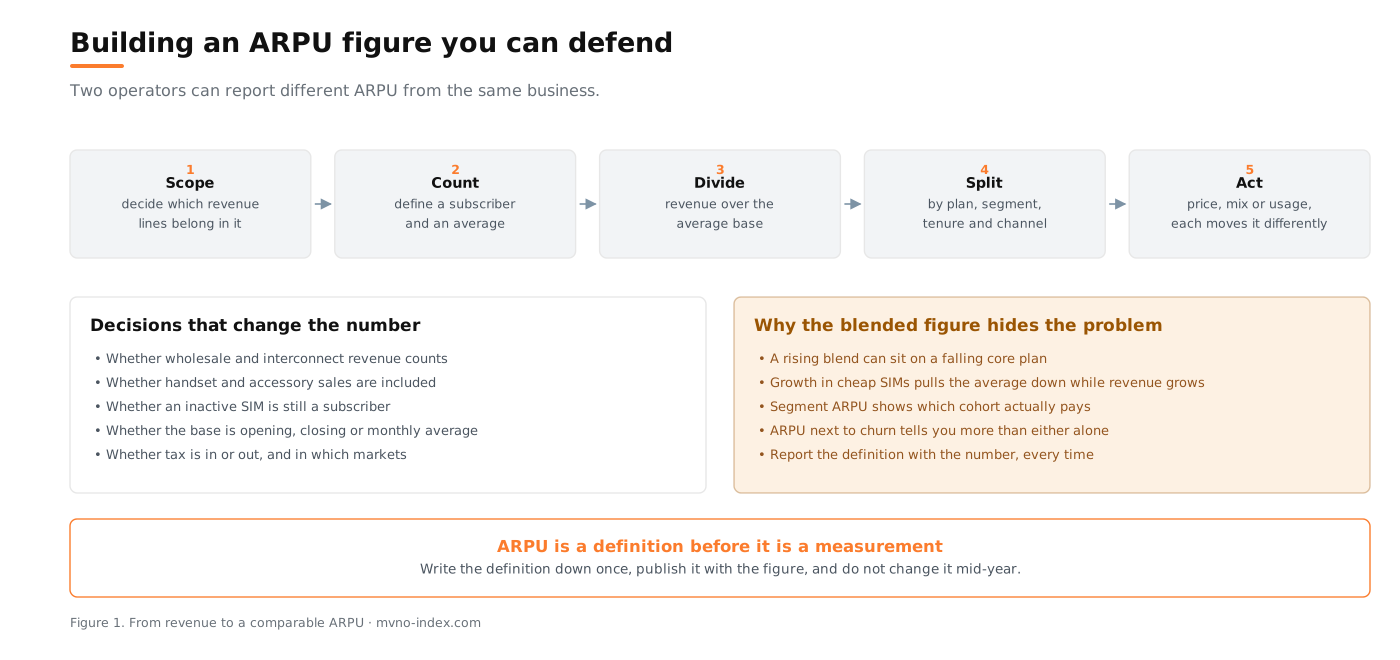
An average subscriber base can be calculated from daily eligible counts. A simpler opening-and-closing average may be adequate for some uses, but it can distort a fast-changing base. For a quarter reported as monthly ARPU, divide quarterly eligible revenue by the sum of the three monthly average bases. Dividing by one average base alone produces a quarterly figure.
Keep a calculation specification alongside the dashboard. It should name the revenue categories, activity rules, currency conversion policy and treatment of taxes. Where the business uses several currencies, separate changes in customer spending from exchange-rate movements. Analysts should be able to reproduce a reported number from the underlying records without guessing which filters were applied.
ARPU Management for MVNOs and IoT Companies
Three levers, three different side effects
| Lever | What it does to ARPU | What it does to the rest |
|---|---|---|
| Raise the price | Up immediately | Churn rises, and the effect lands a quarter later |
| Shift the mix upward | Up gradually | Needs a reason to upgrade, which costs marketing |
| Grow usage inside the bundle | Flat, unless out of bundle | Wholesale cost rises with nothing to show |
| Remove the cheapest plans | Up on paper | Revenue falls: the ratio improved, the business did not |
Why Take Control of ARPU Reporting?
An MVNO needs enough reporting control to understand its own customers even when an MVNE operates billing. Ask for transaction-level exports, historical subscription states and documented calculation rules. A dashboard supplied by a partner is useful, but it should not be the only evidence available when a commercial dispute or product review arises.
For a business selling both consumer mobile and IoT connectivity, separate the two populations. A low-usage sensor and a monthly handset subscription have different economics. Combining them can produce a neat average that supports neither pricing decision. The same principle applies when enterprise account fees cover many connections: show the account economics as well as revenue per connection.
Advantages and Disadvantages of MVNO ARPU Management
Advantages
- A consistent ARPU measure makes product changes easier to evaluate. Teams can see whether an upgrade campaign increases recurring revenue among comparable customers and whether the increase persists after a promotion ends. Combined with customer feedback, this helps distinguish a useful paid feature from an offer that merely shifts existing spending into another category.
- ARPU also improves commercial conversations. Suppliers can price against a credible subscriber forecast, and management can test how changes in customer mix affect revenue. It becomes easier to compare a platform charging per subscriber with one charging a percentage of revenue, provided the complete fee schedules and minimum commitments are included.
Disadvantages
- The average hides variation. A small group of high spenders may lift ARPU while most customers buy the lowest-priced plan. A successful acquisition campaign can lower the average because new customers enter on a discount. Removing inactive connections can raise ARPU without creating any additional revenue. Each movement needs an explanation before action follows.
- ARPU can also become a poor incentive. Raising prices may increase the metric temporarily while accelerating churn. Selling larger bundles can increase revenue but reduce contribution if wholesale consumption grows faster. Review contribution per subscriber, retention and acquisition payback with the same customer cohorts, rather than rewarding the ARPU figure in isolation.
Organizational Impact of MVNO ARPU Management
Finance should own the calculation policy, while product and commercial teams own the actions taken from it. Agree definitions before quarterly targets are set. When the methodology changes, show the effect and, where practical, restate comparable periods. Otherwise a reporting adjustment can be mistaken for a successful pricing initiative.
Customer-facing teams need a different level of detail from executives. A retention team benefits from renewal behaviour and service history. Product managers need bundle adoption and downgrade patterns. Executives need a concise explanation of price, mix and customer-volume changes. Giving everyone the same unexplained average encourages conflicting interpretations.
Use an illustrative contribution check when evaluating an offer. If monthly ARPU is EUR 15 and directly attributable monthly service costs are EUR 9, the remaining EUR 6 is contribution under that defined cost scope. It is not net profit. Acquisition spending, overhead, financing and other excluded costs still have to be funded.
Before purchasing analytics software, request a demonstration using your own definitions and representative anonymised records. Include an annual plan, a mid-month cancellation, a refunded charge and a customer with several subscriptions. A vendor that can explain these cases clearly is more useful than one that offers an attractive dashboard with an undocumented revenue formula.
Redundancy and High Availability
ARPU reporting needs recoverable data and repeatable calculations. A missing usage file or duplicated billing batch can change the result even when service delivery is normal. Monitor data completeness, reconcile record counts and retain the calculation version used for each published period. Close a reporting period through an explicit process rather than an informal spreadsheet copy.
Back up the reporting definitions as well as the data. Test whether historical reports can be recreated after restoring a database or changing a billing supplier. If a feed fails, mark the result as incomplete instead of presenting an old value as current. Commercial decisions should not depend on a dashboard that silently stops updating.
Impact of 4G and 5G and Future Networks on ARPU for MVNOs
ARPU in 4G Services
Large data bundles can make retail revenue relatively stable while consumption rises. Examine the cost of heavy users, tethering and roaming against the wholesale arrangement. A plan that performed well at launch may become less attractive as application behaviour changes. Review usage distributions rather than assuming every subscriber consumes the advertised allowance.
ARPU in 5G Services
5G may support differentiated offers, enterprise services or additional capabilities, but access to 5G does not automatically justify a higher price. Establish what customers value and what the host permits the MVNO to sell. Test willingness to pay before committing to a premium tariff or assuming that faster access will lift the average.
Long Term Revenue Planning
Future network generations should enter the business case through specific services, costs and customer needs. Preserve comparable reporting as products evolve. Track whether new revenue comes from existing customers spending more, new customers joining, or an accounting change. That explanation remains useful regardless of which access technology carries the traffic.
Frequently Asked Questions ARPU for MVNOs
What does ARPU mean for an MVNO?
It means average revenue per user over a defined period. In mobile reporting, the user is often an eligible subscription or connection. Always state that denominator, because revenue per account can be very different from revenue per SIM.
Is ARPU the same as profit per customer?
No. ARPU measures revenue. Profitability also depends on wholesale charges, platform fees, support, acquisition spending and other costs. Use a separately defined contribution measure to understand the economics of a customer or product.
What is a good MVNO ARPU?
There is no universal target. The right level depends on market, customer segment, service scope and cost structure. Compare similar products with consistent definitions, then assess whether the revenue supports retention and acceptable contribution.
Should inactive SIMs be included?
That depends on the reporting policy. Define inactivity and eligibility explicitly, apply the policy consistently, and disclose changes. Counting every issued SIM can depress the average, while removing dormant subscriptions can increase it without additional sales.
Can ARPU fall while the business improves?
Yes. A profitable lower-price segment can expand faster than a premium segment and reduce the blended average. Examine total revenue, contribution, acquisition costs and retention before concluding that a lower ARPU is a problem.
How can an MVNO improve ARPU sustainably?
Offer relevant upgrades, improve renewal, reduce avoidable billing errors and develop services customers actually use. Test the effect on contribution and churn. A price increase that drives valuable customers away may weaken the business despite an initially higher average.
What should an ARPU reporting supplier demonstrate?
Request reproducible calculations, historical subscriber states, adjustment handling and reconciliation to finance records. Ask the supplier to explain a change in the average using actual product and customer movements, with exports available for independent review.
Summary
ARPU helps an MVNO understand revenue per eligible customer or connection, provided the calculation is consistent and the result is read alongside costs and retention. Its greatest value comes from explaining changes and supporting better product decisions.
Define your reporting policy before comparing tools. Use the MVNO Index solution provider directory to shortlist billing and analytics partners, then request a demonstration built around your tariffs, wholesale costs and customer data.
Subjects about how to start your own MVNO