MVNO Success: Five Levers, Four of Them Commercial
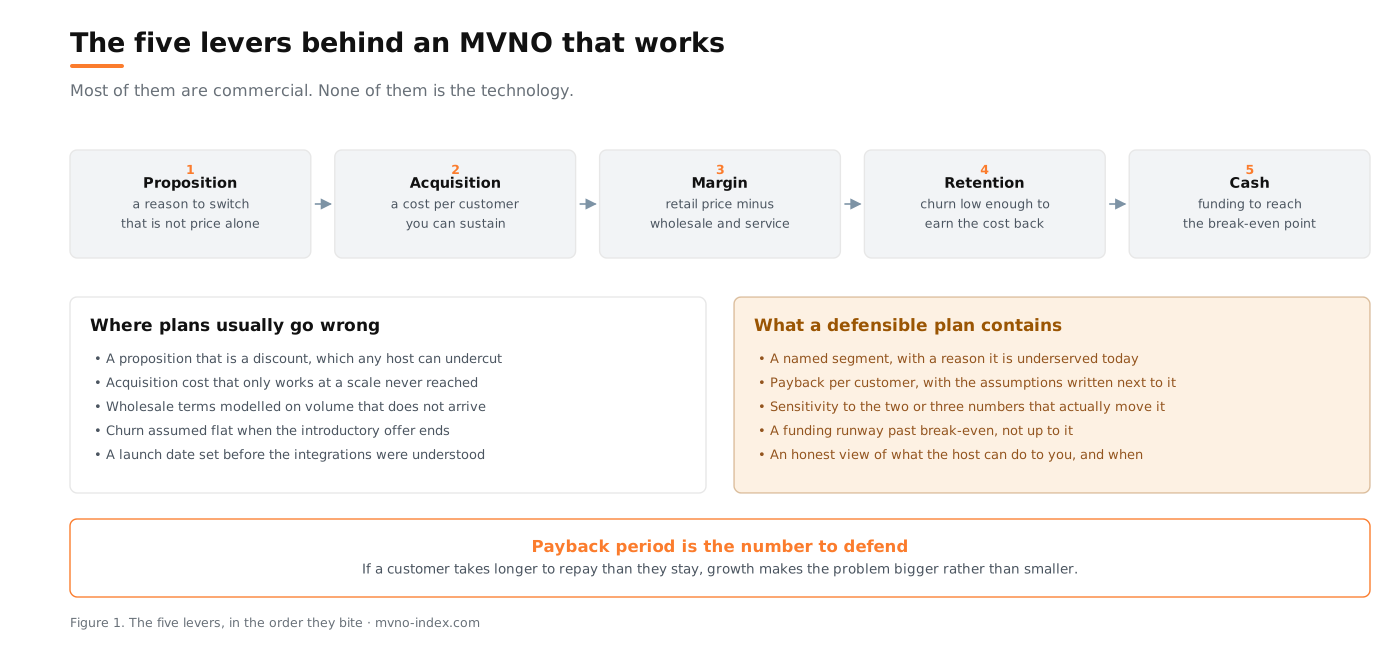
An MVNO succeeds on five levers, and four of them are commercial. A proposition that gives a defined segment a reason to switch which is not only price, an acquisition cost the business can sustain, a margin that survives the wholesale rate, churn low enough that a customer repays what they cost to win, and funding that reaches past break-even rather than up to it. Technology choices matter, but they rarely decide the outcome on their own.
An MVNO succeeds when it gives a defined customer group a compelling reason to buy and remain with its mobile service, while earning enough contribution to support the business. Network access is essential, but access alone rarely explains why a customer should choose one brand over another. The proposition, distribution and operating model need to work together.
For a new or growing MVNO, the practical task is to prove those relationships before making large commitments. Validate demand, model realistic costs and test the complete customer journey. A launch can be technically successful while the business struggles with acquisition cost, weak retention or an unsuitable wholesale agreement. Success planning should address all of these from the beginning.
On this page
- History and Evolution of MVNO Business Models
- Core Utility and Functionality of Success Planning
- What is MVNO Success Planning Used For?
- Key Functions of an MVNO Success Framework
- Technical Integration and Data Model
- Integration with Other Systems
- Technical Data Model and Key Calculations
- Ownership for MVNOs and IoT Companies
- Why Own the Commercial Outcome?
- Advantages and Disadvantages of a Focused MVNO Strategy
- Organizational Impact of MVNO Success Planning
- Redundancy and High Availability
- Impact of 4G and 5G and Future Networks
- Success Factors for 4G Offers
- Success Factors for 5G Offers
- Long Term Business Success
- Frequently Asked Questions about MVNO Success Factors
- Summary
History and Evolution of MVNO Business Models
MVNOs have served many different markets, from price-focused mobile subscriptions to community brands, business communications and international connectivity. The common feature is the use of another operator's radio access under an agreed commercial arrangement. The customer proposition and the amount of technology controlled by the MVNO vary considerably.
Digital channels and eSIM have changed some aspects of distribution and onboarding, but they have not removed the need for a credible business model. A convenient purchase flow cannot compensate indefinitely for poor service or unsustainable pricing. The MVNO business plan should connect the intended audience, offer and cost structure before platform selection begins.
Core Utility and Functionality of Success Planning
Five levers, and the assumption that usually breaks each one
| Lever | The plan says | What tends to happen |
|---|---|---|
| Proposition | A segment is underserved | The host launches a sub-brand at the same price |
| Acquisition | Cost per customer falls with scale | The cheap channels saturate first |
| Margin | Wholesale improves at volume | The volume tier is never reached |
| Retention | Churn stays at the launch level | It rises when the introductory offer ends |
| Cash | Break-even in month eighteen | Funding runs to month eighteen exactly |
What is MVNO Success Planning Used For?
Success planning turns a broad idea into testable commercial assumptions. Identify the customer, the problem the service solves and the route by which that customer will discover and buy it. Then estimate what the business must spend to acquire and serve that customer. Each assumption should have an owner and a way to gather evidence.
A useful plan distinguishes launch from sustainability. Launch requires a working service and an effective acquisition process. Sustainability requires customers to remain, pay and generate acceptable contribution over time. Set measures for both stages. A large first-month activation count is encouraging only when the resulting customers behave in a way the business can support economically.
Key Functions of an MVNO Success Framework
Customer focus defines the offer. A brand targeting small businesses may need dependable support and account controls, while a travel proposition may prioritise simple activation and destination coverage. Choose the features that support the target use case. Adding every available capability can increase complexity without giving the intended buyer another reason to purchase.
Distribution determines whether the proposition can reach customers affordably. Existing communities, retail locations and partner channels can be valuable, but access to an audience is not the same as proven conversion. Test the purchase journey and measure the cost of completed, usable activations. Clicks and registrations are intermediate signals rather than commercial outcomes.
Unit economics connect the retail price to wholesale usage, platform fees, payments and support. Include acquisition spending and expected retention in the wider business case. A plan should remain understandable when usage is higher, growth is slower or churn is worse than expected. Those scenarios help identify which commitments the business can safely carry.
Unit economics are worth reducing to a single question: how long does a customer take to repay what they cost to acquire, and do they stay longer than that? If the answer to the second half is no, every new customer makes the shortfall larger, and growth is the problem rather than the cure.
Technical Integration and Data Model
Integration with Other Systems
The customer journey spans marketing, ordering, payments, provisioning and customer care. Test these systems together on representative devices and products. A payment may complete while activation fails, leaving a customer charged for an unusable service. The operating process must identify and resolve such cases without requiring the customer to coordinate the suppliers.
Billing and network records need to support accurate service entitlements and charges. The MVNO should be able to explain a balance change or invoice using reliable evidence. An attractive application cannot compensate for uncertain charging. Include reconciliation and historical reporting in platform selection rather than treating them as back-office features to add after launch.
Partner dependencies should be visible in the architecture. The MVNE and MVNA role guide helps clarify the commercial chain, while the actual agreements determine accountability. Identify who operates each critical service and how the retail support team reaches that operator when a customer journey fails.
Technical Data Model and Key Measures
Maintain consistent records for customers, subscriptions, products and lifecycle events. Activation, first successful use, renewal and cancellation should have clear definitions. These events allow the business to analyse cohorts and distinguish a subscriber who purchased successfully from one who abandoned setup or never used the service.
Five levers, in the order they start to bite.
Track revenue and contribution alongside acquisition and retention. ARPU describes revenue per defined user or connection, while churn describes departure under a stated policy. Neither has a universal interpretation without context. Use comparable cohorts and document the definitions so apparent improvement cannot be created merely by changing the reporting population.
Forecast cash as well as commercial margin. Supplier deposits, minimum commitments and advance purchases can create funding needs before retail revenue arrives. Model the timing of receipts and payments, including refunds and disputes. A profitable-looking tariff can still place pressure on cash if the commercial arrangements require substantial upfront funding.
Ownership for MVNOs and IoT Companies
Payback per customer, and what it tells you.
| If payback takes | And the average customer stays | Then |
|---|---|---|
| Three months | Two years | Growth largely funds itself |
| Nine months | Two years | Growth works, but needs working capital |
| Eighteen months | Two years | Thin: one rise in churn removes the margin |
| Longer than the customer stays | Anything | Every new customer makes the loss bigger |
Why Own the Commercial Outcome?
The MVNO can outsource technical tasks, but it must retain ownership of its customer promise and business model. Someone inside the organisation needs to understand whether the delivered service matches the offer. This includes customer communications, support quality and the financial consequences of product changes. Supplier contracts should reinforce that ownership with usable reporting and escalation.
A business combining mobile subscriptions and IoT should define separate success measures where the economics differ. An IoT deployment may involve long sales cycles and installation work, while a consumer product may depend on rapid digital conversion. A shared platform can support both, but a blended growth target can conceal problems in either segment.
Advantages and Disadvantages of a Focused MVNO Strategy
Advantages
-
A clear customer focus makes product and partner decisions easier. The team can prioritise capabilities that support the intended offer and decline features that add cost without improving it. This can simplify launch and give marketing a more concrete message than a general promise of better mobile service.
-
Evidence-based planning also improves wholesale discussions. A credible traffic profile, acquisition plan and operating model help suppliers prepare relevant proposals. The MVNO can compare complete offers against the same assumptions and explain where flexibility is needed. This is more productive than negotiating an isolated data rate before the product is defined.
Disadvantages
-
A narrow proposition can create concentration risk if it depends on one channel, community or customer type. Test the durability of that access and understand what happens if a partner changes its priorities. Expansion may be appropriate later, but it should follow evidence rather than an early attempt to sell to everyone.
-
There is also a risk of excessive planning without market contact. Forecasts become more useful when they are updated from real customer behaviour. Run a controlled launch with enough operational support to learn safely. The objective is to reduce important uncertainty, not to create a large document that postpones every commercial decision.
Organizational Impact of MVNO Success Planning
Assign owners for product, operations, finance and customer experience. A small team may combine roles, but the responsibilities still need to exist. Establish how conflicting priorities are resolved, such as launching a promotion while support is handling a recurring activation fault. Commercial growth should not outrun the ability to deliver the service.
Customer care should be involved before launch. Agents need accurate product information, useful diagnostics and clear escalation routes. Repeated contact about the same issue is both a cost and a signal that a process needs improvement. Feed those causes back into product and supplier reviews rather than measuring support only by response speed.
Marketing should use claims that the service can demonstrate. Confirm coverage, roaming, device support and any restrictions before publication. A host's own retail features may not match the MVNO's wholesale scope. Clear expectations can improve retention by reducing the gap between what customers thought they bought and what they receive.
Prepare a launch review based on complete journeys. Verify ordering, activation, number transfer where applicable, charging, support and cancellation. Ask the host and enablement partners to participate. The wholesale agreement guide can support commercial preparation, but practical acceptance should demonstrate the actual offer on representative customer devices.
Redundancy and High Availability
Reliability includes both the network service and the systems customers use to manage it. An available radio network does not help a new customer whose activation cannot complete. Define the consequences of failures in provisioning, payments and customer care, then agree recovery responsibilities with the relevant providers.
Prepare communications for incidents before they occur. Support teams need a reliable status source and guidance on what can be promised. Customers should receive accurate information about the affected service and available workarounds. Avoid publishing a restoration time that no operating team has confirmed, because repeated missed promises can damage trust further.
Test recovery and business continuity with realistic scenarios. Include a failed supplier interface, a delayed usage feed and a sudden increase in support demand. Maintain access to the records required to continue operations or migrate. Supplier resilience and the MVNO's own processes need to work together during disruption.
Impact of 4G and 5G and Future Networks
Success Factors for 4G Offers
An LTE-based product can remain commercially relevant when it meets the customer's needs at a sustainable cost. Verify voice, messaging and roaming as well as data. Changes in legacy network availability can affect devices and fallback behaviour, so the product roadmap should include a supported migration process where needed.
Success Factors in 5G IoT
5G may enable additional applications, but the business case should identify the specific capability required. Device availability, coverage and commercial access must align. A faster network does not repair poor sensor data or an unused dashboard. Validate the customer outcome before treating a network upgrade as the main reason to deploy.
Long Term Deployment Success
Plan for changes in network availability, device software and suppliers over the expected asset lifetime. Preserve useful records and define how migration would work. Future-proofing is more credible when it consists of supported update and replacement processes than when it rests on an unspecified promise about the next network generation.
Frequently Asked Questions about MVNO Success Factors
What is the strongest starting point for an MVNO?
A defined customer group with a credible reason to choose the service. Validate the proposition and route to market before selecting every technical component. The business model should guide the platform and wholesale requirements.
Is a low retail price enough to succeed?
Usually it is only part of the proposition. The price must support the complete cost of service and acquisition, while the customer experience must
Which metrics matter most?
Use a coherent set covering activation, retention, revenue, contribution and acquisition cost. Definitions and customer cohorts matter more than a universal dashboard. The measures should explain where the business earns value and where it loses customers or money.
Should a new MVNO build its own core?
That depends on required control, scale, capability and economics. Managed enablement can be appropriate, while greater ownership may suit other models. Compare the complete operating responsibility and cost instead of treating ownership as a sign of commercial maturity.
Why do technically successful launches struggle?
Demand, distribution or unit economics may differ from the forecast. Customers may also encounter poor onboarding or support after the initial launch test. Technical readiness is necessary, but sustainable customer behaviour must be validated separately.
How can an MVNO reduce supplier risk?
Define responsibilities, test complete journeys and maintain useful reporting and exports. Review performance regularly and agree migration assistance. A practical continuity plan is more valuable than assuming a supplier will never change or fail.
What should be proven before scaling marketing?
Prove that customers can activate, use, pay for and obtain support for the service reliably. Examine early retention and contribution. Increasing acquisition spending before those processes work can multiply operational problems and cash pressure.
Summary
MVNO success comes from a relevant proposition, effective distribution and economics that remain sound through real customer usage. Reliable operations and well-managed partners turn the initial offer into a service customers are willing to keep.
Build your requirements around the target customer and compare partners in the MVNO Index solution provider directory. Request a complete proposal and a controlled launch plan with measurable commercial and service outcomes.
Subjects about how to start your own MVNO