What is an MVNO?
An MVNO (Mobile Virtual Network Operator) is a company that sells mobile service under its own brand while buying network access wholesale from an operator that owns spectrum and radio towers. It sets its own prices, owns the customer relationship, and runs its own billing and support, without building a network.
An MVNO, or Mobile Virtual Network Operator, is a company that offers mobile telecommunications services (voice, SMS, and data) to subscribers under its own brand, without owning the physical radio network infrastructure that carries those services. Instead of building and operating mobile towers, spectrum licenses, and radio access networks, an MVNO purchases wholesale network capacity from a licensed Mobile Network Operator (MNO) and resells it to its own customer base at retail prices, wrapped in its own brand identity, pricing, and service proposition.
This model makes mobile entrepreneurship accessible to a far wider range of businesses than the capital-intensive MNO model ever could. A retailer, a media company, a fintech brand, a sports club, or an ethnic community organization can all become mobile operators (offering their existing customers a relevant, differentiated mobile service) without investing billions in network infrastructure. Understanding what an MVNO is, how it works, and what it takes to launch one successfully is exactly what MVNO Index is built to help you do. This page is your definitive starting point.
What is an MVNO: key takeaways
An MVNO is a mobile brand that sells connectivity over another operator's network, without owning spectrum or radio infrastructure of its own.
- What is an MVNO? A Mobile Virtual Network Operator is a mobile brand that sells connectivity over another operator's network, without owning spectrum or radio infrastructure.
- Who starts an MVNO? Broadly three groups, including brands with an existing customer base in retail, media or fintech that add mobile to deepen a relationship they already have.
- How many types of MVNO are there? A spectrum rather than a fixed list, running from Light MVNOs that outsource almost all technical and operational functions to Full MVNOs that run their own core.
- How do you start an MVNO? Define the business model, secure a wholesale network agreement, select technology partners such as an MVNE, BSS and OSS, and obtain the necessary approvals.
Watch: what an MVNO is, who starts one, and the range of models from Light to Full (2 min 5 s).
On this page
- History and Evolution of the MVNO
- Core Concept and Functionality of an MVNO
- What Does an MVNO Actually Do?
- Key Characteristics of an MVNO
- How an MVNO Makes Money
- The MVNO Ecosystem: MNO, MVNE, MVNA, and MVNO
- How the Ecosystem Works Together
- Technical Infrastructure and Key Systems
- Licensing, Numbering and Number Portability
History and Evolution of the MVNO
The MVNO concept was born in Europe in the late 1990s, with Virgin Mobile UK widely credited as the world's first consumer MVNO when it launched in 1999. Regulatory changes across Europe and the United States, designed to increase competition in the mobile market, opened the door for non-network operators to access wholesale capacity and compete at the retail level. Through the 2000s and 2010s, the MVNO model expanded globally, spawning thousands of brands across every conceivable market segment. Today, MVNOs account for a significant share of mobile subscribers in many mature markets and continue to grow rapidly, driven by new technology enablers like eSIM, 5G, and cloud-native BSS and OSS platforms that lower the barriers to entry further still.
How big is the market today? GSMA Intelligence put the global MVNO count at approximately 2,100 as of August 2025, a market that has grown from a handful of European experiments into a standard part of the mobile industry in almost every developed market.
Core Concept and Functionality of an MVNO
What Does an MVNO Actually Do?
At its most fundamental level, an MVNO buys mobile network access in bulk from one or more MNOs through a wholesale agreement and packages it into retail products and services sold under its own brand. The MVNO takes full commercial responsibility for acquiring subscribers, defining tariffs and service plans, managing billing and customer care, and creating the brand experience, while the physical network is operated by the MNO host.
The degree to which an MVNO owns and controls its own technology infrastructure varies significantly depending on the type of MVNO it chooses to become. A lightweight MVNO may outsource almost all operational and technical functions to an MVNE (Mobile Virtual Network Enabler), retaining only the brand and customer relationship. A Full MVNO, at the other end of the spectrum, owns and operates its own core network elements, SIM cards, and BSS/OSS systems, giving it maximum control, flexibility, and independence from its MNO host. Understanding the full range of MVNO types is essential before committing to a model, explore the different types of MVNOs for a comprehensive breakdown.
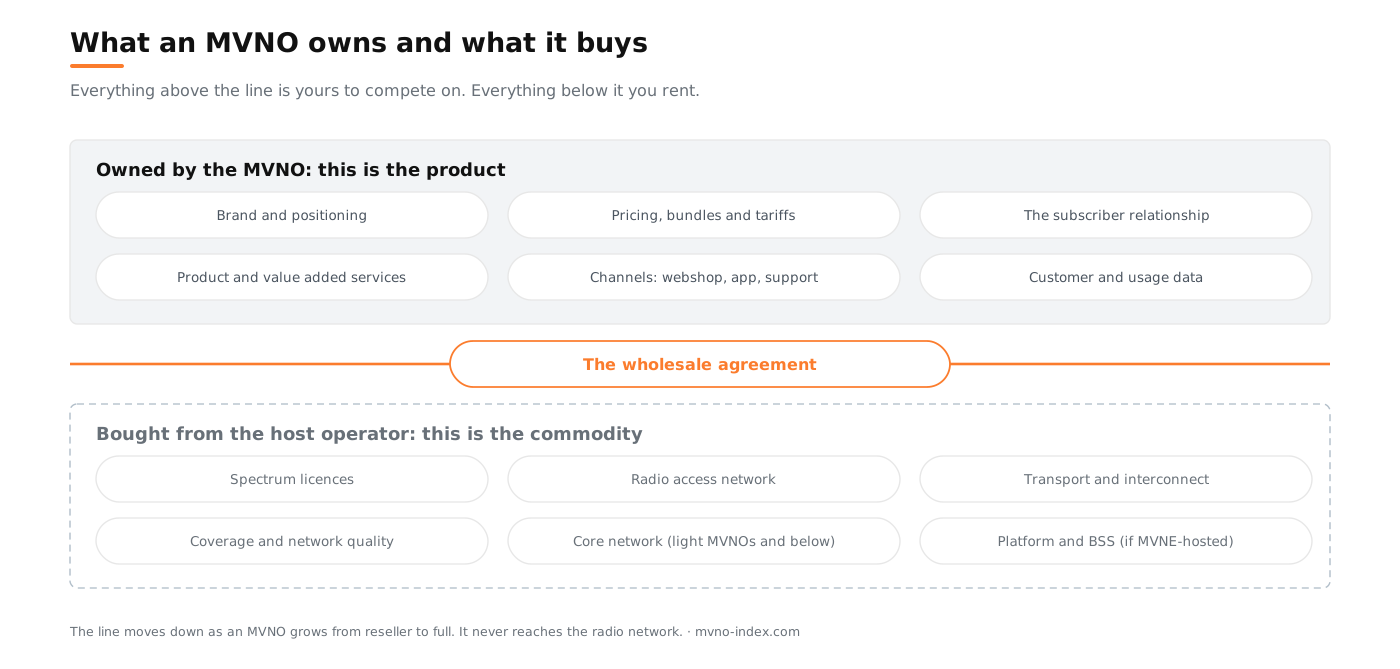
What an MVNO owns and what it buys. The wholesale agreement is the line between the two.
Key Characteristics of an MVNO
Every MVNO, regardless of size or type, shares a set of defining characteristics that distinguish it from other types of mobile market participants:
Own Brand Identity: The MVNO markets its mobile services under its own brand name, with its own pricing, packaging, and customer promise. Subscribers may have no visibility of the underlying MNO whose network powers the service. The brand is the MVNO's primary commercial asset.
No Owned Radio Access Network: An MVNO does not hold spectrum licenses or operate base stations, masts, or any radio access network (RAN) infrastructure. All radio access is provided by the host MNO through a commercial wholesale agreement.
Wholesale Network Access Agreement: The foundation of every MVNO business is the wholesale agreement negotiated with one or more MNOs. This agreement defines the commercial terms, per-minute, per-SMS, and per-MB rates, as well as the technical interconnection, service level commitments, and roaming terms that govern the relationship.
Own Customer Relationships: The MVNO owns the subscriber relationship entirely. It manages subscriber acquisition, tariff management, billing, customer care, and retention, all of which are the primary drivers of its commercial success or failure.
Own SIM Identity (in most cases): Most MVNOs issue their own SIM cards bearing their own MNC (Mobile Network Code) and MVNO branding, giving them a distinct identity on the network. The use of eSIM and iSIM technologies is increasingly common, enabling digital SIM provisioning without physical card distribution.
Variable Infrastructure Ownership: Depending on its type, an MVNO may own some or all of its core network elements such as the Home Location Register (HLR), Home Subscriber Server (HSS), Online Charging System (OCS), and Policy and Charging Rules Function (PCRF), or it may rely on shared infrastructure provided by an MVNE or the MNO itself.
How an MVNO Makes Money
An MVNO earns the difference between what it pays the host network and what the subscriber pays it. Every other number in the business is a cost against that difference.
On the buying side you pay a wholesale rate. That rate can be metered, per gigabyte, per minute, per SMS or bundled into a price per subscriber per month, and it almost always improves with committed volume. This is exactly why the MVNA layer exists: it buys at a scale a small operator cannot reach and resells that rate onwards. What you negotiate here sets the ceiling on everything you can do commercially, which is why the wholesale agreement deserves more preparation than any other document in the launch.
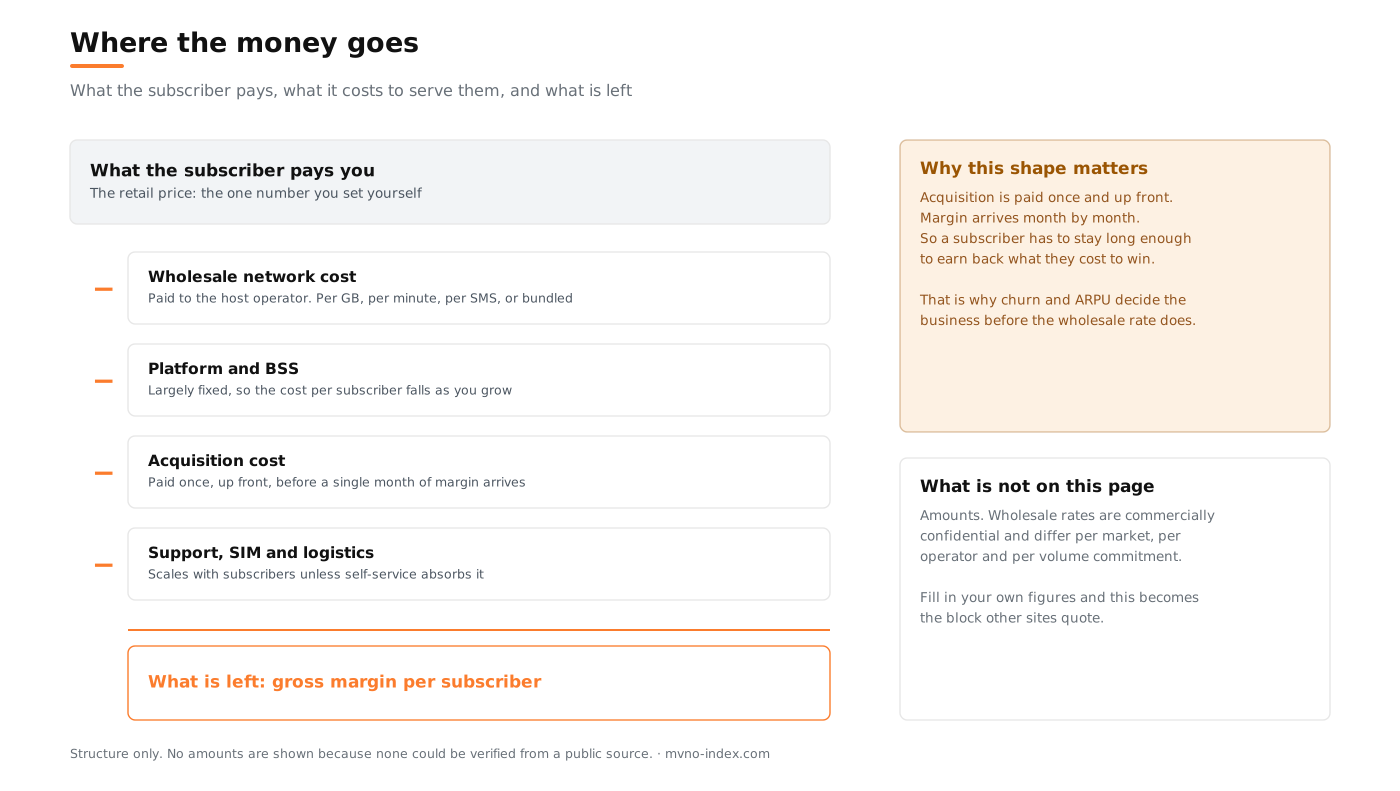
On the selling side you set your own retail price. Between the two sit four costs. The platform and BSS are largely fixed, so the cost per subscriber falls as you grow, which is the whole argument for an MVNE at the start. Acquisition is paid up front while the margin arrives month by month, so it is the item that most often decides whether the model works. Support scales with subscribers unless self-service absorbs it. And SIM, eSIM and device logistics are small per unit and easy to underestimate in total.
That shape has one consequence worth stating plainly: an MVNO is a retention business before it is an acquisition business. A subscriber has to stay long enough to earn back what you paid to win them, so churn and average revenue per user matter more than the headline wholesale rate. Model this properly in your financial plan before you sign anything.
Where the money goes: what the subscriber pays, what it costs to serve them, and what is left.
Where the money goes: the MVNO margin in one view
| Item | Who bears it | Comment |
|---|---|---|
| Wholesale network cost | MVNO pays the host operator | Per GB, per minute, per SMS, or a bundled rate per subscriber |
| Retail price | Subscriber pays the MVNO | The MVNO sets it. This is the whole point of the model |
| Platform and BSS | MVNO, or included in an MVNE deal | Largely fixed, so the cost per subscriber falls as you grow |
| Acquisition cost | MVNO | Paid up front, earned back monthly. The item that decides the model |
| Support cost | MVNO | Where self-service pays for itself |
| SIM, eSIM and logistics | MVNO | Small per unit, easy to underestimate in total |
| Spectrum and radio network | Host operator | Never the MVNO. This is what you buy instead of building |
The MVNO Ecosystem: MNO, MVNE, MVNA, and MVNO
The mobile value chain has four roles. The MNO owns the spectrum and the radio network and sells wholesale capacity; the MVNA buys that capacity at scale and resells it to smaller players; the MVNE runs the technical platform of core elements, BSS and OSS, SIM management and interconnects for several MVNOs at once; and the MVNO owns the brand, the pricing and the subscriber. Which of these you are, and which of them you buy from, is the first structural decision you make. The differences between MVNE, MVNA and MVNO sets out all four roles side by side, and the solution provider directory lists who does what in each layer.
Technical Infrastructure and Key Systems
The technology stack that powers an MVNO varies depending on its type and level of infrastructure ownership, but every MVNO requires a defined set of core technical components to operate:
Core Network Elements: Depending on whether the MVNO is a Full MVNO, Thick MVNO, or Light MVNO, it may own and operate some or all of the following: the Home Location Register (HLR) or Home Subscriber Server (HSS) for subscriber identity management, the Online Charging System (OCS) for real-time billing, the Offline Charging System (OFCS) for post-paid charging, and the PCRF for policy management. Explore the full core network elements section of MVNO Index for a comprehensive guide to each component.
BSS and OSS: The Business Support System (BSS) handles subscriber management, billing, rating, and customer-facing operations. The Operational Support System (OSS) manages network operations, provisioning, and fault management. Together, the synergy between BSS and OSS is what makes a modern MVNO commercially agile and operationally efficient. Selecting the right BSS and OSS is one of the most important platform decisions an MVNO makes, read the guide on how to select the right BSS and OSS for detailed guidance.
SIM Management: The MVNO issues SIM credentials to subscribers, managing the lifecycle of physical SIM cards, eSIMs, and iSIMs across its subscriber base. Understanding the history, current state, and future of SIM technology is essential for any MVNO making long-term technology choices.
Networks: The MVNO must understand the capabilities and limitations of the mobile networks it uses to serve its subscribers, including coverage, capacity, latency, and speed across 2G, 3G, 4G/LTE, and 5G. For MVNOs targeting IoT or M2M segments, knowledge of IoT network technologies such as NB-IoT and LTE-M is equally important.
Licensing, Numbering and Number Portability
Two practical questions come up in every launch and neither is usually answered on a "what is an MVNO" page: am I allowed to do this, and whose phone numbers am I handing out?
On permission: in the European Union, electronic communications services fall under the general authorisation regime of the European Electronic Communications Code. In practice that means you register with the national regulator rather than apply for a licence in the older sense, but what registration involves. Fees, reporting, security obligations, emergency call duties. Is set nationally and differs per market. Check with the regulator of the country you intend to launch in before you assume either way.
On numbers: telephone numbers are a national resource, allocated by the regulator, and formatted according to the ITU-T E.164 numbering plan. You either use ranges sub-allocated by your host MNO or hold your own allocation. The choice looks administrative and is not: it decides who is accountable to the regulator, who can port numbers away from whom, and what happens to your subscribers if you change host.
On portability: in the EU, Article 106 of the Code. "Provider switching and number portability": gives subscribers the right to keep their number when they switch provider, and Ofcom sets the equivalent rules in the UK. That means your platform needs two flows, not one. Porting in is the one everybody builds, because it wins customers. Porting out is the one that gets under-designed, and it is the one the regulator will ask you about.
Starting an MVNO: What You Need to Know
Why Start an MVNO?
Who starts an MVNO? Broadly three groups. Brands with an existing customer base add mobile to deepen a relationship they already have retail, media, fintech and lifestyle operators all work this way. Community and niche operators serve a segment the mainstream ignores, from diaspora calling to discount propositions. And enterprise and IoT operators want control over connectivity because it is part of their product rather than an add-on to it.
For those ready to take the next step, the full guide to starting your own mobile brand on MVNO Index walks through every decision, from business model selection to technology procurement, in structured detail. You will also want to build your MVNO business plan, marketing plan, and financial plan using the dedicated guides available on this site.
Advantages and Disadvantages of Running an MVNO
Advantages:
- Low Infrastructure CapEx compared to an MNO, as the MVNO does not need to invest in spectrum, towers, or radio access network equipment.
- Speed to Market enabled by the ability to launch on existing, proven network infrastructure within months rather than the years required to build a physical network.
- Brand Leverage for businesses with existing customer relationships, the MVNO model allows those relationships to be extended into mobile without disrupting the core business.
- Flexibility and Differentiation to serve specific subscriber segments with tailored tariffs, services, and experiences that generic MNO brands cannot match.
- Scalable Revenue Model with recurring subscription revenues that compound as the subscriber base grows, underpinned by relatively predictable wholesale cost structures.
- Access to Growing Technology Enablers including eSIM, 5G, cloud-native BSS, and AI-driven operations that continuously lower the cost and complexity of running a modern MVNO.
Disadvantages:
- Dependency on MNO Host for network quality, coverage, and the commercial terms of the wholesale agreement, areas over which the MVNO has limited direct control.
- Wholesale Cost Sensitivity meaning that MVNO margins are directly tied to the rates negotiated in the wholesale agreement, which can compress significantly in highly competitive markets.
- Subscriber Acquisition Cost can be high, particularly for consumer MVNOs competing against well-funded incumbent MNO retail brands with established marketing budgets.
- Operational Complexity in managing billing, customer care, regulatory compliance, SIM management, and technology partnerships simultaneously, especially in the early stages of launch.
- Limited Network Differentiation for MVNOs that rely entirely on a single MNO host, as they cannot directly control the network experience that their subscribers receive.
- Risk of Common MVNO Mistakes that are well documented and entirely avoidable, read the guide on some of the biggest MVNO mistakes to ensure your launch avoids the most common pitfalls.
Organizational Impact of Running an MVNO
Launching and operating an MVNO has profound organizational implications that extend well beyond the technology team:
Operational Impact: An MVNO must build or procure a full operational capability spanning subscriber management, billing, care, fraud management, SIM logistics, and regulatory compliance. The operational model must be designed from the outset to scale processes that work for 1,000 subscribers must be capable of handling 100,000 without linear cost growth. Investment in BSS and OSS automation is critical to achieving this scalability. The guide to exceptional customer care is essential reading for any team building a care function for the first time.
Financial Impact: The MVNO's financial model is built on the margin between wholesale costs and retail revenues, amplified by subscriber volume and ARPU. Managing wholesale costs through skilled negotiation of the wholesale agreement, controlling subscriber acquisition costs, and maximizing lifetime value through retention are the three primary financial levers. Telecom Expense Management is an often-overlooked discipline that can deliver material cost savings by identifying billing errors and optimizing wholesale cost structures. Building a rigorous financial plan before launch is non-negotiable.
Commercial and Marketing Impact: The MVNO's commercial success depends almost entirely on its ability to define, reach, and retain a specific subscriber segment better than competing brands. This requires a focused marketing plan, a compelling brand proposition, and continuous investment in retention. The power of a subscriber app is increasingly a key differentiator, enabling self-service, loyalty features, and digital engagement that reduce care costs while improving satisfaction.
Technical Impact: Selecting the right technology partners and platform architecture is one of the most consequential early decisions an MVNO makes. The wrong choices create technical debt and operational constraints that are expensive to unwind. The guide on how to find and select the right MVNO solution provider provides a structured framework for evaluating vendors across every technology domain.
MVNO Business Models: Which Type is Right for You?
There is no single MVNO template. The established models run from discount operators competing purely on price, through data-centric, business and enterprise, M2M and IoT and media propositions, to sector plays in healthcare, logistics and utilities. The model you pick decides your target subscriber, your technology stack, your wholesale requirements and your route to profit, in that order. The full comparison of MVNO types works through each one.
Some real examples per model
| Business model | What the proposition rests on | Named operators |
|---|---|---|
| Discount | Price, thin service, low cost to serve | H�rbi ZERONEO MOBILE |
| Data-centric | Data bundles, often eSIM and travel | Airalo SettleSim |
| Business / enterprise | Account management, fleet control, SLAs | Vocus Mobile Legos |
| M2M and IoT | Devices rather than people, long lifecycles | IXT Transatel IoT Latin America |
| Media and entertainment | Content bundled with connectivity | DirecTV M�vil Sky Mobile Ireland |
| Community | International rates for a defined group | Love Mobile MyCharity Mobile |
The Impact of 5G, eSIM, and AI on MVNOs
5G: New Capabilities and New Competitive Dynamics
The rollout of 5G networks is opening significant new opportunities for MVNOs. Higher data speeds, ultra-low latency, and network slicing capabilities create the conditions for MVNOs to offer differentiated, performance-sensitive services that were not commercially viable on 4G. For IoT-focused MVNOs, 5G RedCap brings reduced-complexity 5G connectivity to a new generation of IoT devices, expanding the addressable market. MVNOs that access 5G wholesale capacity early and build propositions that leverage its distinctive capabilities will be positioned to capture the most valuable emerging subscriber segments.
eSIM: Removing the Physical Barrier to Entry
The mainstream adoption of eSIM in consumer smartphones and IoT devices is transforming the MVNO subscriber acquisition and onboarding experience. An eSIM-enabled MVNO can acquire and activate a new subscriber entirely digitally, no SIM card needs to be ordered, shipped, or inserted. This dramatically reduces the cost and friction of subscriber acquisition, opens new digital distribution channels, and enables seamless multi-network access for roaming and IoT use cases. The introduction of SGP.32 eSIM Remote SIM Provisioning specifically for IoT devices further extends these benefits to device-centric MVNO models. For MVNOs evaluating their SIM strategy, understanding the full comparison of SIM, eSIM, and iSIM features is essential.
Artificial Intelligence: Smarter Operations and Richer Subscriber Experiences
Artificial Intelligence is rapidly becoming a practical operational tool for MVNOs of all sizes. AI-driven analytics can predict churn before it happens, personalize tariff recommendations, automate fraud detection, and optimize marketing spend. In customer care, AI-powered chatbots and automated resolution workflows can handle a growing proportion of subscriber contacts without human intervention, reducing costs while maintaining satisfaction. For MVNOs evaluating AI adoption, the detailed analysis of pros and cons of AI for subscribers and MVNOs and the practical guide on do's and don'ts when using AI for an MVNO on MVNO Index are essential reading. Additionally, the growing potential of Fixed Mobile Convergence (FMC) is creating new opportunities for MVNOs to bundle mobile with fixed broadband, increasing subscriber value and reducing churn through deeper service integration.
Frequently Asked Questions
What does MVNO stand for?
MVNO stands for Mobile Virtual Network Operator. It is a company that sells mobile services under its own brand using wholesale network access from a licensed Mobile Network Operator (MNO), without owning its own radio access network or spectrum.
What is the difference between an MVNO and an MNO?
An MNO (Mobile Network Operator) owns and operates the physical radio network, including spectrum licenses, towers, and base stations. An MVNO does not own any network infrastructure; it buys wholesale access from an MNO and resells it to subscribers under its own brand.
What is a mobile network virtual operator?
A “mobile network virtual operator” is usually written as a mobile virtual network operator, or MVNO. It is a mobile provider that sells calls, texts, and data under its own brand without owning a radio network. Instead, it rents capacity from a network operator (MNO) and resells it to its own customers. Coverage is usually the same as the host network, and MVNOs can offer prepaid plans, postpaid plans, or both.
What is the difference between an MVNO, MVNE, and MVNA?
An MVNE (Mobile Virtual Network Enabler) provides the technical and operational platform that MVNOs use to operate. An MVNA (Mobile Virtual Network Aggregator) aggregates wholesale capacity from MNOs and resells it to MVNEs and MVNOs. The full explanation is available on the MVNE, MVNA, and MVNO differences page.
How many types of MVNOs are there?
There is a spectrum of MVNO types ranging from Light MVNOs (which outsource almost all technical and operational functions) to Full MVNOs (which own their own core network). The different types of MVNOs page covers the full classification in detail.
How do I start an MVNO?
Starting an MVNO requires defining your business model, securing a wholesale network agreement, selecting your technology partners (MVNE, BSS, OSS), obtaining any required regulatory licenses, and building your commercial launch plan. The complete guide to starting your own mobile brand covers every step of this process.
How long does it take to launch an MVNO?
Launch timelines vary depending on the MVNO type and the complexity of the chosen technology stack. A Light MVNO launching on an established MVNE platform can be live within a few months. A Full MVNO building its own core network requires 12 to 24 months or more.
Where can I find MVNO solution providers?
MVNO Index maintains a comprehensive, filterable solution provider directory covering MVNEs, MVNAs, BSS vendors, OSS vendors, core network element providers, SIM suppliers, connectivity providers, and more.
How many MVNOs are there worldwide?
GSMA Intelligence reported approximately 2,100 MVNOs operating globally as of August 2025. The number has grown steadily as eSIM lowered the barrier to entry and as wholesale access became a standard product rather than a negotiated exception.
Does an MVNO need its own licence and phone numbers?
It depends on the market. In the European Union, electronic communications services fall under the general authorisation regime of the European Electronic Communications Code, which normally means registering with the national regulator rather than obtaining a traditional licence. Phone numbers are allocated nationally; an MVNO either holds its own ranges or uses ranges sub-allocated by its host operator. Both arrangements are common and the choice affects number portability and regulatory accountability.
Summary
An MVNO (Mobile Virtual Network Operator) is a mobile services business that delivers voice, SMS, and data to subscribers under its own brand, using wholesale network access from a licensed MNO rather than owning physical network infrastructure. The MVNO model is one of the most commercially flexible frameworks in the telecommunications industry, enabling businesses from nimble startups to established global brands to participate in the mobile market at a fraction of the cost of network ownership.
The keys to MVNO success are choosing the right business model for your target subscriber segment, selecting the right partners across the MVNE, BSS, OSS, and core network layers, negotiating a sound wholesale agreement, and executing a focused commercial strategy that builds subscriber value and loyalty over time.
MVNO Index is built to give you everything you need to make those decisions well: comprehensive educational content across every dimension of the MVNO business, a searchable solution provider directory, a consultancy directory of specialist advisors, and a rich library of business models, operational guides, and technical references. Whether you are evaluating whether to start an MVNO, actively planning your launch, or looking to optimize an existing operation, MVNO Index is your authoritative, independent reference. Start with the guide to starting your own mobile brand and build from there.
Subjects about how to start your own MVNO