MVNO Cybersecurity and Privacy: Four Exposures, Four Answers
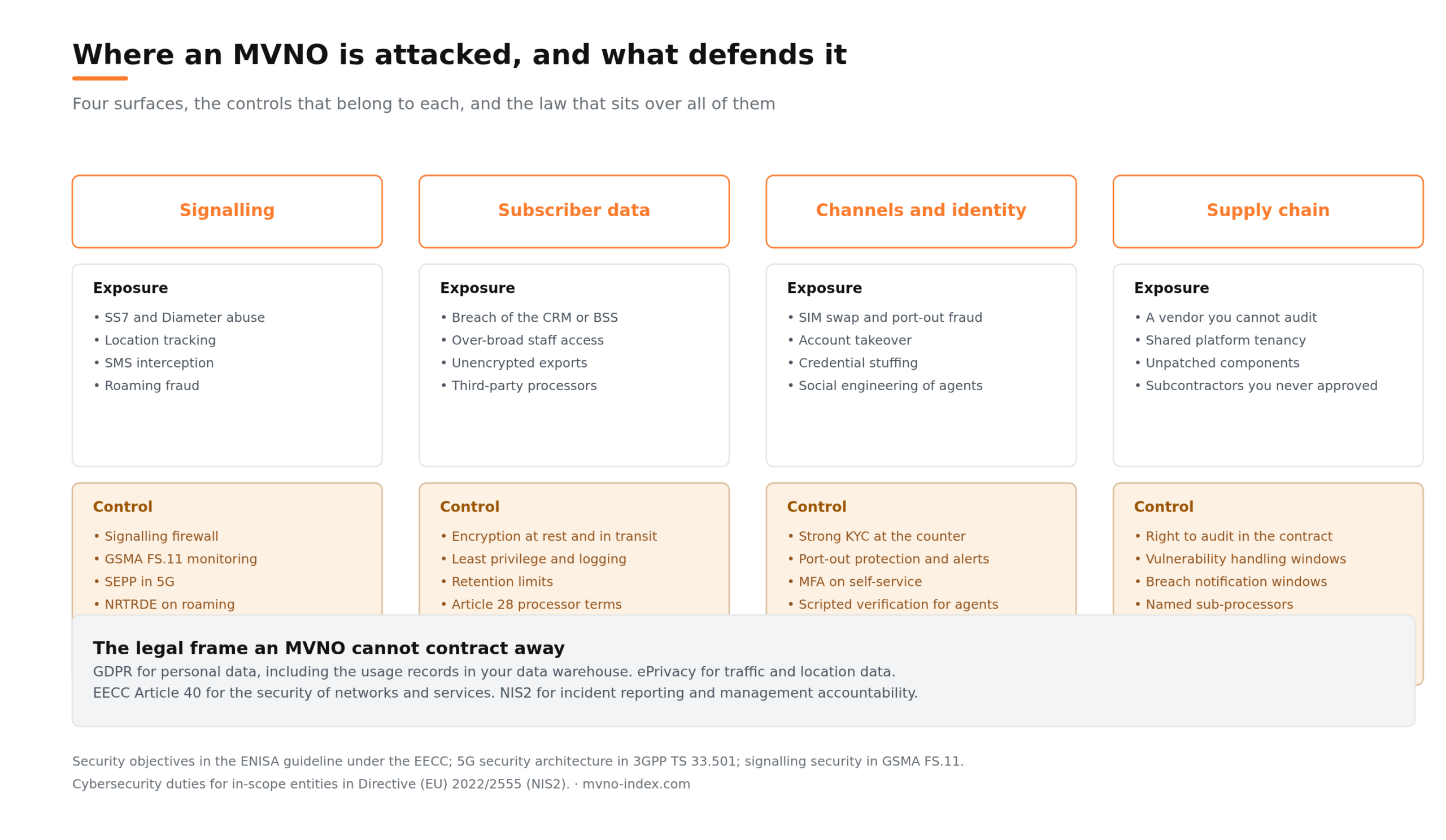
Cybersecurity and privacy for an MVNO is not one product but four exposures with four sets of controls: the signalling network, the subscriber data you hold, the channels where identity is verified, and the vendors who run systems on your behalf. The legal duties. The GDPR, the ePrivacy rules, Article 40 of the EECC and, for in-scope entities, NIS2. Stay with you whoever operates the platform.
Cybersecurity and Privacy Solutions form a critical and non-negotiable layer of protection within the architecture of every modern MVNO, IoT operator, MVNE, and MVNA. Understanding their scope is essential for grasping how mobile operators protect subscriber data, secure network elements, and remain compliant with global privacy regulations. These solutions act as the comprehensive defensive framework covering identity protection, network security, fraud prevention, data privacy, and regulatory compliance across all layers of a mobile business. You will find a robust cybersecurity and privacy strategy to be indispensable for any operator aiming to build subscriber trust, protect revenue, and sustain long-term operational integrity.
On this page
- History and Evolution of Cybersecurity and Privacy in Telecom
- Core Utility and Functionality of Cybersecurity and Privacy Solutions
- What are Cybersecurity and Privacy Solutions Used For?
- Key Functions of Cybersecurity and Privacy Solutions
- Technical Integration and Architecture
- Integration with Other Systems
- Technical Architecture and Key Interfaces
- Cybersecurity and Privacy for MVNOs and IoT Companies
- Why Invest in Dedicated Cybersecurity and Privacy Solutions?
- Advantages and Disadvantages
- Organizational Impact of Cybersecurity and Privacy Ownership
- Redundancy and High Availability in Cybersecurity
- Regulatory Compliance and Privacy Frameworks
- Impact of 4G, 5G, and IoT on Cybersecurity
- The Expanding Threat Landscape
- 5G Security Architecture
- IoT Security Challenges
- Frequently Asked Questions
- Summary
History and Evolution of Cybersecurity and Privacy in Telecom
The need for dedicated cybersecurity in mobile telecoms became apparent with the widespread rollout of 2G and 3G networks, as the commercialization of SMS and data services introduced new vectors for fraud, eavesdropping, and unauthorized access. Early protections were largely built into network standards themselves, such as SIM-based authentication via the Authentication Center (AuC) and device identity verification through the Equipment Identity Register (EIR). As mobile networks evolved into the IP-based world of 4G LTE and the cloud-native 5G Core, the threat landscape expanded enormously, making dedicated cybersecurity and privacy solutions a separate and essential discipline in their own right.
Core Utility and Functionality of Cybersecurity and Privacy Solutions
Exposure, control, and the standard behind it
| Exposure | Control | Reference |
|---|---|---|
| SS7 and Diameter abuse, location tracking | Signalling firewall and monitoring | GSMA FS.11 |
| 5G interconnect exposure | SEPP at the network border | 3GPP TS 33.501 |
| Subscriber data breach | Encryption, least privilege, retention limits | GDPR, and the ENISA guideline |
| SIM swap and port-out fraud | Strong verification, port-out alerts | National numbering rules and your own process |
| Vendor and supply chain risk | Right to audit, patch and breach windows | Contract terms, backed by EECC Article 40 |
| Incident reporting duty | A tested process, with named accountability | NIS2, for in-scope entities |
What are Cybersecurity and Privacy Solutions Used For?
Cybersecurity and Privacy Solutions for MVNOs, IoT companies, and mobile operators serve as the comprehensive protective layer that safeguards every dimension of a mobile business. Their primary purpose is to detect, prevent, and respond to threats targeting subscribers, network infrastructure, business data, and revenue streams. They protect against a wide spectrum of risks including SIM swap fraud, SS7 and Diameter signaling attacks, data breaches, unauthorized API access, and non-compliance with privacy regulations such as the GDPR, the CCPA, and telecom-specific frameworks like 3GPP security standards.
For an MVNO or IoT operator, deploying these solutions is essential to protect the subscriber data held in the Home Location Register (HLR) or Home Subscriber Server (HSS), to secure the charging flows processed by the Online Charging System (OCS), and to harden the signaling plane managed by the Diameter Routing Agent (DRA). Without robust cybersecurity tools in place, all of these critical systems become attack surfaces that can be exploited to cause financial loss, regulatory penalties, and permanent reputational damage.
Key Functions of Cybersecurity and Privacy Solutions
Understanding the core functions of cybersecurity and privacy solutions reveals why they are indispensable in modern mobile operations:
- Subscriber Identity Protection: Secures subscriber credentials, IMSI data, and SIM provisioning workflows against SIM swap attacks, IMSI catchers, and unauthorized profile manipulation, working in close coordination with the Subscriber Identity Module (SIM) and eSIM infrastructure.
- Signaling Security: Monitors and filters SS7, Diameter, and GTP signaling protocols to detect and block malicious signaling attacks, including location tracking attempts, call interception, and denial-of-service attacks targeting the Signaling Transfer Point (STP) and DRA.
- Fraud Detection and Prevention: Deploys real-time analytics and machine learning models to identify fraudulent patterns in charging, roaming, and service usage, protecting the revenue managed by the OCS and Offline Charging System (OFCS).
- Network Access Control: Enforces strict authentication, authorization, and access control policies across all network interfaces, OSS, and BSS platforms to prevent unauthorized access by internal and external actors.
- Data Privacy and Consent Management: Implements technical controls to enforce data minimization, purpose limitation, and subscriber consent in accordance with GDPR and other applicable privacy regulations, covering all subscriber data processed across BSS/OSS systems.
- Encryption and Key Management: Applies end-to-end encryption for data in transit and at rest across all network interfaces, including the air interface, core network signaling, and interconnect links, protecting sensitive information from interception.
- Vulnerability Management and Penetration Testing: Continuously identifies and remediates security weaknesses in network functions, APIs, and operational systems through structured vulnerability scanning, patch management, and regular penetration tests.
- Security Information and Event Management (SIEM): Aggregates security logs from all network elements and IT systems into a centralized SIEM platform, enabling real-time threat detection, incident correlation, and audit trail generation for compliance purposes.
- API Security: Secures the modern service-based interfaces of the 5G Core and public-facing APIs, preventing abuse, injection attacks, and unauthorized data extraction via exposed endpoints.
- Incident Response and Recovery: Defines and executes structured incident response plans to contain breaches, recover compromised systems, notify relevant authorities within regulatory deadlines, and document lessons learned to prevent recurrence.
Technical Integration and Architecture
Integration with Other Systems
Cybersecurity and Privacy Solutions do not operate in isolation. They must be deeply integrated with every layer of the mobile operator's infrastructure to be effective. In the core network, they connect to subscriber databases such as the HLR and HSS, to the Authentication Server Function (AUSF) and Unified Data Management (UDM) in 5G environments, and to the Policy and Charging Rules Function (PCRF) or Policy Control Function (PCF) for real-time enforcement of security-driven policies.
On the signaling layer, security probes and firewalls integrate with the DRA, STP, and Session Border Controller (SBC) to intercept and inspect all signaling traffic crossing the network boundary. The Session Management Function (SMF) and User Plane Function (UPF) are hardened through deep packet inspection and policy enforcement capabilities. The BSS and OSS platforms, including customer portals, CRM systems, provisioning engines, and billing systems, must also be integrated with identity and access management (IAM) solutions to control who can access what data and when.
For IoT operators, the attack surface is dramatically larger. Every connected device, IoT SIM, and management platform represents a potential entry point. Cybersecurity solutions here must extend to the device level, securing IoT Devices through certificate-based authentication, firmware integrity checks, and over-the-air (OTA) update protection.
Technical Architecture and Key Interfaces
A mature Cybersecurity and Privacy architecture for an MVNO or IoT operator is typically structured across several complementary layers:
- Perimeter Security Layer: Firewalls, intrusion detection and prevention systems (IDS/IPS), and signaling firewalls that sit at all network boundaries, including the interconnect to the host MNO, roaming partners, and the public internet.
- Identity and Access Management (IAM) Layer: Controls authentication and authorization for all internal users, system-to-system interfaces, and subscriber-facing APIs. This layer enforces multi-factor authentication (MFA), role-based access control (RBAC), and privileged access management (PAM).
- Data Protection Layer: Manages encryption keys, certificate lifecycles, data masking for non-production environments, and the pseudonymization or anonymization of subscriber data for analytics and reporting use cases.
- Monitoring and Detection Layer: The SIEM platform aggregates logs and events from all sources, while a Security Operations Center (SOC) or managed detection and response (MDR) service provides 24/7 threat monitoring, alerting, and initial triage.
- Compliance and Governance Layer: Tracks regulatory obligations, manages consent records, generates audit reports, and coordinates with data protection authorities (DPAs) in case of a reportable personal data breach.
Four exposures, the controls that belong to each, and the law that sits over all of them.
Cybersecurity and Privacy for MVNOs and IoT Companies
Why Invest in Dedicated Cybersecurity and Privacy Solutions?
For a Full MVNO or an IoT company, investing in dedicated Cybersecurity and Privacy Solutions is a strategic imperative, not an optional expense. Consider that as a mobile operator, you hold some of the most sensitive personal and location data that exists: subscriber identities, real-time location information, call records, device identifiers, and payment data. A breach of this data carries severe financial penalties under GDPR and equivalent regulations, as well as the loss of subscriber trust that is almost impossible to rebuild.
Furthermore, as operators take on more ownership of their core network elements to gain independence and flexibility, their security responsibility increases proportionally. Owning and operating an HLR, HSS, or OCS means that you are directly accountable for the security of the data those systems process. Partnering with the right cybersecurity solution provider, or selecting an MVNE that has these protections built into its platform, is one of the most important decisions you will make when building your mobile business. Use the MVNO Index Solution Provider directory to find and compare vendors offering cybersecurity and privacy capabilities for MVNOs and IoT operators.
Advantages and Disadvantages
Advantages:
- Subscriber Trust and Retention through demonstrable protection of personal data and communications.
- Revenue Protection by neutralizing fraud against the OCS, roaming systems, and interconnect billing.
- Regulatory Compliance with GDPR, national privacy laws, and 3GPP security standards, avoiding heavy fines and enforcement actions.
- Operational Resilience through rapid incident detection, containment, and recovery capabilities that limit business disruption.
- Competitive Differentiation particularly relevant for Business MVNOs, Healthcare MVNOs, and Fintech MVNOs where security is a core buying criterion.
- Secure IoT Deployments enabling M2M and IoT MVNOs to serve enterprise customers with demanding security requirements
Disadvantages:
- Significant initial investment in tools, platforms, and specialist security expertise.
- Ongoing operational costs for a SOC, SIEM licensing, and continuous vulnerability management.
- Complexity of integrating security controls across a heterogeneous stack of BSS, OSS, and core network elements.
- Rapidly evolving threat landscape requiring continuous updates to detection rules, policies, and staff training.
- Risk of false positives in fraud detection that may inadvertently impact legitimate subscriber services.
Organizational Impact of Cybersecurity and Privacy Ownership
Integrating a comprehensive Cybersecurity and Privacy program has implications across every dimension of the organization:
Operational Impact: Security operations require dedicated personnel or a managed service provider with expertise in telecom-specific threats, including SS7 and Diameter signaling attacks, SIM fraud, and IoT botnet activity. Processes for patch management, incident response, and change management must be formalized and tested regularly. Security must be embedded into the operational workflows of the teams managing OSS and BSS platforms, not treated as a separate silo.
Financial Impact: Cybersecurity investment carries both direct costs (platform licenses, SOC staffing, penetration testing) and indirect benefits that are difficult to quantify until an incident occurs. The cost of a major data breach, including regulatory fines, breach notification obligations, customer compensation, and reputational damage, far exceeds the cost of preventive investment. Operators should also consider the Telecom Expense Management perspective: fraud losses are a direct drain on margin and are entirely preventable with the right controls.
Legal and Compliance Impact: GDPR requires MVNOs operating in or targeting EU residents to implement technical and organizational measures proportionate to the risk of processing personal data. This means conducting Data Protection Impact Assessments (DPIAs) for high-risk processing activities, appointing a Data Protection Officer (DPO) where required, maintaining records of processing activities, and ensuring that any data shared with the host MNO, MVNE, or third-party vendors is governed by appropriate Data Processing Agreements. Breaches that affect the rights and freedoms of individuals must be reported to the relevant supervisory authority within 72 hours.
Cultural Impact: Building a security-conscious organizational culture is as important as deploying the right technology. All staff handling subscriber data or operating network systems must receive regular security awareness training. The Guide to Exceptional Customer Care highlights how trust is the foundation of the subscriber relationship, and security incidents directly undermine that trust.
Redundancy and High Availability in Cybersecurity
Cybersecurity systems must themselves be designed with the same resilience standards applied to mission-critical network elements. A security platform that goes offline during an attack is worse than useless. Key security components, including the SIEM, signaling firewalls, and IAM systems, must be deployed in active-active or active-standby configurations with geographic redundancy where feasible.
Incident response plans must be tested through regular drills, including tabletop exercises and simulated breach scenarios, to ensure that teams can execute under pressure. Recovery Time Objectives (RTO) and Recovery Point Objectives (RPO) must be defined for security infrastructure in the same way as for core network elements. Backup authentication mechanisms must be available so that operator staff can still securely access critical systems even if primary IAM infrastructure is impaired during an incident.
Regulatory Compliance and Privacy Frameworks
Four legal frames, and what each actually demands
| Instrument | What it governs | The duty in one line |
|---|---|---|
| GDPR (Regulation (EU) 2016/679) | Personal data, including usage records | Lawful basis, minimisation, retention limits, and processor contracts |
| ePrivacy Directive 2002/58/EC | Traffic and location data, and marketing | Confidentiality of communications, and consent where required |
| EECC Article 40 (Directive (EU) 2018/1972) | Security of networks and services | Appropriate measures, and notification of significant incidents |
| NIS2 (Directive (EU) 2022/2555) | Cybersecurity risk management and reporting | Management accountability, and reporting on a regulated clock |
One of the most demanding aspects of operating as an MVNO or IoT company today is navigating the complex and evolving landscape of privacy and data protection regulation. The key frameworks that operators must address include:
- General Data Protection Regulation (GDPR): Applicable across the European Union and the European Economic Area, GDPR sets stringent requirements for the lawful processing of personal data, the rights of data subjects (including access, rectification, erasure, and portability), and the security of processing. MVNOs must implement privacy by design and by default in all systems that process subscriber data.
- 3GPP Security Standards: The 3rd Generation Partnership Project (3GPP) defines security architectures for each generation of mobile networks. For 4G LTE, this includes the TS 33.401 specification; for the 5G Core, the relevant standard is TS 33.501. MVNOs operating their own core must be familiar with these standards and ensure that all deployed network functions conform to them.
- GSMA Security Guidelines: The GSMA publishes a comprehensive set of security guidelines specifically for mobile operators, including the GSMA FS.11 SS7 Vulnerability Assessment, FS.19 Diameter Security, and the IoT Security Guidelines. These are widely regarded as the industry baseline for telecom security practices.
- National and Sector-Specific Regulations: Depending on the markets in which an MVNO operates, additional obligations may apply, including requirements from national cybersecurity agencies, financial services regulators (particularly relevant for Fintech MVNOs), and health data regulations (critical for Healthcare MVNOs).
Operators should consider working with a specialist Consultancy partner to conduct a regulatory gap analysis and build a compliance roadmap tailored to their specific business model and geographic footprint.
Impact of 4G, 5G, and IoT on Cybersecurity
The Expanding Threat Landscape
The evolution from legacy 2G/3G networks to 4G LTE introduced IP-based signaling and with it an entirely new category of vulnerabilities. SS7 and Diameter protocol weaknesses, which allow attackers to track subscriber locations, intercept calls and messages, and manipulate charging, became well-documented attack vectors that are still actively exploited today. Operators who own or interface with signaling infrastructure must deploy dedicated signaling firewalls and monitoring solutions to address these threats.
5G Security Architecture
The 5G Core introduces significant security improvements at the architecture level, including enhanced mutual authentication through the Authentication Server Function (AUSF), privacy protection for subscriber identifiers (SUPI/SUCI), and a service-based architecture that uses TLS-secured HTTP/2 for all inter-function communication via the Service Communication Proxy (SCP). However, 5G also dramatically increases the attack surface by enabling massive IoT deployments, network slicing, and edge computing, each of which introduces new security considerations that must be managed.
IoT Security Challenges
For M2M and IoT MVNOs, the cybersecurity challenge is uniquely demanding. Billions of connected IoT Devices often have limited processing power, no display, and long operational lifespans that make regular security updates difficult. Each device represents a potential entry point into both the operator's network and the enterprise customer's infrastructure. Effective IoT security requires device-level certificate provisioning, network-level anomaly detection, and the ability to remotely isolate compromised devices without disrupting the broader service. Technologies such as eSIM, iSIM, and the SGP.32 eSIM Remote SIM Provisioning standard play an important role in securing IoT device connectivity at scale. Understanding the differences between NB-IoT, LTE-M, and 5G RedCap is also relevant, as each network technology carries its own security characteristics and risk profile.
Frequently Asked Questions
Why do MVNOs need dedicated cybersecurity solutions?
MVNOs process highly sensitive subscriber data and operate network infrastructure that is exposed to well-documented telecom-specific attack vectors, including SS7 fraud, SIM swap attacks, and Diameter signaling exploits. Dedicated solutions are required to detect and prevent these threats and to meet regulatory obligations.
What is the biggest cybersecurity threat for MVNOs today?
SIM swap fraud and SS7/Diameter signaling attacks remain among the most impactful threats. Both allow attackers to take over subscriber accounts or intercept communications, leading to financial fraud, data breaches, and severe reputational damage.
Are MVNOs subject to GDPR?
Yes. Any MVNO operating in or processing the personal data of individuals in the European Union is subject to GDPR. This includes obligations around lawful processing, data subject rights, breach notification, and the security of processing.
How does 5G affect cybersecurity requirements?
The 5G Core introduces stronger built-in security mechanisms, including SUPI/SUCI privacy protection and mutual authentication. However, 5G also expands the attack surface through network slicing, edge computing, and massive IoT connectivity, requiring updated security strategies and tools.
What should an MVNO look for in a cybersecurity solution provider?
Operators should look for providers with proven telecom-specific expertise, coverage of signaling security (SS7, Diameter, GTP), fraud management, SIEM capabilities, and demonstrated experience with GDPR and 3GPP security standards. Use the MVNO Index Solution Provider directory to identify and shortlist qualified vendors.
How do cybersecurity solutions integrate with BSS and OSS?
Security solutions integrate with BSS and OSS platforms via APIs and log-forwarding mechanisms, feeding event data into the SIEM and enabling automated fraud response actions such as service suspension or alert escalation.
What is the role of Artificial Intelligence in telecom cybersecurity?
AI and machine learning are increasingly used to detect anomalous behavior patterns in subscriber usage, signaling traffic, and network operations that would be impossible to identify through manual analysis or static rule-based systems. Learn more about how AI is transforming MVNO operations on the Artificial Intelligence and a Mobile Brand page.
Summary
Cybersecurity and Privacy Solutions are the foundational protective framework that every MVNO, IoT operator, MVNE, and MVNA must put in place to protect its subscribers, infrastructure, revenue, and regulatory standing. From securing the signaling plane managed by the DRA and STP, to protecting subscriber identities in the HLR and HSS, to hardening the modern 5G Core and securing vast IoT device deployments, the scope of cybersecurity in mobile telecoms is broad and continually expanding.
Investing in the right cybersecurity and privacy capabilities is not merely a compliance exercise. It is a direct investment in subscriber trust, operational resilience, and sustainable business growth. Operators who build security into the foundations of their business from day one, whether they are starting a new MVNO or scaling an existing IoT platform, will be better positioned to grow with confidence, win enterprise customers, and navigate an increasingly regulated and threat-rich environment.
Use the MVNO Index Solution Provider directory to find qualified cybersecurity and privacy vendors for your mobile or IoT business, or explore the Consultancy section to find expert partners who can help you design and implement a security and compliance strategy tailored to your specific needs.
General Information