MVNO and MVNE: The Split That Prevents Arguments
Introduction about the MVNO and MVNE Relationship
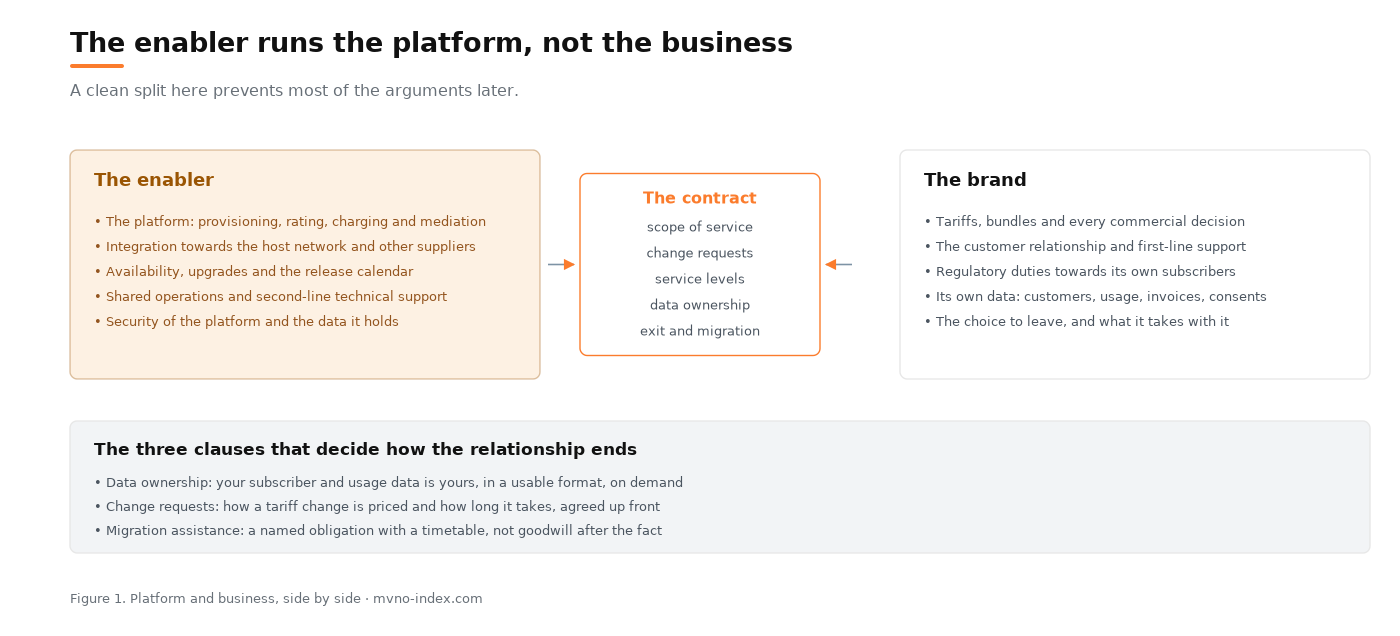
An MVNE supplies the platform an MVNO would otherwise have to build: provisioning, rating and charging, mediation, and the integrations towards the host network. The brand keeps everything commercial, including tariffs, the customer relationship and its regulatory duties towards its own subscribers. A clean split prevents most later arguments, and three clauses decide how the relationship ends: who owns the data, how a change request is priced, and what migration assistance is actually owed.
A mobile virtual network enabler, or MVNE, supplies technical and operational capabilities that help an MVNO deliver mobile services. Its scope can include provisioning, billing, core network functions, interfaces and managed operations. The MVNO builds the customer proposition and retains the responsibilities assigned to it in the operating model, even when much of the underlying technology is outsourced.
The relationship works best when both parties agree how a customer journey will operate from start to finish. A platform feature list is only part of that discussion. The MVNO also needs clear ownership of product changes, incidents, data and migration. Select an MVNE for demonstrated delivery of the intended business, rather than for the longest list of available modules.
On this page
- History and Evolution of Mobile Enablement
- Core Utility and Functionality of the Relationship
- What is an MVNE Relationship Used For?
- Key Functions of the Enablement Agreement
- Technical Integration and Data Model
- Integration with Other Systems
- Technical Data Model and Key Interfaces
- Relationship Ownership for MVNOs and IoT Companies
- Why Choose an MVNE?
- Advantages and Disadvantages of an MVNE Relationship
- Organizational Impact of the Enablement Relationship
- Redundancy and High Availability
- Impact of 4G and 5G and Future Networks
- Enablement for 4G Services
- Enablement for 5G Services
- Long Term Partnership Planning
- Frequently Asked Questions about MVNO and MVNE Relationships
- Summary
History and Evolution of Mobile Enablement
MVNEs emerged to share the systems and expertise needed to launch and operate mobile brands. Instead of building every capability independently, an MVNO could use an established platform and operating team. This made technical entry more practical for businesses whose main strength was distribution, a customer community or a differentiated retail service.
Enablement has since expanded into modular platforms, managed core services and broader digital integration. Some MVNEs also provide aggregated wholesale access, while others work with the MVNO's chosen host. The MVNE and MVNA comparison explains the distinction, but each proposal should identify its actual commercial and technical responsibilities.
Core Utility and Functionality of the Relationship
Where the line between platform and business should fall
| The enabler | The brand | |
|---|---|---|
| Provisioning and charging | Runs it | Specifies what it must do |
| Host integration | Builds and maintains it | Owns the commercial agreement |
| Tariffs and bundles | Implements them | Decides them |
| First-line support | Second line and platform faults | Owns the customer conversation |
| Subscriber and usage data | Processes it | Owns it, and may export it |
| Regulatory duties to subscribers | Supports them technically | Carries them legally |
| Deciding to leave | Must assist | Decides, and takes the base along |
What is an MVNE Relationship Used For?
The relationship supplies the systems and processes needed to turn a retail offer into a working mobile service. An order must create the right subscription, enable the intended network capabilities and produce accurate charges. The MVNE may perform much of that work, but the complete journey also involves the MVNO's channels and the host network.
The MVNO can therefore concentrate more of its resources on customers and products. This does not mean technical oversight becomes unnecessary. The brand still needs enough understanding to specify requirements, assess changes and challenge service failures. A managed platform is most effective when the customer organisation can use it confidently and govern the relationship competently.
Key Functions of the Enablement Agreement
Platform scope identifies which functions are included and which require separate suppliers. Billing may mean rating usage, producing invoices, managing balances or some combination of those activities. Customer management may provide a back-office interface without a complete retail application. Define the required workflows so familiar product labels do not hide missing responsibilities.
Operational scope establishes who monitors services, handles incidents and performs maintenance. It should distinguish standard support from custom development and explain how urgent changes are managed. The MVNO needs to know which decisions it can make through configuration and which depend on an MVNE release or host approval.
Commercial scope connects fees to the delivered services. Setup charges, recurring minimums, per-subscriber fees and change costs should be considered together. Ask how prices evolve as the business grows or adds a new market. A low launch price can become expensive if ordinary product changes repeatedly require paid projects.
Technical Integration and Data Model
Integration with Other Systems
The MVNE platform may connect retail channels, payment services, customer care and network provisioning. Map each interface and identify the system responsible for the authoritative record. A customer account, a mobile subscription and a SIM are related but distinct objects. Confusing them can create activation errors and make later migration difficult.
A practical integration specification describes the customer journeys as well as the endpoints. Include ordering, identity checks where applicable, activation, top-up, tariff change, suspension and cancellation. For each journey, define the final state and the recovery process after a failure. An API returning an accepted response does not necessarily mean the network service has changed.
Reporting integration should make billing and service status understandable to the MVNO. Require useful historical exports and access to the evidence needed for support. The core network overview helps identify where platform records depend on functions operated by the MVNE, the MNO or another supplier.
Technical Data Model and Key Interfaces
Maintain stable identifiers across customer, subscription, product and network records. Record the effective dates of service and tariff changes. Support staff should be able to reconstruct what a subscriber was entitled to at the time of an incident or disputed charge. A current-state dashboard alone cannot answer every historical question.
Platform and business, side by side, with the contract between them.
Interfaces need versioning, documented errors and safe handling of repeated requests. If a payment succeeds but a top-up request times out, the system must avoid losing the customer's balance or crediting it twice. Ask the MVNE to demonstrate these partial-failure cases. They reveal operational maturity more clearly than a successful single activation.
Tenant separation matters when several MVNOs share the platform. Access controls, configuration and reporting should prevent one brand's users or processes from affecting another's records. Performance isolation also deserves testing. A large batch operation for another tenant should not unexpectedly stop your customer service unless that limitation is explicit and acceptable.
Two things are worth measuring before they matter: how long a straightforward tariff change takes from request to live, and what it costs. Ask for the last three as examples with dates. An enabler that cannot produce them is telling you something about the fourth.
Relationship Ownership for MVNOs and IoT Companies
The three clauses that decide how it ends
| Clause | A weak version | A workable version |
|---|---|---|
| Data ownership | Data is available on request | Named records, a usable format, a stated frequency |
| Change pricing | Changes are quoted per request | A rate card, with lead times, agreed up front |
| Migration assistance | The supplier will cooperate | A named obligation, a timetable and a price |
Why Choose an MVNE?
An MVNE can reduce the amount of technology and specialist operations an MVNO must build itself. It can be particularly useful where a standard platform matches the intended offer. Greater customisation may still be possible, but it needs a sustainable development and support model. Compare the value of control with the cost of maintaining unique features.
IoT businesses should test device lifecycle operations rather than relying only on consumer-mobile demonstrations. Factory activation, suspension, fleet changes and bulk provisioning can create different workloads. The platform should support the intended account structure and diagnostic needs. An attractive retail portal may have little value if enterprise customers need dependable APIs and detailed fleet reporting.
Advantages and Disadvantages of an MVNA Relationship
Advantages
-
An established MVNE can provide reusable integrations and operational experience that shorten the path to a working service. Standard processes may also reduce implementation risk. The benefit is strongest when the provider can demonstrate the same relevant capabilities in a production-like environment and clearly identify any work still required for your launch.
-
Shared platforms can spread infrastructure and development costs across several customers. An MVNO may gain access to capabilities that would be difficult to fund alone. Evaluate how enhancements are prioritised and how the shared roadmap affects your business. A feature has practical value only when it is available, supported and usable under your agreement.
Disadvantages
-
Dependence on a platform can constrain product choices and change timing. A tariff that appears simple commercially may require substantial configuration or development. Ask the MVNE to implement representative offers during evaluation, including discounts, renewals and exceptions. This makes the boundary between standard capability and paid customisation visible before the contract is signed.
-
Migration can also be demanding. Subscriber data, balances, product logic and network configurations may need to move together. An export of customer names and telephone numbers is not a complete exit solution. Agree usable formats, assistance, costs and access periods, then test a sample migration dataset while the relationship is still being established.
Organizational Impact of the Enablement Relationship
The MVNO needs a product owner who can translate business requirements into platform behaviour. It also needs operational and financial contacts who can investigate incidents and charges. These roles can be small at launch, but they must be explicit. Leaving every question with an account manager creates delays when specialist decisions are required.
Agree a release and change process. The MVNE should explain what will change, which journeys may be affected and what testing is needed. The MVNO should provide timely decisions and representative test cases. Shared accountability makes change safer than either party assuming that the other will discover every customer impact.
Finance should reconcile retail results, platform fees and wholesale charges using a common view of subscriptions and periods. Analyse the cost of support and custom work as the business develops. A platform that looked economical at launch may need a different commercial arrangement once the MVNO adds complex enterprise or international products.
Supplier evaluation should include people and processes as well as software. Ask who handles a difficult activation fault outside normal business hours and how an unresolved invoice dispute is escalated. Use the solution provider selection guide to compare evidence, then request a scoped trial with named acceptance responsibilities.
Redundancy and High Availability
Availability should be defined for customer journeys, not just individual servers. An operational billing application is insufficient if it cannot reach the provisioning interface or payment service. Map dependencies and agree how partial outages are handled. Some functions may continue in a limited mode, while others need to stop safely until state can be confirmed.
Test recovery of subscriptions, balances and unfinished transactions. A platform restart should not create duplicate charges or lose a completed activation. Ask how the MVNE detects inconsistent states and reconciles them with the network. Recovery procedures should include the actions expected from the MVNO's customer-care team.
Capacity during failure matters as much as normal throughput. A surviving deployment may face both live traffic and a backlog of retried requests. Request evidence under that condition. The contract should also establish how incidents are communicated and reviewed so recurring causes lead to changes rather than repeated apologies.
Impact of 4G and 5G and Future Networks
Enablement for 4G Services
An MVNE may support LTE data while voice, messaging and roaming depend on additional integrations. Confirm the complete service path for the intended devices. Legacy network retirement can require changes across the host, platform and customer base, so establish who identifies affected subscribers and coordinates the transition.
Enablement for 5G Services
5G support should be described in terms of available functions and tested journeys. The platform may need changes for new core interfaces or commercial services, but host access remains essential. Network slicing and exposure APIs should not be assumed to be included merely because the MVNE advertises a 5G-capable platform.
Long Term Platform Planning
Review the roadmap against the MVNO's business priorities and capacity to adopt change. Maintain portable data, documented product rules and a practical exit plan. Future functionality should enter the agreement through specific scope and acceptance criteria when it is sufficiently defined, rather than through broad promises of indefinite compatibility.
Frequently Asked Questions about MVNO and MVNE Relationships
Does an MVNE supply the MNO agreement?
Sometimes. A provider may combine enablement with wholesale aggregation (MVNA), but this is not inherent in the MVNE role. Confirm whether network access is included and identify the contractual party responsible for it.
Can an MVNO keep its own customer systems?
Often, if the MVNE offers suitable interfaces and the integration is supported. Establish which system owns each record and how failures are reconciled. Retaining a customer-facing application still requires dependable connections to the underlying service processes.
Who owns the subscriber data?
Rights and responsibilities must be established in the agreement and applicable data arrangements. Specify access, permitted use, exports and retention. Do not rely on a general ownership statement without checking whether the data can be retrieved in a usable form.
Does a managed platform remove technical responsibility?
It transfers defined operating tasks, but the MVNO still needs to govern the service it sells. The brand must specify requirements, assess customer impact and maintain a clear route for incidents and changes.
How should MVNE pricing be compared?
Use the same subscriber forecast, product scope and transaction assumptions. Include setup, minimums, recurring fees, support and expected changes. Ask for an example invoice at launch and at later growth stages.
Can one platform serve consumer and IoT customers?
Potentially, but the workflows and commercial models differ. Test fleet operations, account hierarchies and lifecycle billing alongside consumer journeys. A shared platform should demonstrate both use cases rather than simply support a large connection count.
What should an MVNE trial prove?
It should prove complete customer journeys, accurate billing and recovery from partial failure. Include a product change and historical data export. Assess the support team's response as part of the service, not as a separate afterthought.
Summary
The MVNO and MVNE relationship turns technology into an operational mobile service. Its success depends on explicit scope, workable interfaces, reliable support and a commercial model that remains suitable as the business grows.
Compare enablement partners through the MVNO Index provider directory. Request demonstrations using your intended products and customer journeys, then select the provider whose delivered capabilities and responsibilities are clear.
Subjects about how to start your own MVNO