Build vs. Buy: What to Build, What to Buy, What to Outsource
Build versus buy is not one decision but one per platform layer. The working rule: buy the commodity layers where mature products exist, and spend your own engineering only where the product actually differs from competitors. What you sign matters as much as what you choose — the exit terms decide how expensive a wrong choice becomes.
One of the most consequential decisions any MVNO operator makes is not about pricing, branding, or target market. It is about technology: what do you build yourself, what do you buy off the shelf, and what do you outsource entirely? This build vs. buy decision shapes your costs, your speed to market, your competitive differentiation, and your long-term operational flexibility.
Get it right and your platform becomes a strategic asset. Get it wrong and you spend years locked into systems that limit your growth, drain your budget, or force an expensive migration at the worst possible moment.
This guide gives you a structured framework for making MVNO vendor selection and build vs. buy decisions with confidence. It covers every layer of the platform, the criteria that matter most, the traps to avoid, and how to evaluate and select the right solution providers for your specific MVNO type and growth ambitions.
On this page
- Why the Build vs. Buy Decision Defines Your MVNO
- Understanding What You Are Actually Deciding
- The Three Options: Build, Buy, and Outsource
- Mapping the Decision Across Your Platform Layers
- The Criteria That Decide Build, Buy or Outsource
- Strategic Fit and Long-Term Alignment
- Technical Capability and Integration Readiness
- Commercial Terms and Total Cost of Ownership
- The Role of MVNEs and MVNAs in Your Build vs. Buy Strategy
- Build vs. Buy by Platform Layer
- Core Network: Build, Buy, or Borrow?
- BSS and OSS: The Commercial Engine Decision
- Value Added Services: Own or Partner?
- Channels: Where the Brand Actually Lives
- Data and Analytics: The Layer Not to Rent
- The Contract: What Decides How Expensive a Wrong Choice Becomes
- Frequently Asked Questions about MVNOs
- Summary
Why the Build vs. Buy Decision Defines Your MVNO
Every MVNO operates a platform that combines multiple technology components: a core network or access to one, a billing and CRM system, an operational support system, service delivery platforms, and customer-facing applications. For each of these components, you face the same fundamental question: do you build it, buy it, or outsource it to a specialist?
This decision matters far beyond the IT department. It determines how much capital you need to launch, how quickly you can bring products to market, how dependent you are on third-party roadmaps, and whether your platform can scale when your subscriber base grows. It also determines the size and shape of your internal team, because every component you build or deeply customize requires people to maintain and evolve it.
Most new MVNOs underestimate the complexity of this decision. They focus on features and price points when evaluating vendors, and overlook integration complexity, vendor dependency, and total cost of ownership over a five-year horizon. This guide helps you avoid that mistake.
Understanding What You Are Actually Deciding
The Three Options: Build, Buy, and Outsource
When you face a platform component decision, you have three fundamental options, and each carries a distinct profile of cost, risk, and control.
Build: You develop the component internally using your own engineering team. This gives you maximum control and the ability to create exactly the functionality you need. It also carries the highest upfront investment, the longest time to delivery, and ongoing maintenance responsibility. Building is rarely the right choice for commodity components like billing engines or provisioning systems, where mature products already exist. It can be justified for components that deliver genuine competitive differentiation that no vendor can replicate.
Buy: You license a commercial product from a vendor and deploy it within your own infrastructure or as a managed service. This delivers proven functionality faster and at lower upfront cost than building. The trade-off is that you depend on the vendor's roadmap, their support quality, and their pricing model over time. Evaluate vendor stability and long-term viability as carefully as you evaluate their product.
Outsource: You delegate the component entirely to a third party, consuming it as a service. This is the model when you use an MVNE for your platform, or a SaaS BSS provider. Outsourcing minimizes your internal operational burden but maximizes your dependency on the provider. You trade control for convenience and speed.
In practice, most MVNOs use a combination of all three across different platform layers.
Mapping the Decision Across Your Platform Layers
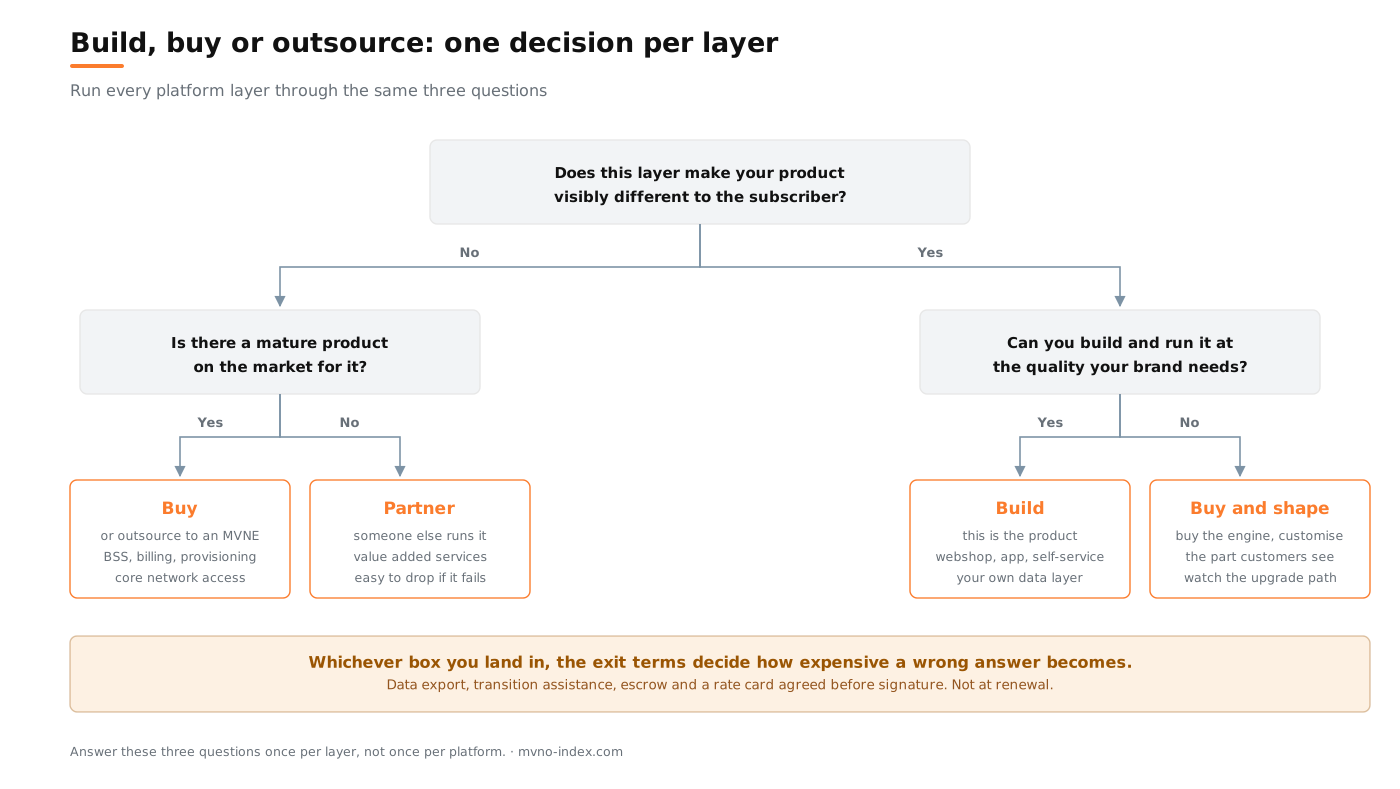
The build vs. buy vs. outsource decision plays out differently at each layer of your MVNO platform. A useful starting point is to map each layer against three dimensions: how much differentiation it delivers, how complex it is to operate, and how mature the vendor market is for that component.
Components that deliver high differentiation, are relatively simple to build, and have immature vendor markets are candidates for building. Components that are commodity in nature, highly complex to operate, and well served by mature vendors are candidates for buying or outsourcing. Most MVNO platform components fall into the latter category, which is why the majority of successful MVNOs buy or outsource the majority of their stack and focus their internal development effort on the customer experience and commercial logic layers.
Build, buy or outsource: the same three questions, run once per platform layer.
The Criteria That Decide Build, Buy or Outsource
A scoring model you can actually use
| Criterion | Weight | What a 5 out of 5 looks like |
|---|---|---|
| Functional fit | 25% | Meets the must-haves today, without roadmap promises |
| Integration readiness | 20% | Documented open APIs; has integrated with your host MNO before |
| Total cost over five years | 20% | Transparent: licence, implementation, change requests, exit |
| Delivery track record | 15% | Named references at comparable MVNOs you can actually call |
| Financial stability | 10% | Will still exist in five years |
| Contract and exit terms | 10% | Data export, transition assistance and escrow agreed up front |
Strategic Fit and Long-Term Alignment
Before you evaluate a single feature or price point, establish whether a vendor is strategically aligned with your MVNO's direction. A vendor that serves your needs perfectly today but whose roadmap diverges from your future requirements will cost you far more in migration and customization than a slightly higher license fee for a better-aligned partner.
Ask vendors directly about their product roadmap for the next two to three years. Evaluate whether they are investing in the areas that matter to your business: 5G readiness, eSIM support, cloud-native deployment, API openness. Check whether their existing customer base resembles your MVNO type. A vendor that primarily serves large MNOs may not prioritize the agility and responsiveness that a growing MVNO needs.
Also assess vendor stability. A technology company that cannot demonstrate financial health and a stable customer base introduces risk into your platform. Request customer references and speak to MVNOs of similar size and complexity who use the platform in production.
Technical Capability and Integration Readiness
The most capable product in isolation is worthless if it cannot integrate cleanly with the rest of your platform. Integration complexity is the most consistently underestimated cost in MVNO platform projects.
Demand open, documented APIs from every vendor you evaluate. Verify that their integration approach aligns with the protocols and standards your other platform components use. For core network integration, check support for Diameter, SS7, and HTTP/2 service-based interfaces for 5G environments. For BSS integration, verify REST API coverage for all key operations: subscriber provisioning, real-time balance queries, product catalog updates, and customer data management.
Request a detailed integration architecture document from each shortlisted vendor, and have it reviewed by a technical architect who understands your full platform stack. If you do not have that capability internally, engage MVNO consultancy support to conduct the technical evaluation.
Commercial Terms and Total Cost of Ownership
License fees and implementation costs are only the visible portion of vendor costs. Calculate total cost of ownership (TCO) over a minimum of five years, including license or subscription fees, implementation and integration costs, ongoing support and maintenance fees, customization costs, upgrade costs, and internal staff costs to operate the system.
Pay close attention to pricing models as you scale. Some vendors charge per subscriber, others per transaction, others on a flat fee basis. A pricing model that looks attractive at 10,000 subscribers can become punitive at 500,000. Model your cost projections against your financial plan at multiple growth scenarios before committing.
Negotiate exit clauses and data portability provisions into every vendor contract. The ability to migrate away from a vendor without losing your subscriber data or facing prohibitive exit fees is a critical risk management tool, even if you never intend to use it.
The Role of MVNEs and MVNAs in Your Build vs. Buy Strategy
An MVNE or MVNA fundamentally changes the build vs. buy calculation for new MVNOs. By providing a fully managed platform that includes core network access, BSS, OSS, and MNO connectivity in a single commercial relationship, an MVNE collapses dozens of individual vendor decisions into one.
This is a powerful proposition for MVNOs that want to launch fast, minimize technical complexity, and focus their resources on commercial execution. The trade-off is reduced architectural freedom and dependency on the MVNE's platform roadmap and pricing.
Evaluate an MVNE relationship using the same criteria as any other vendor: strategic alignment, technical capability, integration openness, and TCO. Pay particular attention to the terms under which you can migrate away from the MVNE if your business grows to a point where a more independent architecture becomes commercially justified. The ability to evolve your architecture over time without starting from zero is a critical factor in the long-term value of any MVNE partnership.
Build vs. Buy by Platform Layer
The default answer per layer
| Layer | Default | Why | When to deviate |
|---|---|---|---|
| Core network | Borrow from the host or MVNE | Enormous cost, no customer-visible difference | Full MVNO with genuine network-level differentiation |
| BSS and billing | Buy | Mature market, high complexity, no upside in building | Never, in practice |
| Provisioning and SIM | Buy or use the MVNE | Standardised and certified | Rarely |
| Webshop and app | Build or heavily customise | This is where the brand lives | Only at the very start, to save time |
| Value added services | Partner | Fast to add, easy to drop if it fails | When the service is the product |
| Data and analytics | Build on bought tooling | Your data is the one asset nobody can sell you | Rarely |
Core Network: Build, Buy, or Borrow?
For most MVNOs, the core network decision is not truly a build vs. buy question. Building a mobile core network from scratch requires deep telecoms engineering expertise, significant capital, and regulatory compliance work that is beyond the reach of most new entrants. The realistic options are to buy a virtualized or cloud-native core network product from a specialist vendor, or to borrow core network capacity from an MNO or MVNE.
Light MVNOs borrow the entire core from their host MNO or MVNE. This is the fastest and cheapest path but provides no network-level differentiation. Full MVNOs buy and operate their own core, gaining complete control over subscriber management, charging, and service delivery. The core network elements you need to evaluate include the HSS, OCS, PCRF, and for 5G, the AMF, SMF, and UPF.
When evaluating core network vendors, prioritize multi-generation support (4G and 5G), cloud-native deployment capability, and proven MVNO references. The core network vendor relationship is long-term and deeply embedded; choose with exceptional care.
BSS and OSS: The Commercial Engine Decision
The BSS and OSS are where most MVNOs make their most impactful and most expensive vendor decisions. These systems directly affect your ability to bill correctly, manage customers, launch products, and operate efficiently. Read the detailed guide on how to select the right BSS and OSS for a deep dive into this specific decision.
The build vs. buy verdict here is almost always buy or outsource. Mature, MVNO-specific BSS platforms exist that deliver the functionality you need without years of custom development. Building a billing engine from scratch introduces enormous risk. The complexity of real-time charging, convergent billing, regulatory compliance, and multi-currency support makes commercial BSS products a far safer choice for the vast majority of MVNOs.
The key differentiation question is not whether to buy a BSS, but how much you customize it. Heavy customization increases initial delivery cost, slows future upgrades, and creates dependency on specialized developers. Design your BSS configuration to use standard product functionality wherever possible, reserving custom development for the specific commercial logic that genuinely differentiates your offer.
Value Added Services: Own or Partner?
Value Added Services such as RCS, voicemail, and subscriber applications are areas where MVNOs frequently face the own vs. partner decision. Building a VAS capability internally is justified only when the service is a core part of your value proposition and no adequate commercial partner exists.
For most MVNOs, partnering with specialist VAS providers and integrating their services through APIs delivers a better outcome than building. It is faster, lower risk, and allows you to swap providers if a better solution emerges. Your marketing plan should define which VAS capabilities are commercially essential, and your architecture should make it easy to add, remove, and replace them without platform-wide disruption.
Channels: Where the Brand Actually Lives
The webshop, the app and the self-service flows are the only part of the platform your subscriber ever sees. This is the one layer where the default answer leans towards build, or at least towards heavy customisation, because it is where your product is visibly different from the operator next to you. It is also where speed matters most: a checkout you can change on a Tuesday afternoon is worth more than a feature-complete portal you have to raise a change request for.
The honest exception is the very beginning. Launching on a standard storefront to get to market, and replacing it once you know what your customers actually do, is a defensible sequence — as long as you plan the replacement rather than discover it. What you should not accept at any stage is a channel layer you cannot instrument: if you cannot see where people drop out of your own funnel, you are optimising blind.
Data and Analytics: The Layer Not to Rent
Mediation, usage records and reporting look like a back-office concern and are in fact the one asset no vendor can sell you. Buy the tooling, data warehouses and BI products are a mature market and building one would be indefensible but insist on owning the raw records that flow into it. A platform that delivers monthly summaries instead of record-level data decides, quietly and permanently, which questions you will be able to answer in three years.
Put this in the requirement list explicitly: record-level export, a retention period you set, a queryable interface rather than a file drop, and a revenue assurance reconciliation between what your host operator bills you and what you billed your subscribers. Vendors rarely volunteer these and rarely refuse them.
Running the Selection Itself
The mechanics of a selection writing requirements before you talk to vendors, an RFI to build a longlist, an RFP against documented requirements, then a proof of concept on the two hardest integrations are the same whichever layer you are deciding. They are set out step by step in how to find and select the right MVNO solution provider, and the solution provider directory is where the longlist comes from. The only point worth repeating here is the one that changes build-versus-buy outcomes: write the requirements before the first demo, because after the first demo you will be writing the vendor's feature list back to them.
The recurring mistakes are worth one line each, because they are all variations on the same error — optimising the visible price instead of the total cost. Selecting on licence price alone, believing integration estimates without a reference call, ignoring vendor financial health, over-customising a standard product, and leaving the exit to the end. The full list of MVNO mistakes covers these and the commercial ones beyond vendor selection.
The Contract: What Decides How Expensive a Wrong Choice Becomes
You do not get to choose again cheaply. The contract is what turns a wrong decision into either a bad year or a lost business, and it is the part of this process that gets the least attention.
Exit and transition assistance. Put in writing what you get on the way out: a full export of your data in a documented format, a stated transition period during which the vendor keeps the service running, and a rate for transition support agreed now rather than at the moment you need it. A vendor who will not write down an exit is telling you something about the exit.
Source code escrow. If you depend on a product and the vendor fails or is acquired and sunset, escrow is what stands between you and a platform nobody can maintain. It is only worth having if the deposit is verified and kept current and the release conditions are specific. An escrow agreement nobody has ever tested is a comfort blanket, not a control.
Service levels with consequences. An SLA without a remedy is an intention. Agree availability targets per component rather than one number for "the platform", a measurement method you can verify yourself, and service credits that scale with the impact rather than with the licence fee.
Data protection. If a vendor processes subscriber data on your behalf, the GDPR requires a written processor agreement — Article 28 — covering purpose, sub-processors, security measures, international transfers and deletion at the end. You remain the controller, which means the vendor's compliance failure is your compliance failure.
Security obligations. Under Article 40 of the European Electronic Communications Code, "Security of networks and services", the duty to secure your network and services stays with you regardless of who operates the systems. Push it down concretely: a right to audit, penetration testing, agreed vulnerability handling times, and breach notification fast enough that you can still meet your own deadline. ENISA's guideline is the reference for what regulators expect to see.
Lawful intercept. Delegating the technical implementation does not delegate the duty. State who implements interception, who is able to respond to a warrant, what the vendor must deliver and within what time. ETSI's lawful interception specifications are the language to use so that both sides mean the same thing.
Pricing that survives success. Agree now what happens at ten times the subscribers you have today. Per-subscriber pricing that is comfortable at launch can become the largest single line in your P&L, and the moment to ask for volume tiers, a cap and a rate card for change requests is before signature, not at renewal.
Lock-in. Every customisation you commission is a decision to stay. Record which customisations are yours, who owns the intellectual property, and whether they survive a version upgrade — because a customisation that breaks on every release is a subscription to your own past decisions.
The clauses that decide the outcome
| Clause | What to ask for | What a weak answer sounds like |
|---|---|---|
| Exit and transition | Documented data export, transition period, agreed day rate | "We have never had a customer leave" |
| Escrow | Verified deposit, current build, specific release triggers | "Escrow can be arranged if you want it" |
| Service levels | Per-component targets, your own measurement, scaling credits | "99.9% platform availability" |
| Data protection | Article 28 processor agreement, named sub-processors | "We are GDPR compliant" |
| Security | Right to audit, pen tests, vulnerability and breach windows | "We follow industry best practice" |
| Lawful intercept | Named responsibility, deliverables and response times | "That is handled by the host operator" |
| Pricing at scale | Volume tiers, a cap, a change request rate card | "We can revisit that at renewal" |
| Customisation and IP | Ownership, upgrade survival, a register of changes | "Everything is configurable" |
How long a selection takes
| Phase | What happens | Duration in your own projects |
|---|---|---|
| Requirements | Written down before the first demo | ... |
| Longlist and RFI | Market scan, capability filter | ... |
| RFP | Structured responses against your requirements | ... |
| Demos and proof of concept | The two hardest integrations, not the showcase | ... |
| Contract negotiation | The clauses in above table | ... |
| Implementation start | Kick-off with the environment ready | ... |
Frequently Asked Questions
What is the build vs. buy decision in the context of an MVNO?
The build vs. buy decision refers to the choice an MVNO makes for each platform component: develop it internally, license a commercial product from a vendor, or outsource it entirely to a managed service provider. Most MVNOs use a combination of all three approaches across different layers of their platform, buying or outsourcing commodity components and building only where genuine differentiation justifies the investment.
Should a new MVNO build its own BSS system?
In almost all cases, no. Building a billing and CRM system from scratch introduces enormous technical risk, requires significant time and capital, and is unlikely to produce a better outcome than a mature commercial BSS product designed specifically for MVNOs. The right approach is to buy or use a managed BSS from an MVNE, and configure it to support your specific commercial requirements. Learn more about what a BSS is and how to select the right one.
How many vendors should an MVNO shortlist during a selection process?
Start with a broad longlist of eight to twelve vendors for an initial RFI, then narrow to three to five for a detailed RFP evaluation, and conduct a Proof of Concept with your final one or two preferred candidates. This staged approach balances thoroughness with efficiency and ensures you make a well-informed final decision without spending months evaluating every vendor in the market.
What is total cost of ownership and why does it matter in vendor selection?
Total cost of ownership (TCO) is the complete five-year cost of a vendor relationship, including license or subscription fees, implementation costs, integration work, ongoing support and maintenance, customization, upgrades, and internal staff costs. TCO matters because the upfront license fee is often the smallest component of the true cost. A vendor with a low license fee but high implementation and customization costs frequently delivers a worse TCO outcome than a higher-priced vendor with a faster, cleaner implementation path.
How do you find and evaluate MVNO solution providers?
MVNO Index maintains a comprehensive global directory of solution providers covering BSS, OSS, core network, connectivity, MVNE, MVNA, and value added services categories. Use the directory to build your initial longlist, then apply a structured RFI and RFP process to evaluate shortlisted vendors against your specific requirements. Engage MVNO consultancy support if you need independent technical or commercial expertise to support the evaluation.
Summary
The build vs. buy decision is not a single choice but a series of decisions made across every layer of your MVNO platform. Getting these decisions right requires clear requirements, disciplined vendor evaluation, honest TCO analysis, and a long-term view of where your business is heading.
The general principle is straightforward: buy or outsource commodity components where mature, proven products exist, and reserve internal development investment for the specific capabilities that create genuine competitive differentiation for your MVNO. Use an MVNE to collapse complexity when speed to market and capital efficiency are the priority, and plan your migration path toward greater architectural independence as your business scales.
Use MVNO Index to research solution providers across every platform layer, access consultancy services for independent evaluation support, and explore the full range of MVNO information resources to inform every stage of your platform strategy.
Subjects about how to start your own MVNO