The Two Averages Every MVNE Should Report
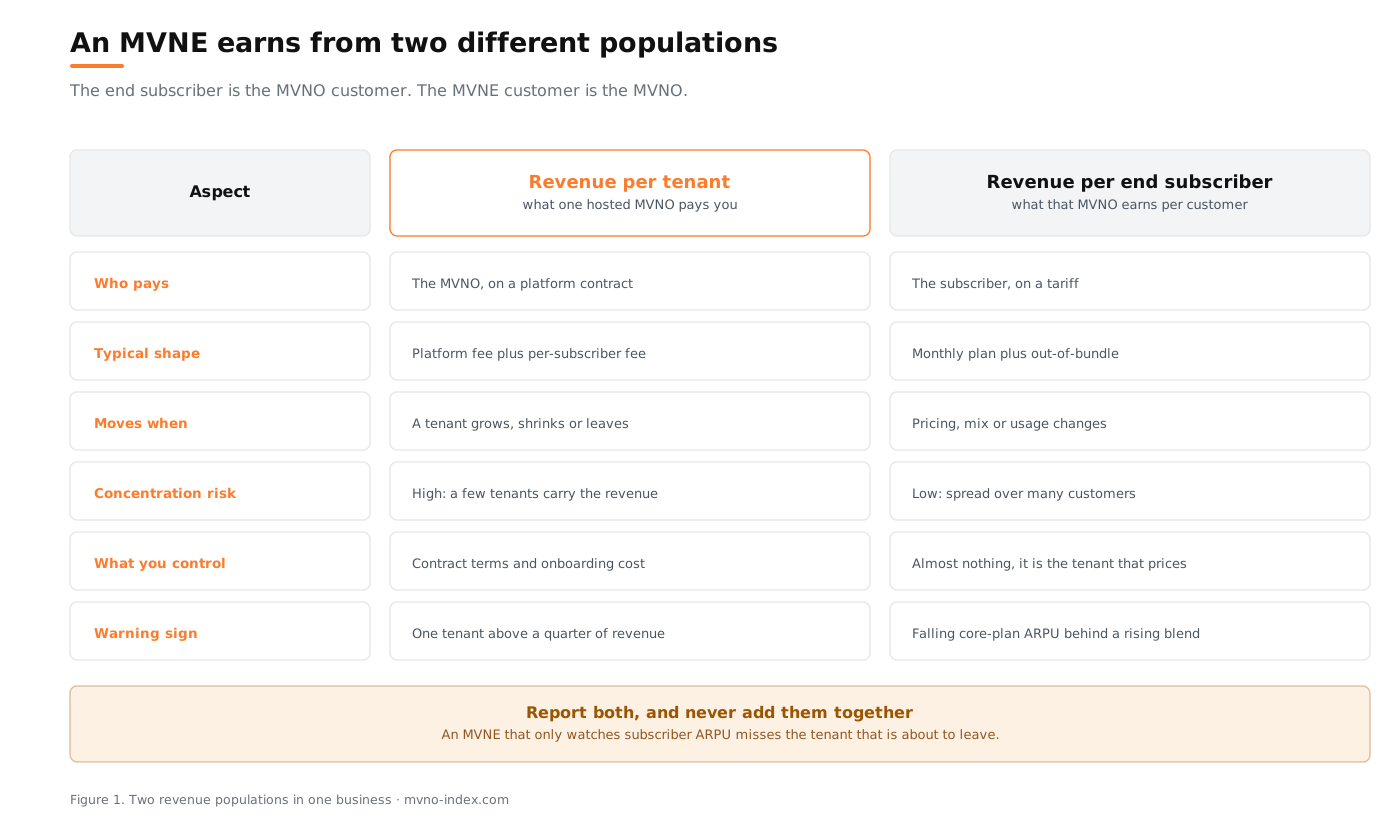
MVNE ARPU is two averages rather than one. Revenue per client is what a single hosted MVNO pays for the platform, usually a recurring fee plus a per-connection charge; revenue per connection is what the platform earns across every hosted subscription. Client revenue is concentrated and contractual, connection revenue is spread and operational, and a blended figure hides the dependency an MVNE most needs to see.
Average revenue per user, or ARPU, needs a precise definition in a mobile virtual network enabler business. An MVNE supplies technical and operational capabilities to mobile brands, so its paying customer is usually another business. The subscribers using the platform may belong to those brands. Revenue per hosted connection and revenue per MVNO client therefore answer different questions.
An MVNE should measure both where they are commercially relevant. Connection revenue helps assess scale, while client revenue reveals concentration and the value of each relationship. Neither measure establishes profitability by itself. Implementation work, network charges, support and customer-specific development can make two apparently similar contracts perform very differently.
On this page
- History and Evolution of MVNE Revenue Models
- Core Utility and Functionality of MVNE ARPU
- What is MVNE ARPU Used For?
- Key Functions of MVNE Revenue Analysis
- Technical Integration and Data Model
- Integration with Other Systems
- Technical Data Model and Key Calculations
- ARPU Management for MVNEs and IoT Platforms
- Why Take Control of MVNE Revenue Reporting?
- Advantages and Disadvantages of MVNE ARPU Management
- Organizational Impact of MVNE Revenue Management
- Redundancy and High Availability
- Impact of 4G and 5G and Future Networks on MVNE ARPUT
- ARPU in 4G MVNE Services
- ARPU in 5G MVNE Services
- Long Term Device Economics of MVNE Services
- Frequently Asked Questions about ARPU for MVNEs
- Summary
History and Evolution of MVNE Revenue Models
MVNE services developed around shared infrastructure and operational capabilities that individual mobile brands would otherwise need to build or integrate. As platforms expanded, charging models came to include setup fees, recurring platform charges, per-connection fees, transaction charges and managed services. Some providers also supply wholesale network access, while others enable an MVNO's separately contracted access.
This variation makes terminology important. The differences between MVNEs and MVNAs provide a useful starting point, but actual contracts determine what a provider sells. Before comparing ARPU, establish whether reported revenue includes airtime resale, software services, implementation projects or a combination of those activities.
Core Utility and Functionality of MVNE ARPU
The two averages side by side
| Aspect | Revenue per client | Revenue per connection |
|---|---|---|
| Who pays | The hosted MVNO | Indirectly, its subscribers |
| Under what | A platform contract | A retail tariff you do not set |
| Typical shape | Recurring fee plus per-connection charge | Blended across every tenant |
| Concentration | High: a few clients carry revenue | Low: spread across the whole base |
| What the MVNE controls | Contract terms and onboarding cost | Very little, the client prices |
| Early warning it gives | A client growing, stalling or leaving | Whether the platform is monetising scale |
What is MVNE ARPU Used For?
An MVNE can use revenue per hosted connection to monitor monetisation as its platform grows. It can use revenue per client to assess account development, concentration and renewal exposure. These measures help explain whether growth comes from more connections, more customer organisations, broader service adoption or changes in pricing.
For an illustrative platform earning EUR 200,000 in eligible monthly service revenue from an average of 100,000 billable hosted connections, revenue per connection is EUR 2. If the same revenue comes from ten eligible client accounts, average monthly revenue per client is EUR 20,000. Both calculations are valid within their stated scope, but they should never share an unexplained ARPU label.
Key Functions of MVNE Revenue Analysis
Separate recurring platform revenue from non-recurring implementation charges. A large launch project can lift a period's average while creating no equivalent recurring uplift. That project may still be valuable, but the commercial explanation should distinguish delivery revenue from the ongoing platform relationship. Otherwise forecasts can assume a level of repeat business that has not been contracted.
Where the line falls between recurring and non-recurring is not only a management choice. IFRS 15 sets out how revenue from a contract with a customer is recognised, and an implementation fee spread over a contract term produces a different monthly figure from the same fee taken at delivery.
Show wholesale connectivity economics separately where network services are included. Gross billing through the platform can look substantial even when most of it is payable to another operator. Revenue recognition and principal-versus-agent treatment require the appropriate accounting assessment. Management reports should make the underlying service margin understandable rather than relying on the largest possible top-line number.
Analyse each client by contract age and service scope. New customers can need intensive onboarding before their connection base grows. Established customers may consume more capacity but less implementation effort. A declining per-connection average can reflect agreed volume discounts, while rising account contribution can show that the relationship is becoming more efficient.
Technical Integration and Data Model
Integration with Other Systems
MVNE reporting draws on tenant management, subscription inventories, billing, service usage and project records. Finance needs the contract version and revenue schedule; operations needs the delivered workload. Connect these records using stable client and subscription identifiers. A brand rename or customer reorganisation should not fragment the historical account view.
The platform should distinguish technical capacity from billable activity. A provisioned subscription might be free during testing but chargeable after commercial activation. API calls, usage records or support services may have separate charging rules. Preserve those rules by effective date so a later contract amendment does not silently rewrite earlier invoices or revenue reports.
Where an MVNA or MNO supplies access, reconcile incoming charges with the relevant client services. Unallocated supplier costs can make profitable-looking accounts appear to subsidise nothing, when the expense has simply been left in a central bucket. The MVNO wholesale agreement should support the reporting and dispute evidence required for this reconciliation.
Technical Data Model and Key Calculations
Maintain client, tenant, product and subscription identifiers, together with billable status and service dates. Record recurring commitments, usage tiers, included volumes and one-time projects separately. Contract minimums deserve their own fields because the invoice may exceed the amount produced by multiplying active connections by a unit rate.
Two revenue populations in one business, and why they must be reported apart.
Consider a hypothetical client paying a EUR 5,000 monthly platform minimum plus a separately agreed project fee. If the recurring unit calculation produces EUR 3,000, the minimum determines the recurring invoice under that arrangement. Dividing EUR 5,000 by the eligible connections explains effective revenue per connection. Mixing in the project fee would answer a different question about total period revenue.
For tiered pricing, document whether the lower rate applies only to incremental connections or retrospectively to the entire base. These structures have different revenue effects at a threshold. Forecast using the actual contract mechanics, including when counts are measured. A spreadsheet with a single blended rate can miss a substantial change when a client crosses a tier.
ARPU Management for MVNEs and IoT Platforms
Revenue concentration, and when it becomes a risk
| Share of revenue from the largest client | What it means in practice |
|---|---|
| Under ten per cent | Losing any one client is survivable |
| Ten to twenty five per cent | A departure costs roughly a year of growth |
| Twenty five to fifty per cent | The client sets your terms, not the other way round |
| Over fifty per cent | You are an outsourced department with a platform licence |
Why Take Control of MVNE Revenue Reporting?
An MVNE needs commercial visibility across all tenants without exposing one client's information to another. Internal reporting should show contribution by contract and service family, while customer portals reveal only the entitled account data. This separation is both an access-control requirement and a practical condition for trusted multi-tenant operations.
IoT clients require additional care because a large connection base can generate little traffic but substantial lifecycle activity. Bulk provisioning, profile changes and troubleshooting may drive costs that a data-volume price does not recover. Compare consumer and IoT clients using their own workload and support patterns instead of assuming that every hosted connection consumes an equal share of the platform.
Advantages and Disadvantages of MVNE ARPU Management
Advantages
- Consistent revenue metrics improve capacity and investment decisions. Management can see whether growth in connections is producing sufficient recurring revenue to support platform expansion. Account analysis also highlights where a standard service is being delivered efficiently and where repeated custom work requires a different commercial arrangement.
- The measures support more credible negotiations. A provider can offer volume discounts with a clear view of the expected workload and contribution. It can also identify useful additional services, such as managed operations or reporting, when customers have a demonstrated need. A proposal tied to a specific operating problem is easier to justify than a broad promise of platform value.
Disadvantages
- A blended average can hide dependency on one large client. Losing that account may remove a substantial share of revenue even if thousands of smaller connections remain. Monitor concentration by client and renewal date. Connection growth spread across several brands is commercially different from growth concentrated in one contract with an approaching exit option.
- ARPU can also obscure delivery effort. An account paying a premium may require dedicated infrastructure, unusual integrations and extensive support. Another account paying less per connection may use standard services with little intervention. Compare recurring contribution and support demand before treating the higher-priced customer as the more attractive relationship.
Organizational Impact of MVNE Revenue Management
Sales and delivery should agree the boundary between included configuration and paid development. Without that boundary, a recurring platform fee can gradually absorb an expanding implementation project. Record scope changes and evaluate their effect on operating cost. This makes renewal discussions more transparent and protects the quality of service for other clients sharing the platform.
Finance should maintain the metric definitions and reconcile them to contractual and accounting records. Operations should supply reliable capacity and activity data. Account managers should explain customer growth, planned launches and changes in service scope. A monthly review works best when these teams resolve differences in the underlying records before debating the average.
Customer onboarding deserves a separate economic view. Measure the time and cost required to reach a stable commercial launch, then compare actual connection growth with the agreed plan. Setup fees do not necessarily recover all onboarding expense, and an optimistic sales forecast can leave capacity and support commitments underfunded for a long period.
When buying a billing or analytics platform, test several contract structures. Include a minimum commitment, a tier crossing, a suspended tenant and an account with implementation revenue. Ask the supplier to reproduce the invoices and explain revenue per connection and per client. Require historical exports so the calculation remains reviewable after a platform change.
Redundancy and High Availability
MVNE Revenue reporting depends on complete usage and subscription records from all relevant tenants. A failed ingestion process can selectively omit one client and distort both averages and forecasts. Monitor delivery completeness by source and tenant, with an accountable owner for exceptions. Do not treat a technically successful file transfer as proof that every expected record arrived.
Recovery should preserve tenant separation and billing history. Test restoration of contract versions, activity records and invoice adjustments, not only the application database. A recovered dashboard that applies today's rates to last year's usage is not a reliable reconstruction. Keep reproducible period closes and a clear audit trail for corrections.
Impact of 4G and 5G and Future Networks on MVNE ARPU
Revenue Models in 4G MVNE Services
Established mobile services often combine relatively predictable platform fees with usage-dependent costs. The important commercial question is how traffic growth, roaming and support affect contribution under the contract. A client adding subscribers can improve scale, but only if the agreed prices cover the corresponding network and operating workload.
Revenue Models in 5G MVNE Services
5G-related services may expand the scope an MVNE can offer, depending on host access and platform capabilities. New functionality can also add integration and support costs. Price a defined service with clear acceptance criteria rather than assuming that a 5G label supports a general premium across every hosted connection.
Long Term Platform of MVNE Economics
Future growth should be assessed through portable data, maintainable interfaces and a manageable cost of change. A heavily customised platform can collect attractive fees while becoming expensive to upgrade. Track the effect of technical complexity on delivery effort and renewals so commercial growth does not conceal a deteriorating operating model.
Frequently Asked Questions ARPU for MVNEs
Who is the user in MVNE ARPU?
It may be a hosted connection or an MVNO client account, depending on the stated measure. Publish these as separate metrics. The MVNE's business customer and the end subscriber using its platform are different commercial units.
Should wholesale airtime be included?
The answer depends on the reporting scope and applicable accounting treatment. Show platform services and connectivity economics clearly, and reconcile the management view to financial reporting. Gross cash or billing volume is not automatically the provider's recognised revenue.
Why can revenue per connection fall during growth?
Volume discounts, fixed fees spread across a larger base and a changing client mix can all reduce the average. Examine account contribution and operating workload before deciding whether the decline represents a commercial problem.
Is revenue per client more useful than per connection?
They answer different questions. Client revenue reveals relationship value and concentration. Connection revenue helps explain scale and pricing. Use both with a consistent scope, especially when client sizes vary significantly.
How should setup fees be reported?
Distinguish them from recurring platform income in management analysis, while applying the appropriate accounting policy to recognition. A busy launch period should not automatically become the baseline for future recurring revenue forecasts.
What can improve MVNE revenue quality?
Clear service boundaries, repeatable onboarding, useful additional services and predictable renewal terms can improve the commercial model. Measure delivery effort and contribution as well as revenue so growth does not depend on unpriced custom work.
What should an MVNE reporting platform demonstrate?
Request tenant-level reconciliation, historical contract handling, tiered pricing and separate views of recurring and project revenue. Test the calculations with actual contract examples and verify that authorised users can export the underlying evidence.
Summary
MVNE ARPU is meaningful only when the commercial unit and revenue scope are clear. Revenue per connection, revenue per client and contract contribution should work together to explain growth, concentration and delivery efficiency.
Define the required reports before selecting billing and analytics tools. Compare suitable partners in the MVNO Index solution provider directory and request a proposal that covers your actual contract structures, tenant controls and reconciliation needs.
Subjects about how to start your own MVNO