Choosing a Solution Provider, Step by Step
Introduction about the MVNO and Solution Provider Relationship
A solution provider relationship is decided before the contract is signed. The work that matters is a requirement list where every line can pass or fail a demonstration, a shortlist compared against that same list, a trial run with your own data and volumes, and a contract that prices change requests and names an exit. After signature the balance of power moves to the supplier, which is why migration terms are agreed while everyone is still enthusiastic.
An MVNO solution provider supplies a product or service that contributes to the mobile business. It may deliver billing software, a core network function, payment processing, customer support technology or a managed operational service. Unlike the more specific MNO, MVNE and MVNA roles, solution provider is a broad description. The agreement must explain exactly what the supplier does.
The relationship should turn a business requirement into a dependable service with clear accountability. Good software can still produce a poor result if integration, data migration or support is left unresolved. Start with the customer journey and operating need, then choose the provider whose scope and evidence match that requirement.
On this page
- History and Evolution of MVNO Supplier Relationships
- Core Utility and Functionality of the Relationship
- What is a Solution Provider Relationship Used For?
- Key Functions of the Supplier Agreement
- Technical Integration and Data Model
- Integration with Other Systems
- Technical Data Model and Key Interfaces
- Relationship Ownership for MVNOs and IoT Companies
- Why Manage Specialist Providers Directly?
- Advantages and Disadvantages of Specialist Relationships
- Organizational Impact of Supplier Management
- Redundancy and High Availability
- Impact of 4G and 5G and Future Networks
- Supplier Relationships in 4G Services
- Supplier Relationships in 5G Services
- Long Term Partnership Planning
- Frequently Asked Questions about Solution Provider Relationships
- Summary
History and Evolution of MVNO Supplier Relationships
Mobile platforms were often purchased as large integrated systems with substantial implementation projects. Many MVNOs now combine managed services, specialist applications and interfaces from several providers. This can make individual capabilities easier to obtain, but it also increases the importance of integration and ownership across organisational boundaries.
The buying process has therefore shifted from comparing feature lists to evaluating an operating relationship. The MVNO solution provider selection guide is a useful starting point. A shortlist should reflect the business model, internal capabilities and dependencies already in place, rather than simply the products with the broadest marketing descriptions.
Core Utility and Functionality of the Relationship
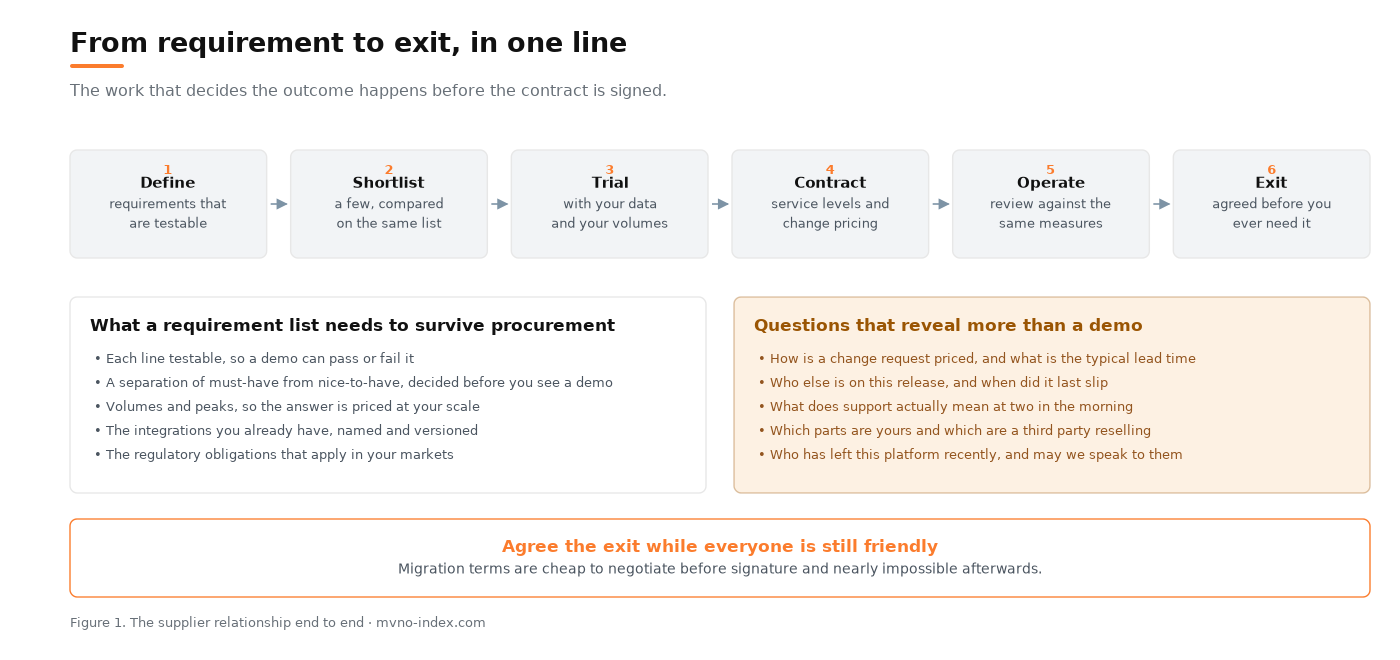
The six stages, and what each one has to produce
| Stage | The output that proves it happened |
|---|---|
| Define | A requirement list where each line can pass or fail |
| Shortlist | The same questions, asked of everyone, written down |
| Trial | Your data, your volumes, your integrations |
| Contract | Service levels, a change rate card, an exit clause |
| Operate | A review against the measures you started with |
| Exit | A migration plan that existed before you needed it |
What is a Solution Provider Relationship Used For?
The relationship gives the MVNO access to expertise, technology or operating capacity it needs to deliver a service. The supplier may provide a finished managed capability or a component that the MVNO integrates and operates. Those are materially different purchases, even when the product names are similar. State the intended operating model before requesting a price.
One decision comes before this one. Whether to buy a capability at all, or build and run it yourself, is a separate question with its own arithmetic; the guide on build versus buy for MVNOs works through it. A supplier conversation started before that question is settled tends to end with a supplier answering it for you.
A clear relationship also provides a route for change. Mobile products evolve, usage grows and external interfaces are updated. The MVNO needs to know how requirements are assessed, what is included in maintenance and when additional development is chargeable. A successful initial installation is only the beginning of the supplier's commercial relevance.
Key Functions of the Supplier Agreement
Scope defines the delivered functions and their boundaries. Describe the important workflows, data inputs and outputs, supported interfaces and operating conditions. A feature described as configurable should be demonstrated using a relevant example. Configuration that requires supplier engineering effort and a separate release may not provide the flexibility the buyer expects.
Acceptance defines how the MVNO will determine that delivery is complete. Use measurable service outcomes and representative cases, including errors and recovery. A milestone based only on software installation can leave essential integrations unfinished. Tie acceptance to the agreed scope and identify which party supplies each test environment and dependency.
Support defines how the service is maintained after launch. Specify hours, severity definitions, escalation and the difference between a response and a resolution. A promise to acknowledge an incident quickly does not establish how service will be restored. Include responsibility for recurring problems and the evidence supplied after a significant outage.
Technical Integration and Data Model
Integration with Other Systems
Every new component should fit into a documented architecture. Identify the systems it reads from, writes to and depends on during normal operation. A billing change may affect customer care, payments and network provisioning. Review these dependencies before committing to implementation dates or assuming the supplier can work independently of other partners.
The core network elements overview helps place technical products in their wider context. Business systems need an equivalent map of customer, product and financial records. The aim is to make the ownership of each transaction clear, particularly where several suppliers can each claim that their own component is functioning correctly.
Integration work should include non-production environments and realistic test data. A sandbox that returns only successful responses may be useful for initial development but insufficient for acceptance. Ask how the supplier supports testing of timeouts, unavailable dependencies, invalid requests and data corrections. These cases often determine the real operating cost after launch.
Technical Data Model and Key Interfaces
Agree the meaning of the data exchanged, not only its format. Two systems can use the same field name while applying different definitions of active customer or completed order. Document identifiers, lifecycle states and effective dates. This reduces the risk of apparently successful integrations that create conflicting business records.
From requirement to exit, and where the bargaining power sits.
Interfaces need a version policy and a practical transition period. The MVNO should know how changes are announced, which versions remain supported and how compatibility is tested. Avoid designs that rely on undocumented behaviour discovered during implementation. Such dependencies can become expensive when the provider makes an otherwise reasonable product update.
Data export must be useful for operations and exit. A file may contain all the rows but omit relationships, historical context or configuration needed to interpret them. Request a sample export and have the receiving team test it. Portability is demonstrated when the records can support a defined task outside the supplier's own application.
Write the exit while the relationship is new. Migration assistance, a data export in a usable format and a stated timetable cost almost nothing to agree before signature, and are close to impossible to obtain once the supplier knows you are leaving.
Relationship Ownership for MVNOs and IoT Companies
Questions that reveal more than a demonstration
| Question | What the answer tells you |
|---|---|
| How is a change request priced | Whether small changes will be affordable |
| What is the typical lead time | How fast you can respond to the market |
| Who else is on this release | Whether your roadmap competes with theirs |
| When did a release last slip | How they behave under pressure |
| What does support mean at 2am | Whether the service level is real |
| Which parts are resold from a third party | Where the accountability actually sits |
| Who left recently, and may we call them | More than any reference they choose |
Why Manage Specialist Providers Directly?
Direct specialist relationships can give an MVNO greater choice and control over important capabilities. They can suit a business with the skills to integrate and govern several services. A more integrated managed offer may be preferable when the team needs one provider to coordinate delivery. Compare both models against the actual organisational capacity available.
IoT companies often need specialists in devices, connectivity and applications. Their relationships should account for long deployment lifetimes and physical access costs. A software change that requires visiting installed devices has a different consequence from updating a retail website. Supplier selection should therefore consider the complete device lifecycle and field-support responsibilities.
Advantages and Disadvantages of an MVNA Relationship
Advantages
-
Specialist providers can bring deeper capability in a defined area and allow the MVNO to choose products that fit its needs closely. Replacing one component may be easier when interfaces and data boundaries are clear. The value depends on a maintainable integration design rather than the number of suppliers in the architecture.
-
Direct relationships can also improve feedback between the MVNO and the product team. A well-defined requirement may lead to a useful enhancement or a clearer workaround. Establish how priorities are discussed and how committed delivery differs from a general roadmap item. This helps the MVNO plan without treating every product conversation as a contractual promise.
Disadvantages
-
Several suppliers can create gaps in accountability. An activation problem may involve a channel, payment service, provisioning platform and network interface. If each provider investigates only its own logs, diagnosis can stall. The MVNO needs an owner for the complete journey and an agreed process for joint incident investigation.
-
Custom integration and configuration can also create dependency. The nominal product may be replaceable while the surrounding workflows are poorly documented. Track those assets and ensure the business has access to the necessary records and rights. A low recurring licence fee may be unattractive if every future change requires expensive specialist work.
Organizational Impact of Supplier Management
Assign a business owner who can explain why the capability is needed and an operational owner who can assess how it performs. Procurement and finance should understand the same scope. This prevents a situation where the contract, implementation team and operating team each have a different view of what was purchased.
Maintain a record of decisions and agreed changes. Scope often evolves during implementation, and informal concessions can become assumed obligations. Document the effect on price, delivery and support. This protects both parties and makes it easier to resolve later disagreements without reconstructing months of email conversations.
Supplier reviews should focus on evidence. Examine service performance, unresolved problems, delivery commitments and upcoming dependencies. Distinguish a one-time incident from a repeated cause that needs corrective action. Commercial discussions become more productive when they use the same facts as operational discussions, rather than treating price and reliability as unrelated subjects.
Before awarding work, ask finalists to demonstrate the most difficult relevant workflow. Provide the same scenario and evaluation criteria to each. Request a complete cost covering implementation, environments, support and exit assistance. An impressive demonstration of an unrelated feature should not outweigh missing evidence for the capability the MVNO actually needs.
Redundancy and High Availability
Availability commitments should identify the service boundary and the dependencies excluded from measurement. An application can meet its own uptime target while a required external connection repeatedly fails. Review the complete customer journey and ensure the commercial arrangement does not leave a critical dependency without an accountable operator.
Recovery testing should include the MVNO and any other affected providers. Verify restoration of configuration, data and unfinished transactions. A supplier may successfully recover its software while leaving the retail system in an inconsistent state. Joint tests reveal these problems before a live outage makes them harder to resolve.
Continuity also depends on the provider's ability to support the product over time. Review access to documentation, named escalation routes and arrangements for termination or product withdrawal. Where an escrow or similar mechanism is proposed, assess whether it would be operationally useful. Access to code alone does not guarantee the ability to run a complex service.
Impact of 4G and 5G and Future Networks
Supplier Relationships in 4G Services
Established LTE services still require maintained interfaces, device support and coordinated change. Legacy retirement can affect systems that appeared stable for years. Ask suppliers which dependencies they monitor and how they identify customers affected by a change. A mature product should have a clear maintenance process, not merely a long installation history.
Supplier Relationships in 5G Services
5G can add functions and commercial capabilities that involve several suppliers. Specify the exact service and identify who integrates it with the host network and retail systems. A product's standards claim should be checked against the supported version and configuration, then validated through the intended end-to-end workflow.
Long Term Supplier Planning
Preserve flexibility through documented interfaces, accessible records and a realistic migration plan. Review roadmaps as planning information and convert required features into explicit delivery commitments when appropriate. Future compatibility is credible when the provider explains how upgrades are managed, tested and funded over the expected relationship.
Frequently Asked Questions about Solution Provider Relationships
Is a solution provider always an MVNE?
No. A solution provider may supply one specialist capability or a broad managed platform. An MVNE has a more specific enablement role. Define the delivered services and responsibilities instead of relying on the company category.
Should an MVNO choose one supplier or several?
Either model can work. One provider may simplify coordination, while several specialists may offer a closer functional fit. Compare integration effort, operational capability, total cost and accountability for the complete customer journey.
What should acceptance testing cover?
It should cover the agreed business workflows, performance conditions and recovery behaviour. Include failure cases and required integrations. Installation or a successful isolated API call is not enough to establish that the service is ready for customers.
Who owns custom development?
The agreement should define intellectual-property rights, usage rights, maintenance and access to documentation. Do not assume that paying for development automatically grants every right needed for modification or migration. Resolve the practical use case before work starts.
How can lock-in be reduced?
Use documented interfaces, maintain configuration records and test data exports. Agree migration support and understand proprietary dependencies. Complete independence is rarely free, so focus on having a practical and affordable exit route.
Are service credits enough protection?
They can support accountability but do not restore customer service. Operational recovery, clear escalation and correction of recurring faults remain essential. Assess the remedy alongside the actual business impact of an outage.
What should a supplier proposal include?
It should include scope, dependencies, acceptance criteria, complete pricing, support responsibilities and exit arrangements. Ask for assumptions to be explicit and compare proposals against the same customer journeys and operating conditions.
Summary
The MVNO and solution provider relationship should connect a clear business need to a maintainable service. Scope, integration and accountability deserve as much attention as product functionality and price.
Use the MVNO Index solution provider directory to build a shortlist. Request comparable proposals and practical demonstrations, then choose the provider whose evidence and operating commitments fit your mobile business.
Subjects about how to start your own MVNO