Buying Through an Aggregator, and What It Costs
Introduction about the MVNO and MVNA Relationship
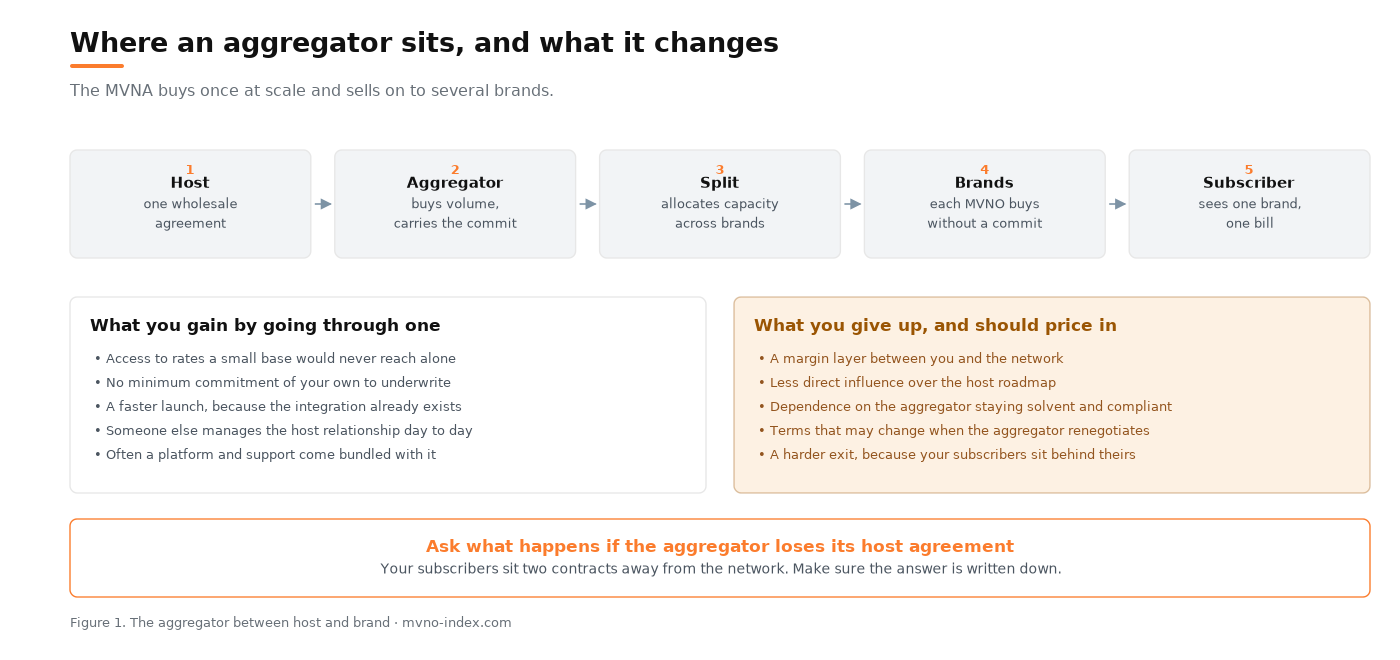
An MVNA buys wholesale access at volume from one or more host networks and resells it to several mobile brands, so an individual MVNO can reach rates and terms its own base would never justify. What you gain is speed, an existing integration and no minimum commitment of your own. What you give up is a margin layer, direct influence over the host roadmap, and a degree of control at exit, because your subscribers sit two contracts away from the network rather than one.
A mobile virtual network aggregator, or MVNA, brings wholesale mobile access to multiple downstream businesses through its commercial arrangements with network operators. An MVNO can use this relationship to obtain services without negotiating every underlying network agreement itself. The exact scope varies: some aggregators also provide technical enablement, while others work with a separate MVNE.
The relationship can make a mobile launch more accessible, but the MVNO still needs to understand what it is buying. Network rights, pricing rules, support responsibilities and exit arrangements should be visible in the proposal. Choose an aggregator for the complete service it can deliver to your target customers, rather than assuming that combined purchasing volume guarantees the best outcome.
On this page
- History and Evolution of Mobile Aggregation
- Core Utility and Functionality of the Relationship
- What is an MVNA Relationship Used For?
- Key Functions of the Aggregation Agreement
- Technical Integration and Data Model
- Integration with Other Systems
- Technical Data Model and Key Interfaces
- Relationship Ownership for MVNOs and IoT Companies
- Why Choose an MVNA?
- Advantages and Disadvantages of an MVNA Relationship
- Organizational Impact of the Host Relationship
- Redundancy and High Availability
- Impact of 4G and 5G and Future Networks
- Aggregation in 4G Services
- Aggregation in 5G Services
- Long Term Partnership Planning
- Frequently Asked Questions about MVNO and MVNA Relationships
- Summary
History and Evolution of Mobile Aggregation
Wholesale aggregation developed around the opportunity to combine demand from several mobile brands. An aggregator can present a larger commercial opportunity to an MNO than an individual early-stage MVNO. It can then package access for downstream customers with different volumes, launch plans and operating capabilities.
Over time, some providers combined aggregation with billing, provisioning, core services and managed operations. This creates convenient offers, but it also blurs the difference between commercial access and technical enablement. Review the MVNE and MVNA differences and then identify the actual roles in each supplier's proposal. The company label alone does not establish the delivered scope.
Core Utility and Functionality of the Relationship
Going through an aggregator, or straight to a host
| Through an MVNA | Direct with an MNO | |
|---|---|---|
| Minimum commitment | Usually none of your own | Expected, and often substantial |
| Rate you can reach | Aggregated volume, minus a margin | Your own volume, at your own terms |
| Time to launch | Shorter: the integration exists | Longer: built for you |
| Influence on the roadmap | Indirect | Direct, in proportion to your size |
| Who manages the host | The aggregator | You |
| Complexity at exit | Higher: two contracts | Lower: one contracta |
| Suits | A launch, or a modest base | Scale that justifies the commitment |
What is an MVNA Relationship Used For?
An MVNA relationship supplies a commercial route to defined mobile services. It may reduce the number of direct network negotiations an MVNO has to manage and provide an established route to launch. The available services still depend on underlying agreements and implementation support. Ask which networks and capabilities are included for the intended customer population.
The aggregator also performs commercial coordination between upstream operators and downstream brands. This can include ordering, usage reconciliation and management of wholesale commitments. The MVNO should know which of these activities are included in the fee and which remain its own responsibility. An incomplete division of work often becomes visible only when the first disputed invoice or service incident occurs.
Key Functions of the Aggregation Agreement
Access definition identifies the network services the MVNO may use and resell. Geographic reach, roaming permissions, supported technologies and service restrictions should be explicit. Several networks listed in a presentation do not necessarily mean that every subscriber can use each one, or that the same tariff and functionality apply across all of them.
Pricing translates the upstream arrangement into the downstream commercial offer. It may include unit rates, bundles, minimum commitments and additional service fees. The aggregator needs its own margin, so the MVNO should compare the complete package rather than assume that all upstream discounts flow through automatically. A useful comparison includes the work and risk the aggregator takes on.
Support coordination connects the retail problem to the party able to resolve it. The MVNA may investigate charges directly but depend on an MNO or MVNE for network faults. Define escalation routes and response responsibilities. The MVNO needs one accountable process even when several organisations contribute to the eventual fix.
Technical Integration and Data Model
Integration with Other Systems
Some MVNAs supply a portal or API for subscription management, while others coordinate access through an MVNE platform. Map the ordering and activation journey before contracting. Identify which organisation owns the system of record and how the MVNO learns that a requested service change has actually completed.
Billing integration requires usage records, price rules and adjustment information. Agree how wholesale charges are linked to retail subscriptions and how late records are handled. If the aggregator provides only invoice totals, the MVNO may struggle to investigate margin changes. Request enough detail to verify the charges without requiring access to confidential information about other customers.
The MVNO's customer support systems also need a usable service view. A customer should not have to describe the same incident to several suppliers. Establish what diagnostic information the MVNA can provide and when upstream escalation is required. The wholesale agreement guide offers a starting point for documenting these commercial and operational dependencies.
Technical Data Model and Key Interfaces
The parties should share reliable mappings between retail subscription identifiers, SIM records and the relevant upstream service. Preserve the history when a product or network arrangement changes. Without that history, an old usage charge can become difficult to reconcile after a subscriber moves to a different tariff.
The aggregator between host and brand, and what sits on each side of it.
Distinguish available, ordered, provisioned and active services. These states may exist in separate systems and may not update simultaneously. An activation interface needs final status reporting and a safe retry process. Test what happens when the MVNO receives a timeout after the upstream service has already been activated.
Data rights are a practical part of the architecture. Specify which records the MVNO can export, how often, in what format and for how long after termination. Reporting access should cover the evidence needed to serve customers and reconcile charges. A dashboard that cannot produce usable historical data can become a serious migration obstacle.
One question belongs in every aggregator conversation and is rarely asked: what happens to our subscribers if your agreement with the host ends? The answer should be written into the contract rather than offered as reassurance, because you are two contracts away from the network and only one of them is yours.
Relationship Ownership for MVNOs and IoT Companies
What to confirm before signing with an aggregator
| Question | Why it matters more here than with a host |
|---|---|
| Which host, or hosts, sit behind this | It determines coverage, roadmap and roaming |
| What is the term of their host agreement | Yours cannot outlive theirs |
| What happens to us if it ends | The answer should be a clause, not a reassurance |
| Which data may we export, and how often | You need your own records to move at all |
| Who resolves a network fault | Two handovers add time to every incident |
Why Choose an MVNA?
An MVNA can suit an MVNO that wants a manageable route to wholesale access and does not yet justify direct MNO commitments. It may also be useful where the aggregator's existing relationships match the target market well. The right choice depends on delivered capabilities, economics and support, not simply the age or size of the MVNO.
For an IoT provider, aggregation can help assemble a broader connectivity offer. However, country coverage, device technology and permitted deployment patterns still need verification. A device that remains abroad for years has different requirements from a travelling handset. Ask for written confirmation of the intended use cases and the process for handling changes in upstream availability.
Advantages and Disadvantages of an MVNA Relationship
Advantages
-
An established aggregator may reduce commercial setup effort and offer an accessible initial commitment. It can provide familiar processes for ordering, billing and network coordination. These benefits can help a small team focus on customer acquisition and service design, provided the packaged capabilities match the product rather than forcing extensive workarounds.
-
Aggregation can also offer a route to several upstream relationships under one commercial interface. This may simplify administration and supplier management. Verify whether that simplification extends to technical operation, support and billing, because a single contract can still hide different processes and limitations across the underlying services.
Disadvantages
-
An additional commercial layer can reduce visibility into upstream constraints. The MVNO may depend on the aggregator to communicate network changes and negotiate new requirements. Ask what information is shared and how requests are prioritised. A feature that matters greatly to one small brand may have limited influence over an upstream roadmap.
-
Dependency also extends to the aggregator's financial and operational position. Consider what happens if its upstream agreement changes or ends. Contractual continuity, notice and migration assistance deserve careful review. The MVNO should understand its options without assuming it can automatically take over the aggregator's network agreement or subscriber arrangements.
Organizational Impact of the Aggregator Relationship
Assign responsibility for checking that the downstream offer remains aligned with upstream delivery. Product teams need current information about features and restrictions. Finance needs clear charging records. Operations needs a tested escalation route. Bringing these views together helps identify a deteriorating relationship before it becomes a customer-facing problem.
Commercial reviews should compare actual usage and subscriber growth with the commitments in the agreement. A minimum that was reasonable under the launch forecast may become difficult after slower acquisition. Conversely, growth may justify a different tier or operating model. Schedule review points and understand whether any rate changes apply automatically or require negotiation.
Support teams should agree what evidence accompanies an incident. Useful records may include time, subscription identifiers, affected service and the steps already taken. A complete first escalation can save repeated exchanges between the MVNO, aggregator and upstream operator. It also makes it easier to distinguish an isolated device issue from a broader network problem.
Before selection, ask each aggregator to price the same realistic scenario. Include expected customer mix, roaming, support needs and growth stages. Request a sample invoice and explain how unusual usage would be charged. The provider selection guide can help turn that information into a comparable shortlist.
Redundancy and High Availability
Multiple upstream networks do not automatically create seamless redundancy. The subscriber identity, device and commercial permissions must support the intended alternative path. Some changes may require a new profile, SIM or provisioning process. Test the actual mechanism and establish how long recovery takes from the customer's perspective.
The aggregator's own systems may be shared dependencies across several upstream options. A common provisioning platform, billing service or support process can fail even when the radio networks remain available. Ask which functions are resilient, how incidents are detected and who communicates with the MVNO during a widespread disruption.
Continuity planning should include commercial failure as well as technical failure. Maintain current exports and a documented migration process. Agree the treatment of customer balances, open disputes and historical records at termination. These details are easier to settle while the relationship is healthy than when service continuity is already under pressure.
Impact of 4G and 5G and Future Networks
Aggregation in 4G Services
For LTE-based offers, confirm voice, messaging, roaming and device support as well as data access. Legacy network retirement can expose gaps in an apparently established product. The MVNA should explain which party validates the supported service path and how affected customers are identified before a dependency is removed.
Aggregation in 5G Services
5G access can vary across upstream operators and contracts. Standalone service, voice support and advanced capabilities need separate confirmation where relevant. An MVNA's access to a network does not establish that every wholesale feature is included for every downstream brand. Ask for current, testable capability descriptions.
Long Term Partnership Planning
Choose a relationship that can accommodate changing volumes and service requirements without making every adjustment a new integration project. Document review points, change procedures and migration rights. Future network claims should be evaluated when the corresponding capability and commercial terms are available, rather than treated as guaranteed product scope today.
Frequently Asked Questions about MVNO and MVNA Relationships
What does an MVNA do for an MVNO?
It provides a commercial route to wholesale mobile services through its upstream arrangements. Some MVNAs also supply technical platforms or managed operations. Confirm those additional roles in the proposal rather than assuming they are inherent in aggregation.
Is an MVNA the same as an MVNE?
No. Aggregation primarily concerns wholesale commercial access, while enablement concerns technical and operational capabilities. One company can perform both roles. The contract should identify the services and responsibilities included in each.
Does an MVNA always offer lower prices?
No. Combined volume may support favourable upstream terms, but the downstream price also includes the aggregator's services and margin. Compare total costs, commitments and responsibilities with direct and alternative offers.
Can subscribers automatically use every listed network?
Not necessarily. Access depends on SIM or profile design, device support and the agreed service. Ask which networks are usable by the intended subscriber and how network selection or migration works in practice.
Who resolves a network fault?
The underlying operator may need to fix the fault, while the MVNA coordinates escalation under the agreement. The MVNO needs a clear support process and useful progress information even when it has no direct operational relationship with that operator.
Can an MVNO later move to a direct MNO agreement?
Potentially, but migration depends on commercial rights and technical arrangements. Review subscriber identities, profiles, numbering, data exports and assistance requirements. Do not assume a direct contract can replace the aggregator without customer-impacting work.
What should an aggregator trial include?
Test activation, service use, billing records and incident escalation for the intended customer scenarios. Include a failed request and a disputed charge. These cases reveal how well the commercial and operational layers work together.
Summary
An MVNA can provide a practical route to wholesale access when its capabilities and commitments fit the MVNO's business. The strongest relationships make upstream dependencies understandable and provide clear support, reporting and migration arrangements.
Use the MVNO Index provider directory to compare aggregators. Request complete proposals against one service specification and select the partner whose demonstrated delivery supports your customer promise and financial plan.
Subjects about how to start your own MVNO