MVNO Roaming Architecture: From Attach to Settlement
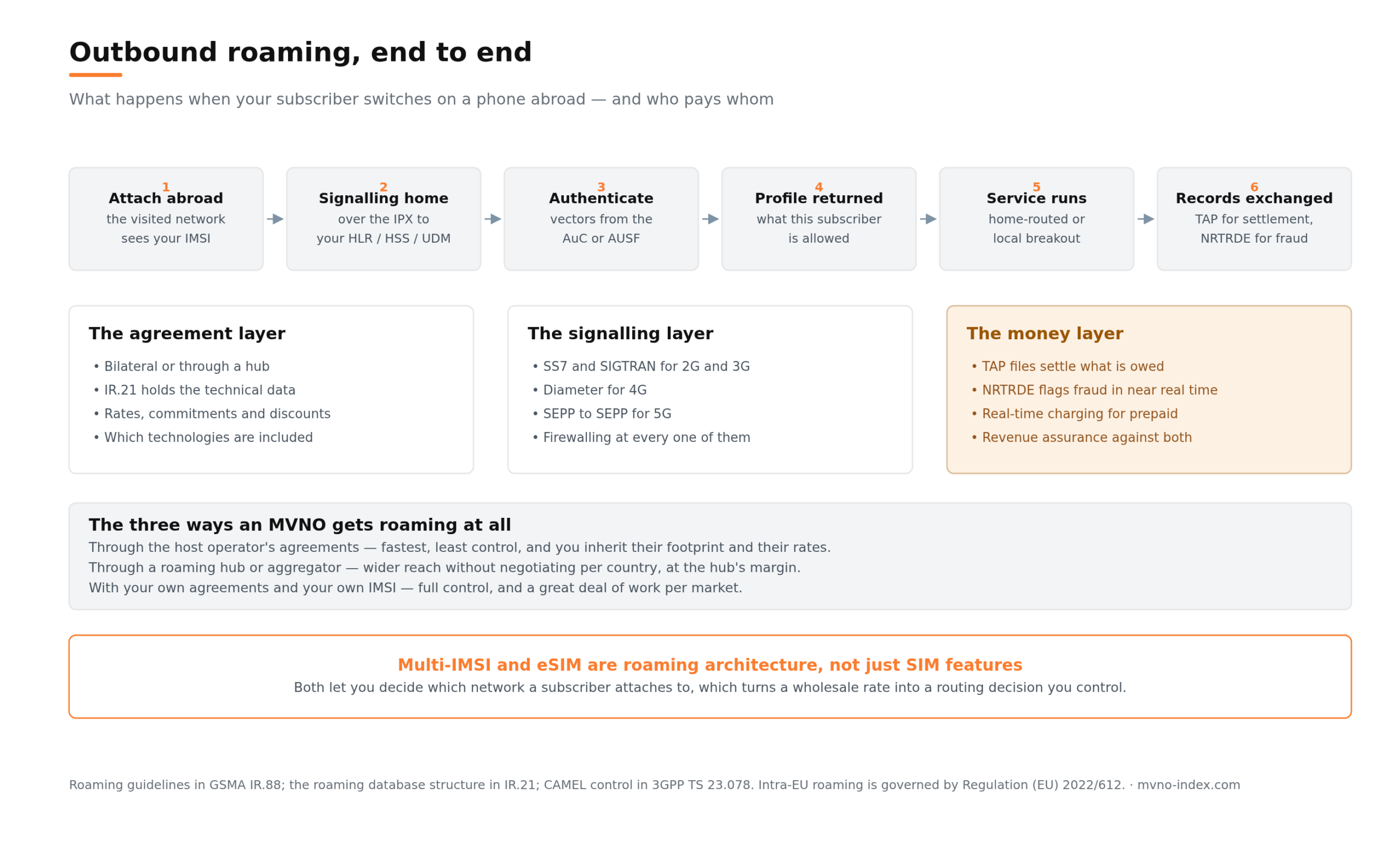
Roaming architecture is the chain that lets a subscriber use a foreign network as if it were yours: a commercial agreement, a signalling path home so the visited network can authenticate the subscriber, a decision about where the data breaks out, and a settlement process that works out who owes whom. For an MVNO the first question is whose agreements you are using. The host operator's, a hub's, or your own.
Roaming is one of the most technically complex and commercially significant capabilities an MVNO can offer. When your subscriber travels abroad and their device connects to a foreign network, a chain of technical processes, commercial agreements, and financial settlements must work seamlessly together. For the subscriber, it looks effortless. Behind the scenes, it involves multiple network operators, international clearing houses, signaling protocols, and real-time charging systems all functioning in coordinated precision.
Understanding roaming architecture is essential for any MVNO that serves mobile subscribers who travel, operates across multiple countries, or competes in the market with a premium connectivity proposition. It is equally critical for IoT MVNOs deploying devices across international borders. This guide explains how roaming architecture works, what infrastructure your MVNO needs to support it, and how to design a roaming strategy that works commercially as well as technically.
On this page
- Why Roaming Architecture Matters for MVNOs
- The Fundamentals of Mobile Roaming
- Home Network vs. Visited Network Roles
- Inbound and Outbound Roaming Explained
- Roaming Agreements and Their Technical Implications
- Signaling Architecture for Roaming
- SS7, Diameter, and IPX Connectivity
- Roaming in 5G: New Architecture, New Considerations
- Charging and Settlement Architecture for Roaming
- TAP and NRTRDE: The Financial Backbone of Roaming
- Real-Time Charging for Roaming Subscribers
- CAMEL and Advanced Roaming Control
- Multi-IMSI and eSIM as Roaming Architecture Alternatives
- Building Your Roaming Architecture: Practical Steps
- Frequently Asked Questions
- Summary
Why Roaming Architecture Matters for MVNOs
Roaming is not a feature you bolt onto your MVNO platform after launch. It requires deliberate architectural decisions, commercial agreements, and operational capabilities that take months to establish. MVNOs that treat roaming as an afterthought regularly discover that their platform cannot support it without significant rework and that their wholesale agreements do not include the terms needed to make it commercially viable.
At the same time, roaming represents a significant revenue and differentiation opportunity. Roaming MVNOs build their entire business model around international connectivity. Business MVNOs use roaming as a key part of their enterprise value proposition. Even general consumer MVNOs lose subscribers to competitors if their roaming experience is poor or their roaming prices are uncompetitive.
Plan your roaming architecture from day one. Even if you do not launch with roaming enabled, design your platform to support it without architectural rework when the time comes.
The Fundamentals of Mobile Roaming
Home Network vs. Visited Network Roles
When a subscriber travels abroad and connects to a foreign network, two networks are involved: the home network (your MVNO's network, where the subscriber's identity and account live) and the visited network (the foreign MNO whose radio network the subscriber is using).
The visited network provides radio access and local routing. It authenticates the roaming subscriber by querying the home network's Home Location Register (HLR) or Home Subscriber Server (HSS), which confirms the subscriber's identity and service profile. The visited network then serves the subscriber according to the agreed roaming terms, and bills the home network for the usage through an interoperator clearing process.
The home network retains responsibility for the subscriber relationship. Your MVNO's core network must be reachable from the visited network for authentication queries and call routing, which means your platform must have appropriate international signaling connectivity, not just domestic network access.
Inbound and Outbound Roaming Explained
Outbound roaming refers to your subscribers using their service while abroad on foreign networks. This is the roaming experience most subscribers think about: making calls, sending messages, and using data while traveling.
Inbound roaming refers to subscribers from other networks using your host MNO's network when they visit your country. As an MVNO, you typically do not directly benefit from inbound roaming revenue (that flows to your host MNO), but you need to understand inbound roaming because it affects network capacity and may influence your wholesale agreement terms.
For most MVNOs, outbound roaming is the primary architectural and commercial focus. The key questions are: which foreign networks will your subscribers be able to roam on, under what commercial terms, and how will your platform manage the real-time charging and policy enforcement required to prevent bill shock and protect your margins?
Roaming Agreements and Their Technical Implications
Three routes to roaming, and what each costs you
| Route | Reach | Control | Work |
|---|---|---|---|
| The host operator's agreements | Whatever the host has | None: their footprint, their rates | Almost none |
| A roaming hub or aggregator | Wide, without per-country deals | Some: you choose which destinations to sell | Moderate, one contract |
| Your own agreements and IMSI | Only what you negotiate | Full: rates, steering, quality | High, per market, continuously |
A roaming agreement between your MVNO (or your host MNO on your behalf) and a foreign operator is not just a commercial contract. It defines the technical parameters under which roaming operates: which services are supported (voice, SMS, data), which charging models apply, what quality commitments are made, and how interoperator settlements are calculated.
Negotiating your own bilateral roaming agreements directly with foreign operators is only practical for Full MVNOs with significant subscriber volumes. Most MVNOs access roaming through their host MNO's existing roaming footprint, which is one of the key selection criteria when choosing your wholesale partner.
Alternatively, roaming aggregators and IPX (IP Packet Exchange) providers offer MVNOs access to roaming agreements with hundreds of networks through a single commercial relationship. This dramatically simplifies both the commercial and technical aspects of roaming connectivity, though it comes with margin implications.
Technically, every roaming agreement must be reflected in your platform's roaming tables: configuration that tells your HLR or HSS which foreign networks your subscribers are permitted to roam on, and what services they are authorized to use when roaming. Keeping these tables accurate and current is an ongoing operational task that your OSS must manage.
Signaling Architecture for Roaming
SS7, Diameter, and IPX Connectivity
International signaling connectivity is the technical backbone of roaming. When your subscriber's device registers on a foreign network, the visited network sends a location update to your HLR or HSS using the MAP (Mobile Application Part) protocol over the SS7 signaling network. For 4G/LTE roaming, this signaling uses Diameter protocols. For 5G, HTTP/2-based service interfaces carry equivalent functions.
Your MVNO platform needs a connection to the international signaling network to receive and respond to these roaming signaling messages. This connectivity is typically provided through an IPX provider or a Signaling Transfer Point (STP). The Signaling Transfer Point (STP) routes SS7 messages between your core network and the international signaling network.
IPX (IP Packet Exchange) networks are the modern interconnect infrastructure that carries both signaling and user data traffic between operators internationally. Connecting to an IPX provider gives your MVNO a single point of access to the global roaming interconnect ecosystem, handling SS7, Diameter, and GRX (GPRS Roaming Exchange) connectivity through one relationship.
Roaming in 5G: New Architecture, New Considerations
5G Core architecture introduces significant changes to roaming. The 5G roaming architecture defines two models: Home Routed (HR) roaming, where the subscriber's data traffic is routed back through the home network's User Plane Function (UPF), and Local Breakout (LBO) roaming, where traffic exits directly from the visited network.
For MVNOs, Home Routed roaming gives you more control over the subscriber's data traffic and makes real-time policy enforcement and charging easier to implement. Local Breakout reduces latency for the subscriber but requires more sophisticated interoperator charging arrangements.
The 5G roaming signaling architecture also introduces the Security Edge Protection Proxy (SEPP), a new network function that protects inter-operator signaling interfaces. Your 5G-capable core network must include or connect to a SEPP to participate in 5G roaming. This is a new architectural requirement that did not exist in 4G, and one that MVNOs planning for 5G roaming must account for in their platform design.
Outbound roaming end to end: attach, authenticate, use, and settle.
Charging and Settlement Architecture for Roaming
The records that settle roaming, and what they are for
| Record | Purpose | Timing | What goes wrong without it |
|---|---|---|---|
| TAP | Settlement between operators | Periodic files | You cannot verify what you are billed |
| NRTRDE | Fraud detection on outbound roamers | Near real time | A fraudulent subscriber runs up days of charges |
| Real-time charging (CAMEL or Diameter) | Prepaid control while abroad | During the session | A prepaid subscriber spends a balance they do not have |
| Your own CDRs | Revenue assurance against the above | Continuous | Nothing to reconcile the operator invoice with |
TAP and NRTRDE: The Financial Backbone of Roaming
Roaming generates usage that must be billed to your subscribers and settled with the visited networks. The financial architecture of roaming relies on two key data exchange mechanisms: TAP (Transferred Account Procedure) and NRTRDE (Near Real Time Roaming Data Exchange).
TAP is the industry-standard format for exchanging roaming usage records between operators for financial settlement. When your subscriber uses data or makes a call while roaming, the visited network generates a TAP record capturing that usage. These records are exchanged through a data clearing house (DCH), which processes them and calculates the interoperator charges owed between networks.
NRTRDE provides near-real-time visibility of roaming usage, delivering data records within a few hours of usage occurring. Your platform uses NRTRDE data to detect potential fraud (subscribers generating unusually high roaming usage quickly) and to trigger spend controls before bills reach unmanageable levels.
Your BSS must be capable of ingesting and processing TAP and NRTRDE data, rating roaming usage against your tariff plans, applying it to subscriber accounts, and generating the appropriate wholesale invoices and interoperator settlement records.
Real-Time Charging for Roaming Subscribers
TAP-based settlement is retrospective, which creates a financial risk: a subscriber can generate significant roaming usage before you have visibility of the cost. Real-time charging for roaming subscribers addresses this risk by enforcing usage limits and spend caps at the point of consumption.
The Online Charging System (OCS) plays a central role here. For outbound roaming, the visited network queries your OCS in real time (using Diameter Ro interface) before granting access to services. Your OCS checks the subscriber's balance and remaining allowance, authorizes the usage, and decrements the balance. When the subscriber's balance reaches zero or their allowance is exhausted, the OCS instructs the visited network to terminate service or redirect the subscriber to a top-up portal.
Implementing real-time charging for roaming requires your OCS to be reachable internationally with low enough latency to respond within the time limits the visited network's policy enforcement requires. This is an architectural requirement that influences both your core network design and your IPX connectivity.
CAMEL and Advanced Roaming Control
CAMEL (Customized Applications for Mobile networks Enhanced Logic) is a protocol that enables your home network to apply service logic to calls and sessions initiated by your subscribers while roaming on foreign networks. Without CAMEL, your ability to control roaming calls in real time is very limited.
With CAMEL, your MVNO can implement real-time balance checks and spend controls for voice calls while roaming, apply customized call routing logic, offer prepaid subscribers the same real-time charging experience while roaming that they have on your home network, and trigger notifications and alerts based on usage events.
CAMEL support requires a CAMEL Service Environment (CSE) in your core network and CAMEL roaming agreements with the visited networks. Not all MVNOs implement CAMEL, but for those serving prepaid subscribers or high-volume international travelers, the investment is justified by the fraud reduction and customer experience benefits it enables.
Multi-IMSI and eSIM as Roaming Architecture Alternatives
Multi-IMSI connectivity offers an alternative to traditional roaming for MVNOs targeting international travelers and IoT deployments. A multi-IMSI SIM carries credentials for multiple networks, allowing the device to connect as a local subscriber rather than a roaming subscriber on partner networks in key countries.
This eliminates roaming surcharges for traffic on partner networks, delivers local network rates to the subscriber, and removes the latency and reliability risks associated with routing traffic back to the home network. For IoT MVNOs deploying devices in many countries, multi-IMSI architecture can dramatically reduce connectivity costs compared to traditional roaming.
eSIM offers a related but distinct approach. Rather than carrying multiple IMSIs simultaneously, an eSIM can switch to a local operator's profile in a new country, accessing local rates and avoiding roaming entirely. For consumer MVNOs targeting international travelers, eSIM-based local profile switching represents the next evolution of international connectivity management.
Building Your Roaming Architecture: Practical Steps
If you are building or enhancing your MVNO's roaming capability, follow these steps to establish a solid architectural foundation.
First, audit your current platform for roaming readiness. Does your HLR or HSS support the MAP protocol versions required for the networks you want to roam on? Does your OCS support real-time Diameter Ro interface for outbound roaming charging? Does your BSS process TAP files and NRTRDE data?
Second, establish your signaling connectivity. Connect to an IPX provider or STP that gives you access to the international signaling network. Ensure your connectivity supports SS7 MAP for 2G and 3G roaming and Diameter S6a and S9 interfaces for 4G roaming.
Third, negotiate your roaming commercial model. Whether through your host MNO's footprint, a roaming aggregator, or direct bilateral agreements, establish the commercial terms under which your subscribers will roam and ensure those terms are economically sustainable at your expected roaming volumes.
Fourth, configure and test your roaming tables, charging rules, and spend controls thoroughly. Roaming testing requires end-to-end testing on actual foreign networks, not just lab simulation. Use the MVNO consultancy resources available through MVNO Index to find specialists with roaming architecture expertise.
Frequently Asked Questions
Does every MVNO need to build its own roaming architecture?
No. Many MVNOs access roaming through their host MNO's existing roaming agreements without needing to build independent roaming infrastructure. Light MVNOs typically inherit whatever roaming capability their host MNO provides. Full MVNOs and those with specific roaming requirements (such as roaming MVNOs) need to build dedicated roaming architecture. Review your wholesale agreement carefully to understand what roaming is included.
What is the difference between TAP and NRTRDE?
TAP (Transferred Account Procedure) is the standard format for exchanging roaming usage records between operators for financial settlement. It is processed in batches and forms the basis for interoperator invoicing. NRTRDE (Near Real Time Roaming Data Exchange) delivers usage records within a few hours, enabling fraud detection and early spend control without waiting for TAP batch processing.
How does 5G change roaming for MVNOs?
The 5G Core introduces new roaming models (Home Routed and Local Breakout), new signaling interfaces, and a new security function (SEPP) for inter-operator signaling protection. MVNOs planning to support 5G roaming need to ensure their core network includes SEPP functionality and that their IPX connectivity supports 5G inter-operator interfaces. The fundamentals of subscriber authentication and interoperator settlement remain consistent with 4G, but the technical implementation details change significantly.
What is the biggest financial risk in MVNO roaming?
Roaming fraud and uncontrolled subscriber spend are the primary financial risks. A subscriber (or a fraudster using a compromised SIM) can generate large amounts of roaming usage before TAP records arrive for settlement. Real-time OCS charging, NRTRDE monitoring, and spend caps are the architectural tools that manage this risk. Without these controls, a single fraud incident can generate costs that exceed months of roaming revenue.
Can an MVNO offer roaming without its own core network?
Yes. MVNOs operating through an MVNE or host MNO can offer roaming using the host's roaming infrastructure, subject to the terms of their wholesale agreement. The MVNO manages the commercial aspects (roaming tariffs, spend caps, customer communications) while the host network handles the technical roaming infrastructure. This is the most common approach for Light and mid-tier MVNOs.
Summary
Roaming architecture is one of the most complex technical and commercial domains in the MVNO business. It requires signaling connectivity, interoperator agreements, real-time charging capability, and robust fraud controls, all working together across multiple operators and clearing systems.
Design your roaming architecture deliberately rather than reactively. Understand what your host MNO's roaming footprint provides and where you need to supplement it. Build real-time charging controls from the start to protect your margins and your subscribers from bill shock. And plan for 5G roaming even if your immediate focus is on 4G, because the architectural requirements are materially different.
Explore the full range of resources on roaming for MVNOs, wholesale agreements, and roaming MVNO business models on MVNO Index. Use the solution provider directory to identify IPX providers, roaming aggregators, and charging system vendors that can support your roaming architecture requirements.
General Information