The Telecom Webshop: From Visitor to Working SIM
A telecom webshop is the online sales and self-service channel of a mobile brand: where a visitor picks a plan, buys a SIM or eSIM, activates it, and later manages the subscription. It is the cheapest acquisition channel an MVNO has, and the only one that runs without staff.
The webshop is the digital storefront of a mobile brand or MVNO and represents the single most important commercial touchpoint between the operator and its (potential) subscribers. A well-designed webshop does not merely display products. It is the primary engine for subscriber acquisition, self-service management, SIM activation, plan upgrades, add-on purchases, and retention. For any operator that wants to grow its subscriber base and reduce reliance on costly physical retail channels, owning and controlling a purpose-built telecom webshop is not a luxury; it is a commercial necessity. Understanding what a telecom webshop must do, how it integrates with the broader BSS/OSS stack, and how to evaluate build versus buy decisions will directly determine the commercial success of your mobile brand.
The telecom webshop: key takeaways
A telecom webshop is the digital storefront where a mobile brand acquires subscribers, sells plans and activates SIMs, acting as the front end to the whole BSS and OSS stack.
- What is a telecom webshop used for? It is the primary digital channel through which a mobile brand acquires subscribers, activates SIM cards, sells plans and bundles, and handles self-service.
- What must a competent webshop be able to do? Present the full product catalogue in a clear, comparable format including SIM only plans, and let subscribers order a physical SIM or activate an eSIM entirely online.
- How does a webshop handle eSIM activation? By integrating with the SM-DP+ provisioning platform to deliver a QR code or app based activation link to the subscriber at the point of purchase.
- Is a telecom webshop a standalone product? No. It is the front end to a deeply integrated stack of back office systems, and one that is not properly integrated will fail at ordering and activation.
Watch: the telecom webshop explained, from catalogue and SIM ordering to eSIM activation through SM-DP+ (1 min 50 s).
On this page
- History and Evolution of the Telecom Webshop
- Core Utility and Functionality
- What is a Telecom Webshop Used For?
- Key Functions of a Telecom Webshop
- Technical Integration and Data Model
- Integration with Other Systems
- Technical Data Model and Key Interfaces
- Webshop Ownership for MVNOs and IoT Companies
History and Evolution of the Telecom Webshop
The earliest MVNO webshops were little more than static brochure sites with a telephone number to call for activation. As broadband penetration grew through the mid-2000s, operators began adding online SIM order forms and basic plan comparison pages. The real transformation came with the smartphone era and the rise of e-commerce platforms, which raised subscriber expectations for self-service, instant activation, and fully digital onboarding to match the standard set by retail giants. Today, the telecom webshop is expected to deliver a seamless, personalized, and fully transactional experience across desktop, mobile, and app channels.
Core Utility and Functionality
What the webshop replaces, and what it costs you
| Sales channel | Cost per order | Available | Works for |
|---|---|---|---|
| Own webshop | Lowest, after the build | 24/7 | Self-service buyers, upgrades, add-ons |
| Retail partner | Commission per activation | Shop hours | Customers who want a device in hand |
| Contact centre | Agent time per order | Staffed hours | Complex or assisted sales |
| Reseller or affiliate | Revenue share | Varies | Reach into someone else's audience |
What is a Telecom Webshop Used For?
The telecom webshop is the primary digital channel through which a mobile brand acquires new subscribers, activates SIM cards, sells plans and bundles, manages self-service requests, and generates additional revenue through add-ons and upgrades. It replaces or supplements the physical retail store, the call center, and the paper-based activation process with a 24/7 digital journey that reduces operational cost and accelerates subscriber growth.
For an MVNO or MVNE, the webshop is also the face of the brand. Every visual design choice, every product description, and every checkout flow communicates the brand's value proposition to a prospective subscriber who may be comparing multiple operators simultaneously. A poorly designed or slow webshop is one of the biggest mistakes an MVNO can make, because it directly suppresses conversion rates and increases churn from the very first interaction.
Beyond acquisition, the webshop is the self-service hub for existing subscribers. Logged-in customers must be able to view their current plan, check remaining allowances, upgrade to a higher tier, purchase data add-ons, change personal details, manage payment methods, and port their number in or out, all without needing to contact customer care. This self-service capability is directly linked to exceptional customer care outcomes, because it deflects routine inquiries away from human agents and onto a lower-cost digital channel.
Key Functions of a Telecom Webshop
The following core functions define a competent telecom webshop and the requirements every operator must address:
Product Catalog and Plan Display: The webshop must present the operator's full product catalog in a clear, comparable format, including SIM-only plans, bundles (voice, data, SMS), prepaid and postpaid options, device bundles, and any value added services (VAS). Pricing, allowances, contract terms, and promotional pricing must all be accurate and dynamically pulled from the BSS product catalog.
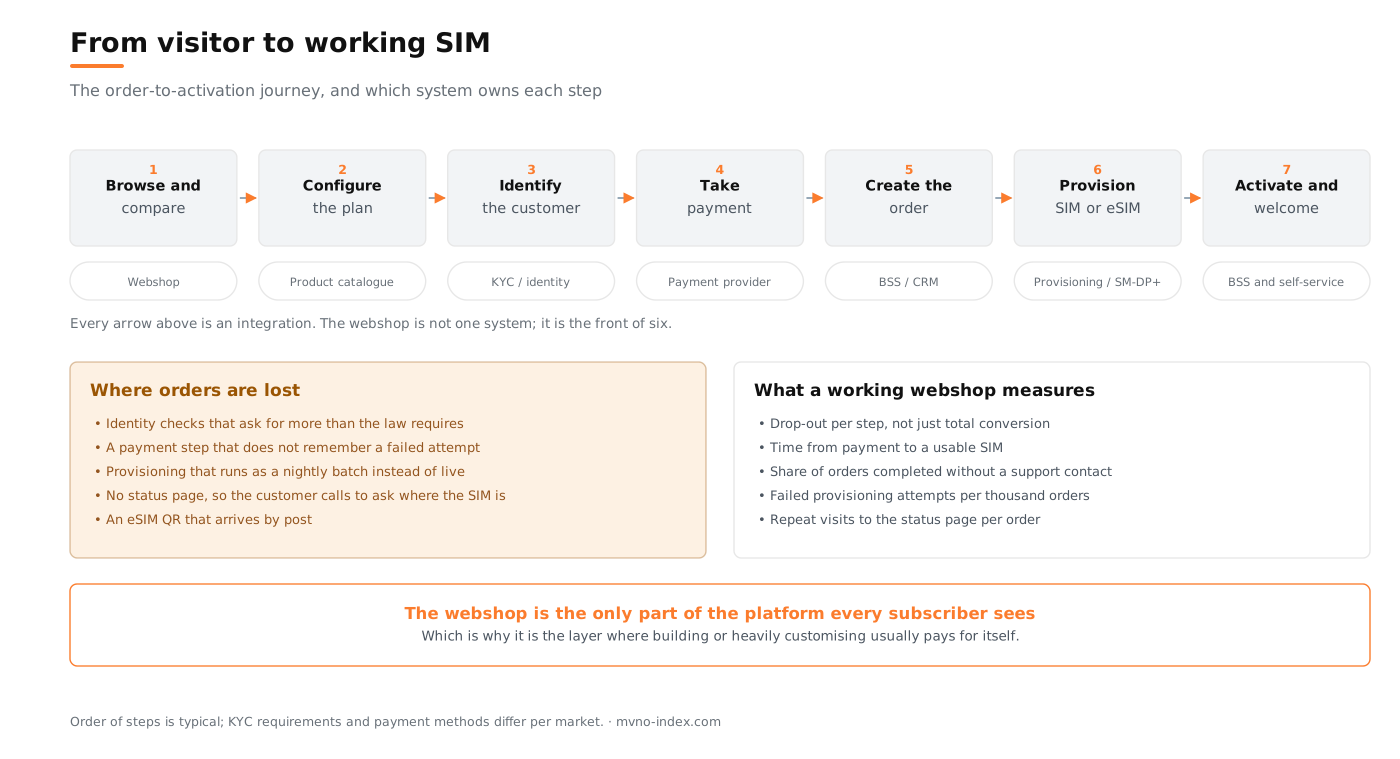
Online SIM Ordering and Activation: Subscribers must be able to order a physical SIM card or activate an eSIM entirely through the webshop. The activation flow must verify identity where required, assign a number, provision the SIM in the HLR or HSS, and trigger the relevant billing profile setup in the OCS or offline charging system, all in a single, uninterrupted digital journey.
Checkout and Payment Processing: The webshop must support secure online payment through credit and debit cards, digital wallets, and where relevant direct carrier billing or bank transfer. The payment flow must be PCI DSS compliant, optimized for conversion, and capable of handling both one-time purchases and recurring subscription billing setup.
Customer Account Portal (My Account): The authenticated self-service area allows existing subscribers to manage every aspect of their account. This includes viewing usage in real time (drawn from the OCS or OFCS), purchasing add-ons, changing plan, updating contact details, managing payment methods, downloading invoices, and initiating port-in or port-out requests.
Number Portability (MNP) Support: The webshop must integrate with or trigger the number portability process, allowing subscribers to bring their existing number to the new operator without leaving the digital channel. This is a critical conversion feature, as the complexity of number porting is a major barrier to switching for many consumers.
eSIM and iSIM Provisioning: For operators offering eSIM or iSIM, the webshop must support QR code delivery or app-based eSIM profile download as a fully integrated step in the activation journey, consistent with SGP.32 eSIM Remote SIM Provisioning standards.
Promotional and Campaign Management: The webshop must support dynamic promotion display, discount code redemption, referral tracking, and time-limited campaign pricing, all configurable without requiring a developer deployment. This is essential for executing the marketing plan of the MVNO efficiently.
Compliance and Regulatory Features: The webshop must capture and store consent for marketing communications, display mandatory terms and conditions, enforce age verification where required, and support GDPR-compliant data subject requests including the right to erasure and data export.
From visitor to working SIM: the order-to-activation journey and the system behind each step.
Technical Integration and Data Model
The systems a webshop has to talk to
| System | What the webshop needs from it | Typical interface |
|---|---|---|
| BSS / billing | Product catalogue, pricing, order creation | REST API, TM Forum TMF620 and TMF622 |
| CRM | Customer record, existing subscriptions | REST API |
| SIM / eSIM provisioning | Stock, activation, profile download | Provisioning API, SM-DP+ for eSIM |
| Payment provider | Authorisation, recurring billing, refunds | Hosted checkout or API |
| Logistics | Shipping of physical SIM and devices | Carrier API or file exchange |
| Identity check | KYC where the market requires it | eID or document verification API |
Integration with Other Systems
The telecom webshop does not operate in isolation. It is the front-end interface for a deeply integrated stack of back-office systems. A webshop that is not properly connected to these systems will create provisioning failures, billing errors, and support ticket volumes that eliminate any efficiency gains from the digital channel.
The primary integration is with the Business Support System (BSS), which holds the product catalog, pricing engine, subscriber accounts, and billing data. Every plan displayed in the webshop must be sourced from the BSS catalog in real time to ensure pricing accuracy and to enable instant provisioning on purchase. The Operational Support System (OSS) handles the network-side provisioning triggered by webshop transactions, including SIM activation, service provisioning, and number assignment.
For subscriber authentication and service entitlement, the webshop integrates indirectly with the HLR in 2G/3G networks or the Home Subscriber Server (HSS) in 4G networks, via the BSS/OSS provisioning layer. Real-time balance and usage data displayed in the account portal is drawn from the Online Charging System (OCS). Invoice and usage history for postpaid subscribers comes from the Offline Charging System (OFCS).
For eSIM operators, the webshop connects to the SM-DP+ (Subscription Manager Data Preparation) platform to trigger eSIM profile download. For IoT operators, the webshop may also serve as the portal through which enterprise customers manage device connectivity, SIM pools, and data plan allocation for fleets.
The value added services (VAS) layer also connects to the webshop. Services such as IVR, voicemail, OTT services, and RCS bundles must all be activatable and manageable through the self-service portal without manual intervention from the operator's back-office team.
Technical Data Model and Key Interfaces
The webshop operates on a structured data model that must align precisely with the BSS/OSS data architecture. Key data entities and interfaces include:
Product Catalog API: The webshop consumes the BSS product catalog via an API (typically REST or GraphQL), pulling plan names, pricing, allowances, eligibility rules, and promotional configurations in real time.
Subscriber Identity and Account API: On login, the webshop authenticates the subscriber against the CRM or subscriber management system and retrieves account status, current plan, active services, and usage summary from the OCS/OFCS.
Provisioning Trigger API: On checkout completion, the webshop triggers a provisioning request to the OSS, which activates the SIM in the HLR or HSS, sets the charging profile in the OCS, and assigns the MSISDN to the subscriber record.
Payment Gateway Integration: The payment processing interface connects to a PCI DSS compliant payment gateway for card transactions and may also connect to a direct debit or SEPA mandate management system for recurring postpaid billing setup.
Identity Verification API: For markets requiring Know Your Customer (KYC) verification at activation, the webshop integrates with an identity verification provider to perform document and liveness checks in the digital onboarding flow.
Analytics and Conversion Tracking: The webshop must emit structured event data to an analytics platform to measure funnel conversion rates, product performance, campaign attribution, and subscriber lifetime value signals.
Webshop Ownership for MVNOs and IoT Companies
Why Own a Webshop?
For any MVNO or IoT operator, owning and controlling your own webshop is essential for commercial independence. When an MVNO relies entirely on a host MVNE's white-label webshop, it surrenders control over the subscriber experience at the most critical commercial moment: the point of sale. Generic white-label shops limit the ability to differentiate through design, to run agile promotions, to optimize conversion funnels based on subscriber behavior data, and to integrate with third-party tools that give competitive advantage.
Owning your webshop means owning your subscriber relationship from the first click. It enables you to build brand loyalty, collect first-party data, personalize the purchase journey, and adapt rapidly to market conditions without waiting for a shared platform vendor to implement changes. For operators targeting a specific niche, whether that is an ethnic MVNO, a discount MVNO, a business MVNO, or a lifestyle MVNO, the webshop is the primary vehicle for communicating and delivering that niche value proposition.
Advantages and Disadvantages of Webshop Ownership
Advantages:
- Full Brand Control over design, user experience, messaging, and product presentation from the first subscriber touchpoint.
- Commercial Agility to launch promotions, change pricing, introduce new products, and A/B test conversion flows without dependency on a third-party platform vendor.
- First-Party Data Ownership capturing subscriber behavior, funnel drop-off, and purchase intent data that feeds directly into your marketing plan and retention strategy.
- Self-Service Deflection reducing the volume of inbound calls and support tickets for routine account management tasks, directly lowering operational cost.
- Revenue Optimization through upsell prompts, cross-sell recommendations, and personalized add-on offers at the account portal level, informed by real-time usage data from the OCS.
- Integration Depth enabling direct API connections to your BSS, OCS, HLR/HSS, and VAS layer for fully automated provisioning and instant activation.
Disadvantages:
- Significant upfront investment in design, development, and BSS/OSS integration if building a custom webshop from scratch.
- Ongoing maintenance and development resource requirements to keep the webshop current with browser standards, mobile UX expectations, and regulatory changes.
- Payment gateway and PCI DSS compliance obligations that require dedicated security attention and periodic audit.
- Risk of downtime or conversion loss if the webshop is not built with adequate redundancy and performance optimization from day one.
- Integration complexity increases significantly when the BSS, OCS, and provisioning systems span multiple vendors, requiring careful API design and version management.
Organizational Impact of Webshop Ownership
Operational Impact: Owning a webshop requires a cross-functional team covering product management, UX design, front-end and back-end development, BSS/OSS integration, and digital marketing. Operational procedures must cover release management, incident response, and a clear escalation path when provisioning failures occur at checkout. The webshop must be monitored continuously for availability, conversion rate anomalies, and payment processing failures, because any degradation in these metrics translates directly into lost subscriber acquisition and revenue.
Financial Impact: The financial plan of an MVNO must account for webshop development, hosting, payment processing fees, and ongoing feature development as line items. The return on this investment is measured in subscriber acquisition cost reduction (versus retail channels), self-service deflection rate (versus call center cost), and average revenue per user (ARPU) uplift from in-portal upsell. Operators that invest in a high-converting, well-integrated webshop typically achieve a lower cost per acquisition and a higher lifetime value per subscriber than those relying on physical retail alone.
Security Impact: The webshop handles sensitive personal data, payment information, and subscriber account access. It must be secured against common web application vulnerabilities (OWASP Top 10), DDoS attacks, credential stuffing, and payment fraud. SSL/TLS encryption, strong authentication for account access (including multi-factor authentication), and regular penetration testing are baseline requirements. The ePrivacy and GDPR obligations of the operator apply in full to data collected through the webshop, including consent management for marketing cookies and communications.
Technical Impact: The webshop must be architected for scalability and resilience, particularly during promotional campaign spikes where traffic can increase by an order of magnitude in minutes. A headless architecture that decouples the front-end presentation layer from the back-end commerce and BSS integration layer is the current best-practice approach, enabling independent scaling of the user-facing and integration layers. Performance optimization, including page load speed, mobile rendering, and checkout step count, directly correlates with conversion rate and is a key technical success factor.
Redundancy and High Availability
The webshop is a revenue-critical system. Any period of downtime or degraded performance during peak hours represents direct revenue loss and potential permanent subscriber loss to a competing operator. Deploying the webshop on a cloud infrastructure with auto-scaling, multi-region redundancy, and a content delivery network (CDN) in front of the front-end layer is the standard approach for operators that take availability seriously. Payment processing must have failover to a secondary gateway to ensure checkout is never blocked by a single third-party outage. The provisioning integration with the BSS/OSS must include queue-based retry logic so that a temporary back-office system outage does not result in failed activations reaching the subscriber. Monitoring must cover availability, response time, error rates, and conversion rate in real time, with automated alerting to on-call engineering when thresholds are breached.
The Webshop as a Marketing and Growth Tool
Beyond transactional functionality, the webshop is the most powerful marketing asset a mobile brand owns. Search engine optimization (SEO) of plan pages, comparison landing pages, and educational content drives organic subscriber acquisition at a cost per visit that no paid channel can match at scale. Content pages that explain the operator's network coverage, SIM card options (including eSIM and iSIM), and value added services also build the authority and trust signals that improve paid campaign performance.
For operators considering artificial intelligence features, the webshop is the natural deployment point for AI-powered plan recommendation engines, chatbot-based sales support, and personalized upsell logic. An AI recommendation engine that analyses a subscriber's current usage and proactively suggests a more suitable plan or add-on at account login can deliver measurable ARPU uplift with no additional marketing spend. The pros and cons of AI for subscribers and the MVNO are explored in detail elsewhere on MVNO Index, but the webshop is clearly the highest-impact deployment environment for subscriber-facing AI features.
Referral program mechanics, loyalty point redemption, and subscriber-generated reviews are additional marketing capabilities that a fully owned webshop can accommodate and that white-label shared platforms rarely support with the flexibility a competitive mobile brand requires. Building these growth mechanics into the webshop from the initial business plan stage, rather than retrofitting them later, delivers significantly better commercial outcomes.
Impact of AI and Emerging Technologies on the Webshop
The Evolving Digital Storefront
The telecom webshop is evolving from a static transactional channel into an intelligent, personalized engagement platform. Artificial intelligence is being applied across the entire webshop journey: from AI-generated plan recommendations at the product catalog stage, to real-time fraud scoring at checkout, to predictive churn signals surfaced in the account portal that trigger automated retention offers. Operators that deploy AI effectively within their mobile brand will increasingly use the webshop as the primary delivery mechanism for these capabilities.
5G, eSIM, and the Future Webshop
The rollout of 5G networks and the accelerating adoption of eSIM are both raising the strategic importance of the webshop. In a world where a subscriber can purchase a SIM, have it provisioned over the air, and be making calls within minutes, the webshop becomes the entire activation channel with no physical touchpoint required. This fully digital journey is only possible when the webshop, the BSS/OSS, and the eSIM provisioning platform are tightly integrated and designed to work together seamlessly. Operators that invest in this integration today will be positioned to acquire subscribers at lower cost and higher speed than those still dependent on physical SIM distribution.
Fixed Mobile Convergence (FMC) adds another dimension to the webshop opportunity, as operators offering both fixed broadband and mobile services increasingly need a unified storefront that presents bundled products, shared account management, and combined billing in a single subscriber-facing interface.
| Feature | A2P SMS | RCS Business Messaging | OTT (WhatsApp, Apple, Viber) |
|---|---|---|---|
| Reach | Every mobile handset, no data needed | Supported devices, data needed | Users of that specific app |
| Rich media | No | Yes | Yes |
| Verified sender | Sender ID registration only | Yes, branded verification | Yes, per platform |
| Operator earns from it | Yes, termination revenue | Yes, where the operator carries it | No |
Frequently Asked Questions about the Webshop
What is a telecom webshop?
A telecom webshop is the digital storefront of an MVNO or mobile brand where prospective and existing subscribers can browse plans, purchase SIM cards, activate services, manage their account, and buy add-ons entirely online.
Why is the webshop important for an MVNO?
The webshop is the primary subscriber acquisition and self-service channel. It directly affects conversion rates, subscriber acquisition cost, customer satisfaction, and ARPU. A high-performing webshop reduces reliance on costly retail and call center channels.
What systems must a telecom webshop integrate with?
A telecom webshop must integrate with the BSS for product catalog and billing, the OSS for service provisioning, the OCS for real-time usage data, the HLR or HSS for subscriber provisioning, and a payment gateway for transaction processing.
Should an MVNO build or buy its webshop?
This depends on the operator's scale, technical capability, and differentiation strategy. Purpose-built or heavily customized solutions offer the greatest commercial flexibility. White-label platforms from an MVNE can reduce time to market but typically limit brand differentiation and integration depth. Engaging specialist consultancy to evaluate the right approach for your specific situation is recommended before committing to a vendor.
How does the webshop support eSIM activation?
An eSIM-ready webshop integrates with the SM-DP+ provisioning platform to deliver a QR code or app-based activation link to the subscriber upon purchase, following SGP.32 eSIM Remote SIM Provisioning standards, enabling fully over-the-air SIM activation without any physical delivery.
Can the webshop be used for IoT subscriber management?
Yes. For IoT and M2M operators, the webshop or an associated self-service portal can serve as the enterprise customer interface for managing SIM pools, device connectivity status, data plan allocation, and bulk provisioning, integrated directly with the BSS/OSS stack.
How does AI improve the telecom webshop?
AI can power plan recommendation engines, personalized upsell prompts, real-time fraud detection at checkout, chatbot-based sales assistance, and predictive churn intervention triggered from account portal usage signals.
Summary
The webshop is the most commercially critical digital asset an MVNO or mobile brand operates. It is simultaneously the subscriber acquisition engine, the self-service portal, the upsell and retention channel, and the brand's most visible digital presence. Owning and controlling a purpose-built, deeply integrated webshop gives an operator full control over the subscriber journey from the first marketing click through to activation, ongoing service management, and churn prevention.
Achieving this requires tight integration with the BSS, OSS, OCS, HLR or HSS, payment gateway, and where relevant the eSIM provisioning platform. It demands investment in design, security, performance, and ongoing feature development. The financial return on that investment, measured in lower acquisition cost, higher conversion rates, reduced call center volume, and ARPU uplift from in-portal upsell, makes a compelling case that is central to any credible MVNO financial plan. As 5G, eSIM, and AI continue to reshape the mobile industry, the webshop will only grow in strategic importance as the definitive channel through which subscribers choose, activate, and stay with their mobile brand.
Value Added Services (VAS)