The Five Decisions Behind an IoT Deployment
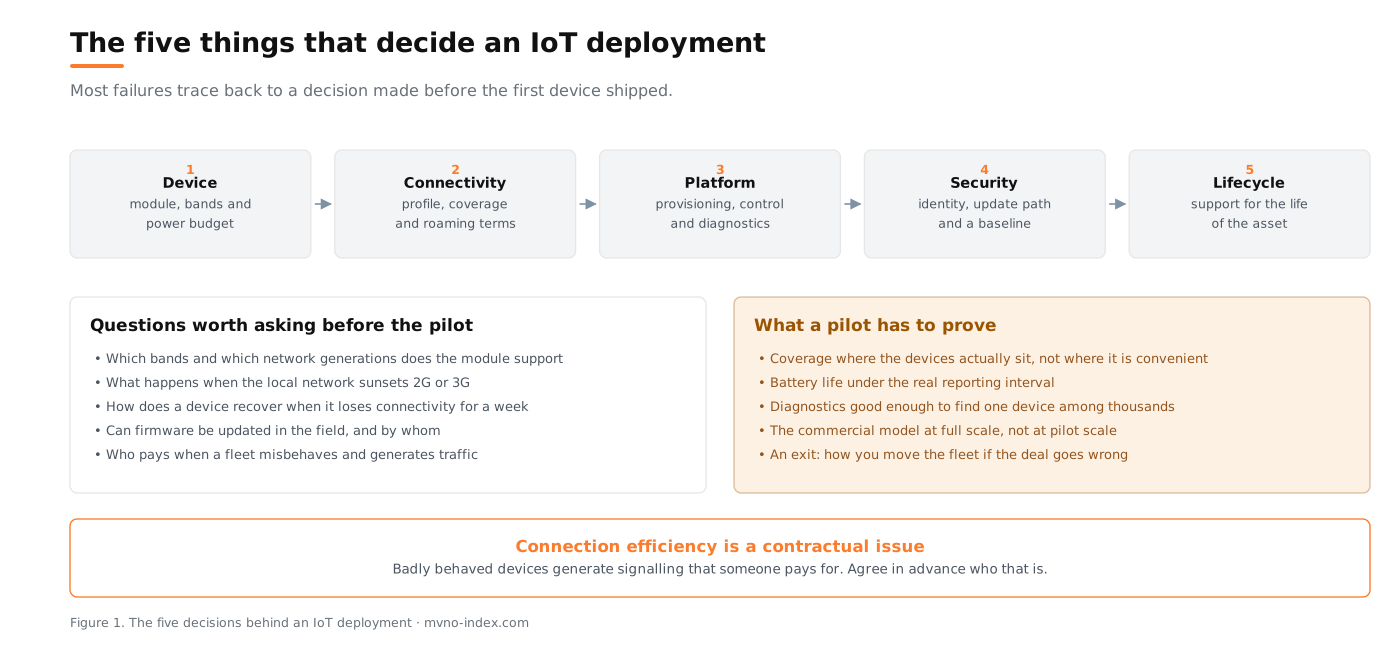
IoT success rests on five decisions taken before the first device ships: the module and the bands it supports, the connectivity profile and its roaming terms, the platform used to provision and diagnose, the security baseline including how firmware is updated, and support for the working life of the asset. None of these is cheap to change once thousands of units are in the field. That is why a pilot proving only the application has not proved the expensive part.
An Internet of Things project succeeds when connected devices produce information or actions that improve a real business process at an acceptable cost. Installing sensors and establishing connectivity are necessary steps in many projects, but they do not establish that the service is useful. Someone must use the data, respond appropriately and maintain the devices throughout their working life.
For an IoT provider or MVNO, the strongest commercial proposition connects those responsibilities into a service customers understand. Begin with the operational problem, validate the complete workflow and price the lifecycle realistically. This approach makes it easier to select suitable technology and avoid a pilot that works technically but cannot be deployed or supported economically.
On this page
- History and Evolution of IoT Delivery
- Core Utility and Functionality of Success Planning
- What is Success Planning Used For?
- Key Functions of an IoT Success Framework
- Technical Integration and Data Model
- Integration with Other Systems
- Technical Data Model and Key Calculations
- Ownership for IoT Companies and MVNOs
- Why Own the Complete Service Outcome?
- Advantages and Disadvantages of a Structured IoT Approach
- Organizational Impact of IoT Success Planning
- Redundancy and High Availability
- Impact of 4G and 5G and Future Networks
- Success Factors in 4G IoT
- Success Factors in 5G IoT
- Long Term Deployment Success
- Frequently Asked Questions about IoT Success Factors
- Summary
History and Evolution of IoT Delivery
Early machine-to-machine projects often focused on connecting a specific device to a remote system. As connectivity and cloud services became more accessible, projects expanded into larger fleets and integrated business applications. The difficult work increasingly moved towards deployment, data quality, security and the organisational process that uses the information.
This shift explains why a successful demonstration does not always become a successful service. A handful of carefully managed devices can hide installation errors and support effort that become expensive at scale. A sound IoT device strategy should therefore cover production, deployment, operation and retirement, not only the initial prototype.
Core Utility and Functionality of Success Planning
The five factors, and what goes wrong when one is skipped
| Factor | Decided before launch | What it costs to fix later |
|---|---|---|
| Device and module | Bands, generations, power budget | A hardware recall |
| Connectivity | Profile, coverage, roaming terms | Renegotiation, or a SIM swap per unit |
| Platform | Provisioning, control, diagnostics | Blind operation at scale |
| Security | Identity, update path, baseline | A fleet that cannot be patched |
| Lifecycle | Support for the life of the asset | Devices outliving their network |
What is Success Planning Used For?
Success planning defines the outcome the project is intended to improve and how that improvement will be measured. A cold-chain sensor might reduce time spent investigating temperature excursions. A meter might remove manual readings. State the baseline, the intended operational change and who benefits. Device count alone is a weak measure of either outcome.
The business case should include the full path from measurement to action. If an alert reaches a dashboard but no team is responsible for responding, the project may create information without value. Agree the workflow before purchasing a large fleet. This also helps distinguish useful features from capabilities that look impressive but do not affect the customer's process.
Key Functions of an IoT Success Framework
Device suitability is fundamental. The hardware must survive the physical environment, support the required measurements and operate within realistic power constraints. Antenna placement, enclosure materials and installation location can affect connectivity. Test the actual assembled product in representative conditions rather than relying only on a module's specifications.
Connectivity must match the workload and deployment geography. Message size, frequency, mobility and response time all influence the choice. Coverage claims should be checked at relevant locations and with the intended device. A service that works outdoors beside a window may behave differently inside a metal cabinet or below ground.
How a device behaves on the network is part of the connectivity decision, not a detail for later. The GSMA publishes connection efficiency guidelines describing how a fleet should attach, retry and back off, and a host operator will hold you to something very like them.
Operational usability completes the design. Devices need identifiable ownership, diagnosable states and a practical recovery process. Customer support should be able to distinguish missing power, poor connectivity and an application problem. Without this visibility, every fault can become an expensive field visit even when the underlying issue could have been resolved remotely.
Technical Integration and Data Model
Integration with Other Systems
An IoT service usually connects devices, a connectivity platform, application software and business systems. Define the responsibility at each boundary. The device may successfully transmit a message while the application rejects it or the customer system fails to create a work order. Test the final operational outcome rather than stopping at network delivery.
The IoT device management environment should support the required lifecycle tasks, such as configuration, inventory and updates. Confirm which devices and versions it supports. A generic platform claim is insufficient if the actual product cannot report its software version or receive an update under the conditions found in the field.
Customer integration deserves early attention. Data formats, identity mapping and access permissions can delay value after the technical installation is complete. Involve the people who own the receiving business process and its systems. They should participate in acceptance testing and confirm that the information is timely and usable for their decisions.
Technical Data Model and Key Interfaces
Assign stable identities to assets and devices, and record their relationship to SIMs or connectivity profiles. Hardware replacements should preserve the business history where appropriate. Include installation location, software version and lifecycle status. These records help support teams understand whether a missing measurement reflects a retired device or an unexpected failure.
Five decisions, all taken before the first device ships.
Measurement data needs context. Time, unit, quality and calibration information may be essential to interpretation. A temperature value without a reliable timestamp can be useless for investigating an event. Define how the application handles duplicates, delayed messages and gaps so it does not silently treat old or repeated information as a new observation.
Interfaces should support the expected workload and failure behaviour. Devices may reconnect together after a power interruption, creating a burst of messages. Applications need sensible retry and duplicate-handling policies. Ask suppliers to demonstrate recovery from a backlog, including whether customer alerts remain meaningful when older measurements arrive after newer ones.
Ownership for IoT Companies and MVNOs
What a pilot has to prove before it counts
| Test | A pilot that skips it proves nothing |
|---|---|
| Coverage where the devices sit | Not in the office: in the basement, or the field |
| Battery life at the real interval | Reporting every minute in a test, hourly in production |
| Recovery after a long outage | A device offline for a week must come back on its own |
| Firmware update in the field | Including the failure case halfway through |
| Diagnostics at scale | Finding one bad device among ten thousand |
| The commercial model at volume | Pilot pricing rarely survives the real fleet |
Why Own the Complete Service Outcome?
An IoT provider does not need to manufacture every device or operate every network, but it does need clear accountability for the service it sells. Define who diagnoses a fault and coordinates the required partners. Customers should not be left deciding whether the device maker, connectivity provider or application supplier owns the problem.
An MVNO entering IoT can contribute connectivity expertise and commercial reach. It should also assess what additional capabilities the use case requires. The M2M and IoT MVNO overview provides context, but the product must still have a credible installation, support and application model for its chosen customer segment.
Advantages and Disadvantages of a Structured IoT Approach
Advantages
-
Starting with a measurable business outcome keeps the technology selection focused. It becomes easier to reject unnecessary complexity and choose a service level that is sufficient for the task. A sensor reporting once a day may need a very different design from a mobile asset requiring frequent location updates.
-
Lifecycle planning also improves commercial predictability. The provider can identify installation, replacement and support costs before setting a price. A realistic pilot produces evidence for the rollout plan and gives the customer a clearer basis for purchase. This reduces the chance that an attractive initial offer becomes unsustainable once the fleet grows.
Disadvantages
-
A disciplined approach requires more coordination before large-scale deployment. Business teams, device specialists and operational staff may need to agree requirements that were initially assumed. This can expose uncomfortable gaps, such as an undefined response process or an installation method that takes too long. Resolving those gaps early is usually less costly than discovering them across an installed fleet.
-
Excessive standardisation can also become a problem if genuinely different use cases are forced into one design. A platform suitable for static meters may not suit mobile equipment. Reuse components where they fit, but preserve the requirements that matter. Simplicity should come from deliberate choices, not from ignoring differences in the operating environment.
Organizational Impact of IoT Success Planning
Assign a business owner who is accountable for the outcome and an operational owner for the deployed service. They should agree how success is measured and how incidents affect the customer's process. A project can otherwise be declared complete by the implementation team while the people expected to use it remain unprepared.
Installation needs a repeatable process. Record device identity, location and acceptance results at deployment. Provide installers with a way to verify that the complete path is working before leaving the site. Poor installation records create avoidable support costs and can make later device replacement or contract migration much harder.
Security should be maintained throughout the lifecycle. Inventory, controlled access and an update process need named owners. Define how credentials are provisioned and replaced, how vulnerabilities are assessed and how retired devices lose access. The appropriate controls depend on the application, but responsibility for them should not disappear between suppliers.
For the security baseline itself there is a published starting point. NIST IR 8259A sets out a core set of cybersecurity capabilities that an IoT device should have, which is a more useful basis for a supplier conversation than a general request for secure devices.
Commercial teams should price the supported outcome. Include onboarding, connectivity, application operation and expected field work in the model. Ask customers to participate in a trial with agreed success measures and a defined route to rollout. A pilot with no budget owner or purchasing criteria can consume substantial effort without becoming a viable contract.
Redundancy and High Availability
Design resilience around the consequence of missing or delayed data. Some devices can buffer measurements and upload them later. Other applications need a prompt alert or a local fallback. Define the acceptable delay and loss for the actual business process. Not every sensor needs continuous connectivity, but every service needs an understood failure mode.
Test power loss, network unavailability and application outages separately. Observe how the device retries, whether it drains its battery and how the backend interprets recovered data. GSMA connection-efficiency guidance is relevant to device behaviour, but the complete product still needs testing under its expected network and workload conditions.
Plan for failures that require physical intervention. Keep replacement procedures, spare-stock assumptions and access arrangements realistic. A remote device installed in a difficult location can cost far more to visit than to connect for a year. Include those economics when comparing hardware, battery design and supplier support commitments.
Impact of 4G and 5G and Future Networks
Success Factors in 4G IoT
LTE-based options serve different power, mobility and throughput needs. Choose according to the actual device and operator support in the deployment locations. The comparison of NB-IoT and LTE-M and 5G RedCap can help frame the discussion, but it does not replace field testing with the intended hardware.
Success Factors in 5G IoT
5G may enable additional applications, but the business case should identify the specific capability required. Device availability, coverage and commercial access must align. A faster network does not repair poor sensor data or an unused dashboard. Validate the customer outcome before treating a network upgrade as the main reason to deploy.
Long Term Deployment Success
Plan for changes in network availability, device software and suppliers over the expected asset lifetime. Preserve useful records and define how migration would work. Future-proofing is more credible when it consists of supported update and replacement processes than when it rests on an unspecified promise about the next network generation.
Frequently Asked Questions about IoT Success Factors
What is the most important IoT success factor?
A clear business outcome with an accountable owner is a strong starting point. It guides technology, deployment and operating decisions. Without it, a project can connect devices successfully while failing to improve the process it was intended to support.
Why do successful pilots fail at scale?
Small pilots can hide manual work, favourable installation conditions and unusually close support. Larger fleets expose those assumptions. Test deployment and recovery processes as well as technical functionality before committing to broad rollout.
Is connectivity the main cost?
Not always. Hardware, installation, integration, support and field visits can be more significant. Compare complete lifecycle costs using the expected deployment environment rather than choosing a supplier only by the monthly SIM price.
How should an IoT pilot be measured?
Use a business baseline and explicit operational criteria. Measure installation effort, data quality, useful outcomes and support demand. Include failure cases and agree what evidence will justify a wider purchase.
Can one connectivity technology serve every device?
No single choice is best for every workload and location. Power, mobility, throughput and coverage requirements differ. Select the technology and provider after defining the device behaviour and deployment conditions.
Who should resolve a multi-supplier fault?
The service agreement should name an accountable coordinator. Individual suppliers may perform the technical fix, but the customer needs a clear route to diagnosis and progress. Agree the evidence and escalation process before launch.
What should a supplier proposal include?
Request supported devices and locations, lifecycle operations, complete pricing, security responsibilities and recovery arrangements. Ask for a trial using representative installations and customer workflows, with a clear acceptance and rollout decision.
Summary
IoT success depends on a useful business outcome, suitable devices and an operating model that remains practical across the full deployment. Connectivity is part of that system, alongside data quality, integration and dependable support.
Use the MVNO Index solution provider directory to identify partners for your use case. Request a scoped pilot and compare complete lifecycle proposals before investing in a large fleet.
Subjects about how to start your own MVNO