Satellite / Direct-to-Device MVNO
Introduction about starting a Satellite / Direct-to-Device MVNO (Mobile Brands)
Direct to device, or D2D, connects an unmodified phone to a satellite using terrestrial mobile spectrum. No dish, no special handset, no separate subscription in the traditional sense. The device simply finds a network when there is no tower within reach. For an industry that has spent three decades filling coverage gaps tower by tower, this changes the shape of the problem.
For MVNOs it raises a question that is commercial before it is technical. Coverage has always been something you inherit from your host operator. Satellite capacity is a different supply chain with a different owner, and the early partnerships have not automatically extended to wholesale customers.
The Satellite MVNO is one of 20 MVNO business models — compare them on tier (type), financing, expected ARPU and launch time.
What do you need to know about starting a Satellite / Direct-to-Device MVNO
- What are the advantages and disadvantages ?
- What are the Revenue sources and Pricing strategy?
- What are suitable segments?
- What kind of Mobile bundles are typically used?
- What kind of ARPU can you expect?
- What is the Go-to-Market Strategy?
- What are some points to think of for the Marketing Plan?
- What kind of financing is to be expected?
- What kind of MVNO type is typically used?
- What is the expected time for the launch?
- What is the expected impact of 5G?
- What is the expected impact of eSIM?
- IOT and its Relation to Satellite / D2D MVNOs
- Benefits of Launching Satellite / D2D MVNO
- Frequently Asked Questions
- Summary
What are the advantages and disadvantages of a Satellite / D2D MVNO?
- Differentiation that customers can actually feel. Coverage is the most common complaint in mobile, and this addresses it directly rather than incrementally.
- It opens segments terrestrial coverage cannot reach. Maritime, remote agriculture, wilderness, and long stretches of road and rail.
- The emergency case sells itself. Messaging from outside coverage during an emergency is a story customers understand without explanation.
- IoT beyond coverage is commercially ready today. Asset tracking across coverage gaps is low bandwidth, latency tolerant, and the incumbent alternative, a dedicated satellite terminal, is far more expensive.
- Retention rather than acquisition. As an add-on it gives subscribers a reason to stay that competitors on the same host network may not be able to match.
- You may not be allowed to resell it. The single biggest risk, and it is contractual rather than technical. See the note above.
- Capacity is genuinely scarce. One satellite beam covers an enormous area with limited throughput shared across everyone in it. This is physics, not a temporary limitation.
- It is messaging first. Current services centre on text and low bandwidth data. Marketing it as a broadband substitute will generate complaints and churn.
- Regulatory authorisation is per country. Spectrum rights and landing permissions do not travel with you across borders.
- Device support is uneven. Not every handset supports every D2D implementation, which complicates the customer promise.
- Pricing power sits upstream. The satellite operator and the host MNO hold it. Your margin is whatever is left.
What are the Revenue sources and Pricing strategy?
Revenue sources
- Add-on to an existing plan. The most common near-term structure and the easiest to sell.
- Premium tier with satellite coverage bundled, positioned above your standard plans.
- Occasional use pricing. Per message, per session or a day pass, aimed at travellers and hikers rather than permanent subscribers.
- IoT per-device subscriptions. Small monthly allowances for trackers and sensors, at volume.
- Enterprise and maritime contracts. Where the alternative is dedicated satellite hardware, and the value comparison is far more favourable.
- Emergency messaging as a free inclusion. Not revenue in itself, but a powerful acquisition and retention device.
Pricing strategy
Be realistic that you are reselling scarce capacity bought from someone with more leverage than you. Standalone consumer satellite service is difficult to make profitable at present. The workable strategies attach it to something else: as a retention feature on a premium tier, as a differentiator in a rural market where your competitors have poor coverage, or as part of an IoT proposition where per-device economics work at volume.
Avoid unlimited framing. Capacity constraints make unlimited satellite promises unwise, and walking them back later is worse than never making them.
What are suitable segments for Satellite / Direct-to-Device MVNO?
- Rural and remote residents. The largest consumer segment, and the one where coverage frustration is highest.
- Outdoor and adventure. Hikers, climbers, skiers, hunters and wild campers, for whom safety is the purchase driver.
- Maritime. Leisure sailors, fishing crews and commercial vessels operating beyond coastal coverage.
- Agriculture and forestry. Machinery, workers and sensors distributed across land with no economic case for a tower.
- Energy, mining and utilities field crews. Remote sites, pipelines and transmission corridors.
- Long haul logistics. Road and rail routes crossing extended coverage gaps.
- Disaster response and NGOs. Working where terrestrial infrastructure is absent or has failed.
- Overlanders, RV and caravan users. A growing leisure segment that self-selects for coverage problems.
- IoT asset trackers. Containers, trailers, livestock, buoys and environmental sensors crossing in and out of coverage.
- Business continuity. Organisations wanting a fallback channel when their primary connectivity fails.

What kind of Mobile bundles are typically used for a Satellite MVNO?
Data: Low bandwidth data for location sharing, weather and messaging apps when out of terrestrial coverage, along with small periodic allowances for IoT devices.
Voice: Limited today and not offered by every service, so confirm what your supply arrangement actually supports before you advertise it.
SMS: The baseline satellite offer, covering text messaging and emergency SOS from outside coverage, usually as an add-on to a normal plan.
What kind of ARPU can you expect for a Satellite / Direct-to-Device MVNO?
ARPU: a modest uplift in consumer, high and defensible in IoT and enterprise..
Why: as a consumer add-on, satellite adds a small monthly increment to an existing subscription. That is not a business on its own, but the retention effect can be worth more than the increment. A subscriber who values coverage they cannot get elsewhere is a subscriber who does not shop around.
Where the real margin is: IoT and enterprise. When the alternative is a dedicated satellite terminal costing an order of magnitude more per site, a low bandwidth NTN subscription is an easy purchase. Maritime and remote industrial customers evaluate it against that benchmark rather than against a consumer tariff.
Work the detail through in your Financial Plan, and model wholesale capacity cost carefully. It behaves differently from terrestrial data, and assumptions carried across from your existing plans will be wrong.

What is the Go-to-Market Strategy for a Satellite / Direct-to-Device MVNO?

- Secure access before anything else. Confirm in writing that your wholesale agreement covers satellite and NTN features, present and future. If it does not, that negotiation is your go-to-market plan until it is resolved.
- Map your coverage gaps. The proposition is only compelling where your customers actually lose signal. Publish that map, because it is more persuasive than any claim.
- Choose your supply route. Three exist: through your host operator's satellite arrangement where permitted, directly with a satellite operator, or via an aggregator or MVNE that has already done the integration.
- Handle the device question early. Support varies by handset and by implementation. A customer who buys the add-on and finds their phone cannot use it is a complaint and a refund.
- Lead with safety, not convenience. The emergency use case converts. The everyday case currently does not, because the everyday experience is a text message.
What are points to think of for the Marketing Plan for a Satellite MVNO?
You need to work out below points in your Marketing Plan.
USP. Service where there is no network. Simple, and genuinely rare.
Coverage claims carry regulatory risk. Be precise about what works, where, on which devices and under what conditions. Regulators in several markets scrutinise coverage advertising closely.
Manage expectations deliberately. Customers hearing "satellite" may imagine broadband. Set the expectation at messaging and you get satisfied customers. Let them assume and you get churn.
Demonstrate rather than describe. Field footage from a genuine dead zone is worth more than any specification sheet.
Segment the message. Safety for outdoor users, continuity for business, cost versus terminal for maritime and IoT. The same feature sells three different ways.

What kind of financing is to be expected for Satellite / Direct-to-Device MVNOs?

Financing: Moderate to High
Reselling as an add-on: Moderate. If your host operator permits it and handles the satellite relationship, your costs are commercial negotiation, billing and product work, plus marketing. This is the accessible route for most MVNOs.
Integrating directly with a satellite operator: High. You take on regulatory authorisation in each market, core network integration, numbering and roaming architecture, device certification and testing, and a considerably longer path to first revenue. This route only makes sense with a specific defensible reason to own the relationship. Work out the detail through in your Financial Plan.
What kind of MVNO type is typically used for Satellite MVNOs?
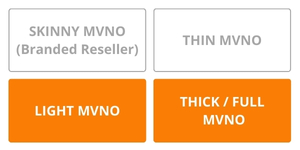
MVNO Type: Light MVNO for resale, Thick/Full MVNO for direct integration.
If you are reselling a satellite feature that your host operator already offers, a Light arrangement is sufficient. The capability sits with the host and you are packaging and billing it.
If you integrate a satellite operator yourself, the requirements escalate quickly. You need your own core to steer between terrestrial and non-terrestrial access, your own IMSI and numbering handling, and regulatory authorisation in every market you operate in. That is Thick or Full territory.
See also: Different types of MVNOs
What is the expected time to launch for Satellite / Direct-to-Device MVNOs?
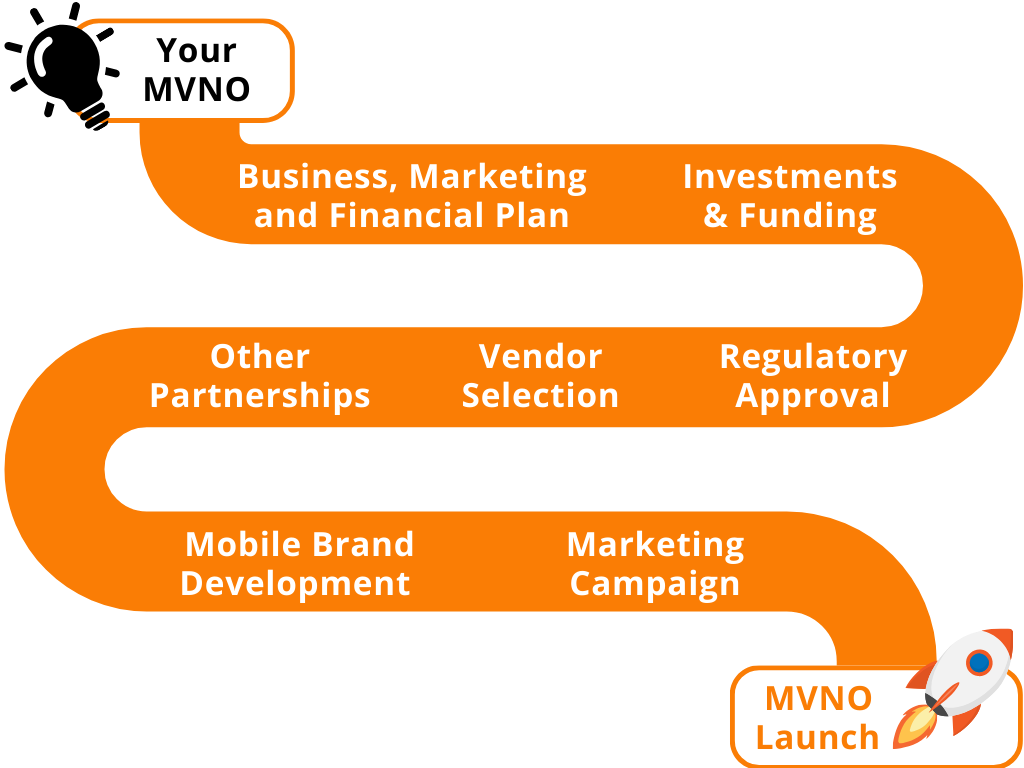
Expected time to launch: 6-12 months (Light), 18-30 months (Thick/Full).
The add-on route is fast because the hard work has been done upstream, assuming access is granted, which is the gating item rather than any engineering task. Budget most of that time for commercial negotiation and for product and billing changes, not technical build.
Direct integration is dominated by regulatory authorisation, which runs per market and cannot be parallelised as much as you would like. Device certification adds further time.
What is the expected impact of 5G for Satellite / Direct-to-Device MVNOs?
5G is what turns satellite from a parallel system into part of the same network. 3GPP has standardised non-terrestrial networks within 5G NR, which means satellite becomes a defined access type that the core can steer traffic to, rather than a separate service bolted on the side. In practice that is what allows an ordinary phone to move between tower and satellite without the user doing anything.
Capacity is the constraint that matters, and it is expected to improve substantially with newer constellations. One figure quoted for next generation satellites is roughly a hundred times the data density of the current generation, with deployment indicated for 2027
For more details see the Mobile Network section.

What is the expected impact of eSIM for Satellite / Direct-to-Device MVNOs?

eSIMis close to a prerequisite here rather than an enhancement.
Profile management across access types. Moving a device between terrestrial and non-terrestrial service, or between operators in different regions, is a profile problem. eSIM is what makes it manageable at scale.
Remote provisioning for unreachable devices. For IoT deployed beyond terrestrial coverage, such as a buoy, a pipeline sensor or a shipping container, you may never physically touch that SIM again. The IoT remote provisioning specification exists precisely for this situation.
For more details see the SIM section.
IoT and its Relation to Satellite / Direct-to-Device MVNO
IoT is the most commercially ready part of direct to device today, and arguably the reason to enter this market at all. The traffic profile suits the constraint: small payloads, tolerant of latency, sent periodically rather than continuously. That is exactly what a capacity limited satellite link handles well, and exactly what consumer browsing does not.
- Asset tracking across coverage gaps. Containers, trailers, rail wagons and plant that pass in and out of terrestrial coverage on every journey.
- Agriculture. Soil, irrigation and livestock monitoring across land that will never justify a tower.
- Energy and pipelines. Flow, pressure and integrity monitoring along corridors hundreds of kilometres long.
- Maritime. Vessel telemetry, catch reporting, buoys and navigation aids.
- Environmental monitoring. River gauges, wildfire detection, seismic and weather stations in remote terrain.
- Utilities and infrastructure. Remote substations, water and reservoir telemetry.
The commercial argument is straightforward. Where the alternative is a dedicated satellite terminal per site, a low bandwidth subscription on a standard cellular module is dramatically cheaper to deploy and maintain. That comparison, rather than any consumer proposition, is where the near-term revenue sits.
What are the benefits of launching Satellite / Direct-to-Device MVNO
Differentiation your host-network competitors may not have. If you secure access and they do not, you have something they cannot replicate by cutting price.
It addresses the most common complaint in mobile, which is no signal, rather than competing on the axes everyone else uses.
It opens genuinely new segments that terrestrial coverage cannot serve at any price.
Strong retention effect. Coverage that a customer relies on for safety is not something they churn away from casually.
A credible IoT growth path with clear economics against the incumbent alternative.
Positioning. Being early and accurate on a fast moving topic builds standing with customers and partners.
Frequently Asked Questions
1. What is a satellite or direct-to-device MVNO?
An MVNO whose proposition includes connectivity to low earth orbit satellites for ordinary, unmodified handsets, using terrestrial mobile spectrum. The customer's phone connects to a satellite when no tower is in range, without special hardware. It is sold either as an add-on to a normal plan or as part of a premium tier.
2. Can MVNOs actually get access to satellite connectivity?
Not automatically, and this is the most important question to resolve before building any plans. At least one major satellite and operator partnership has explicitly excluded MVNO access, and industry commentary in 2026 raised the concern that this could become standard practice. The protection is a parity of access clause in your wholesale agreement, covering not only current features but ones introduced during the term. Check your existing contract before assuming.
3. Does it work with normal phones?
That is the defining characteristic, with no dish and no satellite handset required. But support varies by device model and by which D2D implementation your supply arrangement uses, so "normal phone" does not mean "every phone". Confirm the supported device list and publish it, rather than letting customers discover the limits after purchase.
4. Is it fast enough for calls and browsing?
Today, generally no. Current services are oriented to text messaging and low bandwidth data, with voice supported in some cases and still limited. This is a capacity constraint rooted in physics, since one beam covers a very large area and everyone within it shares the throughput. Newer constellations are expected to improve this substantially, but you should sell what works now rather than what is promised.
5. For IoT, is NTN better than a traditional satellite terminal?
For low bandwidth periodic reporting, usually yes on cost. A standard cellular module with NTN capability is far cheaper to buy, deploy and maintain than a dedicated satellite terminal per site, and it uses the same device management as the rest of your estate. A dedicated terminal still wins where you need continuous higher bandwidth links or guaranteed availability.
6. What regulatory approvals are needed?
This varies by country and is one of the more demanding aspects of direct integration. Expect to deal with spectrum authorisation for satellite use of terrestrial bands, landing rights, and national rules on emergency calling and lawful intercept. Approvals do not travel across borders, so each market is a separate exercise. If you resell through a host operator that already holds the authorisations, most of this sits with them, which is another reason the add-on route is more accessible.
Summary
Satellite direct to device is the newest genuine category in mobile and the only one that changes what coverage means. For an MVNO the opportunity is real: a differentiator customers immediately understand, access to segments terrestrial networks cannot serve, and an IoT proposition with clear economics against dedicated satellite hardware.
But the first question is not technical or commercial in the usual sense. It is whether you are permitted to sell it at all. Early partnerships have excluded wholesale customers, and an MVNO whose agreement is silent on satellite may find the next major coverage differentiator simply unavailable. Resolve that, then build.
Be honest about capability in the meantime. This is messaging, not broadband, and the operators who set expectations accurately will keep the customers that the ones who over-promise lose.
MVNO Business Models