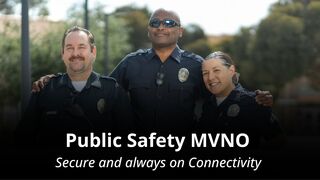
Public Safety MVNO
Introduction about starting a Public Safety MVNO (Mobile Brands)
Emergency services worldwide are migrating from narrowband radio (TETRA, P25, TETRAPOL) to broadband LTE and 5G. Radio gave them something consumer networks never had to provide: instant group voice, guaranteed access during a crisis, and coverage designed around incidents rather than population density. Broadband gives them video, data and a far larger device ecosystem, but only if those original guarantees can be reproduced.
That gap defines the market. A public safety operator is not selling a cheaper tariff to a new segment. It is selling a set of guarantees, namely priority, pre-emption, resilience and security, that a standard mobile service does not offer at any price.
It is also the model where the letters "MVNO" are least automatic. Dedicated national networks and 5G network slices compete directly with the MVNO route, and deciding between the three is the first strategic question, not a technical detail settled later. This page covers all three, because a reader who chooses badly here loses years.
The Public Safety MVNO is one of 20 MVNO business models — compare them on tier (type), financing, expected ARPU and launch time.
What do you need to know about starting a Public Safety MVNO
- What are the advantages and disadvantages ?
- What are the Revenue sources and Pricing strategy?
- What are suitable segments?
- What kind of Mobile bundles are typically used?
- What kind of ARPU can you expect?
- What is the Go-to-Market Strategy?
- What are some points to think of for the Marketing Plan?
- What kind of financing is to be expected?
- What kind of MVNO type is typically used?
- What is the expected time for the launch?
- What is the expected impact of 5G?
- What is the expected impact of eSIM?
- IOT and its Relation to Public Safety MVNOs
- Benefits of Launching Public Safety MVNO
- Frequently Asked Questions
- Summary
What are the advantages and disadvantages of a Public Safety MVNO?
- Contracts measured in years, not months. Framework agreements commonly run five to ten years, with churn close to zero once dispatch and control room systems are integrated.
- Switching costs work in your favour. An agency that has built its operating procedures around your service does not change supplier casually.
- Funding is stable. Public safety budgets are politically protected in most markets and survive downturns better than consumer discretionary spend.
- Price is not the primary axis. You compete on resilience, coverage and capability, which is a far more defensible position than undercutting.
- The application layer is yours to own. Push to talk, location, evidence handling and dispatch integration generate more margin than airtime.
- Procurement is slow and formal. Twelve to thirty-six months from first contact to contract is normal, and you fund that period yourself.
- Few customers, large stakes. A national market may hold only a few dozen buying authorities. Losing one tender is material.
- Liability is different in kind. When a consumer network fails, customers complain. When this one fails during an incident, there are inquiries.
- The capability bar is high. Priority, pre-emption and mission critical voice are not features most host operators offer off the shelf. Each needs a bespoke wholesale agreement.
- Compliance overhead is continuous. Security accreditation, cleared personnel, data residency and audit are running costs, not a one-off.
What are the Revenue sources and Pricing strategy?
Revenue sources
-
- Per-user subscriptions. Usually banded by role, so a frontline officer with priority, video and push to talk costs more than an administrator.
- Mission critical application licences. MCPTT, MCData and MCVideo, sold per seat.
- Device as a service. Ruggedised handsets, vehicle routers and body-worn cameras, supplied and managed rather than sold.
- Integration and professional services. Control room, computer aided dispatch and records systems.
- Deployable coverage. Portable cells and drone-borne relays, on retainer or per deployment.
- Data services. Evidence storage, retention and disclosure workflows.
Pricing strategy
Tender driven, and evaluated over total cost of ownership across the contract term rather than a monthly headline rate. Your comparison point is the agency's existing radio contract, including maintenance, terminals and control room infrastructure, not consumer tariffs. Price the guarantees explicitly. An availability commitment with defined pre-emption behaviour is the product, and it should appear as a line item rather than being bundled invisibly into airtime.
What are suitable segments for Public Safety MVNO?
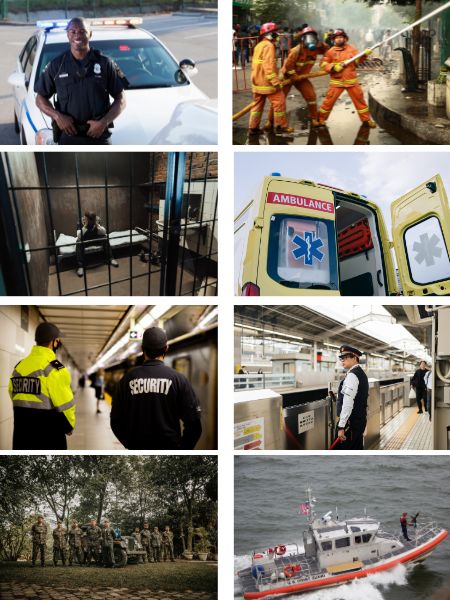
- Police forces. The largest single user group, and typically the anchor tenant that makes a business case work.
- Fire and rescue services. Heavy demands on device ruggedisation, in-building coverage and firefighter telemetry.
- Ambulance and emergency medical services. Pre-hospital patient data, vehicle telematics and hospital handover.
- Search and rescue, mountain and coastal rescue. These teams operate precisely where terrestrial coverage ends.
- Emergency management and civil protection agencies. Coordination across multiple services during major incidents.
- Utility emergency and restoration crews. Storm and outage response, often working alongside emergency services.
- Border, customs and coastguard. Wide area coverage and cross-jurisdiction working.
- Prison and correctional services. Controlled environments with unusual security constraints.
- Transport authority incident teams. Highways, rail and metro response.
- Hospital and major trauma networks. Where clinical and emergency response overlap.
What kind of Mobile bundles are typically used for a Public Safety MVNO?
Data: High uplink data for body-worn and vehicle video, mapping and telemetry, with guaranteed capacity that holds when an incident congests the cell.
Voice: Mission critical push to talk group calling with priority and pre-emption, plus direct mode for when infrastructure is unavailable.
SMS: Alerting, dispatch messaging and status updates that must still be delivered when the network is under load.
What kind of ARPU can you expect for a Public Safety MVNO?
ARPU: High.
Why: revenue per user sits far above consumer levels, but the airtime component is not what gets you there. The subscription carries priority handling, mission critical applications, managed devices and support obligations. Agencies accept that pricing because the comparison is a dedicated radio network with its own terminals and maintenance contract, which is substantially more expensive per user.
What it is based on: guaranteed service levels, application licensing and device management, rather than data volume. Modelling this as a data consumption business will produce the wrong answer.
Work the detail through in your Financial Plan. Note that the compliance and accreditation burden is a fixed cost that does not scale down, so a small agency contract can be unprofitable at the same per-user price that works for a national force..

What is the Go-to-Market Strategy for a Public Safety MVNO?

Public safety is bought, not sold, and it is bought through formal procurement. The go-to-market question is therefore less about demand generation than about eligibility and evidence.
- Get onto the framework first. In most markets you cannot bid without being on an approved supplier framework, and that qualification is itself a project with a lead time.
- Win one reference deployment. The first agency is the hardest and the most important. Every subsequent tender will ask who else uses you.
- Partner rather than build everything. Mission critical platform vendors, ruggedised device manufacturers, dispatch and records vendors, and systems integrators who already hold the relationships.
- Plan for parallel running. No agency switches off its radio network on a Friday. Expect several years of dual operation and price it in.
- Engage early in the specification. Requirements are often shaped a year or more before a tender is published. Suppliers absent from that conversation end up bidding against someone else's specification.
What are points to think of for the Marketing Plan for a Public Safety MVNO?
You need to work out below points in your Marketing Plan.
USP. Guaranteed access during an incident. Everything else is supporting detail.
Evidence over adjectives. Publish coverage data, availability figures and incident performance. This audience discounts marketing language heavily and rewards numbers it can check.
Channels. Sector conferences, standards bodies, professional associations and trade press. Consumer marketing channels are irrelevant here.
Audience. You are writing for procurement officers, chief officers and technical authorities, three readerships with different questions, often reading the same document.
Reputation asymmetry. One publicised failure will outrun ten quiet successes. Build incident communications planning before you need it.

What kind of financing is to be expected for Public Safety MVNOs?

Financing: High
The cost base is unusual in three ways. First, you will likely need core network elements of your own, or a dedicated hosted core, because priority handling, sovereign data residency and lawful intercept obligations are hard to satisfy on a light arrangement. Second, mission critical platform licensing and security accreditation are significant and start before any revenue. Third, and most often underestimated, the procurement cycle means eighteen to thirty-six months of funded operation before the first invoice.
Device inventory and deployable assets add further working capital if you offer device as a service. Work the detail through in your Financial Plan.
What kind of MVNO type is typically used for Public Safety MVNOs?
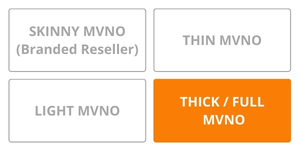
MVNO Type: Thick/Full MVNO
The reasoning is requirement driven rather than preference. Priority and pre-emption need control over policy and charging. Sovereignty and data residency rules often require the core to sit inside national borders and be operated by cleared personnel. Lawful intercept obligations attach to the operator holding the subscriber records. None of that survives a branded reseller or light arrangement.
Consider the alternatives honestly. The MVNO route is one of three, and not always the right one.
- Dedicated network. Own spectrum and infrastructure. Maximum control, maximum cost, and generally only viable at national scale with government backing.
- Network slice. A logically separated slice of a commercial 5G network with contractual quality of service. Faster and cheaper than a dedicated build, and increasingly the mainstream answer.
- MVNO. Makes most sense where an organisation wants its own subscriber relationship, applications and devices, without operating radio infrastructure.
See also: Different types of MVNOs
What is the expected time to launch for Public Safety MVNOs?
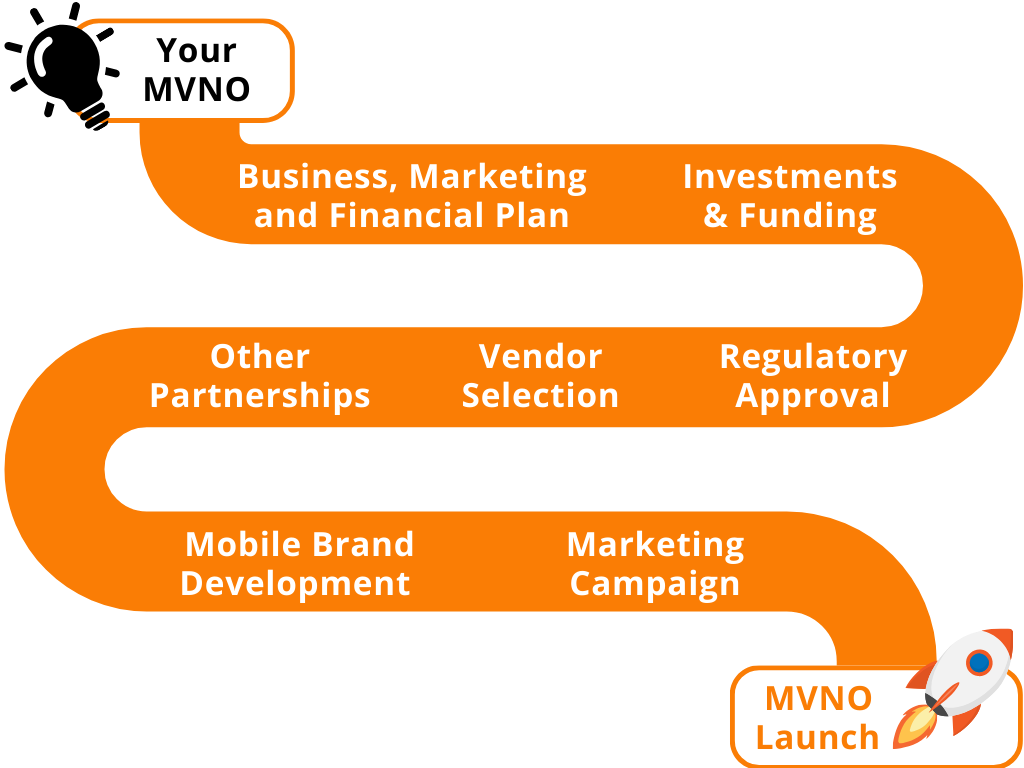
Expected Time to Launch: 18-36 months
The technical build is rarely the critical path. Procurement timetables, security accreditation and integration with existing control room systems dominate the schedule, and none of them compress easily. Accreditation in particular is sequential, since some assessments cannot begin until earlier ones have completed.
Where time can be recovered: start framework qualification and security accreditation in parallel with commercial discussions rather than after them, use an established mission critical platform rather than building one, and target a single agency for a first deployment rather than a national rollout.
What is the expected impact of 5G for Public Safety MVNOs?
5G is what makes broadband credible for mission critical use, principally through network slicing. A slice provides logical separation and contractual quality of service on a commercial network. It is the guarantee that narrowband radio provided physically, delivered commercially instead. Reported deployments include operators running public safety specific slicing, and at least one public safety network has moved to a 5G standalone core with per-application slicing (reported mid-2026, worth verifying current status before citing).
Beyond slicing, low latency makes remote operation of drones and ground robots practical, high uplink supports several simultaneous live video feeds from one incident, and edge compute allows analytics to run on scene rather than backhauling everything.
For more details see the Mobile Network section.

What is the expected impact of eSIM for Public Safety MVNOs?

eSIM matters here for two reasons that differ from the consumer case.
Fleet provisioning. Agencies manage thousands of devices across vehicles, stations and personal issue. Remote provisioning removes physical handling from the deployment and replacement process entirely.
Resilience through multiple profiles. A device that can fall back to a second network when the primary is unavailable is a genuine mission critical capability, not a convenience. This is one of the strongest arguments for eSIM in the sector.
One caution. Some agencies' security policies restrict remote provisioning, on the grounds that anything that can be changed over the air can be attacked over the air. Expect to support removable SIM alongside eSIM for some customers. For more details see the SIM section.
IoT and its Relation to Public Safety MVNO
Public safety generates one of the densest device-per-user ratios of any sector. A single frontline officer may carry or be accompanied by several connected devices, and the vehicle adds more.
- Body-worn cameras. Continuous or triggered upload, heavily uplink biased.
- Vehicle telematics and ANPR. Location, status, automatic number plate recognition, and in-vehicle networks acting as local hubs.
- Firefighter physiological monitoring. Heart rate, core temperature, motion and man-down detection, plus breathing apparatus telemetry.
- Hazmat and gas sensors. Atmospheric readings streamed to incident command.
- Drones and ground robots. Aerial survey, hazardous area entry and live video.
- Environmental early warning. Flood gauges, wildfire detection and seismic sensors, feeding the same operational picture.
- Asset and equipment tracking. Including controlled items with strict accountability requirements.
The operational value is not the individual device but the combined picture. A commander who can see where personnel are, what they are breathing and what the drone can see, on one screen, is the outcome being purchased. That integration layer is where a public safety operator differentiates.
What are the benefits of launching Public Safety MVNO
Exceptionally low churn. Once integrated into operational procedure, the service becomes part of how the agency works.
Revenue visibility. Multi-year framework contracts with defined user numbers make forecasting unusually reliable.
Competition on capability, not price. A market where the cheapest bid does not automatically win.
Adjacent markets open up. Utilities, transport, critical infrastructure and private security have overlapping requirements and shorter sales cycles.
Capability that transfers. Priority handling, resilience engineering and security accreditation are assets you can sell into enterprise markets.
Public value. Rarely decisive commercially, but it matters for recruitment, partnerships and standing in the sector.
Frequently Asked Questions
1. What is a public safety MVNO?
A mobile operator serving police, fire, ambulance and related emergency services, providing priority and pre-emption over civilian traffic, mission critical push to talk voice, and the security and resilience guarantees those organisations require. It runs on a host operator's radio network but typically controls its own core, applications and devices.
2. Is an MVNO the right model, or should agencies use a dedicated network or a slice?
All three are in use. A dedicated network offers maximum control at a cost usually only viable nationally with government backing. A 5G network slice provides contractual quality of service on a commercial network and is increasingly the mainstream answer. The MVNO model fits where an organisation wants to own the subscriber relationship, applications and devices without operating radio infrastructure. The right answer depends on scale, budget, and how much control is genuinely required rather than assumed.
3. What is MCPTT and why does it matter?
Mission Critical Push To Talk is the 3GPP standardised replacement for the instant group voice that narrowband radio provided. It matters because it is the capability agencies will not give up: one button, immediate talkgroup voice, with priority and emergency call handling. Broadband without it is not a credible replacement for radio.
4. Does this apply to military communications?
Partly, and the distinction is worth being precise about. Tactical military communications sit outside the MVNO model. They use dedicated, hardened and often deployable systems on sovereign spectrum, frequently with satellite or HF links, designed to work with no commercial infrastructure at all. What can be served by an MVNO is the non-tactical remainder: garrison and base connectivity, logistics fleets, administrative users and personnel welfare. That is closer to a government enterprise contract than to a mission critical deployment.
5. What accreditations and certifications are needed?
This varies substantially by country and there is no universal list. Expect requirements covering personnel security clearance, data residency and sovereignty, encryption standards, lawful intercept, service availability commitments and independent security assessment. Because these are jurisdiction specific, treat accreditation as a per-market project rather than something achieved once and reused.
6. How long does it take to launch a public safety MVNO?
Typically eighteen to thirty-six months. Procurement timetables and security accreditation set the pace, not the network build. Framework qualification alone can take many months before you are eligible to bid.
Summary
The public safety MVNO sells guarantees rather than connectivity. Priority and pre-emption, mission critical group voice, resilience and security are the product, and airtime is the delivery mechanism. That makes it structurally different from every other model here. The buyer is a public authority working to a formal procurement timetable, the contract runs for years, churn is close to zero, and price is not the deciding factor.
The trade-off is patience and capital: eighteen to thirty-six months of funded operation before revenue, a continuous compliance burden, and a small number of high-stakes customers. And there is the honest caveat that runs through this page. The MVNO route competes with dedicated networks and 5G slices, and for many agencies one of those will be the better answer. An operator entering this market should be able to say clearly why the MVNO model is right for the specific customer in front of them, because the customer will ask.
MVNO Business Models