Cloud Native for MVNO
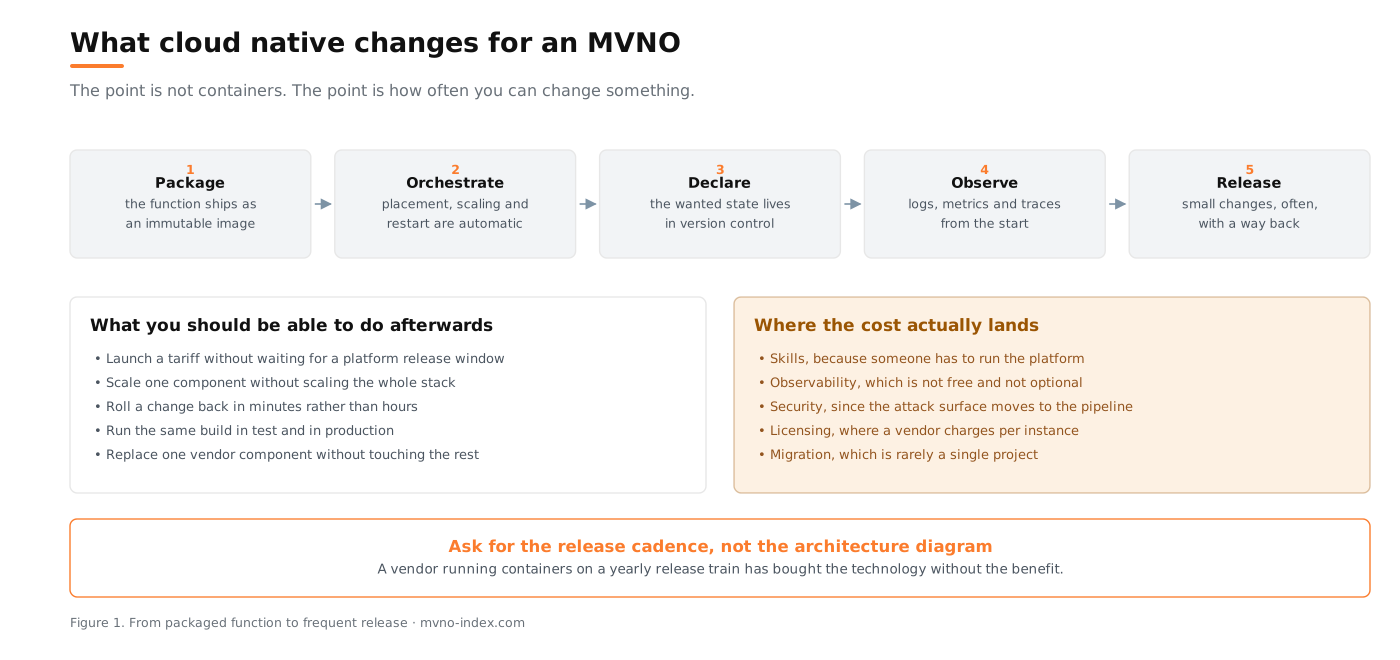
A cloud native MVNO runs its platform as loosely coupled services that are packaged as immutable images, placed and scaled automatically, described by configuration held in version control, and observed from the start. The CNCF definition names containers, service meshes, microservices and declarative APIs among the techniques. What it buys an operator is release frequency: the ability to launch a tariff or fix a defect without waiting for a quarterly platform window.
A cloud native MVNO uses software and operating practices designed for automated deployment, managed change and scalable services. The approach may cover customer systems, billing, operational platforms and network functions. It can run on public, private or hybrid infrastructure. Hosting an existing application on a cloud server does not by itself establish that the application has these characteristics.
For an MVNO, the practical benefit is the ability to change and operate services reliably as the business grows. That benefit depends on architecture, integration and the team's operating model. Evaluate a cloud native proposal through real product changes, recovery tests and complete costs, rather than treating containers or a cloud-provider logo as evidence of a better mobile service.
On this page
- History and Evolution of Cloud Native MVNOs
- Core Utility and Functionality of a Cloud Native MVNO
- What is a Cloud Native Platform Used For?
- Key Functions of a Cloud Native Operating Model
- Technical Integration and Data Model
- Integration with Other Systems
- Technical Data Model and Key Interfaces
- Cloud Platform Ownership for MVNOs and IoT Companies
- Why Choose a Cloud Native Model?
- Advantages and Disadvantages of a Cloud Native MVNO
- Organizational Impact of a Cloud Native MVNO
- Redundancy and High Availability
- Impact of 4G and 5G and Future Networks
- Cloud Native Operations in 4G Services
- Cloud Native Operations in 5G Services
- Preparing for Future Services
- Frequently Asked Questions about Cloud Native MVNOs
- Summary
History and Evolution of Cloud Native MVNOs
Telecom platforms have moved from dedicated appliances towards virtualised software and increasingly automated infrastructure. Virtualisation separates software from a particular physical server, while cloud native approaches also change how applications are designed, released and managed. The two ideas are related, but they are not interchangeable descriptions of the same implementation.
MVNO platforms have followed different paths. Some businesses buy a managed suite, while others combine specialist products and operate selected components themselves. The OSS and BSS environment and the mobile core may therefore mature at different speeds. A realistic transformation plan accounts for those differences instead of assuming every component must be replaced together.
Core Utility and Functionality of a Cloud Native MVNO
What the label should mean, and how to check it
| The claim | The question that tests it |
|---|---|
| It runs in containers | How many releases did you ship last quarter |
| It scales automatically | Which component scaled last, and what triggered it |
| It is API first | May we see the API description, not the brochure |
| It is observable | Can you trace one subscriber request end to end |
| It is resilient | What happened the last time an instance died |
| It is portable | Has this ever run anywhere other than your own cloud |
What is a Cloud Native Platform Used For?
A cloud native platform supports the operational work behind launching and maintaining mobile products. Automated environments can make changes more repeatable, and independently managed services can reduce the scope of some updates. These capabilities are useful when the MVNO needs frequent tariff changes, partner integrations or capacity adjustments without a large manual deployment exercise each time.
The customer outcome still matters more than the internal architecture. An activation must complete, a payment must be recorded correctly and a support agent must see accurate service status. Cloud native design should make these journeys easier to operate and improve. It does not remove the need for clear product rules or well-tested connections to the host network.
Key Functions of a Cloud Native Operating Model
Automation manages infrastructure and application configuration through repeatable definitions. Teams can rebuild an environment from controlled records rather than relying on undocumented manual changes. This improves consistency only if the definitions are maintained and access to change them is controlled. An automated mistake can otherwise spread more quickly than a manual one.
Observability provides evidence about service behaviour through useful metrics, logs and traces. The important measure is whether teams can diagnose a failed customer journey across several components. A collection of infrastructure charts is insufficient if no one can explain why a SIM order completed in billing but never became active on the network.
Controlled delivery allows software changes to be tested, introduced and, where supported, reversed with a limited impact. Compatibility between services and data versions remains essential. A platform that deploys frequently but cannot recover safely from an unsuccessful database change has not solved the operating problem that matters to customers.
The vocabulary here is not ours alone. The CNCF Telecom User Group has written up cloud native thinking for telecommunications, which is a useful reference when a supplier and a buyer are using the same words for different things.
Technical Integration and Data Model
Integration with Other Systems
The platform must connect customer channels, billing, payment services, provisioning and the relevant network functions. A cloud deployment does not make external interfaces more complete or more reliable. Agree ownership for each integration and define how timeouts, retries and partial failures are handled. The product should remain understandable when one dependency is unavailable.
Host-network access often imposes practical constraints on connectivity, security and supported procedures. An MVNO may need private links, approved interfaces or specific deployment locations. Review these requirements before selecting infrastructure. Moving an application to another region can change latency, data handling and the cost of connecting to the host.
The 5G Core architecture uses service-based interactions for relevant control-plane functions, but that does not make every implementation operationally cloud native. Ask how the actual product manages state, upgrades, scaling and failure. Standards alignment and deployment quality answer different questions and both require evidence.
Technical Data Model and Key Interfaces
Separate the commercial customer, subscription, SIM, service and network-state records. They may be stored in different systems, but their relationships must remain explicit. When a user cancels a product, the platform needs a controlled workflow that updates billing and network service consistently. Distributed software makes this coordination more important, not less.
The point is not containers. The point is how often you can change something.
Interfaces should document identifiers, supported versions, error responses and duplicate-request behaviour. A repeated activation request should not create multiple charges or conflicting service states. Asynchronous operations need status tracking so the customer channel can distinguish accepted, in progress, completed and failed. This is a product requirement as well as an engineering detail.
Stateful services need a clear recovery design. Restarting an application instance does not necessarily restore a lost transaction or subscriber context. Ask which data is replicated, how consistency is maintained and what happens during a regional connectivity failure. Request a demonstration that follows an actual transaction through recovery, including the final customer-visible result.
Cloud Platform Ownership for MVNOs and IoT Companies
Where the cost of cloud native actually lands
| Cost | Why it is easy to miss in a business case |
|---|---|
| Platform skills | Someone has to run the orchestration layer |
| Observability | Priced per volume, and the volume grows with you |
| Pipeline security | The attack surface moves to the build chain |
| Licensing per instance | Scaling out multiplies a per-node fee |
| Migration | Rarely one project, usually several years |
| Exit | Managed services are the hardest part to take with you |
Why Choose a Cloud Native Model?
An MVNO may choose this model to support faster product changes, automated operations or growth across several markets. It can consume those capabilities as a managed service without operating the underlying infrastructure itself. The right ownership model depends on the skills available, the desired control and the business consequences of platform failure.
IoT businesses can benefit from repeatable provisioning and integration with device and application platforms. Their workloads may include large activation batches and long periods of low traffic. Test both patterns. A system that scales smoothly for steady retail transactions may behave differently when a factory activates thousands of devices within a short window.
Advantages and Disadvantages
Advantages:
Repeatable deployment can reduce configuration drift and make testing more representative of production. Modular services may allow selected functions to scale or change independently. These benefits are strongest when interfaces are stable and the provider has disciplined operations. Ask for evidence from realistic workloads rather than assuming the architecture automatically delivers shorter release cycles.
A managed cloud platform can also reduce the amount of infrastructure an MVNO has to maintain directly. This can free a small team to concentrate on products and customer service. The contract should still provide visibility into service health, access to data and clear responsibilities for incidents, upgrades and security maintenance.
Disadvantages:
- Distributed platforms introduce dependencies between applications, databases, networks and infrastructure services. A fault can be difficult to diagnose when each supplier sees only its own component. More independently deployable services can also mean more configuration, monitoring and version relationships to manage. Simplicity should remain an explicit design objective.
- Costs can be harder to predict than a single fixed platform fee. Compute, storage, traffic, support and software licences may all vary separately. Data transfer and duplicated recovery environments can be material. Compare the full operating cost at launch, expected scale and failure conditions before deciding that a consumption-based price will be cheaper.
Organizational Impact of a Cloud Native MVNO
Cloud native operations require clear ownership of releases and service reliability. Even with a managed supplier, the MVNO needs someone who can assess changes, coordinate customer impact and challenge unexplained incidents. Outsourcing platform operation does not outsource responsibility for the retail promise made to subscribers.
Procurement should examine the cost and practicality of leaving the platform. Data export alone may not reproduce product rules, workflows or integrations elsewhere. Request documentation of configurations and dependencies, together with migration assistance and a clear termination process. Test a sample export before signing so portability is demonstrated rather than merely described.
Security responsibilities need to be divided across the infrastructure provider, platform supplier and MVNO. Identity management, patching, secret handling and incident response may belong to different parties. Record who performs each task and what evidence the MVNO receives. A general statement that the cloud is secure does not define operational accountability.
For supplier selection, request a demonstration of a complete product change. Ask the provider to add an offer, activate a test subscription, bill it, introduce a controlled failure and recover. The solution provider selection guide can help structure the comparison, but the acceptance criteria should reflect your intended mobile business.
Redundancy and High Availability
High availability is an architectural outcome, not a property conferred by using several containers. Independent failure domains, reliable data handling and sufficient surviving capacity all matter. A second application instance provides little protection if both instances depend on the same unavailable database, network path or identity service.
Define recovery objectives at the customer-service level. Establish how long activation, usage reporting and customer support may be unavailable, and how much recent data loss is acceptable for each function. Different services may need different designs. A billing record and a temporary dashboard metric do not necessarily require the same recovery treatment.
Test loss of a component and, where relevant, an entire deployment location. Verify that monitoring detects the failure, traffic reaches healthy services and state remains consistent. Include restoration after the outage, because returning to normal operation can expose problems that are not visible during initial failover. Keep the test evidence current after significant changes.
Impact of 4G and 5G and Future Networks
Cloud Native Operations in 4G Services
An MVNO can modernise customer systems and operational workflows while continuing to sell LTE services. The access generation does not determine whether billing or provisioning can be automated. Prioritise changes that address actual operating problems, such as slow activation or repeated invoice errors, rather than requiring a network-generation change first.
Cloud Native Operations in 5G Services
5G deployments can increase the number of services and interfaces an operator manages. Automation and observability can help, but commercial access remains dependent on host agreements and implementation support. A cloud native core does not automatically grant an MVNO network slicing, exposure APIs or control over radio resources.
Preparing for Future Services
Maintain documented interfaces, portable business data and a tested upgrade process. These provide practical flexibility as networks evolve. Avoid purchasing an unspecified future capability solely because it appears on a roadmap. Contract for delivered functions and define how later features will be evaluated, priced and accepted when they become available.
Frequently Asked Questions about Cloud Native MVNOs
Is a hosted MVNO automatically cloud native?
No. Hosting describes where software runs. Cloud native describes architectural and operating approaches that support automation, scalability and managed change. Ask how the actual platform is deployed, upgraded, monitored and recovered.
Does cloud native require a public cloud?
No. Public, private and hybrid infrastructure can support cloud native approaches. Choose the deployment model around service requirements, operational capability, host connectivity and complete cost rather than a single infrastructure label.
Are containers enough to prove the claim?
No. A container can package software without changing its underlying dependencies or recovery behaviour. Evaluate state management, interfaces, deployment automation and failure handling through practical demonstrations.
Can a small MVNO use this model?
Yes, often through a managed platform. The MVNO still needs clear service requirements and supplier oversight. Operating every infrastructure component directly is not a prerequisite for benefiting from automated platform services.
Will it always reduce cost?
No. Savings depend on workload, licensing, operations and the resources required for resilience. Model the full bill at several growth levels and include traffic, storage, support, integration and migration costs.
What should a platform trial demonstrate?
It should demonstrate a complete customer journey, a controlled product change and recovery from a realistic failure. Verify billing accuracy, observability and operational ownership alongside deployment speed before committing to the platform.
Can the platform be moved between cloud providers?
Potentially, but portability depends on the application and its dependencies. Proprietary databases, networking and operational services can make migration substantial. Request a documented migration approach and evidence that configurations and data can be exported usefully.
Summary
A cloud native MVNO uses automation and appropriate software architecture to operate and change mobile services reliably. The value depends on demonstrated customer outcomes, clear responsibilities and manageable costs across the complete platform.
Shortlist partners through the MVNO Index solution provider directory and request a proposal covering integration, operations, recovery and exit. Compare the delivered service and evidence from testing before choosing a deployment model.
General Information