The Entitlement Server: Why Wi-Fi Calling Is Greyed Out
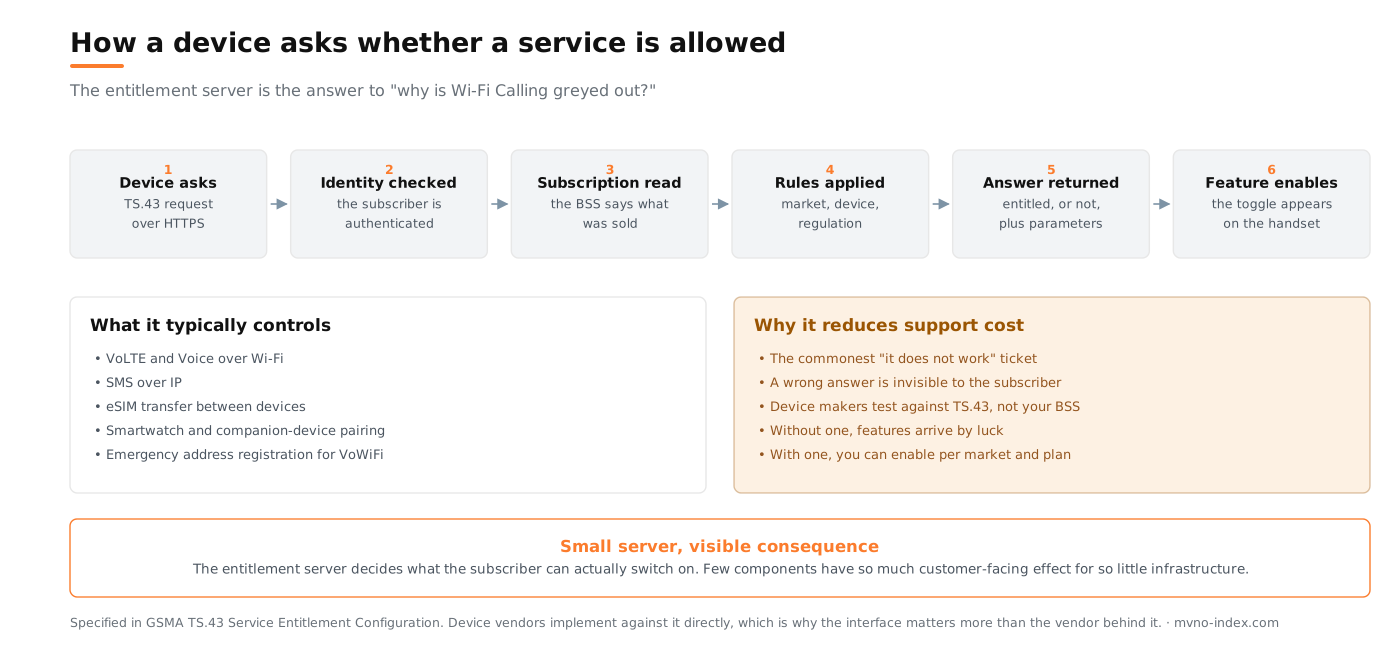
An entitlement server tells a device whether a service may be switched on. When a handset asks whether Wi-Fi Calling, VoLTE, SMS over IP or an eSIM transfer is permitted for this subscriber, the entitlement server checks the subscription and the market rules and answers. Using the interface defined in GSMA TS.43. It is small infrastructure with very visible consequences.
The Entitlement Server (ES) is a critical and increasingly important platform component within the architecture of modern mobile operators, MVNOs, and IoT service providers. Understanding its purpose is essential for any operator that wants to deliver device-level service activation, feature enablement, and network capability unlocking in a controlled, automated, and scalable way. The Entitlement Server acts as the authoritative backend system that a device queries to determine which services, features, and network capabilities it is permitted to access based on the subscriber's current plan, the device type, the network generation in use, and the operator's business rules. It is the system that answers the device's fundamental question: "What am I allowed to use?" It governs features such as Wi-Fi Calling (VoWiFi), Voice over LTE (VoLTE), Rich Communication Services (RCS), eSIM consumer provisioning flows, and advanced 5G service entitlements. For any operator aiming to deliver a high-quality, self-configuring device experience while maintaining full control over which subscribers access which premium capabilities, deploying a capable Entitlement Server is not a luxury; it is a core operational requirement.
On this page
- History and Evolution of the Entitlement Server
- Core Utility and Functionality of the Entitlement Server
- What is the Entitlement Server Used For?
- Key Functions of the Entitlement Server
- Technical Integration and Data Model
- Integration with Other Systems
- Technical Data Model and Key Interfaces
- Entitlement Server Ownership for MVNOs and IoT Companies
- Why Own an Entitlement Server?
- Advantages and Disadvantages of Entitlement Server Ownership
- Organizational Impact of Entitlement Server Ownership
- Redundancy and High Availability
- Entitlement Server in the Context of eSIM and RCS
- Impact of 4G, 5G, and Beyond on the Entitlement Server
- Entitlement Server Continuity Across Network Generations
- 5G and 6G Architecture Implications
- Frequently Asked Questions about the Entitlement Server
- Summary
History and Evolution of the Entitlement Server
The concept of a dedicated Entitlement Server emerged in the early 2010s as device manufacturers and mobile operators began deploying VoLTE and Wi-Fi Calling at scale and needed a standardized, automated mechanism to configure devices with the correct service settings without requiring manual intervention from the subscriber or operator support teams. GSMA and 3GPP formalized the Entitlement Server architecture and its HTTP-based XML configuration protocol in a series of specifications, most notably the GSMA IR.92 (IMS Profile for Voice and SMS) ecosystem and the GSMA TS.43 standard, which defines the service entitlement configuration framework used by devices today. As eSIM adoption accelerated and Rich Communication Services (RCS) gained widespread traction, the Entitlement Server's scope expanded significantly to cover profile provisioning flows, RCS activation, and 5G feature gating, evolving from a VoLTE configuration helper into a central service control platform.
Core Utility and Functionality of the Entitlement Server
What the entitlement server actually controls
| Feature | What the subscriber sees | What goes wrong without it |
|---|---|---|
| VoLTE | Calls over 4G instead of falling back to 2G or 3G | Calls drop to legacy, or fail where legacy is switched off |
| Voice over Wi-Fi | The Wi-Fi Calling toggle in settings | The toggle is greyed out and nobody can explain why |
| SMS over IP | Messages that work without a circuit-switched fallback | Messages fail on Wi-Fi only |
| eSIM transfer | Moving a profile to a new phone without a shop visit | The customer calls support instead |
| Companion devices | A smartwatch sharing the subscriber's number | The watch cannot be activated |
| Emergency address | A registered address for VoWiFi emergency calls | A regulatory problem, not a feature problem |
What is the Entitlement Server Used For?
The Entitlement Server is the definitive backend authority for determining and communicating to a device which services and network features a subscriber is entitled to use at any given moment. When a subscriber inserts a SIM into a new device, powers on after a network change, or installs a new application such as an RCS messaging client, the device sends an entitlement query to the operator's Entitlement Server over a secure HTTPS connection. The server evaluates the request against the subscriber's current plan, the device's capabilities, the operator's service policies, and any network-specific rules, and returns a structured configuration response that tells the device precisely which features to activate, which settings to apply, and which services to register for.
This automated device configuration flow is what enables features like Wi-Fi Calling and VoLTE to activate seamlessly on a compatible device the moment a subscriber's plan includes those services, without any action required from the subscriber or the operator's customer care team. It eliminates the need for manual APN configuration guides, operator-specific device settings menus, and support calls triggered by subscribers who cannot access services they have paid for. For operators building their customer care strategy and aiming to reduce contact rates, the Entitlement Server is one of the highest-value automation investments available. Operators considering how to start their MVNO business should evaluate their entitlement strategy alongside their BSS and OSS platform selection, as the Entitlement Server sits at the intersection of both domains.
Key Functions of the Entitlement Server
Let us investigate the core functions of the Entitlement Server to understand its critical role in modern network operations and subscriber experience management:
- VoLTE Entitlement and Configuration: The Entitlement Server evaluates whether a specific subscriber on a specific device is permitted to use Voice over LTE, and returns the IMS configuration parameters required for the device to register for VoLTE service, including P-CSCF addresses, IMS APN details, and codec preferences.
- Wi-Fi Calling (VoWiFi) Entitlement: It determines whether the subscriber and device combination is authorized to use Wi-Fi Calling and returns the configuration required for the device to establish a secure IPsec tunnel to the operator's ePDG (Evolved Packet Data Gateway), enabling voice calls over Wi-Fi networks.
- RCS Service Entitlement and Activation: The server manages the activation and configuration of Rich Communication Services (RCS) on the subscriber's device, including providing the RCS APN, provisioning server address, and feature capability flags that control which RCS features (chat, file transfer, group messaging) the subscriber may use.
- eSIM Consumer Provisioning Entitlement: In eSIM workflows, the Entitlement Server plays a gatekeeping role, verifying that a subscriber is authorized to initiate a profile download or transfer before the device is directed to the SM-DP+ server. This is a key component of the SGP.32 Remote SIM Provisioning and consumer eSIM transfer flows.
- 5G Feature Entitlement: As operators deploy 5G networks, the Entitlement Server is used to gate access to 5G-specific features such as network slicing, enhanced IMS, and standalone 5G data capabilities, ensuring that only subscribers on qualifying plans and compatible devices can access those features.
- Device Capability Verification: Before returning an entitlement response, the server verifies that the requesting device actually supports the requested feature, cross-referencing the device's IMEI or device model against a device capability database to prevent mis-configuration of devices that lack the hardware or software support for a given service.
- Subscription Plan Validation: The server queries the operator's subscriber management or BSS layer in real time to confirm that the subscriber's current active plan includes entitlement to the requested service before granting access, ensuring that premium features are not activated on base-tier plans.
- Entitlement Token Issuance: For services that require ongoing authorization, the Entitlement Server can issue time-limited entitlement tokens that the device presents when registering for IMS or other services, enabling the operator to enforce re-validation at defined intervals without interrupting the subscriber's active session.
- Logging and Audit: The platform maintains a complete log of every entitlement query and response, providing operators with data for troubleshooting, billing verification, compliance, and service adoption analytics.
Technical Integration and Data Model
Integration with Other Systems
The Entitlement Server is a centrally connected platform that sits at the intersection of the device ecosystem, the core network, and the BSS layer. Its integration points span multiple systems and must be carefully designed to ensure that entitlement decisions are accurate, real-time, and consistent with the subscriber's current state across all connected platforms.
On the subscriber management side, the Entitlement Server integrates with the Home Location Register (HLR) or Home Subscriber Server (HSS) to verify subscriber identity and retrieve service profile data. It connects to the operator's BSS and product catalogue to validate plan entitlements in real time. For IMS-related features, it integrates with the IMS core, including the Session Border Controller (SBC), to supply correct configuration parameters. For RCS, it connects to the RCS platform or a third-party RCS aggregator. For eSIM workflows, it interfaces with the SM-DP+ and Subscription Manager infrastructure as part of the SGP.32 RSP architecture. It also integrates with device identity databases (TAC/IMEI databases) to perform device capability checks before issuing entitlement responses. For charging-related entitlements, it may interact with the Online Charging System (OCS) to verify real-time balance or quota status for feature access.
Technical Data Model and Key Interfaces
The Entitlement Server operates on a structured data model and uses standardized, well-documented protocols that enable reliable interoperability with the diverse range of devices and platforms it must serve:
- GSMA TS.43 HTTP/XML Protocol: The primary device-to-server communication protocol is based on HTTPS with an XML payload structure defined in GSMA TS.43. Devices send a structured HTTP GET or POST request containing their IMSI, IMEI, and requested service node, and the server returns an XML configuration document containing the entitlement verdict and all required service parameters.
- Subscriber Entitlement Policy Database: An internal database stores operator-defined entitlement rules, mapping combinations of subscriber plan, device capability class, and network type to specific service entitlement outcomes and configuration parameter sets.
- Device Capability Repository: A database of device model profiles, indexed by TAC (Type Allocation Code) derived from the IMEI, storing the feature support flags for each device model, used to verify that the requesting device can support the service being requested.
- Northbound REST/SOAP APIs: Integration interfaces with the BSS, product catalogue, and subscriber management systems, allowing the Entitlement Server to query plan and profile data in real time during entitlement evaluation.
- Audit and Analytics Database: A timestamped record of all entitlement transactions, capturing the query parameters, policy evaluation outcome, configuration response issued, and any error or exception conditions, used for operations, compliance, and service adoption reporting.
Entitlement Server Ownership for MVNOs and IoT Companies
Who answers the device, and what that costs you
| Arrangement | Who decides | Consequence |
|---|---|---|
| Host operator's entitlement server | The host | Their feature set, their launch pace, their market rules |
| MVNE-hosted | Your MVNE, on your rules | Workable for most; check how fast rules can change |
| Your own | You | Needed if you launch devices or markets on your own schedule |
| None at all | Nobody | Features appear by accident, and support carries the cost |
Why Own an Entitlement Server?
For a Full MVNO that offers IMS-based voice, Wi-Fi Calling, RCS messaging, or eSIM services, owning a dedicated Entitlement Server is the difference between delivering a seamless, premium subscriber experience and relying on a host MNO's generic entitlement policies that may not reflect the MVNO's own plan structures, device portfolio, or brand proposition. Without its own Entitlement Server, an MVNO cannot independently control which subscribers on which plans can access which features. Every entitlement decision is delegated to a third party, which introduces delays, inflexibility, and a fundamental loss of control over the subscriber experience. MVNOs that compete on service quality, feature richness, or a specific niche such as business mobility or healthcare connectivity will find that owning the entitlement layer is essential for delivering on their value proposition.
For IoT operators, the Entitlement Server plays a more targeted but equally important role, particularly in scenarios involving eSIM-enabled IoT devices that need to verify entitlement before initiating a profile download or service activation. Operators evaluating their platform stack should review how to find and select the right solution provider and include the Entitlement Server as a defined requirement alongside their core network elements and BSS/OSS selection.
Advantages and Disadvantages
Advantages:
- Full Control over service entitlement policies, enabling the operator to independently define which subscribers on which plans can access which features, without dependency on a host MNO's configuration.
- Superior Subscriber Experience through automated, real-time device configuration that activates services like VoLTE, Wi-Fi Calling, and RCS seamlessly on compatible devices without subscriber intervention.
- Reduced Customer Care Costs by eliminating the most common categories of service activation support contacts, as devices self-configure correctly the first time based on accurate entitlement responses.
- Plan and Product Agility enabling the operator to instantly reflect new plan tiers, promotional feature inclusions, or service restrictions in entitlement policy without waiting for a host network configuration change.
- eSIM and RCS Readiness providing the gateway control layer required for consumer eSIM provisioning flows and RCS activation in accordance with GSMA specifications.
- Detailed Analytics on service feature adoption rates, device capability distribution, and entitlement failure patterns, which directly inform product development and network investment decisions.
Disadvantages:
- Initial investment in platform licensing, integration development, and the specialist expertise required to configure and maintain entitlement policies across a complex plan and device matrix.
- Operational complexity in maintaining an accurate device capability database and keeping entitlement policies synchronized with the BSS product catalogue as plans and features evolve.
- The Entitlement Server must be kept current with evolving GSMA specifications (TS.43 updates, new feature node definitions) as new services and device generations are introduced, requiring ongoing platform maintenance investment.
- For smaller MVNOs with limited feature sets and a narrow device portfolio, the cost and complexity of owning an Entitlement Server may outweigh the benefits compared to leveraging a shared platform through an MVNE.
- Integration with multiple upstream systems (HLR/HSS, BSS, OCS, IMS, eSIM platform) requires careful API management and ongoing synchronization to prevent entitlement decisions from being based on stale subscriber data.
Organizational Impact of Entitlement Server Ownership
Analyzing the impact of integrating an Entitlement Server across the key dimensions of an operator's organization:
-
Operational Impact: The Entitlement Server introduces a dedicated operational responsibility for managing service entitlement policies and device capability data. Operations teams must maintain the entitlement rule engine to reflect the current plan portfolio accurately, update the device TAC database as new handsets enter the market, and monitor entitlement transaction success and failure rates to detect and resolve configuration issues before they affect subscribers at scale. Because the Entitlement Server is in the critical path for service activation on every new or upgraded device, monitoring and alerting on its availability and response time must be embedded in the operator's network operations center (NOC) procedures.
-
Financial Impact: The business case for owning an Entitlement Server is compelling for operators at meaningful scale. The reduction in customer care contacts for service activation failures, APN misconfiguration, and Wi-Fi Calling setup issues can deliver significant savings in support costs within the first year of deployment. The ability to instantly activate new premium features on qualifying subscriber devices without manual intervention also accelerates revenue realization from new product launches. Operators building their financial plan for their mobile brand should model the contact rate reduction benefits of automated entitlement alongside the platform investment cost.
-
Security Impact: The Entitlement Server handles authenticated subscriber identity data and governs access to premium network services. It must enforce strong mutual authentication between itself and the querying device, using HTTPS with certificate-based or token-based authentication to prevent unauthorized entitlement queries from fraudulent devices or third parties. Access to the entitlement policy management interface must be protected with strict role-based access controls, and all entitlement transactions must be logged for fraud detection and compliance purposes. For operators offering eSIM services, the Entitlement Server's role as a gatekeeper in the profile provisioning flow makes its security posture especially critical, as a compromised entitlement check could allow unauthorized profile downloads.
-
Technical Impact: The Entitlement Server must be deployed as a high-availability, low-latency platform capable of responding to entitlement queries within the timeout windows enforced by device operating systems, typically within a few seconds. It must maintain real-time synchronization with the BSS product catalogue and subscriber management systems to ensure that entitlement responses always reflect the subscriber's current plan state. Integration with the device capability repository must be kept current as new device models are released, and the platform must support horizontal scaling to handle peak query volumes during large subscriber base migrations or major device launch events.
Redundancy and High Availability
The Entitlement Server is in the critical path for service activation on every device that queries it at power-on, SIM insertion, or service registration. If the Entitlement Server is unavailable, devices may fail to activate VoLTE, Wi-Fi Calling, or RCS, resulting in degraded subscriber experience and increased customer care volume. Achieving robust redundancy and high availability requires deploying clustered, active-active Entitlement Server instances behind a load balancer, with geographic distribution across at least two data centers to protect against single-site failures. The entitlement policy database and subscriber data cache must be replicated in real time across all active instances so that failover is seamless and does not result in inconsistent entitlement responses for in-flight device queries. Response time SLAs must be enforced at the load balancer level, with automatic failover to a secondary instance if the primary exceeds the defined latency threshold. Because device operating systems typically implement retry logic for failed entitlement queries, a brief platform interruption will generally result in automatic recovery without subscriber impact, provided the recovery time is within the device's retry window. However, extended outages will result in devices failing to self-configure, making proactive monitoring and rapid incident response essential operational disciplines for any team managing an Entitlement Server in a production environment.
Entitlement Server in the Context of eSIM and RCS
This section is added because the Entitlement Server plays a uniquely expanded and strategically important role in both the eSIM provisioning flow and the RCS service activation lifecycle, beyond its traditional function in VoLTE and Wi-Fi Calling configuration. Visitors to MVNO Index who are evaluating or building eSIM or advanced messaging capabilities will benefit from understanding this connection directly.
For operators deploying eSIM technology for consumer devices, the Entitlement Server is the first checkpoint in the profile provisioning or transfer flow. Before a device is permitted to contact the SM-DP+ to download or activate an operator profile, it must receive a valid entitlement confirmation from the operator's Entitlement Server. This gatekeeping function ensures that only subscribers who are authorized and on plans that support eSIM can initiate the provisioning process, preventing unauthorized profile downloads and ensuring that the operator's eSIM business rules are enforced at every activation event. Operators adopting SGP.32 Remote SIM Provisioning for IoT devices will find similar entitlement checkpoints embedded in the IoT provisioning architecture.
For RCS, the Entitlement Server is the activation gateway that tells a device's RCS client whether the subscriber is entitled to use RCS and, if so, supplies the provisioning server address and feature flags the client needs to complete its registration. Without a correctly configured Entitlement Server response, an RCS-capable device will fall back to SMS and MMS, meaning the operator loses the engagement, retention, and revenue benefits that RCS delivers. Operators who have invested in RCS as part of their value-added services (VAS) strategy must treat the Entitlement Server as a prerequisite to realizing those benefits across their subscriber base.
Impact of 4G, 5G, and Beyond on the Entitlement Server
Entitlement Server Continuity Across Network Generations
The Entitlement Server is fundamentally an application-layer platform that communicates with devices over HTTPS, making it largely independent of the underlying radio access technology. An entitlement query from a device connected to a 4G LTE network and one from the same device connected to a 5G NR network are technically identical from the Entitlement Server's perspective. This generation independence makes the Entitlement Server a durable platform investment that does not require replacement as the operator's radio network evolves. However, the set of services and features that the Entitlement Server must manage grows with each network generation, meaning the platform must be extensible to support new service node definitions and feature flags as they are introduced by evolving GSMA and 3GPP specifications.
5G and 6G Architecture Implications
The deployment of 5G Standalone (SA) networks introduces new entitlement requirements that existing Entitlement Servers must be extended to support. Features such as network slicing, 5G-specific IMS registration, and enhanced QoS capabilities require new entitlement node definitions and configuration parameters that must be added to the entitlement policy engine and device configuration response schema. The 5G Core's cloud-native architecture also encourages Entitlement Server vendors to offer containerized, cloud-native deployments that integrate via REST APIs with 5G network functions such as the Unified Data Management (UDM) and Policy Control Function (PCF), enabling tighter real-time integration between network policy and device-level service entitlement. Looking toward 6G, the increasing convergence of device intelligence and network programmability is likely to further expand the Entitlement Server's role as the authoritative policy gateway between the operator's service layer and the device ecosystem, making it an increasingly central component of the operator's platform architecture.
Frequently Asked Questions
What is the primary function of an Entitlement Server?
The primary function of the Entitlement Server is to act as the authoritative backend that evaluates and communicates to a device which services and network features a subscriber is entitled to access, based on their plan, device capabilities, and the operator's service policies.
Which services does the Entitlement Server typically control?
The Entitlement Server commonly controls entitlement for VoLTE (Voice over LTE), Wi-Fi Calling (VoWiFi), RCS messaging, eSIM profile provisioning, and 5G-specific features such as network slicing and standalone 5G IMS registration.
How does a device communicate with the Entitlement Server?
Devices communicate with the Entitlement Server using a standardized HTTPS request with an XML payload, as defined in the GSMA TS.43 specification. The device sends its IMSI, IMEI, and the service it is requesting entitlement for, and the server returns an XML configuration response.
Why is the Entitlement Server important for reducing customer care costs?
When the Entitlement Server correctly configures devices automatically at activation, subscribers do not need to manually configure services or contact support for help activating features like Wi-Fi Calling or RCS, directly reducing the volume of service activation support contacts.
What is the relationship between the Entitlement Server and eSIM?
In consumer eSIM workflows, the Entitlement Server acts as the authorization gatekeeper. A device must receive a valid entitlement confirmation from the operator before it is permitted to initiate a profile download from the SM-DP+ server, ensuring only authorized subscribers can activate eSIM profiles.
Can an MVNO without its own Entitlement Server offer VoLTE and Wi-Fi Calling?
In some cases yes, if the host MNO provides a shared entitlement service. However, the MVNO will have limited or no control over the entitlement policies applied, which may not accurately reflect its own plan structures or device portfolio, resulting in inconsistent service activation for its subscribers.
How does the Entitlement Server interact with the BSS?
The Entitlement Server queries the operator's BSS or product catalogue in real time during each entitlement evaluation to verify that the subscriber's current active plan includes the service being requested, ensuring entitlement decisions always reflect the subscriber's current commercial state.
Summary
The Entitlement Server (ES) is the authoritative device-to-network service configuration gateway that determines, in real time, which services and features each subscriber on each device is permitted to access. For a Full MVNO offering IMS-based services, Wi-Fi Calling, RCS, or eSIM, owning a dedicated Entitlement Server is a strategic investment that delivers automated, accurate device configuration at scale, reduces customer care costs significantly, and provides the control layer needed to reflect the operator's own plan structures and service policies in every device activation event. It is the enabling platform for seamless RCS activation, eSIM consumer provisioning, and 5G feature gating, and it integrates deeply with the HLR/HSS, BSS, OCS, SBC, and core network to deliver entitlement decisions that are accurate, real-time, and commercially aligned. Operators building their platform stack and reviewing their solution provider options should place the Entitlement Server alongside their BSS, OSS, and core network element decisions as a foundational component of their service architecture. In a market where subscriber experience and service agility are primary competitive differentiators, the Entitlement Server is one of the highest-return platform investments an operator can make.
Cross-Generation Services