Call Recording: Capture is the easy half
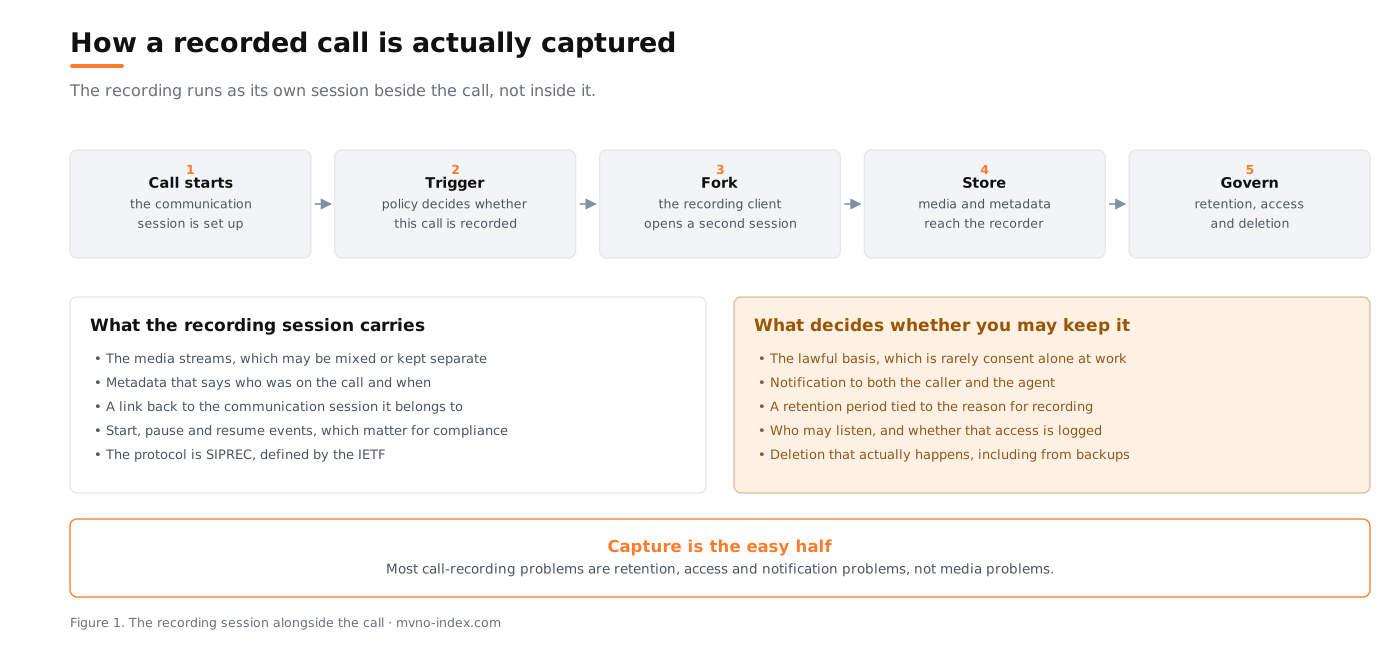
Call recording captures a conversation as a separate session running alongside the call itself. A recording client, usually in a session border controller or an application server, forks the media to a recording server and sends metadata that says who was on the call and when. The IETF defines this as SIPREC. The hard part is rarely capture: it is the lawful basis, the notification, the retention period and who is allowed to listen afterwards.
Call recording captures the audio of a telephone conversation and stores it with information that helps an authorised person find and understand the recording. For an MVNO, it can form part of a business mobile offer, a contact-centre service or a managed communications product. Its usefulness depends on complete capture, reliable retrieval and appropriate controls throughout the recording's lifetime.
A recording product must work across the calls the customer actually makes. Domestic mobile calls, Wi-Fi Calling, transfers and roaming can follow different paths. Before buying a solution, define the required scope and applicable legal obligations. A product advertised as mobile recording should not be assumed to capture every call on every network or device.
On this page
- History and Evolution of Call Recording
- Core Utility and Functionality of Call Recording
- What is Call Recording Used For?
- Key Functions of a Recording Service
- Technical Integration and Data Model
- Integration with Other Systems
- Technical Data Model and Key Interfaces
- Recording Ownership for MVNOs and IoT Companies
- Why Operate or Resell Call Recording?
- Advantages and Disadvantages of Call Recording
- Organizational Impact of Call Recording
- Redundancy and High Availability
- Impact of 4G and 5G and Future Networks on Recording
- Call Recording in 4G Services
- Call Recording in 5G Services
- Future Recording Requirements
- Frequently Asked Questions about Call Recording
- Summary
History and Evolution of Call Recording
Business recording began with equipment attached to telephone lines and private switching systems. As voice moved to IP networks, recording could be integrated with session signalling and media flows. Hosted communications then made central recording and browser-based retrieval accessible without requiring every customer to maintain local storage equipment.
Mobile services add complexity because users change location, access method and device. A recording service may be integrated with a telephony platform, a network component or an application. These approaches have different coverage and control characteristics. Understanding the wider core network architecture helps an MVNO establish where recording can actually occur.
Core Utility and Functionality of Call Recording
Call recording and lawful intercept are not the same thing
| Feature | Call recording | Lawful intercept |
|---|---|---|
| Why it exists | Quality, training, evidence of instructions | A legal order |
| Who decides | The business, within the law | A warrant or its national equivalent |
| Who may know | Both parties are normally told | The subject must not be told |
| Where it sits | Application or border layer | Inside the network, under a separate regime |
| Who may access | Named roles, with a log | Only the authorised agency |
| Retention | A period you set and can justify | Set by the order and the law |
What is Call Recording Used For?
Businesses may record calls for quality review, evidence of agreed instructions, training or specific regulatory purposes. Each purpose should have a defined scope, authorised users and retention policy. A training requirement may need only selected interactions, while another use case may require systematic capture. The technical design should follow the documented purpose rather than defaulting to recording everything indefinitely.
Recording can also support complaint investigation. The value comes from being able to locate the correct conversation and establish whether it is complete. Audio without reliable time, participant and call-context information can be difficult to interpret. A useful service therefore manages recordings as controlled business records, not merely as a folder of sound files.
Key Functions of a Recording Service
Capture is the first function. The platform must receive the intended audio streams and recognise the relevant call events. It should handle both directions of speech and the supported changes that occur during a call. A successful call setup does not prove that the recorder received usable audio or that the file contains the entire conversation.
Indexing connects audio to searchable information, such as time, authorised account, call identifier and relevant participants. Transfers and conferences require special attention because one customer interaction may involve several call legs. Ask how the product represents those relationships so a search does not return an apparently complete recording that omits part of the interaction.
Storage and retrieval complete the service. Recordings need controlled access, retention handling and evidence of administrative actions. Export may be required for an authorised investigation or customer migration. Transcription and analytics are additional processing functions with their own accuracy and privacy considerations; they do not replace the original audio or the need to verify important statements.
Technical Integration and Data Model
Integration with Other Systems
A network recording solution may connect to an IMS environment, session border controller, business telephony platform or contact-centre system. The integration point determines which calls are visible. An MVNO relying on a host network must establish whether the host permits the required media and signalling integration, and who operates it.
SIPREC is an IETF protocol approach for session recording using a recording client and recording server. It provides a defined way to convey recording media and associated information. Support for SIPREC is useful interoperability evidence, but it does not establish that every desired mobile call path is included or that the complete application meets a customer's recordkeeping requirements.
The specific documents are worth naming in a tender. The protocol itself is RFC 7866, the metadata model is RFC 7865, and RFC 9806 corrects the metadata media type. Ask a supplier which of the three their implementation follows and from which release, because an older build can be standards compliant and still disagree with a newer recorder.
Customer systems may need retrieval links, case references or authorised exports. Use interfaces with explicit access controls and account boundaries. A customer relationship management integration should expose recordings only to the appropriate users. Avoid placing unrestricted file links in ordinary customer notes where access may be broader than the recording policy allows.
Technical Data Model and Key Interfaces
The data model should associate a recording with its account, call identifiers, time information, participants and capture status. Preserve information about missing media or interrupted recording rather than presenting an incomplete file as complete. Time synchronisation matters when evidence from several systems must be compared during an incident or dispute.
The recording runs as its own session beside the call, not inside it
Ask how identifiers behave through transfers, conferences and forwarded calls. The original caller, current participants and billed subscriber may be different entities. A single telephone-number field may not describe the interaction accurately. Test representative scenarios and inspect the resulting metadata before agreeing that the integration is complete.
Storage requirements depend on concurrent calls, recording duration, encoding, replication and retention. Estimate these from the expected workload and include growth and recovery capacity. A price per recorded minute may exclude retrieval traffic, archive storage or export. Request a complete cost model and an explanation of how expired recordings and their replicas are removed.
Recording Ownership for MVNOs and IoT Companies
The six questions a recording policy has to answer
| Question | What a weak answer looks like |
|---|---|
| On what lawful basis do we record | Consent from an employee, which is rarely freely given |
| Who is told, and when | A line in a contract nobody reads |
| How long do we keep it | Until the storage fills up |
| Who may listen back | Anyone with access to the platform |
| Is that access logged | No, or logged somewhere nobody reviews |
| Does deletion really happen | Removed from the console, still in the backups |
Why Operate or Resell Call Recording?
An MVNO serving business customers may use recording to meet a specific communications requirement and differentiate its offer. Ownership of the recording platform is optional. A managed service may provide the required capabilities with less operational work, while a dedicated deployment may offer greater control over integration and customer-specific policies.
For an IoT business, recording is relevant only where the solution includes a voice interaction, such as an assisted-service terminal or a supported voice workflow. Ordinary telemetry does not become a call-recording use case. Establish the actual communication path and customer purpose before adding recording capability to an IoT proposal.
Advantages and Disadvantages of Virtual PBX Ownership
Advantages:
-
Reliable recordings can reduce uncertainty when investigating a customer interaction. They can also support focused coaching when managers have an appropriate review process. The business benefit depends on people being able to retrieve and use the material, so usability and search quality deserve attention alongside capture technology.
-
A central service can provide consistent policies across supported users and devices. It can simplify account administration and reduce dependence on employees remembering to start a local application. Demonstrate that consistency under the intended operating conditions, including changes in access method and supported roaming scenarios, rather than assuming central deployment guarantees universal coverage.
Disadvantages:
-
Recording creates a sensitive information store. Conversations may contain personal or confidential material that requires careful access and retention controls. The applicable rules vary by jurisdiction, employment context and industry. Obtain a specific assessment of lawful basis, notices, permissions and recording scope before launch; consent should not be treated as a universal answer to every situation.
-
Incomplete coverage can create false confidence. A service may capture ordinary calls while missing a transfer, a roaming route or an unsupported application call. Storage growth and retrieval workload can also exceed initial estimates. Include these limitations and costs in the service description so customers understand exactly what they are purchasing.
Organizational Impact of Call Recording
Assign ownership for the recording policy, technical operation and authorised access. These responsibilities may sit with different teams, but they need a shared process. Customer support should know how to investigate a missing recording without giving broad access to conversation content. Administrative convenience is not a sufficient reason to grant unrestricted playback rights.
For employee-related recording, transparency and proportionality require specific consideration. UK ICO guidance on worker monitoring is one jurisdictional reference, not a global legal template. Multinational customers may need different policies across countries. Retention periods and access procedures should be approved for the intended purpose and reviewed when that purpose changes.
Sales teams need an accurate capability matrix. It should identify supported devices, call types, access methods and known exclusions. Avoid promising a compliance outcome solely because a platform offers encryption or immutable storage. Compliance depends on the customer's obligations, configuration, processes and use of the service as well as the technology.
Before signing, request a trial with realistic calls. Include inbound and outbound conversations, hold, transfer, conference, rejected calls and changes in connectivity. Verify the audio, metadata, retrieval permissions and capture alarms. Compare suppliers on demonstrated coverage and support accountability, using the solution provider selection guide to structure the evaluation.
Redundancy and High Availability
Recording availability has to be measured separately from voice availability. A call can continue successfully while recording fails. Define whether a recording failure should raise an alarm, affect the call or trigger another approved action. The correct behaviour depends on the service purpose and must be agreed with the customer before an incident occurs.
Test loss of the recording server, storage access and the connection between capture and storage. Establish whether media is buffered, duplicated or lost, and how any gap is reported. Backups should support restoration without exposing recordings to unauthorised operators. A second server is useful only if the surrounding capture path and storage are also resilient.
Retention and recovery can conflict if restored backups reintroduce records that should have expired. Include deletion handling in the recovery design and document any lawful preservation process. Test restoration of both audio and metadata so files remain searchable and access policies remain attached. A directory of recovered audio with no reliable index is a poor operational recovery.
Impact of 4G and 5G and Future Networks on Recording
Call Recording in 4G Services
VoLTE uses IMS-based voice, which can provide relevant integration points for supported recording designs. Actual access depends on the host and service architecture. Legacy fallback and other call paths may need separate handling. Validate the complete customer experience rather than treating LTE coverage as proof of recording support.
Call Recording in 5G Services
IMS-based voice remains relevant for VoNR, but support must be verified across devices, registration and the deployed voice path. A subscriber showing a 5G indicator does not identify the recording architecture. Ask suppliers to demonstrate supported transitions and explain whether any voice fallback changes capture behaviour.
Future Recording Requirements
As communications services evolve, preserve portable records, documented interfaces and clear policy ownership. New transcription or analytics features should be evaluated for accuracy and appropriate use before being added to the product. Buying a recording service should include an export and migration plan so customers can retain authorised access when their communications supplier changes.
Frequently Asked Questions about Call Recording
Can an MVNO record every mobile call automatically?
Only within the supported and authorised service design. Coverage depends on the host, integration point, devices and call paths. Require a written scope and evidence from representative tests instead of relying on a broad mobile-recording claim.
Is SIPREC a complete recording product?
No. It is a protocol for recording sessions and related information. Storage, search, access control, retention and customer workflows require additional capabilities. Protocol support does not establish legal compliance or universal call coverage.
Does a call announcement make recording lawful everywhere?
No. Requirements vary by jurisdiction and context. Determine the applicable basis, transparency requirements and any necessary permissions for the intended purpose. Have the service policy assessed before recording begins.
Can encrypted calls be recorded?
It depends on where media is available and which systems are authorised to process it. End-to-end encryption and network recording can impose different constraints. Ask the provider to explain the supported security model without assuming that encryption can simply be bypassed.
Is a transcript equivalent to the audio?
No. Transcription can omit words, misidentify speakers or misunderstand technical language. Keep the original recording where required and verify important passages. The transcript should be treated according to its purpose and demonstrated accuracy.
How long should recordings be retained?
Use the period justified by the applicable purpose and obligations. There is no universal duration for all business calls. Define deletion, authorised preservation and backup handling together so the policy can actually be implemented.
What should a supplier for a call recording trial prove?
It should prove capture completeness, searchable metadata, appropriate access and visible failure reporting across the agreed call scenarios. Include retrieval and export tests, then compare the total storage, support and migration costs before purchase.
Summary
Call recording can strengthen a business communications offer when it captures the intended calls and makes them securely retrievable. The service must combine technical coverage with a clear purpose, appropriate policy and dependable operations.
Use the MVNO Index provider directory to shortlist recording and voice-platform partners. Request a scoped proposal and a practical trial that covers your host network, customer workflows and recording requirements.
Value Added Services (VAS)