Short Codes and Long Codes: Which One Do You Need?
A short code is a 5 or 6 digit number leased for high-volume application messaging. A long code is a normal 10 to 15 digit telephone number used for conversational or lower-volume traffic. The choice decides throughput, cost, how filters treat the traffic, and what registration is required before a single message is delivered.
Short codes and long codes are the two fundamental categories of telephone numbers used by businesses, MVNOs, and IoT operators to send and receive SMS and MMS messages at scale. Understanding the difference between these number types, when to deploy each, and how they integrate with the broader mobile infrastructure is essential for every operator that wants to deliver reliable, compliant, and high-throughput messaging to its subscribers. Short codes are abbreviated 5 to 6-digit numbers registered for high-volume application-to-person (A2P) messaging, while long codes are standard 10 to 15-digit telephone numbers used for conversational or lower-volume person-to-application (P2A) and application-to-person traffic. Both play a decisive role in the messaging strategy of any mobile brand, MVNE, or IoT platform that relies on SMS as a communication, authentication, or engagement channel.
On this page
- History and Evolution of Short & Long Codes
- Core Utility and Functionality
- What are Short & Long Codes Used For?
- Key Functions and Characteristics
- Types of Short & Long Codes Explained
- Short Codes: Dedicated, Shared, and Vanity
- Long Codes: Standard, Toll-Free, and 10DLC
- Technical Integration and Data Model
- Integration with Other Systems
- Technical Data Model and Key Interfaces
- Short & Long Code Ownership for MVNOs and IoT Companies
- Why Own or Manage Short & Long Codes?
- Advantages and Disadvantages
- Organizational Impact of Short & Long Code Management
- Regulatory and Compliance Considerations
- Impact of 5G and RCS on Short & Long Codes
- Frequently Asked Questions about Short & Long Codes
- Summary
History and Evolution of Short & Long Codes
Short codes emerged in the early 2000s alongside the explosion of SMS-based premium services, ring-tone downloads, and television voting campaigns. Regulators and carriers quickly recognized the need for a structured numbering regime to separate high-volume commercial messaging from ordinary person-to-person traffic. Long codes, originally designed purely for voice calls and peer-to-peer SMS, were later formalized for commercial A2P use through frameworks such as 10DLC (10-digit long code) registration in the United States and equivalent national programs elsewhere.
Core Utility and Functionality
What are Short & Long Codes Used For?
Short and long codes are the outward-facing numerical identities that your subscribers see when they receive an SMS from your mobile brand, platform, or service. Short codes are the primary tool for high-volume, time-critical messaging such as one-time passwords (OTPs), two-factor authentication (2FA) codes, marketing campaigns, service alerts, and subscriber notifications. Their abbreviated format makes them instantly recognizable and easy for users to interact with. Long codes, by contrast, are suited for conversational messaging, customer care interactions, appointment reminders, and lower-volume transactional communications where a standard telephone number format is preferred or required. For IoT applications, long codes are widely used to receive status reports, device alerts, and machine-generated data transmissions via SMS.
Selecting the correct number type is not merely a technical decision. It directly affects deliverability rates, carrier filtering risk, subscriber trust, regulatory compliance, and ultimately the revenue potential of your messaging channel. Any operator building a mobile brand or IoT platform must evaluate its messaging volume, use case, and target geography before committing to a number type and registration path.
Key Functions and Characteristics of Short & Long Codes
The following core properties define how short and long codes operate and differentiate them in practice:
Short Code Functions:
- High Throughput Delivery: Short codes are provisioned on carrier networks to handle very high message volumes, often processing hundreds of messages per second, making them the correct choice for OTP delivery, mass marketing sends, and emergency alerts.
- Carrier-Approved Messaging: Dedicated short codes are provisioned directly with mobile network operators and are pre-approved for specific use cases, reducing the risk of carrier filtering or message blocking.
- Keyword-Based Interaction: Short codes support inbound keyword interactions (e.g., a subscriber texts "STOP" or "INFO" to a short code), enabling self-service opt-in and opt-out flows that are mandatory under messaging compliance regulations.
- Brand Recognition: A dedicated short code becomes a recognizable sender identity, reinforcing subscriber trust and brand consistency across all SMS communications.
- Shared Code Campaigns: Shared short codes allow multiple brands to use the same number distinguished by keywords, though this model has been deprecated in several markets due to compliance risks.
Long Code Functions:
- Conversational Messaging: Long codes support two-way person-to-person style conversations, making them suitable for customer support, appointment booking, and lead qualification workflows.
- 10DLC Registration (US Market): In the United States, long codes used for A2P messaging must be registered under the 10DLC framework, which ties the number to a verified brand and approved campaign, significantly improving deliverability.
- Toll-Free Long Codes: Toll-free numbers (e.g., 1-800 numbers in North America) are also used as long codes for A2P messaging and offer high throughput compared to standard local long codes, bridging the gap between short code capacity and standard long code conversational use.
- IoT and M2M SMS: Long codes are widely used by IoT platforms and M2M MVNOs to send and receive machine-generated status updates, alerts, and commands via SMS, where conversational style and two-way communication are required.
- Cost Efficiency: Long codes are significantly less expensive to acquire and maintain than dedicated short codes, making them attractive for startups, smaller MVNOs, and IoT deployments with moderate messaging volumes.
Types of Short & Long Codes Explained
Number types compared
| Type | Format | Throughput | Cost | Registration |
|---|---|---|---|---|
| Short code | 5–6 digits | Highest | Highest, leased per month | Vetting and approval, per country |
| Toll-free | Country-specific prefix | High | Medium | Verification required in the US |
| 10DLC | Standard 10-digit US number | Medium, tiered by trust | Low to medium | Brand and campaign registration |
| Standard long code | Local or international number | Lowest, throttled | Lowest | Little to none, and filtered accordingly |
| Alphanumeric sender ID | Text, not dialable | Varies | Low | Registration required in many markets |
Short Codes: Dedicated, Shared, and Vanity
Short code flavours
| Flavour | What it is | Trade-off |
|---|---|---|
| Dedicated | Your code alone | Full control of reputation, highest cost |
| Shared | Several senders on one code | Cheaper, but one bad sender damages everyone. Largely phased out in the US |
| Vanity | A code you choose, e.g. 12345 | Memorable, higher lease cost, subject to availability |
There are three primary variants of short codes that operators and businesses can acquire and deploy.
A dedicated short code is leased exclusively by a single brand or operator. This is the gold standard for high-volume messaging because the entire throughput capacity and sender reputation of the number belongs solely to your brand. Dedicated short codes are provisioned directly with carriers, and every use case (marketing, OTP, alerts) must be approved as part of the provisioning process. They are the correct choice for any MVNO or platform that sends millions of messages per month and cannot afford delivery failures on authentication or transactional messages.
A shared short code places multiple brands on the same number, differentiated only by the keyword that subscribers use to interact. While shared codes were historically a cost-efficient option, most major markets including the United States have phased them out due to the risk of one brand's compliance violation affecting all others sharing the number. Any operator evaluating a shared code solution today should proceed with significant caution and verify current carrier acceptance in its target market.
A vanity short code is a short code that the operator selects for its memorability, often spelling a word or using a repeating digit pattern (e.g., 12345 or 77777). Vanity codes carry a premium lease cost but offer superior brand recall, particularly for consumer-facing marketing campaigns where the code appears in broadcast advertising or on product packaging.
Long Codes: Standard, Toll-Free, and 10DLC
A standard long code is a regular 10 to 15-digit phone number that can send and receive SMS. In most markets, standard long codes have historically had low throughput limits for A2P messaging and are susceptible to carrier filtering when used for bulk sends without proper registration.
10DLC (10-digit long code) is the current regulatory framework in the United States that requires all businesses using local 10-digit numbers for A2P messaging to register their brand and individual messaging campaigns with The Campaign Registry (TCR). Once registered and carrier-approved, 10DLC numbers receive substantially higher throughput allowances and significantly lower filtering rates. For any operator or brand targeting US subscribers with conversational or transactional SMS, 10DLC registration is not optional; it is a commercial and compliance requirement.
Toll-free long codes occupy a middle tier between short codes and standard long codes. They offer higher per-number throughput than unregistered local long codes, are subject to their own carrier verification process (toll-free verification), and are widely recognized by US consumers. They are a practical alternative for businesses that want higher throughput than a standard long code provides but are not yet ready to invest in a dedicated short code.
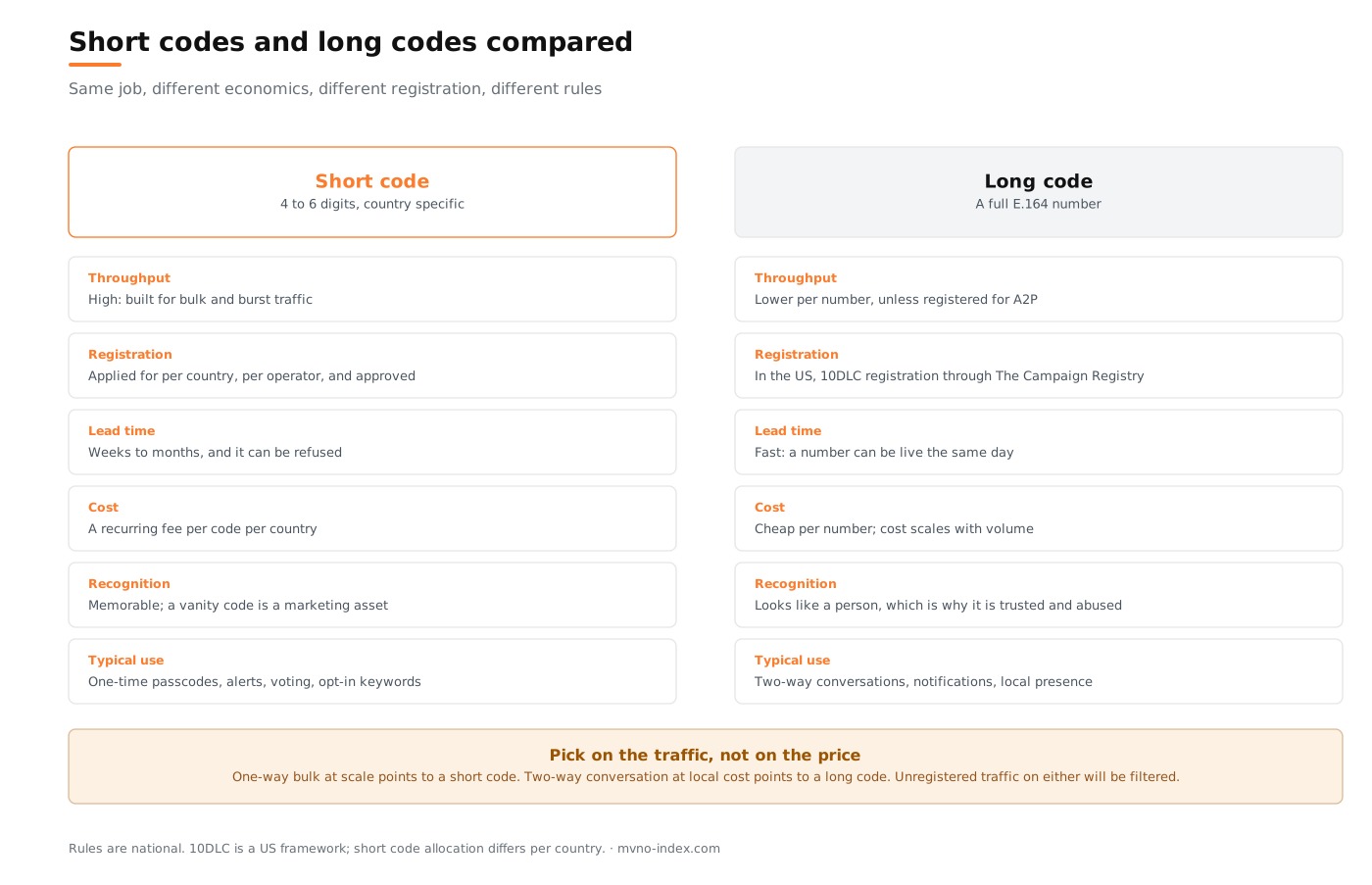
Short codes and long codes compared on throughput, registration, lead time, cost, recognition and typical use.
Technical Integration and Data Model
Integration with Other Systems
Short and long codes do not operate in isolation. They are front-end numbering assets that sit on top of a broader messaging infrastructure. Understanding the integration chain is critical for any operator that wants to control its messaging stack.
The core technical component that routes and stores SMS messages is the Short Message Service Center (SMSC). The SMSC is the network element responsible for the store-and-forward delivery of SMS messages. Short and long codes are the addressing layer that the SMSC uses to route inbound and outbound messages to the correct application or subscriber. The SMSC connects to the Home Location Register (HLR) or its 4G/5G successor the Home Subscriber Server (HSS) to verify subscriber availability and routing information before delivering messages.
For A2P messaging at scale, the number codes are also integrated with SMS aggregators and messaging platforms via SMPP (Short Message Peer-to-Peer) protocol connections. These aggregators sit between the enterprise application or MVNO platform and the carrier's SMSC, handling message submission, delivery reporting, and inbound routing. The Business Support System (BSS) of an MVNO or IoT platform will typically interface with the messaging layer to trigger transactional SMS (e.g., usage alerts, billing notifications) using the operator's assigned short or long code as the sender identity. For charging of premium SMS services, the Online Charging System (OCS) interacts with the SMSC to authorize and deduct balances in real time for MO (mobile-originated) premium SMS transactions.
Rich Communication Services (RCS) is an increasingly important complementary channel. While RCS operates independently of traditional short and long code addressing, many operators are deploying hybrid strategies that combine short code SMS for guaranteed universal delivery with RCS for richer, app-like messaging experiences on supported devices.
Technical Data Model and Key Interfaces
Short and long codes are provisioned as number resources within the carrier's numbering plan and SMSC routing tables. From a data model perspective, the following elements define how these numbers function:
- Number Provisioning Records: Each short or long code is provisioned in the carrier's numbering management systems with metadata including the assigned operator or brand, approved use cases, throughput limits, and routing destinations (e.g., the SMPP endpoint of an aggregator or the MVNO's own SMSC).
- SMPP Bindings: The A2P messaging application binds to the SMSC via an SMPP transceiver session, submitting messages with the short or long code as the source address. Inbound replies from subscribers are routed back to the same SMPP connection based on the destination address matching the provisioned code.
- Keyword Routing Tables: For short codes, inbound keyword responses (STOP, START, HELP, INFO) are mapped in routing tables to specific handling logic, typically managed by the messaging platform or aggregator.
- Campaign Registry Linkage (10DLC/TCR): In 10DLC environments, each long code is associated in the TCR database with a registered brand entity and one or more approved campaign types, and this association is referenced by carriers when applying throughput and filtering policies.
- Delivery Receipt Flows: Both short and long codes generate delivery receipts (DLRs) that travel back through the SMSC and SMPP stack to the originating application, confirming successful handoff to the subscriber's handset.
Short & Long Code Ownership for MVNOs and IoT Companies
Why Own or Manage Short & Long Codes?
For a Full MVNO or an IoT platform, controlling your own short and long code portfolio is a direct lever on subscriber experience, commercial messaging revenue, and regulatory compliance. Consider that the short or long code that appears on your subscriber's screen is your brand's most visible communications identity. Relying entirely on codes managed by a host MVNE or aggregator means you have limited control over throughput limits, use case approvals, and the risk of your messaging being affected by another tenant's compliance violations on a shared resource.
Owning or directly leasing a dedicated short code or a portfolio of registered 10DLC long codes gives your brand the autonomy to define its messaging strategy, scale throughput on demand, and maintain a clean sender reputation. For IoT operators, having a provisioned range of long codes assigned to specific device fleets or customer accounts enables granular routing, monitoring, and billing at the device level, which integrates directly with your BSS/OSS stack.
Advantages and Disadvantages
Advantages of owning and managing short & long codes:
- Full Control over sender identity, throughput configuration, and use case approvals for all messaging campaigns.
- Brand Consistency through a recognizable, dedicated number that subscribers associate exclusively with your mobile brand.
- Regulatory Independence by managing your own 10DLC brand and campaign registrations, removing dependency on a third-party aggregator's compliance standing.
- Revenue Opportunities via premium SMS services where the short code is the billing identifier, integrated with your OCS for real-time charging.
- Scalability to grow messaging volume without renegotiating throughput limits with an intermediate aggregator.
- IoT Granularity through dedicated long code ranges assigned to device pools, enabling precise routing and per-device billing.
Disadvantages of owning and managing short & long codes:
- Short code lease costs can be substantial, typically several hundred to several thousand dollars per month per dedicated code depending on the market.
- Short code provisioning timelines can run from six to twelve weeks in many markets, requiring advance planning before campaign launches.
- 10DLC registration and ongoing campaign management adds operational overhead, including monitoring for TCR status changes and throughput tier reviews.
- Compliance obligations for opt-in, opt-out, and HELP keyword handling must be implemented and maintained by your own team.
- International short code coverage requires separate code acquisition and provisioning in each target country, increasing cost and complexity for operators with a cross-border messaging strategy.
Organizational Impact of Short & Long Code Management
Operational Impact: Managing a short or long code portfolio requires dedicated processes for number provisioning, campaign registration, compliance monitoring, and sender reputation management. Operations teams must maintain up-to-date records of all registered codes, their approved use cases, throughput limits, and carrier-specific restrictions. Opt-out handling (STOP keyword processing) must be automated and consistently applied across all outbound messaging to avoid regulatory violations. Integrating code management workflows with your OSS ensures that provisioning events, deactivations, and throughput changes are captured and reflected in your service catalog in real time.
Financial Impact: The financial case for owning a dedicated short code versus using a shared aggregator resource depends on messaging volume. At high volumes, the per-message cost economics of a dedicated short code lease become highly favorable compared to aggregator per-message pricing. For MVNOs generating premium SMS revenue, the short code is directly linked to the revenue flow passing through the OCS, and controlling this asset eliminates the margin taken by an intermediary. Long code portfolios under 10DLC represent a low-cost, high-return investment for brands with moderate messaging volumes, particularly for customer care and transactional use cases.
Security and Compliance Impact: Short and long codes are the front line of your subscribers' trust. SMS fraud, including smishing (SMS phishing) and number spoofing, is a growing threat. Operators must implement sender ID validation, message content screening, and robust opt-out compliance to protect subscribers and maintain carrier relationships. The SMSC and messaging platform must be configured to block unauthorized use of your codes and to log all inbound and outbound message events for audit purposes. For MVNOs operating in regulated sectors such as healthcare or fintech, SMS compliance including consent management and data retention adds an additional regulatory layer that must be addressed at the platform level.
Technical Impact: Short and long codes must be integrated cleanly with the SMSC, the messaging aggregator or direct carrier connection, and the BSS/OSS stack. Throughput management, failover routing, and delivery receipt processing must be configured to meet the SLAs required for OTP and authentication messaging, where delivery latency directly affects subscriber experience and conversion rates. For IoT deployments, long code routing tables must scale alongside device fleet growth without manual provisioning intervention.
Regulatory and Compliance Considerations
Regulatory requirements around short and long codes vary significantly by country and continue to evolve as regulators respond to SMS fraud and spam. This section is an additional topic beyond the core structure because compliance is uniquely complex for short and long code management compared to most other network elements, and it directly determines whether your messaging reaches subscribers at all.
In the United States, the CTIA (Cellular Telecommunications Industry Association) and carriers enforce the Short Code Monitoring Handbook for short codes and the 10DLC framework for long codes. Non-compliant senders face message filtering, throughput throttling, or permanent number deactivation. In the European Union, the ePrivacy Directive and GDPR impose strict requirements on consent for commercial SMS, with national regulators in individual member states adding further local rules. In many markets across Asia and Latin America, carriers operate their own A2P SMS whitelisting and sender registration schemes that must be completed before commercial messaging is permitted.
For any MVNO or IoT operator building a messaging strategy, compliance must be treated as a precondition, not an afterthought. The cost of non-compliance, whether in the form of carrier blocks, regulatory fines, or subscriber complaints, far exceeds the cost of implementing compliant systems from the outset. Engaging specialist consultancy support to navigate the regulatory landscape in your target markets is a sound investment before committing to a number acquisition strategy.
Impact of 5G and RCS on Short & Long Codes
The Evolution of Messaging Addressing
Short and long codes were designed for SMS, a protocol rooted in the 2G era and carried forward through 3G, 4G/LTE, and into 5G as a backwards-compatible service. The underlying SMS infrastructure, including the SMSC and the numbering plan, does not fundamentally change with the transition to 5G, meaning that short and long codes retain their relevance as the primary addressing mechanism for A2P SMS in 5G-capable networks.
5G and RCS Architecture
The transformational change to watch is Rich Communication Services (RCS). RCS is the next-generation messaging protocol that replaces SMS with a richer, IP-based messaging experience supporting read receipts, typing indicators, high-resolution media, and interactive buttons. In the RCS architecture, sender identification moves from a simple short or long code to a verified RCS Business Messaging (RBM) sender profile, which includes a brand name, logo, and verified identity. This means that the short code as a visual identifier for the subscriber may eventually be supplemented or replaced by a branded RCS sender profile.
However, the transition is gradual and geography-dependent. SMS via short and long codes will remain the universal fallback for A2P messaging for the foreseeable future, particularly for OTP and authentication use cases where guaranteed delivery across all devices and network types is a non-negotiable requirement. Operators planning a messaging strategy today should plan for a parallel world where short and long codes handle SMS delivery while RCS handles enriched brand interactions on supported devices. The what is the potential of 5G for MVNOs article explores broader implications of 5G for mobile brands in more detail.
Frequently Asked Questions about Short & Long Codes
What is the main difference between a short code and a long code?
A short code is an abbreviated 5 to 6-digit number optimized for high-volume A2P SMS messaging. A long code is a standard 10 to 15-digit telephone number used for conversational or lower-volume messaging. Short codes offer higher throughput and carrier-approved status; long codes are lower cost and support two-way conversational flows.
Can an MVNO own its own short code?
Yes. A Full MVNO can lease a dedicated short code directly through the relevant national short code registry and provision it with the host MNO's SMSC infrastructure. This gives the MVNO full control over throughput, use case approvals, and sender reputation.
What is 10DLC and why does it matter?
10DLC is the US regulatory framework requiring businesses to register their brand and messaging campaigns before using 10-digit local long codes for A2P SMS. Registration with The Campaign Registry (TCR) improves deliverability, increases throughput limits, and is a carrier requirement. Unregistered long code traffic is subject to aggressive filtering and blocking.
How do short codes connect to the SMSC?
Short codes are provisioned as routing entries in the carrier's SMSC. Outbound messages submitted by an application via SMPP use the short code as the source address, and the SMSC routes inbound subscriber replies back to the application's SMPP binding based on the provisioned destination.
What happens to short codes in a 5G network?
Short codes remain fully functional in 5G networks as SMS is retained as a backwards-compatible service. The longer-term evolution is toward RCS, where branded sender profiles may supplement short code identity, but SMS via short and long codes will remain the universal A2P delivery channel for the foreseeable future.
What is the difference between a dedicated and a shared short code?
A dedicated short code is leased exclusively by one operator or brand, giving full throughput and reputation control. A shared short code is used by multiple brands differentiated by keyword. Shared codes have been deprecated in many markets due to compliance risks, and dedicated codes are the recommended approach for any serious messaging operation.
Which number type is best for IoT messaging?
For IoT and M2M applications, long codes are typically the preferred choice because they support two-way communication, are cost-efficient to provision in bulk, and can be assigned to individual device pools for granular tracking and billing through your BSS/OSS stack.
Summary
Short codes and long codes are the foundational numbering assets that determine how your mobile brand or IoT platform communicates with subscribers via SMS. Short codes deliver the throughput, carrier approval, and brand recognition required for high-volume use cases such as OTP delivery, marketing campaigns, and service alerts. Long codes, particularly under the 10DLC framework, provide a cost-efficient, conversational, and two-way messaging channel suited for customer care, IoT device communications, and transactional notifications.
For a Full MVNO or IoT operator, taking ownership of your short and long code portfolio rather than relying on a host MVNE or aggregator is a strategic decision that delivers brand autonomy, revenue control, and the ability to scale messaging operations independently. This decision requires investment in provisioning, registration, compliance management, and integration with your SMSC, OCS, and BSS. The regulatory landscape around short and long code usage continues to evolve, and compliance must be built into your messaging architecture from day one. As RCS matures and 5G networks become the norm, short and long codes will coexist with richer messaging channels, but their role as the universal, reliable backbone of A2P messaging will remain indispensable for years to come.
Value Added Services (VAS)