The IP Multimedia Subsystem: The Control Layer Behind VoLTE
The IP Multimedia Subsystem (IMS) is the control layer that makes voice and video work over an all-IP mobile network. It sets up and tears down sessions through the CSCFs, authenticates against the HSS or UDM, invokes application servers for the services a subscriber has, and hands traffic to other networks through border elements. VoLTE, VoWiFi and VoNR are all profiles of it.
The IP Multimedia Subsystem (IMS) is the standards-based architectural framework that forms the control plane and service platform for delivering real-time multimedia services such as voice and video calling over all-IP mobile networks, including 4G VoLTE and 5G VoNR. It provides the intelligence and control required to offer reliable, quality-assured communication services in an environment that no longer supports circuit-switched voice. IMS serves as the “softswitch” of the IP world, managing everything from registration and authentication to session setup, billing, and supplementary features.
On this page
History and Evolution of IMS
The IMS concept was introduced in the early 2000s through 3GPP Release 5 specifications. Initially designed to support multimedia services over 3G (UMTS), its complexity and the continued use of legacy circuit-switched voice delayed widespread adoption.
The transition to 4G LTE fundamentally changed this. With LTE’s all-IP Evolved Packet Core (EPC), traditional circuit-switched voice was no longer supported, creating a need for an IP-based voice solution. This led to the introduction of Voice over LTE (VoLTE), which used IMS as its mandatory control and signaling platform.
As 5G emerged, IMS remained essential as the foundation for Voice over New Radio (VoNR). It has since become the standard platform for delivering voice and rich communication services across all mobile network generations.
Core Utility and Functionality of IMS
IMS establishes, maintains, and terminates real-time multimedia sessions using the Session Initiation Protocol (SIP). It separates service control from network transport, providing a consistent service layer for voice, video, messaging, and rich communication services (RCS).
By deploying IMS, operators and MVNOs can transition from legacy 2G and 3G systems, ensure quality of service (QoS), comply with emergency call regulations, and accelerate new service deployment.
Key Functional Components
The CSCFs, and what each one is for
| Element | Role | Where it sits |
|---|---|---|
| P-CSCF: Proxy | First contact point for the device | At the network edge, often beside the SBC |
| I-CSCF: Interrogating | Finds the right S-CSCF for a subscriber | At the border of the home network |
| S-CSCF: Serving | Holds the profile, applies filter criteria, routes | In the core of the home network |
| BGCF: Breakout Gateway Control | Chooses where to leave IMS for the PSTN | Between IMS and the circuit world |
| MGCF: Media Gateway Control | Translates signalling towards the PSTN | At the PSTN boundary |
| IBCF: Interconnection Border Control | Controls the border with other IMS networks | At the interconnect |
Session Control
The Call Session Control Functions (CSCFs) form the core of IMS and manage all signaling and service control processes.
P-CSCF: The user’s first point of contact, enforcing policies and establishing secure communication.
I-CSCF: Handles network queries and directs sessions to the appropriate serving node.
S-CSCF: Maintains session state and applies service logic according to user profiles.
Subscriber Data and Authentication
The Home Subscriber Server (HSS) stores user data and service information, allowing the S-CSCF to correctly process calls and apply features.
Application Hosting
Application Servers (AS) host and execute services such as conferencing, call forwarding, voicemail, and supplementary VoLTE features.
Interworking
The Media Gateway Control Function (MGCF) and Media Gateway (MGW) enable interconnection between IMS and legacy circuit-switched or PSTN networks.
Security and Quality of Service
The P-CSCF ensures secure SIP signaling and interacts with the Policy Control Function (PCF in 5G or PCRF in 4G) to maintain QoS for real-time traffic such as voice.
Technical Integration and Data Model
IMS integrates extensively with the mobile core, charging systems, and signaling infrastructure.
Integration with Other Systems
Packet Core (EPC/5GC):IMS session control is separate from data transport. The P-CSCF communicates with the PCRF/PCF to establish dedicated QoS bearers for real-time media.
Charging Systems:Integration with Online and Offline Charging Systems (OCS/CHF) allows IMS to generate charging data records for both prepaid and postpaid services.
Signaling Systems:While SIP handles call setup, IMS uses the Diameter protocol to communicate with the HSS and PCRF/PCF for authentication and policy control.
Core Protocols
IMS relies on established Internet Engineering Task Force (IETF) protocols:SIP for session signaling, SDP for describing media parameters, RTP for carrying real-time media, and Diameter for authentication, authorization, and accounting.
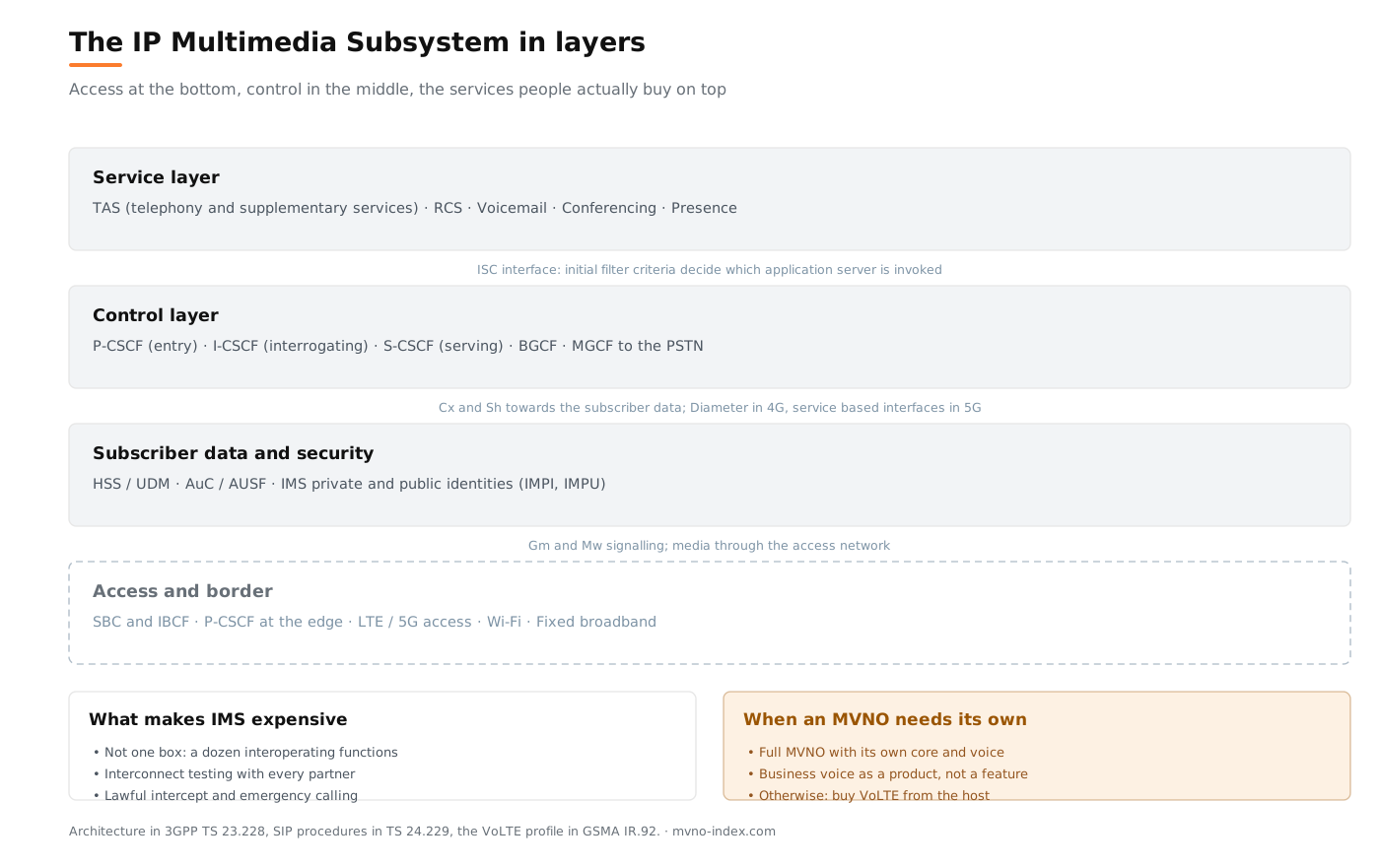
IMS in layers: access and border at the bottom, control in the middle, the services people buy on top.
Operational Aspects of IMS
IMS Security and Topology Hiding
Security is critical within IMS because it interfaces with external networks and end-user devices.The Proxy-CSCF acts as a security gateway, and the Interconnection Border Control Function (IBCF) provides topology hiding to prevent exposure of internal network details.All SIP signaling is secured using IPsec, and deep packet inspection ensures that only valid messages reach core elements, protecting against denial-of-service and malformed signaling attacks.
IMS Charging and Billing
IMS supports both real-time and postpaid billing:
Online Charging:Used for prepaid services through real-time interaction with the OCS. The Charging Trigger Function (CTF) in the CSCFs and Application Servers reports chargeable events as they occur.
Offline Charging:For postpaid services, IMS elements generate Call Detail Records (CDRs) that are sent to the Charging Gateway Function and billing system after sessions are completed.
IMS in the Internet of Things (IoT)
IMS is increasingly relevant for IoT and M2M environments that demand reliable real-time communications.It underpins mission-critical push-to-talk (MC-PTT) and mission-critical video (MC-Video) services for public safety and emergency response.In IoT ecosystems, IMS supports voice and video for gateways and smart devices, while its integration with the HSS/UDM enables unified identity management across diverse device types.Although most low-bandwidth IoT use cases do not require IMS, applications requiring high-quality, SIP-controlled real-time sessions depend on it.
The Cost of IMS and Signaling Infrastructure
Owning an IMS core involves significant capital and operational expenses. Costs vary depending on the vendor, deployment model (bare metal, NFV, or cloud-native), and integration complexity. The following provides a representative cost framework for a mid-sized MVNO or regional operator.
| Cost Category | Description | Indicative Range (USD) |
|---|---|---|
| Software License and Purchase | Includes CSCFs, HSS/UDM integration modules, MGCF, SBC/IBCF, and Application Servers. Vendors often charge per concurrent session or per subscriber. | $350,000 – $1,200,000 |
| Setup and Integration | Covers deployment, configuration, interoperability testing with EPC/5GC, signaling routing, and number portability systems. | $150,000 – $500,000 |
| Hardware or Cloud Resources | If deployed on-premise: high-availability servers and media gateways. For virtualized or cloud-native IMS, compute and storage capacity must scale with subscriber load. | $75,000 – $300,000 annually |
| Operational Costs (OPEX) | Includes staff (NOC, VoLTE engineers, DevOps), monitoring tools, and system updates. | $200,000 – $600,000 per year |
| Vendor Support and Maintenance | Annual maintenance and software assurance, typically 10–18% of license cost. | $50,000 – $180,000 per year |
| Interconnect and Signaling Fees | Connectivity to PSTN, inter-MNO, or IPX networks. | $20,000 – $100,000 per year |
| Training and Certification | Initial vendor or third-party training for IMS operations and troubleshooting. | $15,000 – $40,000 (one-off) |
Example: Total 3-Year Cost Estimate
For a mid-sized Full MVNO serving around 250,000–500,000 subscribers:
The three-year cost example, as a table rather than as headings
| Item | Indicative range |
|---|---|
| Initial purchase and setup | USD 800,000 to 1.5 million |
| Annual operations and support | USD 250,000 to 600,000 |
| Three-year total cost of ownership | USD 1.6 to 3.3 million |
Smaller or hosted-MVNO models can reduce this by 60–80% through managed IMS-as-a-Service or vendor-hosted solutions.
IMS Ownership for MVNOs and IoT Companies
When owning IMS makes sense
| MVNO type | Voice arrangement | Verdict on owning IMS |
|---|---|---|
| Branded reseller, thin | Host operator's voice | No: there is nothing to own |
| Light MVNO | Host operator's voice, own BSS | No |
| Thick MVNO | Host voice, or an MVNE-hosted IMS | Rarely: host it if you need the features |
| Full MVNO, consumer | Own core, voice can still be hosted | Only with real volume |
| Full MVNO, business voice | Own IMS and TAS | Yes: this is where the product lives |
For Full MVNOs and IoT providers, owning an IMS core can significantly increase autonomy and service differentiation. Without it, these operators must depend on a host MNO’s infrastructure, limiting flexibility and control over service quality and innovation.
| Advantages | Disadvantages |
|---|---|
| Enables VoLTE/VoNR for 4G and 5G | High initial investment and technical complexity |
| Provides direct control over QoS and media handling | Requires specialized SIP and Diameter expertise |
| Allows rapid innovation via Application Servers | High ongoing maintenance and operational costs |
| Ensures compliance with regulatory and emergency services | Integration challenges with HSS/UDM and packet core |
| Offers full control over billing and charging models | Increased responsibility for service continuity and upgrades |
When IMS Ownership Makes Business Sense
Full MVNOs
Ownership becomes economically viable when subscriber volumes reach a level where per-user hosting fees exceed the cost of operating a private IMS. It also enables custom service differentiation (such as unique conferencing, enterprise features, or regulatory control) and ensures full autonomy over service quality and routing.
IoT and M2M Companies
In mission-critical or highly secure environments, owning an IMS ensures reliability, flexibility, and confidentiality. It supports custom signaling requirements, advanced policy enforcement, and strict regulatory compliance. This is particularly relevant for public safety, defence, or industrial communications where reliability and control are non-negotiable.
Interoperability and Standardization
IMS is built on globally standardized protocols defined primarily by the 3rd Generation Partnership Project (3GPP), with implementation guidelines from the GSM Association (GSMA) and protocol definitions from the Internet Engineering Task Force (IETF).
To ensure seamless interconnection between networks, IMS implementations must comply with standards such as:
The specifications an IMS deployment has to comply with
| Specification | Subject |
|---|---|
| 3GPP TS 23.228 | IMS architecture |
| 3GPP TS 24.229 | SIP signalling procedures |
| 3GPP TS 32.260, 32.262 and 32.299 | Charging and accounting |
| GSMA IR.92 | IMS profile for voice and SMS over LTE |
| GSMA IR.94 | Video over LTE |
| GSMA IR.95 | IMS interconnect guidelines |
Interoperability testing is essential for ensuring consistent service quality across multiple vendors and network types. Many operators participate in VoLTE/VoNR Interoperability Test (IOT) programs coordinated by GSMA or regional telecom alliances.
For MVNOs deploying their own IMS, compliance with these specifications is critical to guaranteeing compatibility with the host MNO and international roaming partners.
Deployment Models and Virtualization
Modern IMS architectures have evolved beyond physical, appliance-based implementations into virtualized and cloud-native deployments.
- Virtualized IMS (vIMS): Based on Network Functions Virtualization (NFV), vIMS allows IMS components such as the CSCF, HSS, and Application Servers to run as Virtual Network Functions (VNFs) on standard servers. This decouples software from hardware, improving resource utilization and reducing hardware CapEx. It also enables faster scaling through virtualization platforms such as OpenStack or VMware.
- Cloud-Native IMS (CN-IMS): The next evolution is container-based, microservice-driven IMS architectures that leverage Kubernetes for orchestration. CN-IMS platforms use stateless functions, API-driven management, and continuous deployment pipelines, allowing near-instant scaling and dynamic resource allocation.
- Operational Benefits: These modern architectures enable elastic scaling to match demand, automated failover, and improved lifecycle management through CI/CD pipelines. For MVNOs or IoT providers with fluctuating voice volumes, cloud-native IMS offers a pay-as-you-grow model, reducing upfront investment while maintaining carrier-grade reliability.
IMS in 5G and Network Slicing Environments
In 5G, the IMS operates as an external Application Function (AF) within the Service-Based Architecture (SBA), interfacing with the 5G Core Network (5GC) through standardized APIs. The IMS leverages the Network Exposure Function (NEF) and the Policy Control Function (PCF) to request network resources and enforce QoS policies for real-time sessions.
Through network slicing, operators can dedicate a virtualized slice of the 5G core to IMS-based voice and video services. This allows guaranteed latency and bandwidth performance independent of other traffic types.
For example, public safety or enterprise voice applications can be hosted in specialized “mission-critical communication slices” that maintain reliability even under network congestion. This architecture ensures that VoNR and IMS-based services remain consistent with 5G’s performance and isolation guarantees.
As 5G Standalone (SA) deployments grow, IMS continues to provide the foundational signaling and control for all voice and rich communication services, integrated seamlessly into the service-based core.
Lawful Intercept and Regulatory Compliance
IMS natively supports Lawful Intercept (LI) and emergency services compliance.The E-CSCF handles emergency call routing, ensuring access to public safety answering points (PSAPs) even without full registration.For lawful intercept, IMS complies with ETSI LI standards, generating communication records accessible through authorized mediation devices. These capabilities are mandatory in most regulatory environments and integral to operator licensing.
Disaster Recovery and High Availability
IMS platforms are designed for high reliability through redundancy and geo-diversity.Typical deployments use active-active clusters across multiple sites, with state replication between Serving-CSCFs and standby nodes. Databases such as the HSS or UDM employ synchronization to ensure no service interruption during node or site failure.
Disaster recovery plans include automated rerouting, backup signaling paths, and failover for media gateways to maintain service continuity under adverse conditions.
Future Outlook
As networks evolve toward 6G and fully cloud-native infrastructures, IMS will continue to serve as the standardized service control layer for voice and rich communications. Its evolution will focus on open APIs, service exposure frameworks, and tighter integration with 5G core functions. Operators may adopt “IMS-as-a-Service” models to reduce ownership costs while maintaining feature control.
In parallel, the role of IMS is expanding to enterprise and private 5G networks, where guaranteed quality and identity management remain critical.
Frequently Asked Questions
What is the main function of IMS?
To provide the control and service platform for real-time multimedia communication such as voice, video, and RCS over IP networks.
What protocol does IMS use?
SIP is used for signaling, and RTP carries the media.
Why is IMS necessary in 4G and 5G?
Both are all-IP networks with no circuit-switched voice; IMS provides the SIP-based framework for voice and video services.
What is the CSCF’s role?
It manages SIP registration, session control, and service application logic.
What is VoLTE?
Voice over LTE is a high-quality voice service over LTE data networks enabled by IMS.
Summary
The IP Multimedia Subsystem (IMS) is the universal, standards-based platform for managing real-time communications in modern mobile networks. By separating service logic from network transport, it provides flexibility, scalability, and control across technologies.
For MVNOs and IoT providers, IMS ownership is a strategic decision balancing autonomy, quality, and cost. Although the total investment can exceed several million dollars over three years, the ability to independently manage VoLTE, VoNR, and next-generation communication services often justifies the cost at scale.
As 4G and 5G networks continue to evolve, IMS remains the cornerstone of carrier-grade communication, ensuring that voice, video, and rich media continue to function reliably in an increasingly packet-based world.
Cross-Generation Services