The Campaign Management System: Turning Data Into Campaigns
A Campaign Management System (CMS) is the platform an MVNO uses to plan, target, send and measure subscriber campaigns across SMS, email, push, in-app and RCS. It sits next to the CRM and the BSS: the CRM holds who the subscriber is, the CMS decides what to say to them and when.
The Campaign Management System (CMS) is a dedicated software platform that enables MVNOs (Mobile Virtual Network Operators), IoT companies, and mobile brands to plan, build, execute, automate, and measure marketing and communication campaigns across multiple subscriber touchpoints. It is the operational engine behind every targeted SMS, push notification, email, loyalty offer, and retention message that a mobile brand sends to its subscriber base. Understanding what a Campaign Management System is, what it does, and how to deploy it effectively is critical for any MVNO that wants to grow its subscriber base, reduce churn, increase average revenue per user (ARPU), and build a brand that subscribers genuinely engage with. In a market where price differentiation is increasingly difficult, the ability to communicate the right message to the right subscriber at the right moment is one of the most powerful competitive advantages a mobile brand can develop. If you are planning to start your own mobile brand or refine how an existing MVNO engages its subscribers, a Campaign Management System belongs at the center of your commercial strategy.
On this page
- History and Evolution of the Campaign Management System
- Core Utility and Functionality of the CMS
- What is a Campaign Management System Used For?
- Key Functions of the Campaign Management System
- Technical Integration and Data Model
- Integration with Other Systems
- Technical Data Model and Key Interfaces
- CMS Ownership for MVNOs and IoT Companies
History and Evolution of the Campaign Management System
Campaign management in telecoms originated in the 1990s as simple batch-driven systems that sent identical promotional SMS messages to entire subscriber lists. As mobile networks grew and subscriber databases became richer, platforms evolved to support segmentation, scheduling, and basic personalization through the 2000s. The smartphone era and the rise of big data in the 2010s transformed campaign management into a real-time, data-driven discipline capable of delivering highly personalized, event-triggered communications across multiple channels simultaneously. Today, AI-powered Campaign Management Systems can predict subscriber behavior, automate entire customer lifecycle journeys, and optimize campaign performance without manual intervention.
Core Utility and Functionality of the Campaign Management System
What is a Campaign Management System Used For?
A Campaign Management System is used to design, deliver, automate, and measure every structured communication between an MVNO and its subscribers. It connects subscriber data, segmentation logic, communication channels, and performance analytics into a single, coordinated platform that turns subscriber insights into targeted actions.
For an MVNO, the CMS is the primary tool for acquiring new subscribers through targeted promotional campaigns, retaining existing subscribers through proactive engagement and loyalty programs, reducing churn by identifying at-risk subscribers and triggering timely interventions, and increasing ARPU by presenting upgrade offers and value-added services to the right segment at the right time. It is the commercial counterpart to the technical infrastructure that powers your network, translating subscriber data from your Business Support System (BSS) into revenue-generating actions.
The CMS is equally important for compliance communications, such as plan change notifications, price increase warnings, data fair use policy alerts, and contract renewal reminders. These are not optional for a regulated telecoms operator, and a Campaign Management System ensures they are delivered accurately, on time, and with a complete audit trail.
A well-deployed CMS also works hand in hand with the MVNO's guide to exceptional customer care, because proactive outbound communication through the CMS reduces the volume of inbound contacts to the Contact Center by answering subscriber questions before they become support calls. This creates a direct operational efficiency benefit in addition to the commercial benefits of better engagement.
Key Functions of the Campaign Management System
The modern Campaign Management System for an MVNO performs a broad range of interrelated functions that span data, content, execution, and measurement:
- Subscriber Segmentation: The CMS queries subscriber data from the BSS and other integrated data sources to build precise audience segments based on criteria including tariff plan, usage patterns, tenure, payment behavior, device type, location, and lifecycle stage. Segmentation is the foundation of relevant, effective campaigns.
- Campaign Design and Content Management: Marketing teams use the CMS to build campaign content, including SMS message copy, email templates, push notification text, and in-app messages, within a structured workflow that includes content approval, brand compliance checks, and message preview across device types.
- Campaign Scheduling and Automation: Campaigns can be scheduled for one-time delivery at a defined date and time, or configured as automated journeys that trigger messages based on subscriber events such as activation, first top-up, data threshold reached, contract approaching expiry, or prolonged inactivity.
- Multi-Channel Orchestration: The CMS coordinates message delivery across all available subscriber touchpoints, including SMS, MMS, email, push notifications via the mobile app, in-app messaging, and outbound voice calls, ensuring a consistent and coordinated subscriber experience across channels.
- Personalization and Dynamic Content: Messages are personalized with subscriber-specific variables such as first name, current plan, remaining data balance, or days until contract renewal. Dynamic content rules allow different message variants to be served to different sub-segments within the same campaign execution.
- A/B Testing and Optimization: The CMS enables controlled experiments where different message variants, send times, or offer values are tested against a split audience, with performance data used to identify the winning variant and apply it to the remaining audience automatically.
- Offer and Voucher Management: The CMS can generate and distribute personalized promotional codes, loyalty rewards, and upgrade offers with defined validity periods, redemption limits, and eligibility rules, integrating with the BSS to apply discounts or product changes automatically when an offer is accepted.
- Opt-Out and Consent Management: The CMS enforces subscriber communication preferences and regulatory consent requirements by maintaining an up-to-date suppression list that prevents opted-out subscribers from receiving marketing communications, protecting the MVNO from compliance risk.
- Campaign Performance Reporting: After each campaign execution, the CMS generates detailed performance reports covering delivery rates, open rates, click-through rates, conversion rates, revenue attributable to the campaign, and opt-out rates. These metrics feed directly into future campaign planning and budget allocation.
- Real-Time Event Triggers: Advanced Campaign Management Systems can respond to subscriber events as they occur in near real time, for example sending a data top-up offer within seconds of a subscriber exhausting their monthly allowance, maximizing the relevance and conversion rate of the communication.
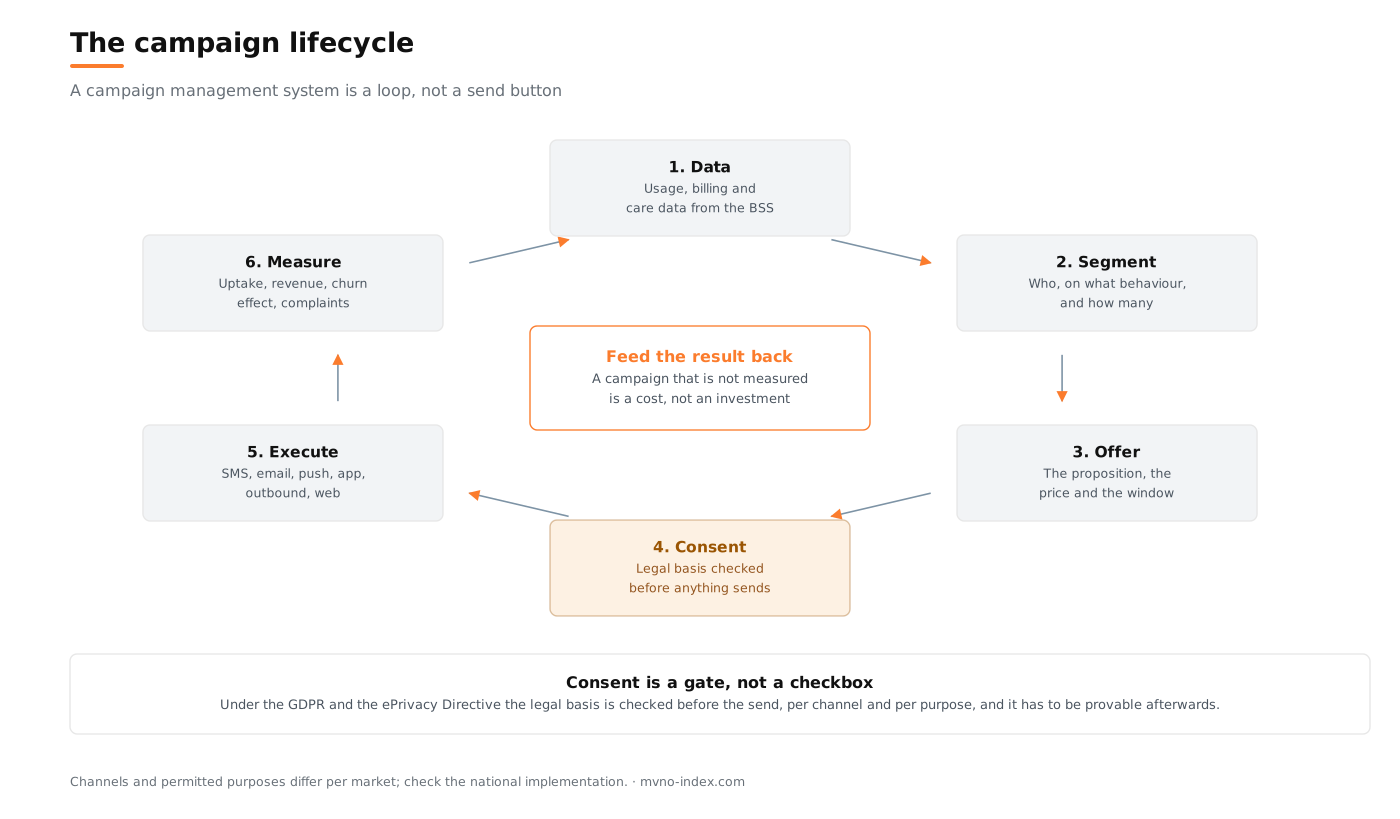
The campaign lifecycle: data, segment, offer, consent, execute, measure and back to data.
Technical Integration and Data Model
Integration with Other Systems
The Campaign Management System derives its power from the richness of the subscriber data it can access and the breadth of the delivery channels it can orchestrate. This makes deep integration with the MVNO's broader technology stack essential.
- Business Support System (BSS): The BSS is the primary data source for the CMS. It provides subscriber profile data, tariff plan information, usage records, payment history, contract dates, and product inventory. The CMS queries this data to build segments and also writes back to the BSS when campaign interactions result in product changes, offer redemptions, or subscription updates. The quality and completeness of your BSS data directly determines the effectiveness of your CMS segmentation and personalization.
- Operational Support System (OSS): The OSS can feed network-level events and quality metrics into the CMS, enabling campaigns triggered by subscriber-specific network experiences. For example, if a subscriber's area has experienced a network outage, the CMS can be configured to send a goodwill gesture or service credit notification to affected subscribers automatically, turning a negative experience into a positive brand moment.
- Online Charging System (OCS): For prepaid subscribers, integration with the OCS enables real-time balance and usage threshold triggers. When the OCS records that a prepaid subscriber has consumed 80% or 100% of their data allowance, it sends an event notification to the CMS, which immediately delivers a targeted top-up offer or bundle upgrade prompt.
- Offline Charging System (OFCS): Post-paid usage data from the OFCS enriches the CMS's subscriber profiles with detailed call, data, and messaging consumption patterns that inform segment building and personalized offer targeting for monthly billing cycle campaigns.
- Short Message Service Center (SMSC): For SMS campaign delivery, the CMS connects directly to the SMSC to submit outbound message batches with the required originator address, message content, and delivery priority settings. The SMSC returns delivery receipts that the CMS uses to track delivery success rates and identify failed deliveries for retry or channel fallback.
- CRM and Customer Care Systems: Integration with the customer care platform ensures that campaign interactions are visible to support agents, enabling them to provide context-aware assistance when subscribers contact the Contact Center in response to a campaign. It also allows the CMS to suppress campaign messages to subscribers with open high-priority support tickets, preventing tone-deaf marketing during service disputes.
- Mobile App: Integration with the MVNO's mobile app enables push notification delivery and in-app message placement as CMS-orchestrated campaign channels, reaching subscribers with rich, interactive content directly within your branded application environment.
Technical Data Model and Key Interfaces
The Campaign Management System is built around a subscriber data model that aggregates and enriches records from multiple source systems into a unified campaign-ready subscriber profile. Key data entities managed by the CMS include:
- Subscriber Profile: The core record containing identity attributes, contact details, communication channel preferences, consent status, and lifecycle stage indicators drawn from the BSS and CRM.
- Segmentation Rules Engine: A configurable logic layer that evaluates subscriber profile attributes against defined criteria to produce audience lists for each campaign. Rules can be static (evaluated once at campaign launch) or dynamic (re-evaluated continuously as subscriber data changes).
- Campaign Catalogue: A repository of all campaign definitions, including audience segments, message content, channel configuration, scheduling rules, offer parameters, and budget constraints.
- Interaction History: A time-stamped record of every message sent to every subscriber, along with delivery status, engagement events, and any resulting conversions. This history is used for suppression, fatigue management, and attribution analysis.
- Delivery Channel APIs: The CMS connects to delivery infrastructure through standardized APIs and protocols, including SMPP (Short Message Peer-to-Peer) for SMS, SMTP or REST APIs for email, FCM and APNs for push notifications, and REST APIs for in-app messaging platforms.
CMS Ownership for MVNOs and IoT Companies
Why Own a Campaign Management System?
For any MVNO serious about subscriber growth, retention, and ARPU development, owning and operating a Campaign Management System is a strategic necessity. Consider that your subscriber base is your most valuable commercial asset. Without a CMS, you have no systematic way to engage that asset, no ability to respond to subscriber behavior in real time, and no mechanism for building the personalized, relevant communication that turns a passive subscriber into a loyal, long-term customer.
MVNOs that rely on their MVNE or host MNO for all subscriber communications sacrifice the ability to differentiate their brand through communication. They cannot run their own promotions on their own schedule, cannot respond to competitive threats with rapid counter-offers, and cannot build the subscriber engagement that reduces churn. As highlighted in the guidance on some of the biggest MVNO mistakes, underinvesting in marketing capability and subscriber engagement is a recurring reason why MVNOs struggle to grow or retain their base.
Your CMS must also inform your broader commercial strategy. The performance data it generates should flow directly into your MVNO marketing plan and your MVNO financial plan, providing empirical evidence of which campaigns deliver the best return and where marketing investment is most effectively deployed.
Advantages and Disadvantages of CMS Ownership
Advantages:
- Full Commercial Autonomy: You control your own campaign calendar, promotional strategy, and subscriber communication without dependency on a third party's systems or timelines.
- Subscriber Data Ownership: Operating your own CMS means your subscriber engagement data stays within your ecosystem, giving you a proprietary intelligence asset that grows in value over time.
- Real-Time Responsiveness: You can launch a targeted campaign within hours of a competitive event, network issue, or market opportunity, rather than waiting for a shared platform to accommodate your request.
- Personalization at Scale: A dedicated CMS enables the deep subscriber-level personalization that generic shared platforms cannot deliver, driving materially higher engagement and conversion rates.
- Churn Reduction: Automated lifecycle campaigns that identify and engage at-risk subscribers before they disconnect are among the highest-return investments available to an MVNO. This capability requires a CMS.
- ARPU Growth: Targeted upgrade offers and bundle promotions delivered to the right segments at the right moment generate incremental revenue that would not exist without a systematic campaign capability.
- Compliance and Audit Control: You maintain direct control over consent records, opt-out management, and campaign audit trails, reducing regulatory risk in markets with strict data protection requirements.
Disadvantages:
- Platform Investment: Licensing or building a capable Campaign Management System requires upfront capital and ongoing subscription or maintenance costs.
- Data Quality Dependency: The CMS is only as powerful as the subscriber data it can access. If your BSS data is incomplete or poorly structured, your segmentation and personalization capabilities will be limited.
- Skilled Resource Requirement: Effective campaign management requires trained marketing professionals who understand both the commercial objectives and the technical configuration of the CMS platform.
- Integration Complexity: Connecting the CMS to the BSS, OCS, SMSC, mobile app, and email infrastructure requires careful integration work and ongoing maintenance as underlying systems evolve.
- Governance and Fatigue Management: Without clear campaign governance policies and subscriber fatigue controls, an MVNO with a CMS risks over-communicating with its subscriber base and generating opt-outs or complaints.
Organizational Impact of CMS Ownership
Operational Impact: Introducing a Campaign Management System creates a new, structured marketing operations discipline within the MVNO. Marketing teams must develop competencies in audience segmentation, campaign briefing, content development, channel configuration, and performance analysis. Campaign governance processes, including approval workflows, compliance checks, and send volume controls, must be established and maintained. The CMS also creates a feedback loop with the customer care team, as campaign responses, opt-outs, and subscriber queries generated by campaigns must be handled efficiently by the Contact Center.
Financial Impact: The CMS is one of the highest-return technology investments available to an MVNO when deployed with clear commercial objectives. Retention campaigns that save even a small percentage of subscribers who would otherwise have churned deliver revenue that far exceeds the cost of the platform. Upgrade campaigns that shift subscribers to higher-value plans grow ARPU without requiring new customer acquisition spend. When building your MVNO financial plan, model the CMS as a revenue driver with measurable ROI, not simply as an operational cost.
Security and Compliance Impact: The CMS handles personal subscriber data and must operate in full compliance with applicable data protection regulations, including GDPR in European markets. Subscriber consent records must be accurately maintained and enforced across all campaign channels. Access to campaign configuration and subscriber data within the CMS must be role-controlled, with audit logs of all data access and campaign executions. Particular care must be taken to ensure that campaign data exports and third-party channel integrations do not transfer personal data to recipients or jurisdictions that are not covered by the MVNO's data processing agreements.
Technical Impact: The CMS must be integrated as a consumer of live data from the BSS, OCS, and OSS, and as a producer of outbound messages through the SMSC, email gateway, and push notification infrastructure. This integration must be designed for high throughput, particularly for large-scale batch campaigns that may need to reach hundreds of thousands of subscribers within a defined time window. API rate limits, message queue management, and delivery retry logic must all be accounted for in the technical architecture. Carefully review the guidance on how to select the right BSS and OSS to ensure your back-office systems expose the data and APIs that a CMS requires to operate at full capability.
Campaign Types and Channels for MVNOs
Campaign channels compared
| Channel | Reach | Cost per message | Best for | Consent needed |
|---|---|---|---|---|
| SMS | Every subscriber, no app or data needed | Low but not free | Time-critical alerts, OTP, urgent offers | Yes for marketing |
| Everyone with an address on file | Near zero | Long messages, invoices, newsletters | Yes for marketing | |
| Push notification | Only subscribers with the app installed | Free | Re-engagement, service updates | Opt-in at install |
| In-app message | Only while the subscriber is in the app | Free | Upsell at the moment of use | Usually covered |
| RCS | Supported devices with data | Higher than SMS | Rich, branded campaigns | Yes for marketing |
Understanding the specific campaign types that deliver the highest value for MVNOs helps focus CMS investment and capability development in the right areas. The most commercially significant campaign categories are:
Acquisition Campaigns: Targeted communications to prospective subscribers through digital advertising channels, referral programs, or partner ecosystems. While the CMS primarily manages communications to existing subscribers, it can integrate with digital marketing platforms to coordinate acquisition messaging with retention and onboarding communications.
Onboarding Campaigns: Automated welcome journeys that guide new subscribers through the first days and weeks of their relationship with the MVNO, covering activation confirmation, first usage prompts, feature discovery, and early engagement incentives. A strong onboarding journey materially reduces early churn, which is consistently one of the highest-risk periods in the subscriber lifecycle.
Usage and Upsell Campaigns: Real-time and scheduled campaigns triggered by subscriber usage patterns, such as data consumption milestones, roaming activation, or low remaining credit, that present timely and relevant upgrade offers. For context on how roaming for MVNOs creates specific campaign opportunities, see the dedicated MVNO Index resource on this topic.
Retention and Win-Back Campaigns: Automated interventions targeting subscribers who show behavioral signals of churn risk, such as declining usage, missed payments, or repeated contact with customer care. Win-back campaigns target subscribers who have already disconnected with re-engagement offers delivered through the channels where their contact details are still valid.
Loyalty and Reward Campaigns: Structured programs that recognize and reward long-tenure subscribers with exclusive benefits, priority service, or personalized offers. Loyalty campaigns are particularly effective for lifestyle MVNOs, sports MVNOs, and ethnic MVNOs where community and identity are central to the brand proposition.
Regulatory and Service Notifications: Mandatory communications including price change notices, fair use policy alerts, terms and conditions updates, and planned maintenance notifications. These must be delivered accurately and on time to defined subscriber segments, with full audit trails.
Impact of AI and Data Analytics on the Campaign Management System
Artificial Intelligence is transforming what is possible within a Campaign Management System, and MVNOs that embrace AI-enhanced campaign capability will gain a decisive advantage in subscriber engagement and retention efficiency.
- Predictive Churn Modelling: AI models trained on historical subscriber behavior can identify subscribers at elevated risk of churning days or weeks before they take any action. This gives the CMS the ability to trigger highly targeted, personalized retention interventions at the optimal moment, when the subscriber is still engaged enough for an offer to be effective.
- Next Best Action Engines: Rather than relying on manually defined campaign rules, AI-powered next best action engines evaluate each subscriber's complete profile, history, and predicted future behavior to determine the most commercially valuable communication to send at any given moment, whether that is a retention offer, an upgrade prompt, a service recommendation, or a loyalty reward.
- Send Time Optimization: Machine learning models can predict the time of day and day of week at which each individual subscriber is most likely to open and act on a message, enabling the CMS to schedule deliveries individually rather than in a single batch, improving open rates and conversion rates across the entire campaign.
- Content Personalization at Scale: AI-driven content generation tools can produce personalized message variants at scale, tailoring the tone, offer, and call to action of each communication to the individual subscriber's profile and predicted preferences, without requiring manual content creation for each variant.
- Campaign Attribution and Budget Optimization: AI analytics can more accurately attribute revenue outcomes to specific campaign interactions in complex, multi-touch subscriber journeys, enabling smarter allocation of campaign budget across channels and campaign types.
MVNOs considering how AI fits into their broader commercial strategy should read the detailed guidance on the pros and cons of AI for subscribers and the MVNO and the practical guidance on the do's and don'ts when using AI for an MVNO before incorporating AI features into their CMS roadmap.
CMS versus CRM, the difference in one view
CMS versus CRM, the difference in one view
| Feature | Campaign Management System | CRM |
|---|---|---|
| Core question | What do we send, to whom, when? | Who is this customer? |
| Holds | Segments, campaigns, journeys, results | Accounts, contacts, cases, history |
| Triggers | Behaviour, usage, lifecycle events | Manual or case-driven |
| Measured on | Response, conversion, churn reduction | Resolution time, satisfaction |
| Without it | Campaigns are spreadsheets and manual sends | No single view of the subscriber |
Frequently Asked Questions about the Campaign Management System
What is a Campaign Management System in the context of an MVNO?
A Campaign Management System is a software platform that enables an MVNO to plan, build, automate, execute, and measure targeted marketing and communication campaigns across its subscriber base. It connects subscriber data from the BSS with delivery channels such as SMS, email, push notifications, and in-app messaging to deliver the right message to the right subscriber at the right time.
How does a CMS differ from a CRM system?
A CRM (Customer Relationship Management) system is primarily a record-keeping and relationship management tool that stores subscriber data and interaction history. A Campaign Management System uses that data operationally to execute outbound communications and automated engagement journeys. In practice, many modern platforms combine CRM and CMS capabilities, but the campaign execution and automation functions are distinct from basic data management.
Why is a Campaign Management System important for reducing churn?
Churn reduction requires proactive identification of at-risk subscribers and timely, personalized intervention before they decide to leave. A CMS enables automated retention journeys triggered by behavioral signals such as declining usage, failed payments, or approaching contract end dates. Without a CMS, these interventions must be performed manually, which is too slow and too resource-intensive to be effective at scale.
How does the CMS integrate with the BSS?
The CMS connects to the BSS via APIs or data feeds to access subscriber profile data, usage records, billing information, and product subscription data for segmentation and personalization. When campaign interactions result in product changes or offer redemptions, the CMS sends update instructions back to the BSS to apply the relevant changes to the subscriber's account.
What compliance obligations apply to MVNO campaign management?
MVNOs operating in markets subject to GDPR or equivalent data protection regulations must obtain and record subscriber consent before sending marketing communications, provide a clear and functional opt-out mechanism in every marketing message, and maintain accurate suppression lists that prevent opted-out subscribers from receiving further marketing. Regulatory notifications such as price change warnings may be exempt from consent requirements but must still be delivered to defined subscriber segments within legally specified timelines.
Can a small or startup MVNO justify investing in a Campaign Management System?
Yes. Even small MVNOs benefit significantly from systematic campaign capability. The commercial risk of not having a CMS, specifically the inability to proactively retain subscribers or drive ARPU growth, typically outweighs the cost of an appropriately scaled platform. Many modern CMS solutions are available as cloud-based SaaS subscriptions with pricing that scales with subscriber volume, making them accessible for MVNOs at all stages of growth.
What are the main security risks associated with a Virtual PBX?
The primary security risks are toll fraud through compromised SIP credentials, denial-of-service attacks targeting SIP infrastructure, and call interception on unencrypted connections. These risks are mitigated through strong authentication, SRTP media encryption, TLS signaling encryption, and the deployment of a hardened Session Border Controller.
Summary
The Campaign Management System (CMS) is the commercial intelligence engine that enables MVNOs and mobile brands to convert subscriber data into targeted, automated, and measurable engagement across every communication channel. It is essential for acquiring new subscribers, onboarding them effectively, driving ARPU through timely upgrade offers, reducing churn through proactive retention campaigns, and building the long-term subscriber loyalty that sustains a profitable mobile brand.
A well-integrated CMS connects directly to the BSS, OCS, OSS, SMSC, and mobile app to deliver personalized, real-time communications at scale. As Artificial Intelligence reshapes campaign capability through predictive modelling, next best action engines, and automated content personalization, the CMS is evolving from a campaign execution tool into a fully autonomous subscriber engagement platform.
MVNOs that invest in a capable, well-integrated Campaign Management System and develop the marketing talent to use it effectively will consistently outperform competitors who rely on generic or reactive communication strategies. Explore the solution providers listed on MVNO Index to find CMS vendors and BSS platforms that serve the MVNO market, and consult the consultancy companies on MVNO Index for expert guidance on defining your campaign management strategy and selecting the right platform for your subscriber base and commercial objectives.
Value Added Services (VAS)