Lawful Intercept: What an MVNO Must Be Able to Do
Lawful intercept is the legally mandated capability that lets an authorised agency, under a warrant, obtain a named subscriber's communications from an operator. It is not optional and not negotiable: it is a licence condition. For an MVNO the practical question is who implements it, you, your host operator, or your MVNE.
Lawful Intercept (LI) is a mandatory, legally regulated capability that every licensed telecommunications operator is required to implement and maintain. It enables authorized law enforcement agencies (LEAs) and national security bodies to intercept, monitor, and collect communications data from specific target subscribers, strictly in accordance with national legislation and judicial oversight procedures. Understanding Lawful Intercept is not optional for any operator: it is a non-negotiable regulatory obligation that applies to every MVNO, MVNE, Mobile Network Operator (MNO), and IoT connectivity provider operating under a telecommunications license.
Lawful Intercept is not surveillance. It is a tightly controlled, court-authorized process with strict procedural safeguards. The operator's role is to provide the technical capability that allows interception to happen when a valid warrant or legal order is presented, while ensuring that no interception occurs without proper legal authorization. Getting this right is fundamental to maintaining an operator license and avoiding severe regulatory and criminal penalties.
On this page
- History and Evolution of Lawful Intercept
- Core Utility and Functionality of Lawful Intercept
- What is Lawful Intercept Used For?
- Key Functions of a Lawful Intercept System
- Technical Integration and Data Model
- Integration with Other Systems
- Technical Data Model and Key Interfaces
- Lawful Intercept Obligations for MVNOs and IoT Companies
History and Evolution of Lawful Intercept
Lawful Intercept has its roots in the analogue era, when telephone wiretapping was a purely physical process performed at the local exchange. With the arrival of digital switching and packet-based networks, regulators in the United States introduced the Communications Assistance for Law Enforcement Act (CALEA) in 1994, establishing the first formal legal framework requiring carriers to build intercept capability into their network infrastructure. European standards bodies followed with the ETSI Lawful Interception standards, and the ITU published its own framework for member states, creating a global baseline that national legislators have continued to adapt and strengthen across every generation of mobile network technology.
Core Utility and Functionality of Lawful Intercept
What is Lawful Intercept Used For?
Lawful Intercept provides law enforcement agencies with the technical means to access two distinct categories of information about a target subscriber. The first is Intercept Related Information (IRI), also known as metadata or Call Data Records (CDRs). This covers information about a communication rather than its content: who called whom, when, for how long, from which cell location, and which device was used. The second is Content of Communication (CC), which is the actual voice call audio, the content of SMS messages, or the payload of data sessions.
Both categories require separate legal authorization in most jurisdictions, with content interception typically requiring a higher level of judicial approval than metadata collection. The operator's Lawful Intercept system must be capable of delivering both types of data, separately and simultaneously, to the designated Law Enforcement Monitoring Facility (LEMF) in real time, without the knowledge of the target subscriber.
Lawful Intercept is used by law enforcement in serious criminal investigations including organized crime, terrorism, fraud, and drug trafficking. It is never a general surveillance tool: each intercept is tied to a specific target identity (typically an MSISDN, IMSI, or IMEI) and a specific time period, as defined in the legal warrant. For operators considering how to start an MVNO, understanding that LI capability must be built into the network design from day one is critical. Treating it as an afterthought creates both regulatory risk and significant retrofit costs.
Key Functions of a Lawful Intercept System
A fully compliant Lawful Intercept system performs the following core functions:
- Warrant Management: The system receives, validates, and records interception warrants or legal orders from authorized law enforcement agencies. Each warrant defines the target identity, the type of intercept authorized (IRI, CC, or both), and the validity period. The system enforces these parameters automatically, activating and deactivating the intercept exactly as specified.
- Target Identification and Provisioning: Once a warrant is validated, the LI system provisions intercept instructions to the relevant network elements. The target may be identified by MSISDN (phone number), IMSI (subscriber identity on the SIM card), or IMEI (device identity tracked by the Equipment Identity Register (EIR)).
- IRI Collection (Metadata): The system collects Intercept Related Information from the relevant network nodes, including call event records, location updates, SMS send/receive events, and data session start/stop events. This data is timestamped and formatted according to the applicable standard (typically ETSI TS 102 232 or 3GPP TS 33.107/33.108).
- Content of Communication (CC) Capture: For authorized content intercepts, the system creates a lawful copy of the communication in real time. For voice calls, this means duplicating the voice stream from the Gateway Mobile Switching Center (GMSC) or the Serving Gateway (S-GW). For data sessions, it involves a deep packet inspection (DPI) function that extracts and copies the data payload from the user plane.
- Mediation and Delivery Function (MDF): The captured IRI and CC data must be formatted, encoded, and delivered securely to the Law Enforcement Monitoring Facility (LEMF) in real time. The Mediation and Delivery Function performs this role, translating internal network data formats into the standardized handover interface format required by the LEA.
- Handover Interfaces (HI1, HI2, HI3): The standardized handover interfaces defined by ETSI divide the LI delivery process into three logical channels. HI1 is the administrative interface used for warrant exchange and acknowledgment. HI2 is the delivery channel for IRI (metadata). HI3 is the delivery channel for CC (content). These interfaces are encrypted and authenticated to ensure the security and integrity of intercepted data in transit.
- Audit Logging and Non-Repudiation: Every LI system action, including warrant receipt, activation, interception events, and delivery confirmations, must be logged in a tamper-evident audit trail. This is critical for legal chain-of-custody requirements and for demonstrating regulatory compliance during audits.
- Confidentiality Enforcement: The existence of an active intercept must be kept strictly confidential. The LI system must be architecturally isolated from systems accessible to general operational staff, ensuring that no employee can inadvertently or deliberately disclose to a target that they are under interception.
Technical Integration and Data Model
The three handover interfaces
| Interface | Carries | In practice |
|---|---|---|
| HI1 | The warrant and its administration | How the agency tells the operator what to intercept, and for how long |
| HI2 | Intercept Related Information (IRI) | Who contacted whom, when, from where — the metadata of the event |
| HI3 | Content of Communication (CC) | The communication itself: the call audio, the message, the data stream |
Integration with Other Systems
A Lawful Intercept system integrates with virtually every major element of the core network to ensure that all communication types can be intercepted regardless of how they are carried across the network. Understanding these integration points is essential when designing a compliant network architecture for a new MVNO or upgrading an existing one.
On the control plane side, the LI system integrates with the Home Location Register (HLR) and Home Subscriber Server (HSS) to identify and track the target subscriber across the network, including when they roam to other networks. It integrates with the Mobility Management Entity (MME) in 4G networks to capture IRI related to session establishment, handovers, and location updates. In 5G, the equivalent integration points are the Access and Mobility Management Function (AMF) and the Session Management Function (SMF).
On the user plane side, content interception for data sessions requires integration with the Packet Data Network Gateway (PGW) in 4G or the User Plane Function (UPF) in 5G. These are the nodes where subscriber data traffic flows through the network, making them the capture point for data content intercepts. Voice content intercepts in legacy 2G/3G networks are captured at the Gateway Mobile Switching Center (GMSC).
SMS interception is handled via integration with the Short Message Service Center (SMSC), which copies the SMS payload for delivery to the LEMF. The Signaling Transfer Point (STP) is relevant in legacy 2G/3G environments where SS7-level signaling must also be monitored. In 4G environments, the Diameter Routing Agent (DRA) provides visibility into Diameter signaling flows that may be relevant for IRI collection.
The LI system also integrates with the operator's BSS (Business Support System) and OSS (Operational Support System) for subscriber identity resolution (mapping MSISDNs to IMSIs and IMEIs) and for audit trail management.
Technical Data Model and Key Interfaces
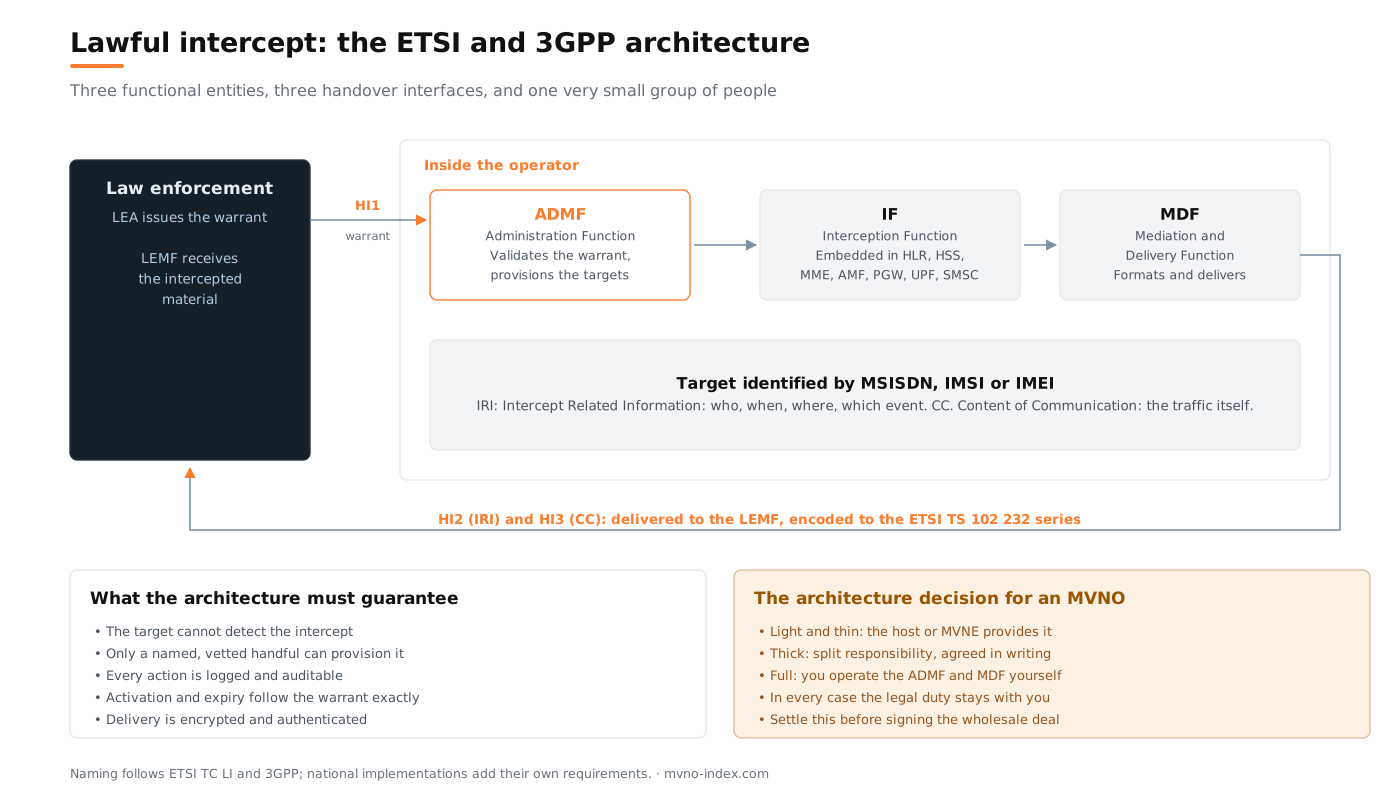
The Lawful Intercept architecture, as defined by ETSI and 3GPP, is built around three functional entities and three handover interfaces:
- Administration Function (ADMF): The central management system that receives warrant instructions from law enforcement via HI1, validates them, and distributes interception tasks to the relevant network elements. The ADMF is the sole point of entry for all LI provisioning and must be access-controlled to a very small number of authorized personnel.
- Interception Function (IF) / Triggering Function: The network element level capability that performs the actual interception. Every compliant network element (HLR, HSS, MME, AMF, PGW, UPF, SMSC, GMSC) contains an embedded Interception Function that activates when instructed by the ADMF and begins copying the relevant IRI or CC data.
- Mediation and Delivery Function (MDF): As described above, this function collects raw intercept data from the IFs, formats it according to the applicable ETSI or national standard, and delivers it securely to the LEMF via HI2 (for IRI) and HI3 (for CC).
- HI1 (Administrative Handover Interface): Used to exchange warrant and target information between the operator and the LEA. This interface must be secured using strong authentication and encryption.
- HI2 (IRI Delivery Interface): Delivers metadata (IRI) records to the LEA's monitoring facility in near real time. Records are encoded in ASN.1 format according to ETSI TS 102 232 series standards.
- HI3 (CC Delivery Interface): Delivers the actual content of intercepted communications (voice, SMS, data) to the LEA's monitoring facility. For voice, the stream is typically encoded in RTP. For data, it may be delivered as a raw IP stream or in a standardized encapsulation format.
The ETSI and 3GPP lawful intercept architecture: ADMF, IF and MDF, with the HI1, HI2 and HI3 handover interfaces.
Lawful Intercept Obligations for MVNOs and IoT Companies
Why Lawful Intercept Matters for MVNOs
Every MVNO that holds its own telecommunications license is legally required to provide Lawful Intercept capability. This obligation does not disappear by virtue of being a virtual operator: if you hold a license and provision subscribers, you are subject to LI law. The precise allocation of LI responsibility between an MVNO and its host MNO depends on the depth of the MVNO's own network stack and the terms of the wholesale agreement. A light MVNO (also called a reseller or branded reseller) that relies entirely on the host MNO's network may be able to fulfill LI obligations by contractually delegating the technical capability to the host MNO, while retaining responsibility for warrant management and subscriber identity resolution. A Full MVNO that operates its own core network elements, including its own HLR/HSS, must deploy and operate a fully compliant LI system covering all network elements under its control.
For IoT MVNOs, LI obligations apply to any communication service, not just human-to-human voice and messaging. If the IoT platform carries data communications that fall within the scope of national LI law (and most national frameworks are drafted broadly enough to include machine-to-machine communications), the operator must be capable of fulfilling intercept orders for those data streams.
Failure to maintain compliant Lawful Intercept capability is a license-threatening violation in virtually every jurisdiction. Regulators in the EU, UK, US, and most other markets have the power to suspend or revoke an operator's license for non-compliance. It is one of the most commonly cited reasons for license conditions being imposed on new MVNO entrants. When selecting an MVNE or platform provider, verifying that the platform includes a compliant LI solution should be a non-negotiable requirement in the due diligence process.
Advantages and Disadvantages of an Owned LI Solution
Advantages:
- Regulatory Independence: Owning your LI system means you are not dependent on a host MNO or MVNE to fulfill warrant obligations on your behalf. You control the warrant lifecycle, the audit trail, and the delivery timeline, which is critical for maintaining a clean regulatory record.
- Confidentiality Control: With your own LI system, you control which personnel have access to intercept information and can enforce strict need-to-know access controls independently of any third party.
- Auditability: Your own system means your own audit logs. You can demonstrate compliance to regulators completely and immediately without relying on a third party to provide records.
- Flexibility: An owned LI system can be updated and adapted to meet evolving national LI regulations and new interception requirements (such as those introduced by 5G) on your own schedule.
- Multi-Country Support: For MVNOs operating across multiple markets, an owned LI platform can be centrally managed while meeting the specific delivery format and handover interface requirements of each national jurisdiction.
Disadvantages:
- High Specialization Required: Lawful Intercept is a highly specialized domain. Deploying and operating a compliant LI system requires expertise in telecommunications law, ETSI/3GPP standards, and network security that is not commonly available in a general IT team.
- Significant Capital Investment: A production-grade, fully compliant LI system covering all network elements and supporting multiple handover interface formats is a substantial capital investment, particularly for smaller MVNOs.
- Ongoing Compliance Burden: LI standards and national legal requirements evolve continuously. Keeping the system compliant requires ongoing engineering investment and legal monitoring.
- Security Sensitivity: The LI system handles the most sensitive data an operator can possess. Securing it to the required standard adds architectural and operational complexity.
- MVNE Delegation May Be Viable: For lighter MVNO models, delegating LI technical capability to a fully compliant MVNE may be a more cost-effective and lower-risk approach than building an owned system.
Organizational Impact of Lawful Intercept
Operational Impact: The LI function must be staffed by a small, carefully vetted team with appropriate security clearance. Warrant processing procedures must be formally documented and rehearsed, as law enforcement agencies may require urgent activation of intercepts on very short notice, including outside of normal business hours. The operator must maintain a single point of contact for LEA liaison that is available at all times.
Financial Impact: Lawful Intercept is a pure cost center: it generates no revenue and must be funded as a regulatory compliance overhead. The costs include the initial platform investment, annual maintenance and licensing fees, staff costs for the LI operations team, and the costs of legal counsel to review incoming warrants and ensure they meet national legal standards before activation. Operators that attempt to minimize LI investment expose themselves to the far greater cost of license suspension or regulatory fines.
Security Impact: The LI system is one of the highest-value targets for malicious actors within a telecom network. A compromised LI system could expose ongoing law enforcement investigations, the identities of targets under surveillance, and the confidential communications of private individuals. The architecture must enforce strict network isolation of LI systems from all other operational systems, strong multi-factor authentication for all access, comprehensive intrusion detection, and regular independent security audits. The OSS and BSS must not have any direct access to LI data or functions.
Technical Impact: The LI system must be integrated into the core network design from the outset. Retrofitting LI capability into an already-live network is significantly more complex and expensive than designing it in from the start. The system must operate without any impact on the quality of service experienced by the target or any other subscriber: a detectable performance degradation caused by an active intercept would both violate the confidentiality requirement and potentially corrupt the legal validity of the intercept. Low latency and high availability are therefore mandatory design requirements.
Regulatory and Standards Framework
Lawful Intercept is governed by a layered framework of national law, regional regulation, and international technical standards. Understanding this framework is essential for any operator assessing its LI obligations.
The primary technical standards are published by ETSI (European Telecommunications Standards Institute) in the TS 102 232 series and TS 101 671, and by 3GPP in TS 33.107 and TS 33.108. These standards define the architecture, interfaces, and data formats for LI across 2G, 3G, 4G, and 5G networks. In the United States, the applicable standard is defined by CALEA and implemented through J-STD-025. Many non-European, non-US jurisdictions adopt ETSI standards as their national baseline.
National legislation adds the procedural layer on top of the technical standard: who can authorize an intercept, under what circumstances, for how long, and with what judicial oversight. In the European Union, national LI laws must comply with the European Convention on Human Rights and EU data protection frameworks, including the GDPR. In many markets, the national telecom regulator publishes specific LI implementation guidelines that operators must follow as a license condition.
For MVNOs that operate across multiple countries, maintaining compliance in each jurisdiction independently is a significant legal and operational burden. Engaging experienced MVNO consultancy support to map LI obligations by market and design a compliant architecture is a practical and cost-effective approach for operators entering new territories.
Impact of 4G, 5G, and 6G on Lawful Intercept
Where interception happens per generation
| Generation | Interception points | Governing specification |
|---|---|---|
| 2G and 3G | MSC, SGSN, GGSN | ETSI and 3GPP legacy LI series |
| 4G LTE | MME, S-GW, P-GW, HSS | 3GPP TS 33.107 series |
| 5G | AMF, SMF, UPF, UDM, via the LI system | 3GPP TS 33.126 and TS 33.127 |
| Handover to the agency | LI mediation function | ETSI TS 102 232 series, ETSI TS 103 120 |
LI in the 4G Evolved Packet Core
The migration from 2G/3G to 4G introduced significant new complexity for Lawful Intercept. The all-IP Evolved Packet Core (EPC) carries voice (via VoLTE), SMS (via IP-SM-GW), and data in a unified IP environment, meaning that all three communication types must be intercepted at the IP level. The LI system must be capable of identifying and separating voice RTP streams from general data traffic at the PGW level, and of handling IRI from both the MME and the HSS.
LI in the 5G Core
The 5G Core (5GC) introduces a Service-Based Architecture (SBA) where network functions communicate via HTTP/2 APIs. 3GPP TS 33.127, 33.128, and 33.129 define the LI architecture for 5G, introducing a new LI reference architecture with updated interfaces specifically designed for the cloud-native, microservices-based 5G environment. Key new integration points include the AMF for IRI related to registration and mobility, the SMF for session-related IRI, and the UPF for content interception of data sessions. The Unified Data Management (UDM) replaces the HSS as the subscriber identity anchor relevant for LI target resolution.
6G and Beyond
As 6G architectures are developed, LI requirements will evolve further to address new communication paradigms including integrated satellite and terrestrial networks, AI-native network functions, and immersive communication services. The fundamental legal obligation to provide intercept capability will not change: it is embedded in national law and is technology-neutral in its application. Operators investing in 6G-ready infrastructure should ensure that LI extensibility is a design requirement from the earliest architecture phase.
Frequently Asked Questions about Lawful Intercept
Is Lawful Intercept mandatory for all MVNOs?
Yes. Any operator holding a telecommunications license that provides communications services to subscribers is subject to LI obligations under national law. The technical implementation may be delegated to a host MNO or MVNE under a contractual arrangement, but the legal responsibility remains with the license holder.
What is the difference between IRI and CC in Lawful Intercept?
IRI (Intercept Related Information) is metadata about a communication: who communicated with whom, when, and from where. CC (Content of Communication) is the actual content: the voice audio, the SMS text, or the data payload. Most jurisdictions require a higher level of judicial authorization for CC interception than for IRI.
Can a target subscriber detect that they are being intercepted?
A properly implemented Lawful Intercept system is completely transparent to the target. There must be no degradation of service quality, no unusual signaling activity, and no access to operator systems by the target or their contacts that would reveal the intercept. Confidentiality of the intercept is a legal requirement in virtually all jurisdictions.
What are the handover interfaces in a Lawful Intercept system?
ETSI defines three handover interfaces. HI1 is used for administrative warrant exchange. HI2 delivers IRI metadata to the law enforcement monitoring facility. HI3 delivers the actual content of intercepted communications. All three interfaces must be encrypted and authenticated.
How does 5G change Lawful Intercept requirements?
5G introduces new network functions (AMF, SMF, UPF, UDM) that replace 4G equivalents and require updated LI integration points. 3GPP TS 33.127 to 33.129 define the 5G LI architecture. The core obligation is unchanged, but the technical implementation must be updated for the 5G Service-Based Architecture.
What happens if an MVNO fails to comply with Lawful Intercept requirements?
Non-compliance with LI obligations is a serious regulatory violation that can result in license conditions, significant financial penalties, or license suspension or revocation, depending on the jurisdiction and the severity of the failure.
What standards govern Lawful Intercept in Europe?
The primary European standards are ETSI TS 102 232 (handover interface specifications) and ETSI TS 101 671 (HI2 and HI3 for circuit-switched networks), supplemented by 3GPP TS 33.107 and TS 33.108 for mobile network-specific requirements.
Summary
Lawful Intercept (LI) is one of the most critical and non-negotiable regulatory obligations that any MVNO, IoT operator, or mobile brand must address before and during commercial launch. It requires deep integration with the core network, spanning elements from the HLR and HSS through to the PGW, UPF, and SMSC. It demands specialized expertise in ETSI and 3GPP standards, robust security architecture, meticulous audit trail management, and a dedicated operational team.
For operators evaluating whether to own, build, or delegate their LI capability, the decision must be driven by the depth of their own network stack and the specific LI legal framework in each market they operate in. Lighter MVNO models may satisfy their obligations through a compliant MVNE or host MNO, while Full MVNOs with their own core network must invest in a fully owned and compliant LI platform.
Building LI compliance into your network design from the start is always less costly and less risky than retrofitting it later. Use the MVNO solution provider directory on MVNO Index to identify platform vendors with proven LI capability, and engage specialized consultancy to map your LI obligations across every market in your operating footprint before you launch.
Value Added Services (VAS)