The Virtual PBX: A Business Product an MVNO Can Own
A virtual PBX is a cloud-hosted telephone system: extensions, call routing, IVR menus, hunt groups and voicemail delivered as a service instead of as a box in a cupboard. For an MVNO selling to businesses it turns a SIM subscription into a communications product, with the margin that comes with it.
The Virtual PBX (Virtual Private Branch Exchange) is a cloud-hosted telephony system that delivers enterprise-grade voice communication features to businesses and mobile brands without requiring any on-premise hardware. For MVNOs (Mobile Virtual Network Operators), MVNEs, IoT companies, and Business MVNOs, understanding the Virtual PBX is essential, because it sits at the intersection of connectivity, subscriber value, and competitive differentiation. A Virtual PBX enables organizations to manage inbound and outbound calls, route them intelligently across extensions, hunt groups, IVR menus, and voicemail systems, all from a centrally managed, cloud-based platform. Whether you are launching a Business MVNO targeting SMEs or a Quad Play MVNO bundling voice with fixed and mobile services, the Virtual PBX is a powerful product you should understand, offer, or integrate.
On this page
- History and Evolution of the Virtual PBX
- Core Utility and Functionality of the Virtual PBX
- What is a Virtual PBX Used For?
- Key Functions of the Virtual PBX
- Technical Integration and Data Model
- Integration with Other Systems
- Technical Data Model and Key Interfaces
- Virtual PBX as an MVNO Product or Internal Tool
History and Evolution of the Virtual PBX
The traditional PBX was a physical telephone switchboard installed on company premises, routing internal calls and connecting businesses to the public telephone network. In the early 2000s, the emergence of Voice over IP (VoIP) and SIP (Session Initiation Protocol) enabled PBX functionality to migrate to software running on standard servers. By the 2010s, cloud computing made it possible to deliver PBX services entirely over the internet, giving rise to the Virtual PBX as a subscription-based, hardware-free solution accessible to businesses of any size. Today, cloud-native Virtual PBX platforms integrate natively with mobile networks, CRM systems, Contact Centers, and AI-powered voice tools.
Core Utility and Functionality of the Virtual PBX
What is a Virtual PBX Used For?
A Virtual PBX is used to manage all inbound and outbound business telephony from a single, centrally administered cloud platform. Instead of routing calls through physical hardware in a server room, a Virtual PBX routes calls intelligently across the public switched telephone network (PSTN), mobile networks, and IP networks based on rules defined by the administrator.
For an MVNO, the Virtual PBX is relevant in two distinct ways. First, it can be offered as a value-added service to business subscribers, giving corporate customers a hosted telephony solution bundled with their mobile plans. This is a compelling proposition for Business MVNOs targeting SMEs, startups, and distributed teams that need professional telephony without the cost or complexity of traditional PBX hardware. Second, the Virtual PBX can be deployed internally within the MVNO's own operations to power its Contact Center, customer care team, and back-office telephony.
In both use cases, the Virtual PBX replaces expensive, inflexible on-premise equipment with a cloud service that can be configured, scaled, and administered through a web interface, making it equally relevant to a two-person startup and a multinational enterprise.
Key Functions of the Virtual PBX
Understanding the core functions of the Virtual PBX reveals why it is such a commercially attractive product for MVNOs to offer and why it is so operationally valuable as an internal tool:
- Auto Attendant and IVR: An automated interactive voice response system greets incoming callers and routes them to the correct department, extension, or voicemail based on their keypad input or spoken commands. This projects a professional image for businesses of any size.
- Call Routing and Hunt Groups: Incoming calls can be distributed across multiple extensions or agents according to configurable rules, including round-robin, simultaneous ring, or sequential routing. Hunt groups ensure that calls are never missed when one line is busy.
- Extension Management: The Virtual PBX assigns internal extensions to users, whether they are working from a desk phone, a softphone application on a laptop, or a mobile device. This is particularly powerful when combined with mobile SIM services, enabling a single business number to ring a mobile handset anywhere in the world.
- Voicemail and Voicemail-to-Email: Each extension can be assigned a voicemail box. Messages can be delivered automatically as audio file attachments to the user's email address, eliminating the need to dial in to retrieve messages.
- Call Recording: Inbound and outbound calls can be recorded automatically for compliance, quality assurance, training, or dispute resolution purposes. Recordings are stored securely in the cloud and accessible via the admin portal.
- Call Transfer and Hold: Agents can transfer live calls to colleagues, place callers on hold with custom hold music, or create conference calls between multiple participants, all without needing physical desk hardware.
- Number Portability and DID Numbers: Virtual PBX platforms support Direct Inward Dialing (DID) numbers, allowing businesses to present local, national, or international phone numbers to callers. Number portability ensures existing business numbers can be migrated to the Virtual PBX without disruption.
- Click-to-Call and CRM Integration: Users can initiate calls directly from a CRM record, browser, or business application with a single click. Incoming calls automatically display the caller's CRM record, giving agents instant context before the call is answered.
- Analytics and Reporting: Administrators gain access to detailed call logs, queue statistics, agent performance metrics, and real-time dashboards that enable data-driven decisions about staffing, routing, and service levels.
- Mobile and Softphone Applications: Users can access the full Virtual PBX feature set from a smartphone application or desktop softphone, making the system fully compatible with remote and hybrid working environments.
Technical Integration and Data Model
The protocol stack behind a virtual PBX
| Layer | What it does | Specification |
|---|---|---|
| Call signalling | Sets up, changes and ends calls | IETF RFC 3261 (SIP), as updated |
| Media | Carries the audio | RTP, negotiated via SDP in SIP |
| Operator voice core | Delivers voice over the mobile network | 3GPP TS 23.228 (IMS); GSMA IR.92 for VoLTE |
| Border control | Protects and normalises SIP at the edge | IETF RFC 5853 (SBC requirements) |
| PBX role in SIP terms | Acts as a back-to-back user agent | IETF RFC 7092 |
Integration with Other Systems
The Virtual PBX does not operate in isolation. It integrates with a range of adjacent systems to deliver its full value, both for MVNO business subscribers and for the MVNO's own internal operations. Key integration points include:
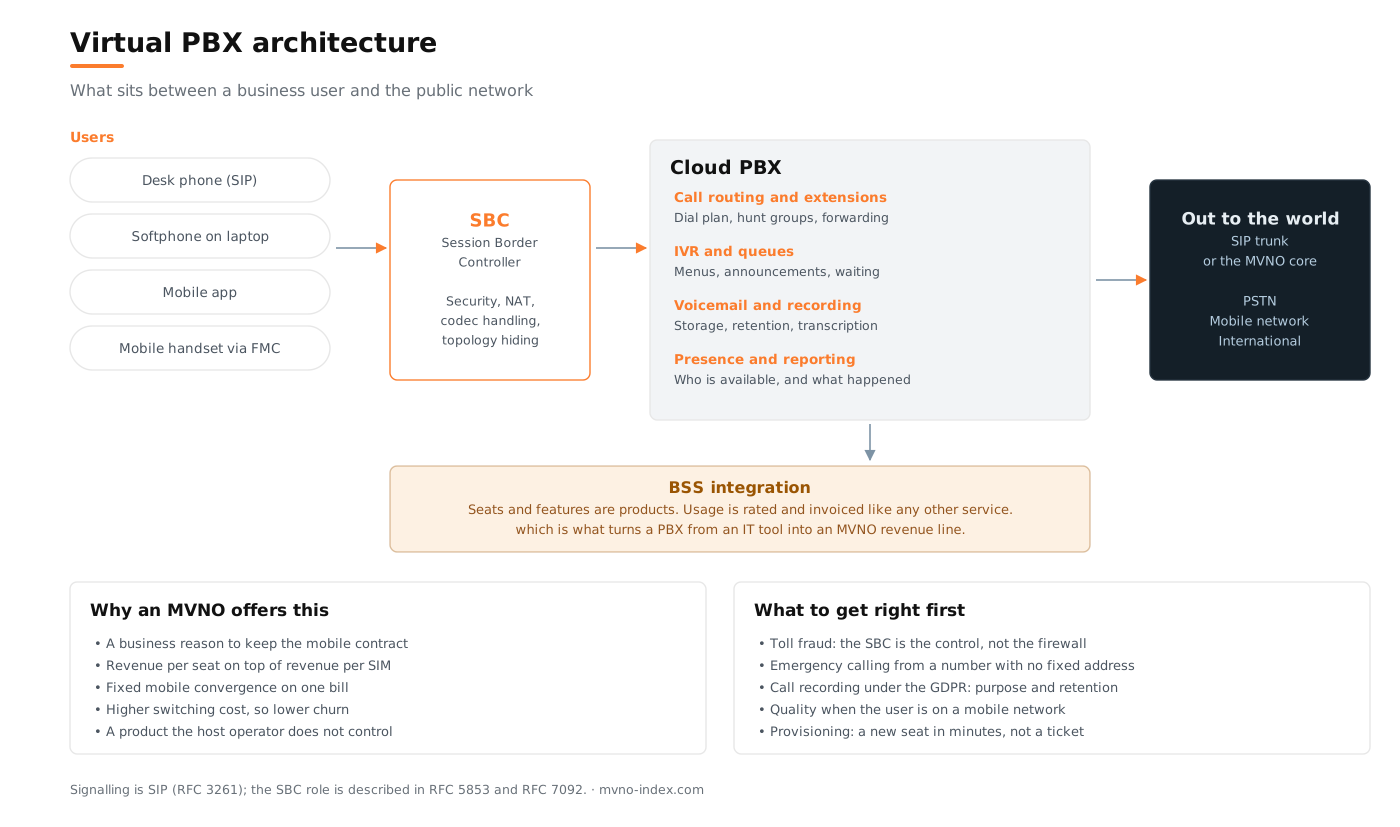
- Mobile Core Network: When offered as an MVNO product, the Virtual PBX must integrate with the mobile core to enable calls to and from mobile SIM subscriptions. This typically involves integration with the Session Border Controller (SBC), which acts as the secure gateway between the IP-based Virtual PBX and the mobile network. The SBC enforces security policies, handles protocol interworking, and manages media traffic across network boundaries.
- Business Support System (BSS): The BSS handles subscription management, billing, and provisioning for Virtual PBX services. When a business subscriber orders a Virtual PBX plan, the BSS triggers the provisioning of their account, assigns DID numbers, and manages recurring billing for their monthly subscription.
- Operational Support System (OSS): The OSS monitors the Virtual PBX platform's health, availability, and performance. Fault alerts, capacity metrics, and service quality indicators flow from the Virtual PBX into the OSS, enabling proactive maintenance and rapid incident response.
- CRM Platforms: Integration with popular CRM platforms such as Salesforce, HubSpot, or Microsoft Dynamics enables click-to-call, automatic call logging, and screen-popping of subscriber records on incoming calls. For MVNO business subscribers, this integration is a major productivity driver and a key selling point.
- Fixed Mobile Convergence (FMC): Advanced Virtual PBX deployments support FMC, enabling seamless call continuity between fixed IP lines and mobile SIM connections. A call started on a desk phone can be handed off to a mobile without interruption, which is a highly valued capability for mobile business users.
Technical Data Model and Key Interfaces
The Virtual PBX is built on standardized VoIP and telephony protocols that ensure interoperability across vendors and network types. The core technical interfaces include:
- SIP (Session Initiation Protocol): The foundational protocol for establishing, managing, and terminating voice and video calls in a Virtual PBX. All extensions, trunks, and gateways communicate using SIP signaling over IP.
- RTP (Real-time Transport Protocol): Carries the actual voice media stream between endpoints. RTP operates in parallel with SIP signaling and must be optimized for low latency and jitter to ensure call quality.
- SIP Trunking: The Virtual PBX connects to the PSTN and mobile networks via SIP trunks, which are virtual connections that carry call signaling and media over IP. SIP trunks replace traditional ISDN or analog telephone lines.
- WebRTC: Modern Virtual PBX platforms support WebRTC, enabling browser-based voice calls without any plugin or application installation. This is valuable for web-based Contact Center and support tools.
- REST APIs: Cloud-based Virtual PBX platforms expose REST APIs that allow MVNOs and their business subscribers to programmatically manage extensions, numbers, call flows, and reporting data, enabling deep integration with business applications.
- SRTP and TLS: Secure Real-time Transport Protocol (SRTP) and Transport Layer Security (TLS) encrypt media and signaling traffic respectively, protecting call content and authentication credentials from interception.
Virtual PBX architecture: users, session border controller, cloud PBX, and the route out to the public network
Virtual PBX as an MVNO Product or Internal Tool
Why Offer or Own a Virtual PBX?
For a Business MVNO or a Quad Play MVNO, offering a Virtual PBX as part of the product portfolio is one of the most effective ways to increase average revenue per user (ARPU), deepen subscriber stickiness, and compete on value rather than price. Business subscribers who bundle their mobile SIMs, data connectivity, and Virtual PBX service with the same MVNO are significantly harder to churn than subscribers on a simple SIM-only plan.
From an internal operations perspective, deploying a Virtual PBX to power your own customer care and Contact Center telephony gives you complete control over call routing, agent management, and call recording without dependency on a third-party telephony provider. This reduces costs, improves reliability, and gives your operations team the flexibility to adapt call flows rapidly in response to changing business needs.
Consider also that Virtual PBX capabilities are increasingly expected as standard by SME subscribers. If you are targeting the business market as described in the guidance on how to start your own mobile brand, the absence of a Virtual PBX offer will limit your ability to win and retain corporate accounts. Adding it to your portfolio early, even if initially sourced from a specialist platform partner, creates a foundation for a much higher-value
Advantages and Disadvantages of Virtual PBX Ownership
Advantages:
- Increased ARPU: Virtual PBX services command a monthly recurring fee per user on top of mobile plan revenue, materially increasing the revenue generated by each business subscriber.
- Subscriber Stickiness: Business subscribers with a Virtual PBX integrated into their operations are far less likely to switch provider, because migrating a telephony system is complex and disruptive.
- Competitive Differentiation: In a crowded MVNO market, offering hosted telephony as part of a business bundle sets your brand apart from pure SIM-only competitors. See how different MVNO business models differentiate on value-added services.
- Scalability: Cloud-based Virtual PBX platforms scale instantly. Adding new users, numbers, or features requires no hardware changes, only configuration changes in the admin portal.
- Remote and Mobile Workforce Enablement: The Virtual PBX supports mobile and home working natively, which aligns perfectly with a mobile-first MVNO proposition.
- Unified Communication Potential: A Virtual PBX can be expanded into a full Unified Communications as a Service (UCaaS) platform, incorporating video conferencing, team messaging, and file sharing alongside voice.
Disadvantages:
- Platform Investment: Building or white-labeling a Virtual PBX platform requires upfront investment in technology, integration, and vendor management.
- Support Complexity: Business telephony subscribers have higher support expectations and more complex technical queries than consumer subscribers. Your customer care team must be trained to support PBX configuration, SIP troubleshooting, and number management.
- Regulatory Obligations: Offering telephony services in most markets triggers obligations around emergency calling (E911/112), lawful interception, and number portability that must be addressed in your compliance framework.
- Quality of Service Dependency: Voice call quality is highly sensitive to network latency and jitter. MVNOs must ensure their connectivity and network infrastructure can deliver the consistent quality of service that business subscribers demand.
- Competitive Pressure from UCaaS Giants: Established UCaaS providers such as Microsoft Teams, Zoom Phone, and RingCentral are well-funded competitors in the business telephony market. Your differentiation must be built on price, integration, support quality, or niche market focus.
Organizational Impact of Virtual PBX
Deploying or offering a Virtual PBX has meaningful impact across multiple dimensions of an MVNO's organization:
Operational Impact: Product teams must manage the Virtual PBX platform alongside the core mobile product stack, including configuration management, feature updates, number inventory, and porting workflows. Technical support teams need training in VoIP troubleshooting, SIP diagnostics, and call flow configuration to support business subscribers effectively. Establishing clear SLAs for Virtual PBX availability and call quality is essential, since voice downtime for a business subscriber has immediate commercial consequences for their operations.
Financial Impact: The Virtual PBX adds a meaningful recurring revenue stream. Each business subscriber paying a per-seat monthly fee for hosted telephony materially improves the unit economics of the subscriber relationship. When modelling the financial case in your MVNO financial plan, include Virtual PBX ARPU uplift, platform costs, support cost increments, and the churn reduction benefit from deeper subscriber integration. The net financial impact is typically strongly positive for MVNOs with a meaningful business subscriber base.
Security Impact: The Virtual PBX handles sensitive business communications and must be secured against common VoIP threats including toll fraud, SIP registration attacks, and call interception. Implementing strong authentication, rate limiting on SIP registrations, encrypted media (SRTP), and encrypted signaling (TLS) is non-negotiable. The Session Border Controller (SBC) plays a critical role in protecting the Virtual PBX from external attacks by acting as a hardened security boundary between the public internet and the core telephony infrastructure.
Technical Impact: The Virtual PBX must be integrated with the MVNO's BSS for automated provisioning and billing, with the OSS for monitoring and fault management, and with the mobile core via an SBC for seamless mobile-fixed voice integration. When planning this integration, consult the guidance on how to select the right BSS and OSS to ensure your back-office systems can support the provisioning and billing workflows that a Virtual PBX product requires.
Redundancy and High Availability
The Virtual PBX is a mission-critical communication tool for business subscribers. A telephony outage directly disrupts their ability to serve their own customers, making redundancy and high availability non-negotiable design requirements for any commercially serious Virtual PBX deployment.
Achieving high availability requires deploying the Virtual PBX platform across at least two geographically separated data centers in an active-active or active-standby configuration. All critical components, including SIP proxy servers, media gateways, databases, and the Session Border Controller (SBC), must be fully redundant. SIP trunks connecting to the PSTN and mobile core should be provisioned with redundant carriers to eliminate single points of failure at the interconnect level.
Automated health monitoring must detect component failures within seconds and trigger failover without human intervention. SLA commitments for business subscribers typically target 99.99% or higher availability, which translates to less than one hour of permitted downtime per year. Achieving this level of reliability requires rigorous architecture, continuous monitoring, and regular disaster recovery testing. Regular failover drills and documented recovery procedures are as important as the technical architecture itself.
Impact of 4G, 5G, and AI on the Virtual PBX
Virtual PBX in the 4G and 5G Era
The widespread availability of high-quality 4G LTE mobile data has already transformed the Virtual PBX market by making mobile softphone applications as reliable as desk phones for most business use cases. The combination of a mobile SIM and a Virtual PBX softphone application turns any smartphone into a fully featured business telephone extension, which is a proposition that resonates strongly with modern, mobile-first business subscribers. Read more about what 5G means for MVNOs in the context of new service capabilities.
The rollout of 5G takes this further. The ultra-low latency and high bandwidth of 5G networks eliminates the remaining performance gap between mobile and fixed voice communications. 5G network slicing will eventually enable MVNOs to provision dedicated quality-of-service guarantees specifically for voice traffic, ensuring that Virtual PBX calls on mobile SIMs maintain consistent quality even during periods of network congestion. This makes the combination of 5G mobile connectivity and a cloud Virtual PBX an exceptionally compelling offer for business subscribers.
AI and the Future of the Virtual PBX
Artificial Intelligence is already reshaping what the Virtual PBX can do, and the pace of change is accelerating. AI-powered features that are either available today or emerging rapidly include:
Intelligent Call Routing: AI can analyze the content of an inbound call in real time and route it to the most appropriate agent based on caller intent, language, sentiment, and historical interaction data, rather than relying solely on keypad input from an IVR menu.
Real-Time Transcription and Summarization: Every call can be automatically transcribed and summarized using large language models, creating searchable records and instant post-call summaries that eliminate the need for manual note-taking by agents or business users.
Sentiment Analysis and Quality Management: AI tools can monitor live calls and flag negative sentiment, long silences, or compliance keywords, enabling supervisors to intervene in real time or triggering automatic quality alerts after the call ends.
AI-Powered Virtual Receptionists: Advanced AI voice agents can handle entire inbound call flows for simple use cases, such as booking confirmations, opening hours enquiries, or FAQ responses, without human involvement. This is particularly valuable for small business subscribers who cannot staff a full-time receptionist.
Fraud Detection: AI can identify anomalous call patterns associated with toll fraud, such as sudden spikes in international call volumes, and automatically block suspicious activity before significant financial damage occurs.
MVNOs that position their Virtual PBX as an AI-enhanced business communication platform, rather than simply a cloud phone system, will be significantly better placed to win business subscribers and command premium pricing. Carefully read the guidance on the pros and cons of AI for MVNOs and the do's and don'ts when using AI before incorporating AI features into your product roadmap.
Traditional PBX versus virtual PBX
Traditional PBX versus virtual PBX
| Feature | Traditional PBX | Virtual PBX |
|---|---|---|
| Where it runs | Hardware on the customer premises | Software in the cloud |
| Upfront cost | Capital purchase and installation | None, subscription per user |
| Adding a user | Engineer visit or licence purchase | A setting in the portal |
| Remote and mobile working | Add-on, often poorly | Native |
| Who carries the risk | The customer | The provider |
| Upgrades | Project | Continuous |
Frequently Asked Questions about the Contact Center
What is the difference between a traditional PBX and a Virtual PBX?
A traditional PBX is a physical telephone switchboard installed on company premises. A Virtual PBX delivers the same functionality from a cloud-hosted platform, requiring no on-site hardware. Virtual PBX systems are faster to deploy, easier to scale, and far lower in upfront cost than traditional PBX installations.
Why should an MVNO offer a Virtual PBX to its business subscribers?
A Virtual PBX increases ARPU, deepens subscriber stickiness, and enables the MVNO to compete on value rather than price in the business segment. Business subscribers who integrate a Virtual PBX with their mobile SIM plans are significantly less likely to churn, improving the overall unit economics of the subscriber relationship.
What protocol does a Virtual PBX use to make calls?
Virtual PBX systems use SIP (Session Initiation Protocol) for call signaling and RTP (Real-time Transport Protocol) for the voice media stream. SIP trunking connects the Virtual PBX to the PSTN and mobile networks.
What is the role of the Session Border Controller in a Virtual PBX deployment?
The Session Border Controller (SBC) acts as the secure gateway between the Virtual PBX platform and external networks, including the mobile core and the PSTN. It enforces security policies, handles protocol interworking, and protects the Virtual PBX from SIP-based attacks such as toll fraud and denial-of-service.
How does a Virtual PBX integrate with an MVNO's BSS?
The Virtual PBX integrates with the BSS via APIs to automate subscriber provisioning, DID number assignment, and recurring billing. When a business subscriber orders a Virtual PBX plan, the BSS triggers automatic account creation and service activation without manual intervention.
Can a Virtual PBX support Fixed Mobile Convergence?
Yes. Advanced Virtual PBX platforms support Fixed Mobile Convergence (FMC), enabling seamless call continuity between fixed IP extensions and mobile SIM connections. This is a highly valued capability for business MVNOs targeting mobile-first enterprises and distributed teams.
What are the main security risks associated with a Virtual PBX?
The primary security risks are toll fraud through compromised SIP credentials, denial-of-service attacks targeting SIP infrastructure, and call interception on unencrypted connections. These risks are mitigated through strong authentication, SRTP media encryption, TLS signaling encryption, and the deployment of a hardened Session Border Controller.
Summary
The Virtual PBX is a cloud-hosted telephony platform that delivers enterprise-grade business communication features without the cost or complexity of traditional on-premise hardware. For MVNOs and IoT companies, it is both a powerful internal operational tool and a commercially attractive value-added service for business subscribers. Offering a Virtual PBX enables Business MVNOs and Quad Play MVNOs to increase ARPU, deepen subscriber stickiness, and compete on value rather than on price alone.
Deploying a Virtual PBX requires careful integration with your BSS, OSS, and mobile core via a Session Border Controller (SBC), as well as a clear approach to security, redundancy, and support. As 5G and AI continue to advance, the Virtual PBX will evolve into an intelligent, fully converged business communication platform, making it an even more compelling part of the MVNO product portfolio.
If you are ready to explore Virtual PBX solutions for your MVNO, browse the solution providers listed on MVNO Index to find specialists in hosted telephony, UCaaS, and business mobile services. If you need strategic guidance on how to build a business subscriber proposition around Virtual PBX, the consultancy companies on MVNO Index can provide expert support tailored to the MVNO market.
Value Added Services (VAS)