A2P Messaging (SMS): How It Works and Why It Pays
A2P messaging (Application-to-Person SMS) is an SMS sent automatically by a business application to a mobile subscriber, a one-time password, a delivery notification, an appointment reminder. For an MVNO it is two things at once: inbound wholesale revenue, and a traffic category that has to be routed, priced and protected against fraud.
A2P Messaging, or Application-to-Person Messaging, is the process by which a software application automatically sends SMS messages to individual mobile subscribers. Unlike Person-to-Person (P2P) messaging, which involves two people exchanging texts through their handsets, A2P SMS originates from a business system and is delivered to a consumer or end user. Examples are everywhere in daily life: the one-time password your bank sends when you log in, the delivery notification from a courier, the appointment reminder from your dentist, or the promotional offer from a retailer. For MVNOs, IoT companies, and any mobile brand operator, A2P SMS is simultaneously a significant revenue stream, a critical infrastructure component, and a channel that demands careful technical and commercial management. Understanding A2P messaging in depth is essential for any operator building a viable MVNO business model.
On this page
- History and Evolution of A2P Messaging
- Core Utility and Functionality of A2P SMS
- What is A2P SMS Used For?
- Key Functions and Message Flow of A2P SMS
- Technical Integration and Data Model
- Integration with Core Network Elements and BSS
- Technical Interfaces and Routing Architecture
- A2P SMS for MVNOs and IoT Companies
A2P versus P2P SMS at a glance
| Feature | A2P SMS | P2P SMS |
|---|---|---|
| Sender | A business application | A person, from a handset |
| Typical protocol | SMPP or REST API via an aggregator | MAP over SS7 between networks |
| Sender identity | Alphanumeric sender ID, long code or short code | MSISDN |
| Termination rate | A2P rate | P2P rate, normally lower |
| Regulation | Opt-in rules, sender ID registration | Consumer rules |
| Volume per sender | High, often in bursts | Low |
History and Evolution of A2P Messaging
A2P SMS emerged in the late 1990s as enterprises discovered that the Short Message Service Center (SMSC) could carry machine-originated traffic alongside peer-to-peer messages. SMS itself has been specified since the earliest GSM releases and is maintained today as 3GPP TS 23.040, Technical realization of the Short Message Service. Early use cases were limited to simple alerts and notifications sent via basic HTTP-to-SMS gateways. The explosion of mobile banking, e-commerce, and two-factor authentication from 2008 onward transformed A2P from a niche service into one of the highest-volume and highest-value traffic categories in global telecommunications. Juniper Research put the mobile business messaging market at $48 billion in 2022, rising to $78 billion by 2027 — a figure worth refreshing, since that projection dates from September 2022.
Core Utility and Functionality of A2P SMS
What is A2P SMS Used For?
A2P SMS is the definitive channel for time-sensitive, high-deliverability, business-to-consumer communication. Its core strength is ubiquity: SMS works on every mobile device, in every country, without an internet connection or a specific application installed. No other messaging channel matches this reach. Businesses choose A2P SMS precisely because they need guaranteed delivery to a specific mobile number regardless of device type, operating system, or data connectivity. For an MVNO, A2P traffic arrives on the network as inbound termination from enterprise senders routing through aggregators and messaging hubs. This traffic must be correctly identified, routed, priced, and monetized. Failing to manage A2P traffic properly means leaving revenue on the table and exposing the network to bypass fraud that directly erodes termination income.
A2P SMS serves a wide range of enterprise use cases across virtually every industry vertical:
Authentication and Security: One-time passwords (OTP), two-factor authentication (2FA) codes, and transaction authorization messages are the largest category of A2P SMS by volume in most markets. Financial institutions, technology platforms, and any organization with a digital login relies on A2P SMS to verify user identity in real time.
Transactional Notifications: Order confirmations, shipping updates, payment receipts, account balance alerts, and service activation notifications are delivered via A2P SMS because the channel delivers within seconds and carries no dependency on app installation or internet access.
Appointment and Event Reminders: Healthcare providers, logistics companies, service businesses, and public sector organizations use A2P SMS to reduce no-shows and improve operational efficiency.
Marketing and Promotional Campaigns: Retailers, media companies, and lifestyle MVNOs use A2P SMS to deliver time-limited offers, loyalty rewards, and subscriber engagement campaigns directly to the mobile handset.
IoT and M2M Alerts: In IoT deployments, A2P SMS carries machine-generated alerts and status notifications from connected devices to human operators or fleet managers. This is particularly relevant for M2M and IoT MVNO operators who manage large device fleets.
Customer Care and Service Updates: Automated service notifications, outage alerts, and customer care follow-up messages are delivered via A2P SMS, connecting naturally to the customer care strategy of any mobile operator.
Key Functions and Message Flow of A2P SMS
Understanding the technical flow of an A2P message through a mobile network is fundamental for any MVNO evaluating how to manage, route, and monetize this traffic category.
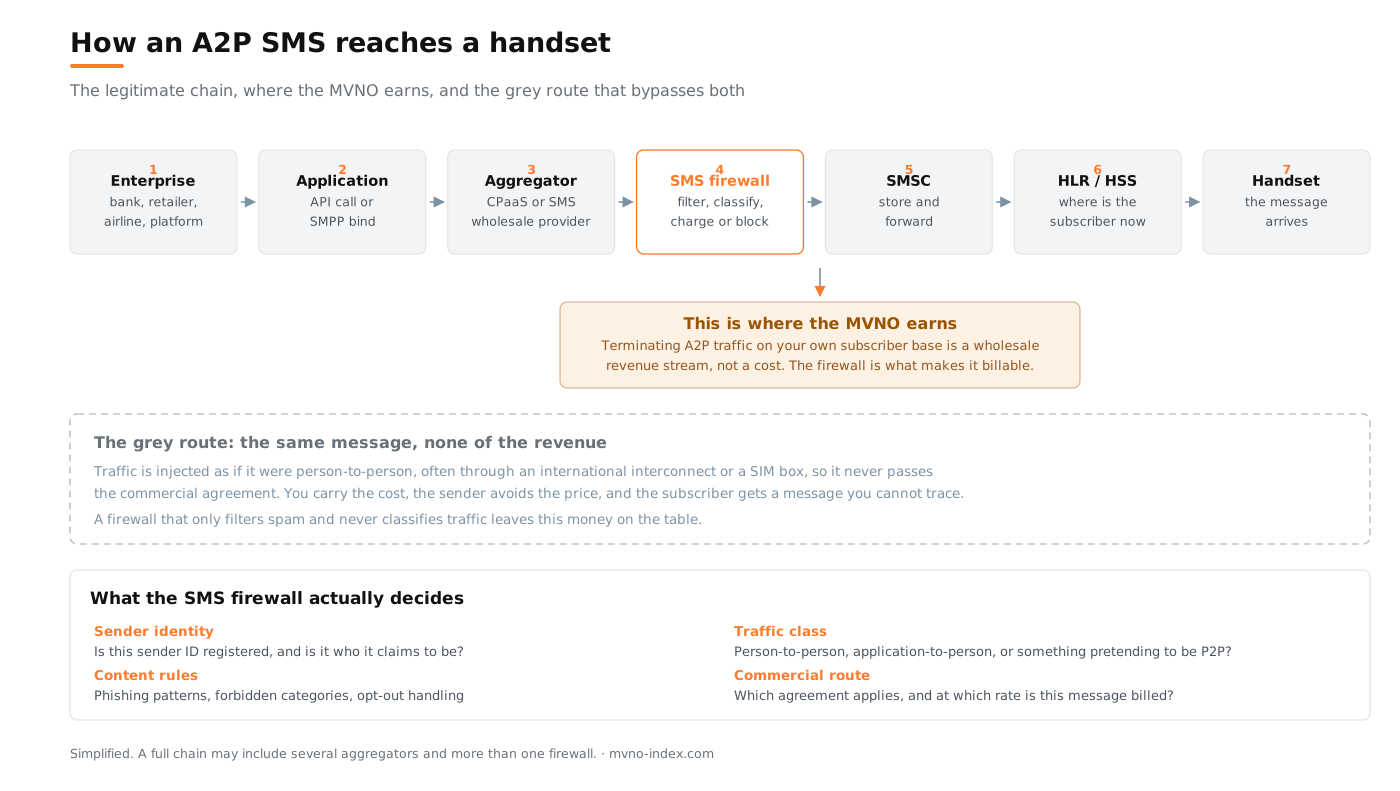
Message Origination: An enterprise application generates an SMS message and submits it to an SMS aggregator or messaging platform via an API, typically using the SMPP (Short Message Peer-to-Peer) protocol or an HTTP-based REST API. The sender identity is expressed as an alphanumeric sender ID (e.g., "MYBANK") or a dedicated long or short code.
Aggregator Routing: The aggregator routes the message through its network of operator connections to identify the correct terminating network for the destination MSISDN (mobile number). This routing typically traverses SS7-based interconnects or SIP/SIGTRAN connections toward the destination operator's SMSC.
SMSC Processing: The terminating operator's Short Message Service Center receives the message and processes it for delivery to the subscriber's handset. The SMSC queries the Home Location Register (HLR) or Home Subscriber Server (HSS) to determine the subscriber's current location and routing information.
Delivery and Acknowledgment: The message is forwarded to the serving Mobile Switching Center or Mobility Management Entity and delivered to the handset. A delivery receipt is generated and returned through the chain to the originating enterprise application, confirming successful delivery.
Charging and Reporting: The terminating event is recorded by the operator's charging infrastructure, including the Online Charging System (OCS) for real-time prepaid interactions and the Offline Charging System (OFCS) for postpaid and wholesale billing. These records flow into the BSS for invoicing and revenue reporting.
How an A2P SMS reaches a handset: the legitimate chain, the point where the MVNO earns, and the grey route that bypasses both.
Technical Integration and Data Model
Integration with Core Network Elements and BSS
A2P SMS does not operate in isolation within a mobile network. It intersects with multiple core network elements and BSS/OSS components at every stage of the message lifecycle. For an MVNO evaluating its A2P SMS strategy, understanding these integration points is essential for making the right commercial and technical decisions.
The SMSC is the central processing node for all SMS traffic, both P2P and A2P: it handles queuing, retry logic, delivery receipts and interconnection with external aggregators. It interfaces with the HLR and HSS to resolve subscriber routing data, and with the Signaling Transfer Point (STP) or Diameter Routing Agent (DRA) for signalling transport.
The BSS plays a critical commercial role in A2P SMS management. It holds the wholesale pricing agreements with aggregators, generates invoices for A2P termination, and provides the revenue reporting that allows the MVNO to track A2P income against cost. When selecting the right BSS and OSS for an MVNO, A2P SMS billing capability, including support for sender ID pricing tiers, per-message wholesale rates, and aggregator settlement, should be a firm evaluation criterion.
Technical Interfaces and Routing Architecture
A2P SMS reaches a terminating MVNO network through several possible interconnect paths, each with different technical and commercial characteristics:
SS7 Interconnect: The traditional method. The originating aggregator connects to the terminating operator via SS7 links, submitting messages using MAP (Mobile Application Part) protocol. This route is universally supported but is increasingly subject to SS7-based fraud and bypass attacks.
SIGTRAN/IP: A modernized version of SS7 transport over IP networks, offering the same protocol semantics as traditional SS7 but with the cost and flexibility advantages of IP-based connectivity.
SIP/SMPP over IP: Many aggregators and operators now exchange A2P traffic via SIP or direct SMPP connections over IP, bypassing the legacy SS7 layer entirely. This is the preferred interconnect model for MVNOs with a cloud-native core network or a modern Evolved Packet Core.
SMS Firewall Interface: Between the interconnect layer and the SMSC, a well-architected A2P SMS infrastructure includes an SMS firewall. This firewall inspects incoming messages, classifies traffic as A2P or P2P, enforces sender ID whitelisting policies, and blocks bypass fraud attempts before they reach the SMSC.
Interconnect paths compared
| Path | Transport | Advantage | Risk or drawback |
|---|---|---|---|
| SS7 interconnect | SS7 links, MAP | Universally supported | Exposed to SS7 fraud and bypass |
| SIGTRAN / IP | SS7 over IP | Same semantics, lower cost | Inherits the SS7 weaknesses |
| SIP or SMPP over IP | IP | Preferred for a cloud-native core | Requires a modern core |
| SMS firewall | Between interconnect and SMSC | Classification and fraud blocking | Needs continuous tuning |
A2P SMS for MVNOs and IoT Companies
Why A2P SMS Matters for MVNOs
For an MVNO, A2P SMS represents one of the most commercially significant and often underoptimized revenue streams in the business. Every SMS from a bank, retailer, or technology platform that is delivered to one of your subscribers generates a termination fee payable to your network. Managing this traffic well means capturing that revenue consistently and protecting it from bypass fraud. Mismanaging it means forfeiting significant income to fraudulent gray routes and unmonitored traffic leakage.
The commercial importance of A2P SMS varies by MVNO type. A Discount MVNO with a large prepaid subscriber base will receive substantial volumes of authentication and notification traffic from financial services and e-commerce platforms used by those subscribers. A Business MVNO may also originate A2P traffic on behalf of its enterprise customers, creating both termination revenue and origination revenue opportunities. A Fintech MVNO may integrate A2P SMS directly into its own financial service products for OTP delivery and transaction alerts.
What A2P SMS means for each MVNO type
| MVNO type | Role of A2P SMS |
|---|---|
| Discount MVNO | High inbound volumes of OTP and notification traffic; termination revenue |
| Business MVNO | Both termination and origination on behalf of enterprise customers |
| Fintech MVNO | A2P inside the product itself: OTP delivery and transaction alerts |
| M2M / IoT MVNO | Fallback channel and management channel for SIM provisioning |
| Media & Entertainment MVNO | Branded messaging as a value-added service to corporate clients |
For IoT operators, A2P SMS takes on a different dimension. SMS is used as a fallback communication channel for IoT devices when data connectivity is unavailable, and as a management channel for SIM provisioning and remote configuration. Ensuring that A2P SMS flows reliably across an IoT device fleet is an operational requirement, not just a commercial one.
A2P SMS must also be considered when building your MVNO marketing plan. Outbound A2P SMS to your own subscriber base is one of the most cost-effective and highest-engagement channels for subscriber communication, service notifications, and loyalty campaigns. The power of a subscriber-facing app is amplified when combined with A2P SMS for critical alerts that must reach the subscriber regardless of app status.
Advantages and Disadvantages of A2P SMS
Advantages
- Universal Reach: SMS reaches every mobile subscriber regardless of handset type, operating system, or internet connectivity. No other messaging channel offers equivalent global penetration.
- High Open and Read Rates: SMS messages are opened and read at higher rates than email, making A2P SMS the preferred channel for time-sensitive and high-priority business communications.
- Significant Revenue Stream: A2P termination represents substantial wholesale revenue for MVNOs with meaningful subscriber volumes. Properly monetized and protected, this traffic stream contributes directly to your financial plan.
- Proven Reliability: SMS has decades of operational history. The delivery infrastructure is mature, resilient, and well-understood by both operators and enterprise senders.
- Low Latency Delivery: A2P SMS messages are typically delivered within seconds under normal network conditions, meeting the real-time requirements of authentication, fraud alerts, and transactional notifications.
- Direct Integration with BSS: A2P charging events integrate naturally with the BSS and charging infrastructure, enabling accurate revenue capture and wholesale settlement.
Disadvantages
- Bypass Fraud Exposure: A2P SMS is heavily targeted by gray route fraud, where fraudulent aggregators deliver messages via P2P routes to avoid paying termination fees. This is one of the most significant revenue leakage risks for any MVNO.
- Regulatory Complexity: A2P SMS is subject to varying regulatory requirements across markets, including sender ID registration obligations, content restrictions, and consumer opt-in and opt-out rules.
- Spam and Unwanted Messaging: Without proper filtering, A2P channels can be misused for spam and phishing campaigns, damaging subscriber trust and creating regulatory liability.
- Competition from OTT Channels: Over-the-top messaging platforms, including WhatsApp Business, Apple Messages for Business, and others, compete with A2P SMS for enterprise messaging budgets in markets with high smartphone and data penetration.
- SMSC Dependency: The quality and capacity of the SMSC is a direct constraint on A2P SMS performance. Under-provisioned or poorly configured SMSCs create delivery delays and message loss that erode enterprise sender confidence.
Organizational Impact of A2P SMS
Operational Impact: A2P SMS operations require dedicated capacity management for the SMSC and interconnect infrastructure, proactive monitoring of delivery rates and fraud indicators, and operational processes for managing aggregator relationships and sender ID registrations. Your operations team must have clear escalation procedures for A2P delivery failures, as enterprise customers sending authentication traffic have extremely low tolerance for delays. This connects directly to the customer care discipline, where service quality issues must be triaged and resolved rapidly.
Financial Impact: A2P SMS can represent a material portion of wholesale revenue for an MVNO with a sizeable subscriber base. However, this revenue is only captured when the traffic is correctly identified as A2P and priced at the appropriate termination rate rather than being routed fraudulently via P2P gray routes. Investing in SMS firewall and traffic analytics tooling delivers a direct and measurable return through revenue recovery. Including A2P revenue projections in your a realistic assessment of subscriber volumes, traffic density per subscriber, and the effective termination rate achievable after fraud protection. MVNO financial plan requires a realistic assessment of subscriber volumes, traffic density per subscriber, and the effective termination rate achievable after fraud protection.
Security Impact: A2P SMS is a vector for several categories of attack. SIM swap fraud, SMS phishing (smishing), and SS7-based interception attacks all target the A2P messaging infrastructure. An SMS firewall with real-time traffic analysis is a security necessity as much as a revenue protection tool. The MVNO must also implement controls to prevent its own network from being used to originate fraudulent or spam A2P traffic, which creates regulatory and reputational risk.
Technical Impact: A2P SMS places specific demands on core network dimensioning, particularly on the SMSC and the signaling infrastructure. Peak A2P traffic volumes, which often coincide with enterprise campaign launches or system-wide OTP events, can generate short-duration signaling spikes that must be absorbed without degrading P2P service quality. The Signaling Transfer Point (STP) and interconnect layers must be dimensioned accordingly. For MVNOs operating a 4G LTE core, the to handle SMS-related signaling alongside policy and charging traffic without contention. Diameter Routing Agent (DRA) must be configured to handle SMS-related signaling alongside policy and charging traffic without contention.
A2P SMS Monetization and Wholesale Strategies
Monetizing A2P SMS effectively is one of the most impactful commercial levers available to an MVNO. The starting point is establishing a clear understanding of your A2P traffic flows: how much A2P traffic terminates on your network, where it originates, what it costs to terminate, and what you are currently earning for it.
The primary monetization mechanism is the wholesale termination rate charged to aggregators for delivering A2P messages to your subscribers. Most MVNOs receive A2P traffic via their host MNO under a wholesale agreement that may or may not explicitly separate A2P termination pricing from P2P pricing. Reviewing and renegotiating your wholesale agreements to include explicit A2P termination pricing is a foundational step in building a properly monetized A2P strategy.
Beyond passive termination revenue, MVNOs can also generate active A2P revenue by offering outbound A2P origination services to enterprise customers within their own subscriber base or market segment. A Business MVNO or a Media and Entertainment MVNO is well positioned to offer branded A2P messaging services to corporate clients, creating a value-added revenue layer on top of standard connectivity.
Sender ID management is another commercial dimension. Many markets now require enterprise senders to register their alphanumeric sender IDs with the terminating operator before those messages will be delivered. This registration process creates a revenue opportunity through registration fees and ongoing management charges, and it simultaneously strengthens fraud protection by ensuring only approved senders can use registered sender IDs on your network.
If you are at the stage of finding and selecting solution providers for your MVNO, ensuring that your prospective SMS firewall, SMSC, and BSS vendors support A2P traffic classification, sender ID management, and aggregator settlement is a non-negotiable requirement. The MVNO Index vendor directory lists solution providers across all relevant categories that can support your A2P SMS strategy.
What Does A2P SMS Cost?
A2P termination is priced per message and varies widely by country, by operator and by the route the traffic takes. Three things drive what you can charge: the wholesale agreement with your host MNO, whether that contract separates A2P from P2P termination at all, and whether a sender ID registration regime applies in your market. Aggregators price the same destination differently depending on whether the route is direct — and a route that looks cheap is often cheap because it is a gray route.
How to Choose an SMS Aggregator
Aggregators sit between the enterprise sender and your network, so the one an enterprise picks determines what actually arrives on your SMSC. Judge a prospective aggregator on: whether it offers direct routes to your destinations or resells them; whether it publishes delivery rates and delivery receipt accuracy; how it handles sender ID registration on your behalf; its position on gray routes, in writing; its settlement terms; and whether it supports the interconnect model your core network actually uses.
Fraud, Filtering, and Compliance in A2P SMS
A2P SMS fraud is one of the most financially damaging issues facing mobile operators globally. The primary fraud type is gray route bypassing, where A2P messages are injected into the network via P2P routes, avoiding the higher A2P termination rate and depriving the operator of legitimate revenue. Additional fraud types include SIM box fraud, where physical SIM cards are used to inject high volumes of fraudulent messages, and SMS phishing attacks that impersonate legitimate enterprise senders. Research by the Mobile Ecosystem Forum with Mobilesquared, conducted between December 2020 and April 2021, put annual operator losses from grey routes at US$7.9 billion and found that almost one third of mobile operators had not invested in a messaging fraud detection solution.
The essential tool for combating A2P fraud is an SMS Firewall. A properly configured SMS firewall sits between the interconnect layer and the SMSC and performs the following functions: traffic classification to distinguish A2P from P2P messages, sender ID validation against a registry of approved senders, gray route detection using behavioral and protocol analysis, and content filtering to block smishing and spam content. The SMS firewall must be updated continuously as fraud patterns evolve, making vendor selection and ongoing management as important as the initial deployment.
Compliance requirements add a further dimension. In most markets, A2P SMS senders are required to obtain explicit opt-in consent from recipients before sending marketing messages, and they must provide a simple mechanism for recipients to opt out. As the terminating operator, the MVNO is not directly responsible for enterprise sender compliance, but allowing non-compliant traffic to terminate on your network creates regulatory exposure. In the United States the CTIA Messaging Principles and Best Practices (May 2023) set out the consent levels that apply to conversational, informational and promotional traffic. Implementing content filtering and aggregator certification policies is the responsible commercial position.
The intersection of A2P SMS compliance with roaming scenarios adds additional complexity. When your subscribers receive A2P messages while roaming on partner networks, or when inbound roaming subscribers receive A2P messages on your network, the applicable regulations and termination pricing may differ from domestic scenarios. Your roaming agreements and SMS firewall configuration must account for these variations.
Sender ID Registration by Market
Several markets now require enterprise senders to register their alphanumeric sender IDs before messages are delivered, and the terminating operator is the party that enforces it. The rules differ per country in who registers, what is verified and what happens to unregistered traffic.
Short Codes, Long Codes and 10DLC
The sender identity an enterprise uses determines throughput, cost and how the message is treated by filters. Short codes carry high throughput at high cost, long codes are cheap but throttled, and in the United States 10DLC (10-digit long code) is the registered route for application traffic on consumer numbers. The CTIA messaging guidelines describe the consent rules that apply to each. For an MVNO these choices decide what enterprise senders can do on your network and what you can charge them.
The Future of A2P: RCS, OTT, and 5G Messaging
A2P SMS is mature and dominant today, but the messaging landscape is actively evolving. Understanding what comes next is important for any MVNO investing in messaging infrastructure and revenue strategy.
Rich Communication Services (RCS) is the most significant evolution of the A2P channel: branded sender verification, read receipts, rich media and interactive buttons, standardised by the GSMA in the RCS Universal Profile. For MVNOs it is both an opportunity — a premium A2P channel to sell — and a challenge, because RCS Business Messaging runs alongside the existing SMS stack rather than replacing it.
WhatsApp Business API, Apple Messages for Business, and Viber Business Messages compete directly with A2P SMS for enterprise messaging budgets. These channels offer rich capabilities similar to RCS but operate outside the operator's network, meaning the operator earns no termination revenue from OTT A2P traffic. The rise of OTT A2P is a structural pressure on SMS termination revenue that MVNOs must address in their long-term business planning.
5G Network Capabilities open new dimensions for A2P messaging. The potential of 5G for MVNOs includes network slicing and enhanced API exposure that can provide enterprise senders with guaranteed delivery quality and real-time analytics for their A2P campaigns, creating a differentiated, premium A2P product that commands higher termination rates than commodity SMS.
Artificial Intelligence is transforming both the enterprise use of A2P SMS and the operator's ability to manage it. AI-powered personalization is increasing enterprise demand for A2P messaging by making campaigns more effective. On the operator side, AI applied to fraud detection, traffic classification, and delivery optimization within the A2P SMS infrastructure. MVNOs that invest in AI-enabled messaging operations today are building a competitive advantage that will extend into the RCS and 5G messaging era. Mobile brands can be directed at fraud detection, traffic classification, and delivery optimization within the A2P SMS infrastructure. MVNOs that invest in AI-enabled messaging operations today are building a competitive advantage that will extend into the RCS and 5G messaging era.
SMS, RCS and OTT messaging compared
| Feature | A2P SMS | RCS Business Messaging | OTT (WhatsApp, Apple, Viber) |
|---|---|---|---|
| Reach | Every mobile handset, no data needed | Supported devices, data needed | Users of that specific app |
| Rich media | No | Yes | Yes |
| Verified sender | Sender ID registration only | Yes, branded verification | Yes, per platform |
| Operator earns from it | Yes, termination revenue | Yes, where the operator carries it | No |
Frequently Asked Questions about A2P Messaging (SMS)
What is the difference between A2P SMS and P2P SMS?
P2P SMS is sent between two people from their handsets. A2P SMS is generated by a business application and sent to a subscriber's number. The two differ in protocol, sender identity, termination rate and regulation — see Table 1 above for the full comparison.
Why is A2P SMS a revenue stream for MVNOs?
Every A2P message delivered to one of your subscribers generates a wholesale termination fee payable by the originating aggregator or sender. With large subscriber volumes, this termination revenue is commercially significant. It is protected and optimized through SMS firewall deployment and proper aggregator pricing agreements.
What is an SMS firewall and why does an MVNO need one?
An SMS firewall is a network element that sits between the interconnect layer and the SMSC. It classifies traffic as A2P or P2P, validates sender IDs, detects and blocks bypass fraud, and filters unwanted or harmful content. Without an SMS firewall, an MVNO is exposed to significant A2P revenue leakage and regulatory risk.
What is gray route fraud in A2P SMS?
Gray route fraud occurs when A2P messages are injected into the network via P2P interconnect routes, avoiding the higher A2P termination rate. The originating aggregator pays a lower P2P rate while the MVNO receives no A2P termination revenue for commercial traffic that should be subject to A2P pricing.
What is RCS and how does it relate to A2P SMS?
RCS (Rich Communication Services) is the next-generation successor to SMS, offering rich media, branded sender verification, and interactive features. RCS Business Messaging is the A2P equivalent of RCS and is progressively replacing SMS as the preferred enterprise messaging channel for high-value campaigns on supported devices.
How does A2P SMS integrate with the MVNO's BSS?
A2P charging events are recorded by the SMSC and processed through the OCS or OFCS into the BSS for wholesale invoicing and revenue reporting. The BSS must support A2P-specific pricing tiers, aggregator settlement workflows, and sender ID management to enable full A2P revenue capture.
Do IoT companies need to manage A2P SMS?
Yes. IoT operators use A2P SMS as a fallback communication and device management channel. They must also manage inbound A2P traffic to connected devices and ensure that SMS-based SIM management commands are processed reliably across their device fleet.
Summary
A2P Messaging (SMS) is a foundational commercial and technical component of any MVNO or IoT operator's business. It is simultaneously a significant wholesale revenue stream from inbound enterprise traffic termination, a critical communication channel for subscriber engagement and service delivery, and a complex operational domain requiring dedicated infrastructure, fraud protection, and compliance management. For an MVNO, capturing the full value of A2P SMS requires integrating an SMS firewall with the SMSC and core network, connecting A2P charging to the BSS and OCS, establishing properly priced wholesale agreements with aggregators, and building a forward-looking strategy that encompasses RCS, OTT channels, and 5G-enabled messaging capabilities.
Whether you are starting your mobile brand, choosing your solution providers, or optimizing an existing operation, A2P SMS deserves dedicated attention in your business plan and technical architecture. The operators who manage it well build a recurring, scalable revenue stream that funds better subscriber experiences and stronger competitive positioning. Those who leave it unmanaged absorb the costs of fraud and regulatory exposure without capturing the income they have rightfully earned.
Value Added Services (VAS)