Virtual Numbers: Routing, Masking and Revenue
A virtual number is a telephone number that is not tied to a SIM or a physical line. It exists in the network and is routed to whatever destination the owner chooses: another number, an app, a call flow, or a platform. That indirection is what makes masking, second numbers and international presence possible.
A virtual number is a telephone number that is not tied to a fixed physical telephone line or a specific SIM card slot in a device. Instead, it is a software-defined number that exists entirely within the network and is routed to one or more destination numbers, applications, or communication platforms. Understanding how virtual numbers work is essential for any Mobile Virtual Network Operator (MVNO), IoT company, or business-focused mobile brand that wants to deliver differentiated, flexible communication services to its subscribers. Virtual numbers are a powerful tool for creating product distinction, driving additional revenue streams, and serving enterprise customers who demand sophisticated telephony features beyond a standard mobile subscription.
On this page
- History and Evolution of Virtual Numbers
- Core Utility and Functionality of Virtual Numbers
- What are Virtual Numbers Used For?
- Key Functions and Features of Virtual Numbers
- Types of Virtual Numbers
- Technical Integration and Architecture
- Integration with Other Systems
- Technical Architecture and Key Interfaces
- Virtual Numbers for MVNOs and IoT Companies
- Why Offer Virtual Numbers?
- Advantages and Disadvantages of Virtual Numbers
- Organizational Impact of Offering Virtual Numbers
- Redundancy and High Availability
- Impact of 4G, 5G, and AI on Virtual Numbers
- Frequently Asked Questions about Virtual Numbers
- Summary
History and Evolution of Virtual Numbers
Virtual numbers emerged in the late 1990s alongside the growth of Voice over IP (VoIP) and the gradual softwarization of telecommunications infrastructure. Early implementations were used primarily by call centers and large enterprises that needed to present a single inbound number across multiple agent lines. With the maturation of SIP trunking and number portability frameworks in the 2000s, virtual numbers became commercially accessible to smaller operators and service providers. Today, they are a mainstream Value Added Service (VAS) and a fundamental building block for cloud communication platforms, Business MVNOs, and IoT deployments worldwide.
Core Utility and Functionality of Virtual Numbers
What are Virtual Numbers Used For?
A virtual number serves as a flexible, software-managed telephony identifier that can be assigned, rerouted, and managed in real time without any physical hardware intervention. Its primary purpose is to decouple the telephone number from the physical infrastructure, giving operators and end users complete freedom to define how calls and messages delivered to that number are handled.
For an MVNO or IoT operator, virtual numbers enable the provisioning of secondary numbers, local presence numbers in multiple countries, dedicated IoT device identifiers, enterprise communication lines, and privacy-preserving numbers for consumer applications. Deploying virtual numbers allows an operator to serve both individual consumers and corporate clients with a single, scalable platform while maintaining a clean separation between the subscriber's primary MSISDN and the business logic applied to each virtual number.
Key Functions and Features of Virtual Numbers
Understand the core functions of virtual numbers to appreciate their strategic value for modern mobile operators:
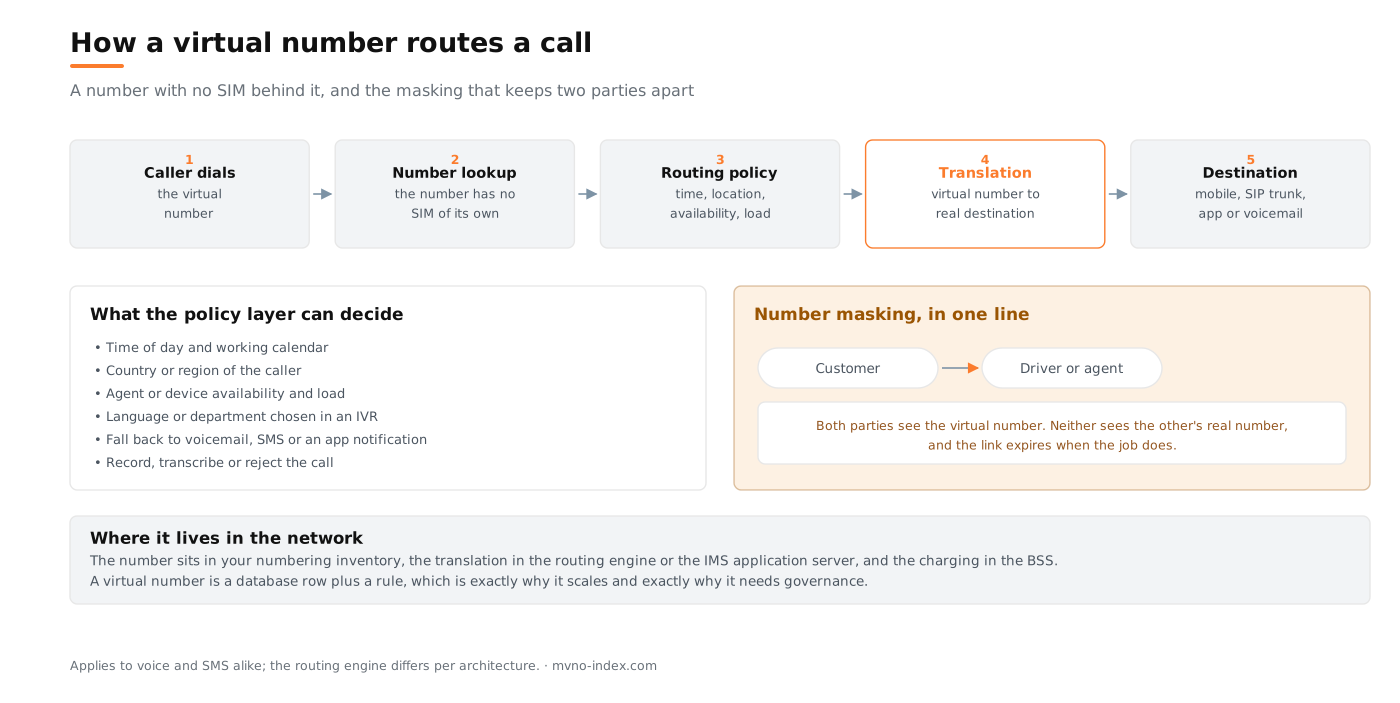
- Call Forwarding and Routing: Incoming calls to a virtual number are routed in real time to one or more destination numbers, SIP endpoints, or applications based on configurable rules (time of day, caller identity, geographic origin, or availability).
- Multi-Device Ringing: A single virtual number can simultaneously ring multiple devices or agents, ensuring that inbound calls are answered regardless of which device the subscriber is using.
- Number Masking: The virtual number is presented as the caller ID on outbound calls, protecting the subscriber's real MSISDN from exposure. This is especially valuable for ride-sharing platforms, healthcare applications, and marketplace services.
- SMS Routing: Virtual numbers can receive and send SMS messages, routing them to email inboxes, webhooks, CRM systems, or mobile applications. This underpins two-factor authentication (2FA), appointment reminders, and marketing campaigns.
- Interactive Voice Response (IVR) Integration: Virtual numbers serve as the entry point for IVR systems, directing callers through automated menus to the correct department, agent, or information service.
- Voicemail and Visual Voicemail: Virtual numbers can be equipped with voicemail and visual voicemail capabilities, providing a professional call handling experience even when the destination is unavailable.
- Geographic and Non-Geographic Numbers: Virtual numbers can carry a local area code from any country or region (geographic numbers) or use toll-free and national rate formats (non-geographic numbers), enabling businesses to establish a local presence globally without physical offices.
- Number Portability Support: Virtual numbers can be ported in and out of a platform, ensuring continuity for subscribers who switch providers.
- Analytics and Reporting: Since all traffic flows through a software layer, virtual numbers provide rich call and message analytics that are unavailable with traditional PSTN numbers, enabling operators and businesses to measure campaign performance, call volumes, and response times in real time.
- Programmable Number Logic: Advanced virtual number platforms expose APIs that allow developers to define call flow logic programmatically, integrating telephony directly into business applications and Over the Top (OTT) platforms.
Types of Virtual Numbers
Types of virtual number and what each is for
| Type | What it gives the user | Typical buyer |
|---|---|---|
| Local or geographic | A local presence in a city or country | Businesses selling into a region |
| National non-geographic | One number for the whole country | Service desks, national brands |
| Toll-free | The caller pays nothing | Customer service, sales lines |
| International / DID | A number in a country you have no office in | Exporters, support desks |
| Second number on one SIM | Work and private separated on one device | Professionals, gig workers |
| Masked / temporary | Neither party sees the other's real number | Marketplaces, delivery, ride hailing |
Virtual numbers are not a single, uniform product. Operators and solution providers offer several distinct categories, each suited to different use cases:
Direct Inward Dialing (DID) Numbers are traditional virtual numbers assigned from a national numbering plan. They carry a geographic area code and are used by businesses to give each employee or department a direct phone line without requiring a separate physical connection. DID numbers are the most common form of virtual number deployed by Business MVNOs.
Toll-Free Numbers are non-geographic virtual numbers where the receiving party bears the call cost. They are a standard tool for customer service operations and are widely used by enterprises that want to present a single national contact number.
Short Codes are abbreviated dialing numbers (typically 4 to 6 digits) used exclusively for high-volume SMS and MMS messaging. They are the standard mechanism for A2P (Application to Person) messaging, including 2FA, marketing campaigns, and subscription services.
Long Code Numbers (Local Numbers) are standard 10 to 15 digit numbers used for P2P and A2P messaging at lower volumes. They are suited to conversational business messaging and are increasingly used in RCS (Rich Communication Services) deployments.
MSISDN Aliases are secondary virtual numbers assigned to an existing SIM card or subscriber profile. The subscriber retains a single physical SIM but can receive calls and messages on multiple numbers simultaneously. This is a popular feature for Business MVNOs offering work-life separation on a single device.
IoT-Specific Virtual Numbers are numbers assigned to machine-to-machine (M2M) devices for remote management, status alerting, and command reception. These are particularly relevant for M2M and IoT MVNOs deploying large fleets of connected devices.
Technical Integration and Architecture
Integration with Other Systems
Virtual numbers do not operate in isolation. They are deeply integrated with multiple layers of the mobile operator's architecture and third-party platforms. The core integration points are:
- The Home Location Register (HLR) or Home Subscriber Server (HSS) holds the subscriber profile and maps the virtual number alias to the physical MSISDN. Any routing decision that touches the subscriber's identity must be coordinated with this system to ensure correct call handling and charging.
- The Short Message Service Center (SMSC) processes inbound and outbound SMS messages associated with virtual numbers. Integration with the SMSC is essential for any operator wanting to provide virtual number-based messaging services.
- The Online Charging System (OCS) ensures that calls and messages routed via virtual numbers are rated and charged correctly in real time. For prepaid subscribers using a virtual number as a secondary line, the OCS must apply the correct tariff rules and deduct balance accurately.
- The Session Border Controller (SBC) secures and manages the SIP signaling between the virtual number platform and the operator's core network or external VoIP interconnects, providing topology hiding, protocol normalization, and fraud prevention.
- The BSS (Business Support System) handles provisioning, billing, and customer management for virtual number products. Tight integration between the virtual number platform and the BSS is critical for automated self-service provisioning, accurate invoice generation, and real-time usage dashboards.
- For operators with a Fixed Mobile Convergence (FMC) strategy, virtual numbers are a central enabler, allowing subscribers to use the same number across mobile, Wi-Fi, and fixed broadband connections seamlessly.
Technical Architecture and Key Interfaces
The technical backbone of a virtual number platform is built around number management databases, SIP-based routing engines, and API gateways. Key architectural components include:
- Number Inventory Database: Stores all allocated virtual numbers, their current routing configurations, assignment status, and associated subscriber or customer records. This database must support near-real-time updates to reflect routing changes made via self-service portals or API calls.
- SIP Routing Engine: Processes all inbound SIP INVITE requests destined for virtual numbers and applies the configured routing logic. The engine consults the number inventory database and any active rules (IVR menus, forwarding schedules, failover lists) to determine the correct next-hop destination.
- REST/HTTP API Layer: Exposes a programmable interface for operators, enterprise customers, and developers to manage virtual numbers, configure routing rules, retrieve call detail records, and trigger outbound messages. This API layer is what transforms a static virtual number into a dynamic communication building block.
- SS7/MAP and Diameter Interworking: For virtual numbers that need to interact with legacy 2G and 3G infrastructure or handle roaming scenarios, the platform must interface with the Signaling Transfer Point (STP) or the Diameter Routing Agent (DRA) to translate and route signaling messages correctly.
- Number Portability Gateway: Handles inbound and outbound number portability requests, ensuring that virtual numbers can be migrated between platforms and operators in compliance with national regulatory requirements.
How a virtual number routes a call, and how number masking keeps two parties apart.
Virtual Numbers for MVNOs and IoT Companies
Why Offer Virtual Numbers?
For a Full MVNO or an IoT operator, virtual numbers represent one of the most commercially compelling Value Added Services available. They directly address the needs of enterprise customers, who are typically high-value, low-churn subscribers. Offering virtual numbers allows an MVNO to move up the value chain from being a pure connectivity provider to becoming a managed communication services partner. This shift supports stronger margins, longer contract durations, and deeper customer relationships.
For an IoT MVNO or M2M operator, virtual numbers provide an addressable identifier for remote devices, enabling operators to send configuration commands, receive status alerts, and support two-way data communication without requiring a full-featured voice subscription on every SIM. This significantly reduces the per-device cost while maintaining the ability to communicate with each unit individually.
Consider that virtual numbers also support Roaming MVNOs and Ethnic MVNOs, which need to provide subscribers with local number presence in multiple countries. A roaming-focused brand can offer its customers a local virtual number for each country they frequently visit, eliminating inbound roaming charges and improving the perceived value of the subscription.
Advantages and Disadvantages of Virtual Numbers
Advantages:
- Revenue Diversification: Virtual numbers generate recurring subscription revenue on top of standard voice and data plans, increasing average revenue per user (ARPU).
- Enterprise Market Access: Positions the MVNO as a credible provider for Business MVNOs and corporate clients seeking managed telephony services.
- Global Number Presence: Enables subscribers and businesses to maintain local phone numbers in multiple countries without physical SIMs or roaming agreements in each market.
- Privacy and Security: Number masking protects subscriber identity in consumer-facing applications such as marketplaces, healthcare platforms, and delivery services.
- Programmability: API-driven number management enables rapid integration with enterprise CRM, ERP, and communication platforms, driving stickiness and reducing churn.
- IoT Device Management: Provides a lightweight, cost-effective communication channel for large IoT deployments.
- Scalability: Virtual numbers can be provisioned and decommissioned instantly via API, supporting rapid business scaling without infrastructure delays.
Disadvantages:
- Regulatory Complexity: Number allocation, porting, and usage rules vary significantly between countries and require ongoing compliance monitoring and interaction with national regulatory bodies.
- Platform Integration Effort: Connecting the virtual number platform to the HLR/HSS, OCS, SMSC, and BSS requires significant technical integration work and expertise.
- Fraud Risk: Virtual numbers are frequently targeted for toll fraud, wangiri (missed call) fraud, and SMS pumping attacks. Robust fraud detection and blocking capabilities are a mandatory investment.
- Interconnect Costs: Routing calls through virtual number platforms incurs additional termination and interconnect costs that must be managed carefully to protect margins.
- Quality Assurance: Ensuring consistent call quality across a software-routed path requires active monitoring and SLA management with all interconnect partners.
- Numbering Resource Management: Operators must actively manage number inventory, reclaim unused numbers, and comply with national number utilization requirements to retain their numbering allocations.
Organizational Impact of Offering Virtual Numbers
Analyzing the full organizational impact of introducing a virtual number product reveals important considerations across operations, finance, security, and technology.
- Operational Impact: A virtual number product requires a dedicated product management and provisioning function. Customer support teams must be trained to handle issues specific to virtual numbers, including routing misconfigurations, porting delays, and interconnect failures. Self-service portals and API documentation must be developed and maintained to empower enterprise customers. The operational model for virtual numbers is closer to a SaaS product than a traditional telecom service, requiring agile development practices and continuous feature delivery.
- Financial Impact: The primary financial benefit is a higher ARPU from business and enterprise subscribers, who typically pay a monthly recurring fee per virtual number in addition to their underlying connectivity plan. The initial investment covers platform licensing or development, integration with core network systems, and interconnect agreements. Operators should also account for ongoing costs related to number inventory management, regulatory compliance, and fraud prevention tooling. When positioned correctly, virtual numbers can generate margins significantly above those of standard voice and data services.
- Security Impact: Virtual numbers concentrate significant voice and messaging traffic on a software platform that is directly exposed to the public telephone network. This creates a substantial attack surface. Operators must deploy real-time fraud detection to identify and block SMS pumping, international revenue share fraud (IRSF), and wangiri schemes. The SBC plays a critical role in hardening the SIP attack surface. Additionally, number masking services handle sensitive personal communication data, requiring strict data protection controls aligned with GDPR and regional privacy regulations.
- Technical Impact: Introducing virtual numbers requires the operator to either deploy a dedicated number management platform or integrate a third-party CPaaS (Communications Platform as a Service) solution into its existing stack. In either case, deep integration with the BSS, OCS, HLR/HSS, and SMSC is required to ensure accurate charging, subscriber management, and message delivery. The technical team must also maintain expertise in SIP, number portability protocols, and API security.
Redundancy and High Availability
Virtual numbers are increasingly used for mission-critical business communications, including customer service hotlines, emergency contact lines, and IoT device management channels. For this reason, high availability (HA) and redundancy are non-negotiable requirements for any commercial virtual number platform.
The standard architecture deploys the routing engine in an active-active cluster across multiple data centers or cloud availability zones. All routing state and number configuration data is continuously replicated across nodes so that the failure of any single instance does not interrupt active calls or message delivery. Inbound SIP traffic is distributed across cluster nodes via load balancing, using the same principles applied to the Diameter Routing Agent (DRA) in the 4G core network.
For operators offering virtual numbers as part of an enterprise SLA, geographic redundancy is the baseline expectation. The number inventory database must be replicated in real time to a geographically separate secondary site, enabling full failover within seconds. Call Detail Record (CDR) generation must also be resilient to node failures to ensure that no billing data is lost during a failover event, as this directly impacts the accuracy of invoices and compliance with regulatory record-keeping requirements.
Impact of 4G, 5G, and AI on Virtual Numbers
Enrichment through 4G and VoLTE
The widespread deployment of 4G LTE and Voice over LTE (VoLTE) significantly enhanced the quality and capabilities available to virtual number platforms. VoLTE delivers HD voice quality to virtual number calls, making them indistinguishable from a conventional mobile call from the subscriber's perspective. The introduction of RCS (Rich Communication Services) further extended the messaging capabilities of virtual numbers, enabling businesses to send interactive messages with images, buttons, and read receipts through virtual number-based A2P channels.
5G and the Programmable Number
5G's potential for MVNOs introduces network slicing and ultra-low latency capabilities that directly benefit virtual number use cases. A virtual number associated with a 5G network slice can guarantee a specific quality of service for calls and messages, making it viable for latency-sensitive applications such as telemedicine, real-time customer support, and industrial IoT command and control. The 5G Service Based Architecture (SBA) also makes it easier to expose virtual number management functions as cloud-native network APIs, accelerating integration with enterprise software platforms.
Artificial Intelligence and Virtual Numbers
Artificial Intelligence is already transforming mobile brands and its impact on virtual numbers is growing rapidly. AI-powered features that can be delivered through a virtual number platform include real-time call transcription and summarization, intelligent call routing based on caller intent detected through speech analysis, automated fraud scoring for inbound calls and messages, conversational AI agents that handle inbound calls without human intervention, and sentiment analysis on customer calls to identify dissatisfaction signals in real time. These capabilities transform the virtual number from a simple routing artifact into an intelligent communication layer, dramatically increasing its value to enterprise subscribers and strengthening the MVNO's competitive position.
Virtual number versus a regular mobile number
Virtual number versus a regular mobile number
| Feature | Virtual number | Regular mobile number |
|---|---|---|
| Tied to | A routing rule in the network | A SIM profile in the HLR or HSS |
| Needs a device | No | Yes |
| Can ring several destinations | Yes | No |
| Portable | Depends on the national numbering rules | Yes, in most markets |
| Typical charge | Monthly rental plus usage | Part of the subscription |
Frequently Asked Questions about Virtual Numbers
What is the difference between a virtual number and a regular mobile number?
A regular mobile number is directly tied to a physical SIM card and a specific network subscription. A virtual number exists purely in software and can be routed to any destination, device, or application without being bound to a single SIM or physical line.
Can a virtual number receive both calls and SMS messages?
Yes. Virtual numbers support both inbound voice calls and inbound SMS messages. Both can be routed independently to different destinations, such as a mobile phone for calls and a webhook for SMS messages.
How are virtual numbers charged?
Virtual numbers are typically charged on a monthly recurring fee per number, combined with per-minute call termination rates and per-message SMS rates. Enterprise customers often negotiate bundle agreements covering a defined number inventory and usage volume.
Are virtual numbers suitable for IoT deployments?
Yes. Virtual numbers are a cost-effective way to assign a communicable identifier to IoT devices without provisioning a full voice subscription. They are widely used in M2M and IoT MVNO deployments for remote device management and status notification.
What is number masking and why is it important?
Number masking is a feature where the virtual number is used as the caller ID on outbound calls, hiding the real mobile number of the calling party. It is essential for privacy-sensitive applications such as ride-hailing, online marketplaces, and healthcare consultations.
What core network elements are involved in virtual number routing?
Virtual number routing interacts with several core network components, including the HLR or HSS for subscriber data, the SMSC for SMS delivery, the OCS for real-time charging, and the SBC for SIP signaling security.
What is the 5G evolution of virtual number services?
In 5G networks, virtual numbers can be combined with network slicing to deliver guaranteed quality of service, and with the 5G SBA to expose number management as programmable network APIs. The core routing and flexibility principles remain unchanged, but the underlying capabilities expand significantly.
Summary
Virtual numbers are a strategically important and commercially powerful capability for any MVNO, IoT operator, or mobile brand that wants to serve enterprise customers, enable privacy-preserving consumer applications, or build programmable communication services. They decouple the telephone number from physical infrastructure, enabling real-time routing, number masking, multi-device reach, and API-driven programmability.
Deploying virtual numbers requires deep integration with core network elements including the HLR/HSS, SMSC, OCS, SBC, and BSS, as well as investments in fraud prevention, redundancy, and regulatory compliance. The rewards are substantial: higher ARPU from enterprise segments, new recurring revenue streams, reduced churn through deeper customer integration, and a differentiated product portfolio that goes well beyond standard voice and data connectivity.
As 5G and AI continue to reshape the telecom landscape, virtual numbers will evolve from a telephony feature into a full-stack programmable communication platform. For operators looking to build a sustainable, high-value business, offering virtual numbers is not just an option: it is a competitive necessity.
Value Added Services (VAS)