The MVNO Contact Center: Channels, Routing and Cost
A contact center is where subscribers reach a mobile brand: by phone, chat, email, social or self-service. For an MVNO it is the largest recurring operational cost after network wholesale, and the single biggest lever on churn, which makes the build-or-outsource decision a strategic one, not a procurement one.
The Contact Center is one of the most visible and strategically important operational components of any MVNO (Mobile Virtual Network Operator), MVNE, or IoT company. It is the primary interface between your brand and your subscribers, making it a critical driver of customer loyalty, revenue retention, and brand reputation. Understanding what a Contact Center is, how it works, and how to build and operate one effectively is essential for every mobile brand that wants to compete and grow in today's demanding market. Whether you are launching a new MVNO, scaling an existing mobile brand, or managing an IoT subscriber base, getting your Contact Center right is not optional. It is one of the most decisive factors in determining your long-term commercial success.
On this page
- History and Evolution of the Contact Center
- Core Utility and Functionality of the Contact Center
- What is a Contact Center Used For?
- Key Functions of the Contact Center
- Contact Center Channels for MVNOs and IoT Companies
- Traditional Channels
- Digital and Self-Service Channels
- Contact Center Ownership for MVNOs and IoT Companies
History and Evolution of the Contact Center
The Contact Center has its origins in the telephone-based call centers of the 1960s and 1970s, where agents answered inbound calls from customers on dedicated telephony infrastructure. As the internet became mainstream in the 1990s, email support was added, expanding the concept of the "call center" into the broader notion of the "Contact Center." The rise of smartphones, social media, and live chat tools in the 2010s accelerated the transformation toward true omnichannel operations. Today, AI-powered chatbots, self-service portals, and cloud-based platforms define the modern Contact Center, making it a sophisticated, data-driven engine for subscriber engagement.
Core Utility and Functionality of the Contact Center
What is a Contact Center Used For?
A Contact Center is the organizational hub through which an MVNO or IoT company manages all subscriber interactions, whether those interactions are inbound requests for help or outbound communications. Its primary purpose is to resolve subscriber issues quickly, accurately, and in a way that leaves the subscriber feeling valued and confident in their choice of mobile brand.
For an MVNO, the Contact Center is responsible for handling activation questions, billing disputes, SIM and eSIM support, network coverage complaints, plan upgrades, service cancellations, and general account management. For IoT companies, it also covers device connectivity troubleshooting, SIM provisioning queries, and M2M service support. In both contexts, the Contact Center is not just a cost center. Operated correctly, it is a powerful tool for reducing churn, increasing customer lifetime value, and generating upsell revenue.
The Contact Center works in close coordination with your Business Support System (BSS) and Operational Support System (OSS), pulling live subscriber data to enable agents to deliver fast, informed, and personalized service. If you want to understand the MVNO's full guide to exceptional customer care, you will find that the Contact Center sits at the core of every successful customer care strategy.
Key Functions of the Contact Center
The modern Contact Center performs a wide range of functions that extend far beyond answering phone calls. Understanding these functions helps MVNOs and IoT companies design a Contact Center that truly serves their subscribers and supports the business:
- Inbound Support Handling: Agents receive and resolve subscriber inquiries across all contact channels, including phone, email, live chat, social media, and in-app messaging. Every interaction is an opportunity to strengthen the subscriber relationship.
- Outbound Engagement: Proactive outreach to subscribers approaching data limits, upcoming contract renewals, or overdue payments. Outbound campaigns also support upselling and cross-selling of new plans or services.
- Complaint Resolution: Structured processes for handling escalated issues, billing disputes, network quality complaints, and service failures. Fast and fair resolution is critical for preventing churn.
- Account Management Support: Assisting subscribers with SIM swaps, eSIM activation, plan changes, top-ups, roaming activation, and personal data updates.
- Technical Troubleshooting: Guiding subscribers through device configuration, network settings, SIM card issues, and connectivity problems. For IoT companies, this extends to M2M device diagnostics and SIM provisioning support.
- Fraud Detection and Reporting: Contact Center agents are often the first to identify suspicious usage patterns or fraudulent activity reported by subscribers. They act as a front-line filter that feeds back into billing and network operations teams.
- Upselling and Retention: Trained agents can recognize upgrade opportunities and retention risks during conversations, turning a support interaction into a revenue-positive outcome.
- Knowledge Management: Maintaining and using an internal knowledge base that keeps agents up to date on plans, promotions, technical issues, and policies, ensuring consistent and accurate service delivery.
- Quality Assurance and Reporting: Monitoring call recordings, chat transcripts, and satisfaction scores to continuously improve agent performance and identify recurring subscriber pain points.
- Compliance and Data Privacy: Ensuring that all subscriber interactions comply with applicable data protection regulations, including GDPR, by handling personal data responsibly across all channels.
Contact Center Channels for MVNOs and IoT Companies
Channels compared, with the cost that follows
| Channel | Cost per contact | Subscriber expectation | Best use |
|---|---|---|---|
| Voice | Highest | Immediate answer | Complex problems, complaints, retention |
| Live chat | Medium | Minutes | Guided troubleshooting, sales support |
| Email or ticket | Medium | Hours to a day | Documentation, billing disputes |
| Social and messaging | Medium | Hours, in public | Reputation-sensitive issues |
| Self-service and app | Near zero | Instant | Balance, top-up, SIM swap, plan change |
| Chatbot | Near zero | Instant, until it fails | Repetitive questions with a clean handover |
Selecting the right mix of contact channels is one of the most important decisions an MVNO can make when designing its Contact Center. The goal is to meet subscribers where they are, on the channel they prefer, while keeping operational costs manageable.
Traditional Channels
- Phone Support: Voice remains the most trusted channel for resolving complex or emotionally sensitive issues. Subscribers experiencing billing disputes, network outages, or service cancellations often prefer speaking to a live agent. For MVNOs targeting older demographics or less digitally active segments, phone support must be a primary channel. Ensure your IVR (Interactive Voice Response) system is intuitive and does not frustrate callers before they reach an agent.
- Email Ticketing System: Email allows subscribers to submit detailed, asynchronous inquiries and attach screenshots or account information. A well-managed ticketing system ensures that every email receives a tracked, accountable response within a defined SLA. Email is particularly effective for non-urgent billing clarifications, formal complaints, and documentation requests.
Digital and Self-Service Channels
- Live Chat: Live chat on your website or mobile app allows subscribers to get real-time answers to quick questions without waiting on hold. It is cost-efficient, scalable, and increasingly the preferred channel for younger, digitally native subscriber segments. Agents can handle multiple chats simultaneously, making live chat one of the most productive channels in the Contact Center portfolio.
- Social Media Messaging: Platforms such as WhatsApp, Facebook Messenger, and direct messaging on Instagram and X (formerly Twitter) have become legitimate subscriber support channels. MVNOs should train agents to monitor brand mentions, respond to direct messages promptly, and escalate complex issues to private channels when needed. Public responsiveness on social media is a powerful trust signal for prospective subscribers as well.
- Mobile App and Self-Service Portal: A well-designed mobile app empowers subscribers to manage their accounts independently, from checking data usage and paying bills to activating roaming or swapping their SIM. Self-service options reduce inbound contact volumes significantly, lowering operational costs and improving subscriber satisfaction simultaneously. Every feature you add to your self-service portal is a call, chat, or email you do not need to staff.
- In-App Messaging and Push Notifications: Proactive in-app messages can inform subscribers about plan expiry, data thresholds, or service updates before they need to contact support at all. This reduces inbound volumes and positions your brand as attentive and transparent.
- Community Forums and FAQ Pages: A structured FAQ section and a community forum where subscribers can help each other reduce the burden on your agents and build a sense of belonging among your subscriber base, which is especially valuable for niche or lifestyle-focused MVNOs. See the guidance on different MVNO business models for context on how community-driven engagement varies by segment.
Call me old-fashion but personally I like to speak to a real person when I need help.
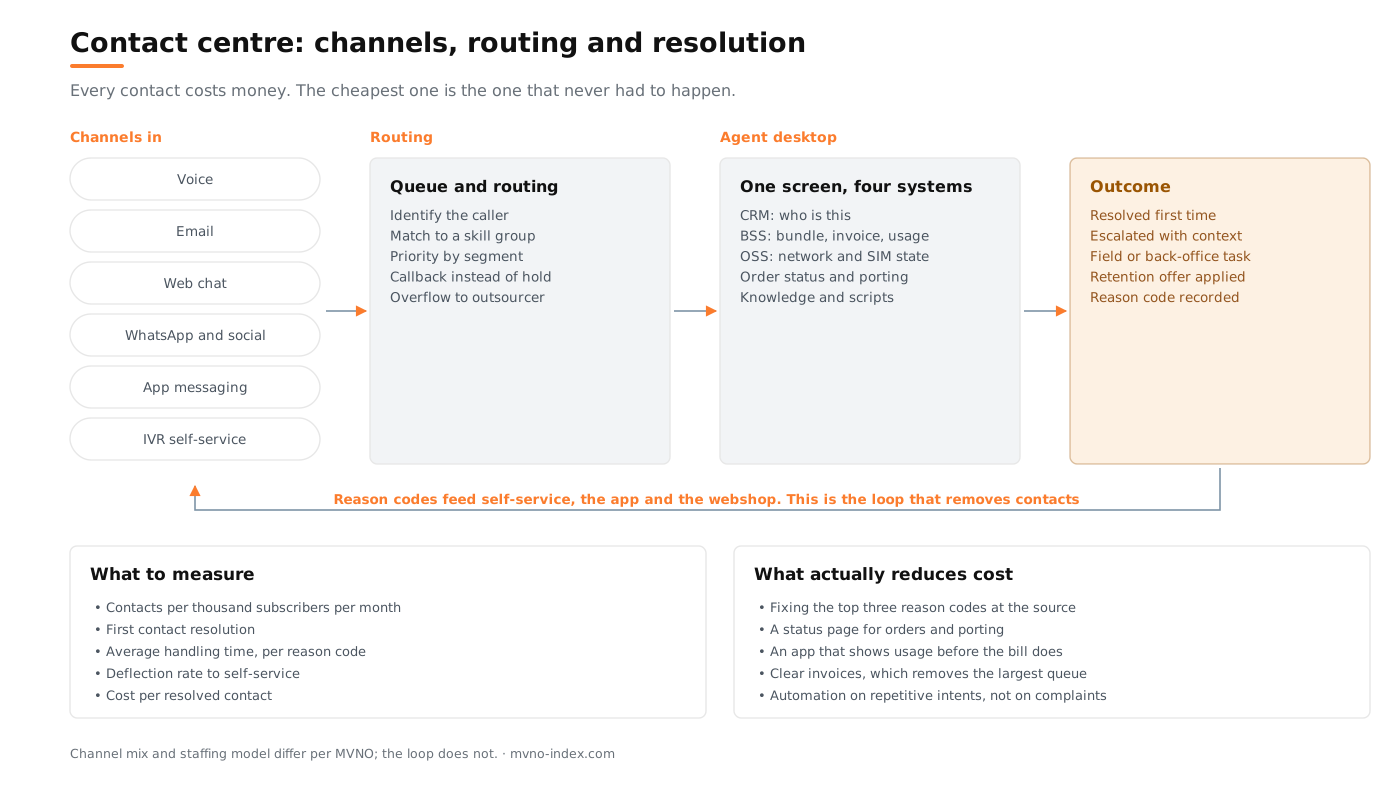
Channels, routing and resolution and the reason-code loop that removes contacts before they happen.
Contact Center Ownership for MVNOs and IoT Companies
Why Own or Control a Contact Center?
For many MVNOs, especially those in the early stages of their journey, outsourcing Contact Center operations to a third-party provider can seem like an attractive option. It reduces initial investment and speeds up time to market. However, there are compelling reasons why growing MVNOs and IoT companies choose to bring Contact Center operations in-house or to at least retain close control over the experience, even when using outsourced agents or cloud platforms.
The Contact Center is the single biggest touchpoint your subscribers have with your brand. It is where trust is built or destroyed. If you outsource this function entirely and lose visibility into how your subscribers are being treated, you lose one of your most important competitive levers. As you read in some of the biggest MVNO mistakes, underinvesting in customer care is consistently one of the top reasons MVNOs fail to grow or face unsustainable churn.
Owning or tightly managing your Contact Center also gives you access to real-time subscriber intelligence. The patterns emerging from your Contact Center, the most common complaints, the most frequent questions, the moments of highest friction, are invaluable data that should feed directly into your business plan, your marketing plan, and your product development roadmap.
Advantages and Disadvantages of Contact Center Ownership
Advantages:
- Complete Brand Control: Every interaction reflects your brand values, tone, and service standards, not those of a generic outsourced provider.
- Real-Time Subscriber Intelligence: Direct access to contact data, complaint trends, and satisfaction metrics that inform business decisions across the organization.
- Faster Issue Resolution: In-house agents have faster access to internal systems, escalation paths, and product knowledge, resulting in shorter resolution times.
- Upsell and Retention Performance: Agents who are deeply embedded in your brand culture are far more effective at identifying and acting on upsell and retention opportunities.
- Data Privacy and Compliance: Retaining control over subscriber data handling reduces the risk of data breaches or non-compliant data processing by third parties.
- Agility: You can rapidly update scripts, processes, and knowledge bases in response to network issues, product launches, or regulatory changes without going through a third party.
Disadvantages:
- Higher Initial Investment: Building or leasing a physical Contact Center, hiring agents, and deploying the necessary technology requires significant upfront capital.
- Ongoing Staffing Costs: Salaries, training, benefits, and agent turnover create a substantial and recurring cost base.
- Scalability Challenges: Managing seasonal or campaign-driven spikes in contact volumes is harder when you rely solely on an in-house team.
- Technology Management Burden: Maintaining Contact Center platforms, CRM integrations, telephony systems, and quality monitoring tools requires dedicated IT resources.
- Time to Operational Readiness: Recruiting and training a high-performing team takes time, which can delay your go-to-market timeline.
Organizational Impact of Contact Center Operations
A well-run Contact Center creates measurable positive impact across multiple dimensions of an MVNO's organization:
Operational Impact: The Contact Center generates a constant stream of operational intelligence. Recurring complaints about billing errors feed back to the BSS. Network quality complaints feed back to the OSS and the host MNO. Teams must define and track key performance indicators including First Contact Resolution (FCR), Average Handle Time (AHT), Customer Satisfaction Score (CSAT), and Net Promoter Score (NPS). These metrics should be reviewed regularly and used to drive process improvements across the business.
Financial Impact: Every unresolved complaint that leads to a disconnection represents lost revenue. Every successful retention call or upsell interaction adds measurable value. MVNOs should calculate the cost per contact across each channel and continuously optimize their channel mix to drive down costs without sacrificing service quality. Self-service automation is typically the highest-return investment for reducing cost per contact.
Security and Compliance Impact: Contact Center agents handle sensitive personal data, including subscriber identities, payment information, and usage records. All agents must be trained on data protection obligations under applicable regulations such as GDPR. Call recordings, chat logs, and ticket data must be stored securely and retained or deleted in accordance with defined data retention policies. Identity verification procedures must be robust enough to prevent social engineering attacks while remaining quick enough not to frustrate legitimate subscribers.
Cultural Impact: Your Contact Center team is a living embodiment of your brand. Investing in agent wellbeing, recognition, career development, and team culture directly translates into better subscriber experiences. High agent turnover, which is a common challenge in Contact Centers, is both costly and damaging to service quality. MVNOs that invest in their people tend to retain better agents who deliver consistently better outcomes for subscribers.
Technology Integration: BSS, OSS, AI and CRM
A modern Contact Center cannot operate effectively in isolation. It must be tightly integrated with the technology systems that power the rest of your MVNO operation.
- CRM Integration: A Customer Relationship Management system is the operational backbone of the Contact Center. It gives agents a unified view of the subscriber, including their current plan, billing history, previous interactions, open tickets, and device information. Without a good CRM, agents are forced to navigate multiple disconnected systems, which increases handle time and frustrates both agents and subscribers.
- BSS Integration: Direct integration with your Business Support System allows agents to access and update billing records, process payments, apply credits, and manage plan changes in real time. This is essential for resolving billing-related contacts quickly and accurately.
- OSS Integration: Access to your Operational Support System allows agents to check network status, identify service-affecting incidents, and provide informed answers to subscribers experiencing connectivity issues rather than generic reassurances.
- Telephony and Omnichannel Platform: A cloud-based Contact Center platform (CCaaS, or Contact Center as a Service) consolidates all communication channels, including voice, email, chat, and social messaging, into a single agent interface. This eliminates channel silos, ensures that agents have full interaction history regardless of channel, and enables intelligent routing of contacts to the most suitable agent.
- Analytics and Reporting: Advanced analytics tools give Contact Center managers real-time visibility into queue lengths, agent occupancy, satisfaction scores, and resolution rates. Speech and text analytics can automatically analyze call recordings and chat transcripts to identify quality issues, coaching opportunities, and emerging subscriber pain points.
AI, Chatbots and the Future of the Contact Center
Artificial Intelligence is fundamentally reshaping what is possible in a Contact Center, and MVNOs that embrace AI tools thoughtfully will gain a substantial competitive advantage in both cost efficiency and subscriber experience.
AI-Powered Chatbots: Deploying a chatbot on your website and mobile app enables 24/7 support for common inquiries such as balance checks, data usage, plan information, and basic troubleshooting. A well-designed chatbot can resolve a significant proportion of contacts without human intervention, reducing queue lengths and freeing agents to focus on complex or high-value interactions. However, it is critical that the chatbot clearly identifies itself as an automated system and provides a seamless handover to a human agent when the subscriber requests it or when the bot reaches the limits of its capability.
AI-Assisted Agent Support: Beyond self-service chatbots, AI can be used to assist human agents in real time. Tools that listen to calls or read chat transcripts can suggest relevant knowledge base articles, flag sentiment shifts in the subscriber's language, or recommend the next best action based on the subscriber's history and current issue. This reduces average handle time, improves first contact resolution, and helps newer agents perform at a higher level sooner.
Predictive and Proactive Engagement: AI-driven analytics can identify subscribers who show behavioral signals associated with churn risk, such as declining usage, repeated billing contacts, or social media complaints. This allows your team to proactively engage those subscribers with targeted retention offers or personalized outreach before they decide to leave. Read more about the pros and cons of AI for subscribers and the MVNO and the do's and don'ts when using AI for an MVNO for a balanced view of how to deploy AI responsibly.
Automated Quality Management: AI-powered quality monitoring tools can evaluate 100% of interactions rather than the small sample that human QA teams can review manually. This provides a far more accurate and comprehensive picture of Contact Center performance and enables targeted coaching interventions for individual agents.
The direction of travel is clear. The Contact Center of the future will be a hybrid operation in which AI handles routine and repetitive contacts at scale, while highly skilled human agents focus on complex problem-solving, empathy-driven interactions, and high-value commercial conversations. MVNOs that invest in this transition now will be significantly better positioned as subscriber expectations and competitive pressures continue to rise.
The KPIs an MVNO contact center is actually judged on
The KPIs an MVNO contact center is actually judged on
| KPI | What it measures | Why it matters for an MVNO |
|---|---|---|
| First contact resolution | Share solved without a follow-up | The strongest single driver of satisfaction and cost |
| Average handling time | Minutes per contact | Drives staffing cost, but cutting it blindly raises repeat contacts |
| Service level | Share answered within the target time | What subscribers notice first |
| Contacts per subscriber per year | Demand on the center | Falls when self-service and onboarding improve |
| Churn among contacting subscribers | Retention effect | Connects the center to revenue, not just to cost |
| Self-service containment | Share resolved without an agent | The only KPI that lowers cost and satisfaction together if pushed too far |
Frequently Asked Questions about the Contact Center
What is the difference between a Call Center and a Contact Center?
A Call Center handles voice calls only. A Contact Center manages subscriber interactions across multiple channels, including phone, email, live chat, social media, and self-service tools. For modern MVNOs, a Contact Center approach is essential because subscribers expect to reach support through the channel of their choice.
Should an MVNO build its own Contact Center or outsource it?
This depends on the MVNO's size, budget, and strategic priorities. Early-stage MVNOs often outsource to reduce upfront investment, while growing MVNOs typically bring operations in-house or adopt a hybrid model to gain better control over brand experience and subscriber data. Regardless of the delivery model, the MVNO must retain ownership of the subscriber experience strategy.
What are the most important KPIs for an MVNO Contact Center?
The most effective approach is to invest in self-service tools such as a mobile app, an intuitive FAQ section, and an AI-powered chatbot. Deflecting routine contacts to automated channels allows human agents to focus on complex issues where they add the most value. Improving First Contact Resolution also reduces repeat contacts, which lowers overall cost per subscriber.
How does the Contact Center connect to the BSS and OSS?
The Contact Center should be integrated with both the BSS and OSS via a CRM or omnichannel platform. This gives agents real-time access to subscriber account data, billing information, and network status, enabling faster and more accurate resolution of contacts across all channels.
What role does the Contact Center play in subscriber retention?
The Contact Center is one of the most powerful retention tools available to an MVNO. Subscribers who feel heard, helped, and valued are significantly less likely to churn. Conversely, a poor Contact Center experience is consistently cited as one of the primary reasons subscribers switch provider. Read more about reducing churn through exceptional customer care.
How should an MVNO handle Contact Center operations for IoT subscribers?
IoT Contact Center support requires specialized knowledge of M2M connectivity, SIM provisioning, and device management. Agents must understand the technical nature of IoT deployments and be able to support business customers rather than individual consumers. Integration with eSIM Remote SIM Provisioning (RSP) systems and IoT platform APIs is often required to resolve connectivity issues efficiently.
How can an MVNO reduce Contact Center costs without harming service quality?
The most effective approach is to invest in self-service tools such as a mobile app, an intuitive FAQ section, and an AI-powered chatbot. Deflecting routine contacts to automated channels allows human agents to focus on complex issues where they add the most value. Improving First Contact Resolution also reduces repeat contacts, which lowers overall cost per subscriber.
Summary
The Contact Center is far more than a support function. For an MVNO or IoT company, it is a strategic asset that directly influences subscriber satisfaction, churn rates, revenue retention, and brand equity. Building and operating an effective Contact Center requires thoughtful decisions about channel mix, technology integration, staffing, and the role of AI-powered automation.
MVNOs that invest in their Contact Center, connecting it tightly to their BSS, OSS, and subscriber data platforms, gain a decisive competitive advantage. They resolve issues faster, retain subscribers longer, and convert service interactions into commercial opportunities. Those that treat the Contact Center as a cost to be minimized rather than a capability to be developed will consistently struggle with churn and brand erosion.
Whether you are just starting to plan your MVNO or you are optimizing an established operation, the Contact Center deserves a place at the center of your strategy. Explore the solution providers listed on MVNO Index to find Contact Center technology and service partners that specialize in the mobile virtual network market, and consult MVNO Index's consultancy directory if you need expert guidance on designing or improving your Contact Center operations.
Value Added Services (VAS)