
1. A timely coincidence
With so many voices publishing on MVNO Index, it is a nice coincidence that the article just before ours, Roman Khalenkov’s The first MVNO in your market should build the MVNE, looks at Pakistan from the enabler angle. We were preparing a piece on the same market, with a different answer to the same question: who should build the shared infrastructure new MVNOs need?
Roman’s argument is that the first entrant should build a multi-tenant MVNE. We agree with the diagnosis: there is no neutral aggregator in Pakistan, no mature local MVNE, and blended ARPU is around one dollar. But in Pakistan we think the best answer is an MVNA run by the host itself, with a much wider scope than BSS: a complete parallel network for virtual operators, with the single exception of the radio.
Our view comes from our work on this market: conversations with the regulator, with some of the host operators and with many of the companies preparing to apply for an MVNO licence.
2. What Pakistan’s framework actually allows
Pakistan’s MVNO regime does not allow a Full MVNO in the classic sense. The MVNO Index article lists four models, from reseller to Full MVNO. In practice, the rules published by the Pakistan Telecommunication Authority (PTA) leave no room for an MVNO with its own core network.
The Policy Framework for MVNO Services approved in December 2025 and the MVNO License template issued in June 2026 are explicit:
- No own network elements. An MVNO may not install its own radio access or core network elements. The only exceptions are solutions for customer care, billing and the systems needed for customised services.
- No own interconnect or roaming. National and international roaming and interconnection run only through the parent MNO’s agreements.
- Numbering through the host. Numbers are allocated in blocks of 10,000 against the parent MNO’s network code, and requested and paid for through the host.
- Shared obligations, split by contract. Quality of service, national security, lawful interception, DIRBS and mobile number portability stay with the MVNO as licensee. They are delivered on the host’s network, so the commercial agreement must say who does what.
- A tight clock. The licence costs USD 140,000 for 15 years, and it is terminated if services do not launch within one year.
In other words, the MVNO owns the brand, the customer, the offer and the billing relationship. Everything that switches, stores, intercepts or routes traffic belongs to the host.
3. Why a BSS-only MVNE is not enough
A BSS-only enabler solves the half of the problem the MVNO is allowed to own. The other half, the network functions that make a brand work as a separate operator, can only sit on the host’s side in Pakistan.
Each new MVNO needs, separately from the host’s own retail brand:
- its own subscriber profiles, SIM ranges and authentication data;
- its own policy and charging rules, APNs and data plans;
- its own voice, SMS and value-added service logic;
- lawful interception, CDR/IPDR retention in Pakistan and DIRBS/EIR checks, mapped to its customers;
- portability flows for its own number blocks;
- QoS reporting to prove it meets PTA’s benchmarks.
If every licensee negotiates these one by one, the host ends up with as many custom integrations as MVNOs, each on its own timeline. That is the problem Roman describes, with one twist: in Pakistan the duplicated work lands on the host’s core, not only on the MVNO’s billing.
A regulator can open the door to MVNOs. It is the host’s network that has to make each of them work, and prove to the regulator that it does.
4. The host-led MVNA: everything but the radio
Our proposal is that the host, or a wholesale unit it controls, runs an MVNA: one aggregation platform that offers each MVNO a complete, separated virtual network. The MVNO plugs its brand, customers and channels into it and launches.
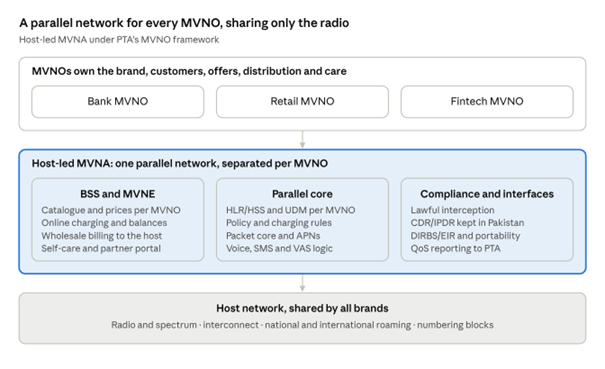
Figure 1. Host-led MVNA: a parallel network for every MVNO, sharing only the radio
The MVNO keeps what PTA lets it own. The MVNA runs, per tenant, the BSS and the parallel core, plus the compliance stack the regulator watches most closely. Only the radio, spectrum, interconnect, roaming and numbering are shared with the host’s own retail brand.
Datora’s Daniel Tibor Fuchs, quoted in Roman’s article, describes his aggregator as “almost like a light MNO”: everything a mobile network has except the radio. That is the model we propose for Pakistan, with one difference. Here, the host is the natural owner of that layer, because the regulation already puts the core, compliance and routing on its side.
For each party, the benefits are concrete:
- MVNO candidates avoid building or contracting their own integrations and can launch inside the one-year deadline, with lower upfront cost.
- The host integrates once instead of once per MVNO, keeps control of its core, earns wholesale revenue and can fence offers by segment to protect its retail base.
- The regulator gets one audited, compliant network behind many brands, which makes lawful interception, data residency and QoS easier to supervise.
The enabler test in Roman’s article still applies, only at a wider scope. Each tenant needs its own catalogue, customers, invoices and users, and also its own subscriber data, policies and interception mapping.
5. What we heard on the ground
The three groups we spoke to want different things, and a host-led MVNA is the one model that answers all of them.
| Who | What matters most to them | What a host-led MVNA gives them |
|---|---|---|
| Regulator | National security, lawful interception, QoS and service continuity for MVNO customers | One compliant network, already audited, instead of a new set of integrations per licensee |
| Host operators | Control of the network, protection of the retail base, a return on capacity | Standard onboarding, wholesale revenue per MVNO and segment-fenced offers |
| MVNO candidates | Launching within the one-year deadline, low upfront cost, focus on their own customers | A ready network and platform: they bring the brand, the customers and the distribution |
The candidates are not only telecom companies: Beyond that telco companies, banks, fintechs, retailers and distribution groups see mobile as a way to deepen relationships they already have. That is exactly the profile the MVNO Index article says has the best chance with an ARPU of around one dollar, and exactly the profile least equipped to run core network integrations.
6. How a host should decide
The choice of host model is a strategic decision that should take is not just a platform purchase. This is the sequence we recommend:
- Set the ambition. What role does the host want in the MVNO market, what wholesale revenue does it expect, and what risk to its retail base will it accept?
- Check host readiness. Capacity by region, numbering, portability, DIRBS, lawful interception, wholesale billing and partner support: what exists today and what would each MVNO add?
- Measure the gaps. Compare current and required capabilities across commercial, operational, technical, contractual and regulatory lines, and agree the criteria for choosing a model.
- Evaluate the models. Wholesale access only, a host-led MVNA, an MVNE service with partners, strategic partner brands, or a hybrid by segment. Score each on economics, cannibalisation, time to market, compliance control and effort.
- Design the target operating model. Which capabilities the host owns, shares or outsources; who is responsible for what between host, MVNOs and suppliers; how the wholesale unit is governed.
- Build the business case and pricing. Five-year economics, wholesale price models (pay-as-you-go, capacity, revenue share, commitments) and price floors that protect the retail brand.
- Standardise the host agreement. One template that covers the eight areas PTA requires: service type, QoS, portability and DIRBS, roaming and interconnect, customer care and data privacy, dispute resolution, national security and revenue sharing.
- Select platforms neutrally and plan onboarding. Run an open selection for core, BSS and compliance components, and name one owner for the programme that ties them together.
Roman makes the same point about programme ownership: vendors sell components, not outcomes, and launch dates are lost in the gaps between them.
7. The window is now
The first host to offer a ready parallel network will set the reference for Pakistan’s MVNO market. Licences are being prepared now, and every licensee has one year to launch. Candidates will choose the host that gets them to market fastest with the least risk.
Roman closes with a question for the first MVNO: are you building only for your own brand, or a route to market for others? In Pakistan we would put that question to the hosts. Are you selling capacity, or are you building the route to market that every new brand will need?
The first answer brings wholesale revenue. The second makes you the platform of the market.

Last blogs from Santiago Gomez Pelaez
View all →-
August 31, 2026
Churn, worst MVNO enemy!
MVNOs may not control the radio network, but they can gain valuable insights into their customers' actual mobile experience. By using device-side telemetry to observe, understand,…
-
July 30, 2026
Fixed-mobile convergence, the long-forgotten one?
As MVNO margins tighten and customer churn increases, fixed-mobile convergence is re-emerging as a key growth strategy. By combining mobile with fibre or Fixed Wireless Access…
-
March 30, 2026
A new MVNO model is possible!
A new MVNO model may be emerging as traditional approaches—mainly competing on price and ever-larger data bundles—begin to show their limits. With hundreds of operators active…