
Recap of Blogs 1 & 2
So far in this series, we have established why mass-market B2B approaches fail in heavy industry (Blog 1) and how MNO/MVNOs can use non-intrusive architectural governance aligned with ISA-95 to solve the IT/OT boardroom paradox (Blog 2). With the structural and technical foundations secured, the final challenge is execution: translating these frameworks into high-margin commercial revenue.
Monetizing Through CUPS Architecture
To turn this strategic framework into real-world cash flow, we have to change our approach to network engineering. Traditional telecom networks route control plane signaling (authentication) and user plane data (the actual message) together through centralized clouds. For heavy enterprises, sending sensitive factory telemetry outside their physical perimeter is a non-starter.
The Sovereign SBU handles this by exploiting Control and User Plane Separation (CUPS) architecture. With CUPS, the complex control plane signaling stays securely anchored in the MNO/MVNO's core network infrastructure, maximizing our existing assets. However, the actual user plane data is routed through a localized, private User Plane Function (UPF) running directly on-premise at the factory edge.
This local edge architecture is built across three high-value pillars:
- Pillar A (Private Transmission): User plane data is protected by physical hardware data diodes and routed via encrypted, dedicated carrier lines straight to premium sovereign processing zones, completely bypassing the public internet.
- Pillar B (Edge OEM Translation): Local edge compute nodes decode legacy machinery protocols through specialized OEM integrations, ensuring real-time control without exposing physical equipment to external threats.
- Pillar C (Single-Tenant Sovereign Cloud AI): Data flows directly into isolated compute cores executing asset-specific machine learning models, ensuring complete data residency and zero risk of multi-tenant data leaks.
Moving Away from Volume-Based Commercial Models
If we want to secure these multi-million-pound contracts, we have to drop standard telco pricing. Charging a heavy industrial client based on raw data volumes (per-gigabyte or per-user) makes no commercial sense. An automated steel mill generates terabytes of telemetry every single day via millions of sensors; volume pricing effectively punishes the client for scaling their digital transformation, which kills adoption and flattens Customer Lifetime Value (LTV).
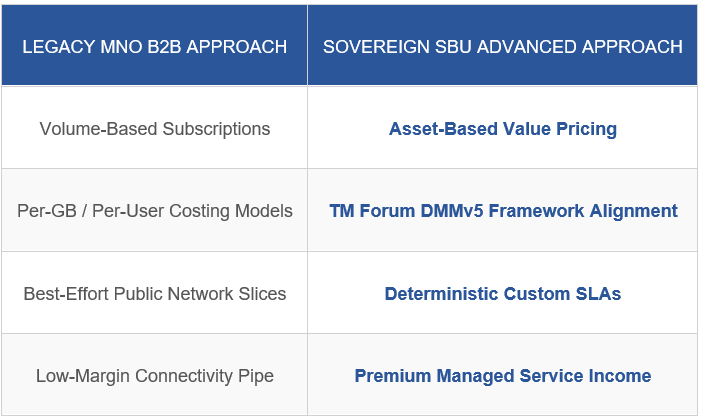
Instead, the SBU aligns its commercial design with the TM Forum Digital Maturity Model (DMMv5) foundations, switching to high-margin, asset-based custom value pricing. Commercial metrics are tied directly to high-level industrial outcomes, such as guaranteeing 99.999% mission-critical network availability, maintaining deterministic microsecond-latency for robotics, or reducing equipment failure through edge AI analytics. This changes the relationship from a volatile utility connection into a highly predictable, premium recurring revenue stream.
The Ultimate Vision: Creating the Industrial Digital Operator
The structural end-game here is to guide the heavy enterprise through an evolutionary shift to become a fully realized Industrial Digital Operator. Under this model, the manufacturing enterprise stops being a passive consumer of fragmented, vendor-proprietary tools and takes centralized, sovereign ownership of its digital infrastructure, effectively mirroring the operational autonomy and architectural discipline of a Tier-1 Mobile Network Operator.
The Industrial Digital Operator model delivers three clear advantages to the enterprise boardroom:
- Absolute Technical Sovereignty: The enterprise breaks free from vendor lock-in, gaining the agility to swap out individual technology layers or automation components without destroying their broader production ecosystem.
- Unified Intelligence and Data Ownership: By breaking down traditional operational silos, the enterprise establishes a single, secured source of truth that feeds both business intelligence and floor-level automation simultaneously.
- Continuous Cyber-Physical Resilience: Cybersecurity transitions from a reactive IT cost center into a core operational asset that actively guarantees zero-downtime productivity.
The Execution Imperative: A Call to Strategic Action
Navigating this complex intersection between industrial C-suites and telecom network architecture requires a specific execution expertise that simply does not exist within traditional, mass-market telecom cultures. Operators attempting to build these high-margin frameworks using standard internal structures routinely face execution paralysis and prolonged procurement delays.
To capture this multi-billion-pound B2B paradigm without disrupting their core consumer business, operators must bridge this capability gap by engaging external strategic counsel and specialized executive directors who can actively orchestrate the tri-party ecosystem, structure outcome-based FinOps models, and operationalize the sovereign infrastructure. For major market players like BT, Vodafone, and global industrial holdings, the opportunity is clear: engage the right strategic leadership today, deploy the Sovereign SBU model or MVNO, and secure absolute market dominance as the foundational enabler of Industry 4.0.
Series Summary: The Blueprint for Industry 4.0 Dominance
Over this three-part series, we have mapped out a comprehensive execution roadmap for the telecom industry. By abandoning monolithic B2B legacy structures (Blog 1), deploying a non-intrusive architecture aligned with ISA-95 standards to resolve boardroom fears (Blog 2), and adopting TM Forum outcome-based asset pricing through CUPS (Blog 3), operators can fundamentally redefine their market position. The choice is stark: continue operating as a low-margin commodity utility pipe, or claim absolute market dominance as the vital structural foundation of the industrial digital era.

Last blogs from Mahdi Gheinaghi
View all →-
September 21, 2026
Resolving the Industrial IT/OT Boardroom Paradox
Industrial enterprises need digital transformation without compromising system availability, physical safety, or operational control. This article explores how a Sovereign Industrial SBU can address the IT/OT…
-
August 13, 2026
Breaking the Mass-Market Telecom B2B Illusion
Telecom operators are sitting on major 5G SA and edge investments, yet traditional B2B models often fail to unlock the value of industrial markets. This article…