

Recap of Blog 1
In our previous post, we dismantled the illusion of mass-market B2B telecom strategies and explained why MNO/MVNOs must spin out a dedicated Sovereign Industrial SBU to bridge the domain capability gap. However, even with the right organizational vehicle, entering the heavy industrial space requires addressing the core operational fears of the boardroom.
The Roots of Industrial Fear: The IT/OT Paradox
To sell advanced network solutions to an industrial board, you have to understand the operational panic behind their hesitation. In corporate IT, the standard framework is the CIA triad, where confidentiality and data integrity take priority, even if it means taking a system offline to apply a security patch. On a continuous-production factory floor, that logic is completely flipped. On a hot rolling mill in a steel plant or a high-pressure distillation column in a refinery, System Availability and Physical Safety override everything else.
An industrial COO looks at a public network or a shared network slice and sees an uncontrolled risk vector. A minor latency spike or a dropped packet in a critical control loop can cause immediate mechanical failure, millions of pounds in ruined hardware, or worse, severe injury to personnel on the floor. This is the IT/OT Convergence Paradox: industrial boards know they need to modernize to survive, but they cannot and will not accept even a fraction of a second of operational risk to get there.
Speaking the Boardroom Language: ISA-95 and IEC 62443 Alignment
The Sovereign Industrial SBU bypasses this anxiety by dropping the telco jargon and aligning its offerings with recognized industrial architecture blueprints. The integration maps directly onto the hierarchical layers of the ISA-95 enterprise standard and the security zones of the IEC 62443 framework:
- LEVEL 4: Enterprise IT & Corporate ERP: Handled via standard public network connections.
- LEVEL 3: Manufacturing Operations (MES / Production Scheduling): Targeted edge monitoring and access control via hardened Demilitarized Zones (DMZs).
- LEVEL 2/1: Real-Time Plant Automation (SCADA, PLCs, DCS): Complete air-gapped isolation via Sovereign Private 5G Edge.
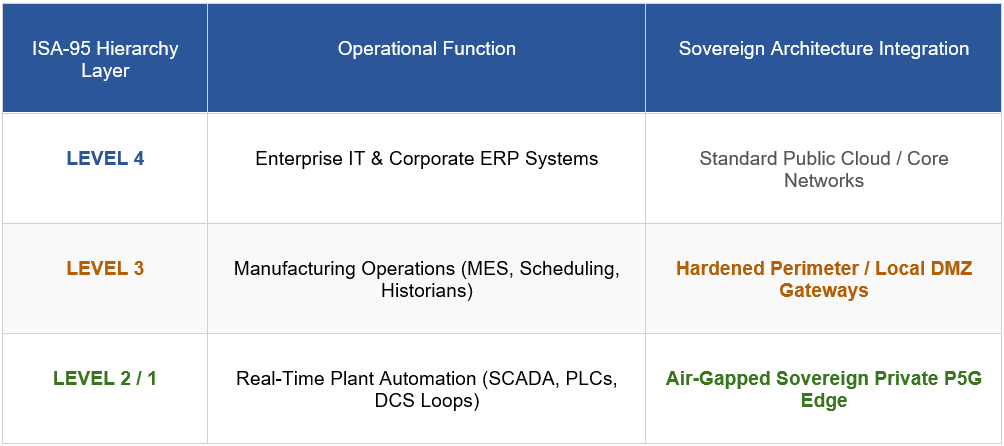
By enforcing this design, the SBU delivers an objective operational blueprint that stops "macro-vendor drift" and costly legacy vendor lock-in. It positions the MNO/MVNO-backed SBU as the ultimate architectural authority, giving the heavy enterprise full control over their data streams and the ability to manage multi-vendor environments from a single dashboard.
The Non-Intrusive Execution Blueprint
The absolute rule of entering the OT domain is simple: Do no harm. Standard IT security relies heavily on active scanning injecting query packets into the network to find vulnerabilities. In a delicate industrial environment, flooding older, legacy PLCs with active scanning packets can crash them instantly, freezing a multi-million-pound production line.
The Sovereign SBU solves this friction point with a non-intrusive operational blueprint:
- Passive Network Monitoring: We deploy physical network TAPs to mirror and analyze raw data traffic in real time. We do not inject a single packet back into the active stream, meaning there is zero threat to engineering tolerances.
- Deep Packet Inspection (DPI): The system decodes native industrial protocols (like Modbus or Profinet) at the edge to immediately flag anomalies, unauthorized firmware changes, or unapproved register adjustments without interrupting operations.
- Contextual Cyber-Physical Correlation: The security operations center doesn't look at cyber alerts in a vacuum. It correlates IT threat data with actual physical plant parameters (like sudden pressure or temperature drops) to instantly separate a malicious network infiltration from standard mechanical wear-and-tear.
This passive approach gives the industrial board exactly what they demand: complete visibility over their asset footprint with zero operational risk. For the parent MNO/MVNO, this translates into a highly sticky managed service that ensures long-term contract retention.
Telecom C-Suite Critique: Managing Commercial Friction and Co-Opetition
From an MNO/MVNO executive perspective, scaling this model introduces a few operational realities that we have to address upfront to protect our margins:
- Managing OEM Co-Opetition: Industrial automation giants (like Siemens, ABB, and Honeywell) are building their own closed, proprietary industrial cloud platforms. We shouldn't compete with them directly. Instead, the Sovereign SBU positions itself as the neutral, secure connectivity layer and data sovereign gatekeeper that aggregates these multi-vendor environments into one boardroom view.
- Mitigating Liabilities and Indemnification: In traditional telecom, downtime means giving out service credits. In an OT environment, a network failure that halts a continuous steel casting line can cost millions. We protect the parent MNO/MVNO by strictly limiting our operational footprint to non-intrusive passive monitoring and data-dioded telemetry collection, ensuring we are completely insulated from physical functional safety liabilities.
- Standardizing Bespoke SLAs: Heavy industries love customized solutions, but MNO/MVNOs need repeatability to achieve scale and high gross margins. The SBU handles this by utilizing the TM Forum Digital Maturity Model (DMMv5) to translate complex industrial requirements into standardized, tier-based commercial blueprints, accelerating our sales cycles.
Coming Up Next in Blog 3...
Now that the architecture is secured and the boardroom's operational fears are resolved, how do we actually monetize this framework? In our third and final post, we will break down the commercial execution, exploring CUPS network architecture and shifting from volumetric pricing to outcome-based value metrics.