
Introduction
The telecom sector is facing an internal execution crisis. Traditional B2C revenue is flat, and standard corporate SME segments cannot support the massive Capex we have already sunk into 5G Standalone (5G SA) and edge compute infrastructures. Growth sits in asset-heavy industrial sectors, but targeting them requires a reality check. When pitching to heavy industries like steel or petrochemicals, our enterprise teams consistently hit a wall: the IT/OT Convergence Paradox. This series offers a practical, high-level blueprint to break this commercial gridlock by establishing an autonomous, ring-fenced Sovereign Industrial SBU, leveraging non-intrusive architectural governance, and switching to outcome-based value pricing.
The Capex Trap and the Flaw in Legacy B2B Thinking
Let’s be honest about the macroeconomic reality facing global telecommunications. The days of relying on consumer cellular growth (B2C) to fix the balance sheet are over. Price commoditization, tight regulation, and pure market saturation have effectively permanently flattened our ARPU. To counter this, operators have spent billions on 5G Standalone (5G SA) cores, fiber, and localized edge compute capacity. The problem is, we are sitting on these advanced capabilities without a clear path to commercial return.
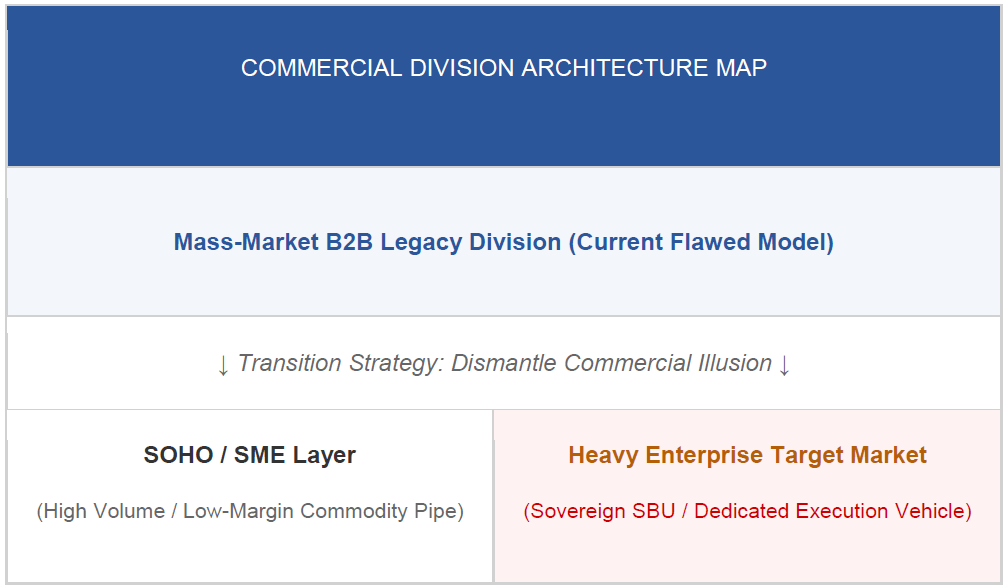
The bottleneck is how operators view the B2B market. Historically, telecom cultures treat B2B as one massive, uniform bucket. Legacy corporate sales divisions try to pitch a local retail shop and a multi-site manufacturing complex using the exact same playbook, systems, and standard product catalogs. This lack of segmentation is a major strategic blunder. If we want to capture the real spend in the industrial digital shift, we have to split our B2B strategy into two entirely separate operational universes:
- The SOHO / SME Layer: This is your high-volume, low-margin transactional business. It needs to be highly standardized, automated via self-service portals, and run on shared public network slices or standard SaaS integrations. It keeps the lights on but won't justify your 5G SA core investment.
- The Heavy Enterprise Layer: This is where the real margin sits. We are talking about asset-dense, high-risk verticals, steel mills, chemical plants, and heavy logistics hubs. This sector does not buy off-the-shelf products; it demands absolute operational isolation, tailored architecture, and boardroom-level transformation partnerships.
The Institutional Capability Gap
An industrial board does not care about our technical network metrics. They don't care about spectrum bands or theoretical peak download speeds. What keeps an industrial COO up at night is risk mitigation, asset utilization, and keeping the plant running. This creates a massive capability gap. Telecom operators have the network assets, but they lack the domain intimacy, the specialized engineering skill set, and the deep operational technology (OT) knowledge needed to sit at an industrial boardroom table. Telecom teams are wired to manage wide-area macro networks; they simply don't speak the language of automated shop floors, programmable logic controller (PLC) loops, or factory safety codes. Trying to close this gap using your existing enterprise sales structure will almost always lead to immediate internal paralysis.
The Sovereign Industrial SBU as the Ultimate Delivery Vehicle
To bypass our own internal bureaucracy and build real credibility with industrial C-suites, we need to spin out an independent, ring-fenced organizational vehicle: the Sovereign Industrial Strategic Business Unit (SBU), or an MNO/MVNO-backed equity Joint Venture (JV). This entity must run on its own P&L, separate from the parent company’s slow procurement and reporting lines.
The sovereign SBU acts as an ecosystem orchestrator. It sits in the middle of a tri-party alliance that brings together the parent operator’s network assets, the global industrial automation OEMs (like Siemens and ABB), and specialized OT security integrators. By ring-fencing this specialized capability, the SBU packages raw telecom infrastructure into a highly secure, unyielding industrial asset. This immediately changes the conversation from an IT vendor pitch to a strategic joint venture centered on protecting the client's long-term enterprise valuation.
Coming Up Next in my next Blog (2)
Understanding the structural shift is only half the battle. In the next post, we will dive deep into the technical heart of the boardroom panic, the IT/OT Paradox, and outline the non-intrusive architectural framework required to win the trust of industrial COOs without disrupting factory floors.
