The Media Gateway: What It Changes, and What It Costs
The Media Gateway (MGW) is where the audio actually flows. Under instruction from an MSC Server or a Media Gateway Control Function over H.248, it converts between codecs and between a timeslot on a circuit and RTP packets on an IP network, and handles echo control, tones and announcements. When the signalling succeeds but nobody can hear anything, this is the element to look at.
A Media Gateway (MGW) carries and processes media between network domains under the control of a separate call-control function. In mobile telephony, it can connect different bearer technologies and perform operations such as packetisation, codec conversion or tone handling where required. Its precise capabilities depend on the gateway type and deployed architecture.
The MGW handles the media path, while functions such as an MSC Server or Media Gateway Control Function provide the relevant control. For an MVNO, this distinction helps explain calls with successful signalling but poor or missing audio. It also prevents capacity planning from treating a voice-processing workload as if it were ordinary application-server traffic.
On this page
- History and Evolution of the Media Gateway
- Core Utility and Functionality of the MGW
- What is the MGW Used For?
- Key Functions of the Media Gateway
- Technical Integration and Data Model
- Integration with Other Systems
- Technical Data Model and Key Interfaces
- MGW Ownership for MVNOs and IoT Companies
- Why Own an MGW?
- Advantages and Disadvantages of MGW Ownership
- Organizational Impact of MGW Ownership
- Redundancy and High Availability
- Impact of 4G, 5G, and 6G on the MGW
- Media Gateways in the 4G Era
- Media Gateways in 5G Voice
- 6G and Long Term Media Planning
- Frequently Asked Questions about the Media Gateway (MGW)
- Summary
History and Evolution of the Media Gateway
Traditional telephone switches combined call control with bearer handling. As networks adopted packet transport, separating those responsibilities allowed control software and media resources to evolve independently. Media gateways connected existing circuit-based equipment with newer packet-based infrastructure while preserving the ability to make ordinary telephone calls.
Mobile networks use the term in several related contexts. A circuit-switched core media gateway can work with an MSC Server, while an IMS media gateway works with an MGCF at the relevant interworking boundary. These variants are not identical configurations. A supplier should identify the intended role, controller and interfaces rather than offering a generic gateway label without architectural scope.
Core Utility and Functionality of the MGW
What the gateway does to the audio
| Operation | When it is needed | What it costs |
|---|---|---|
| Transcoding | The two ends use different codecs | Quality, delay and processing capacity |
| Packet to circuit conversion | One side is TDM | Little, but it is a hard dependency |
| Echo cancellation | A circuit leg is involved | Processing, and some delay |
| Tones and announcements | The network has to say something | Little |
| Conference bridging | Three or more parties | Capacity per participant |
| Content interception | A lawful intercept warrant applies | Nothing optional about it |
What is the MGW Used For?
A media gateway establishes the bearer connection requested by its controller. For a call crossing from packet voice to a circuit-switched network, it can connect the packet stream with the required circuit-side resources. It may also adapt media formats where the two ends cannot use the same representation directly.
The gateway's work is visible in the quality of the conversation. Delay, packet loss, jitter, incompatible codecs and incorrect tone handling can all affect usability. Call-control success is therefore only one part of acceptance. Test actual speech in both directions and verify the media path under the traffic and transport conditions expected in production.
Key Functions of the Media Gateway
Bearer termination provides the endpoints needed to receive and transmit media. Depending on the product, these can include circuit-side and packet-side resources. The gateway must create and release the correct associations in response to control instructions, avoiding resource leaks and unintended connections between unrelated calls.
Media conversion adapts between supported transport or encoding arrangements. Transcoding changes the voice codec where required, but it is not needed for every call. Avoid unnecessary conversions where the architecture supports a compatible end-to-end codec, because each conversion can add processing cost and affect quality.
Packetization and jitter handling support packet-based media transport. A jitter buffer can smooth arrival variation, but additional buffering can increase delay. Suppliers should demonstrate the chosen settings under realistic network conditions rather than presenting a single best-case audio result from an unloaded laboratory connection.
Tone, DTMF and announcement-related capabilities support telephone interactions such as menu selection. Echo-control functions may be relevant to the bearer environment. The exact feature set varies, so list the services your traffic requires. A gateway that carries ordinary speech correctly can still fail when a customer enters digits into an automated service.
Technical Integration and Data Model
Integration with Other Systems
The controlling function depends on the gateway's role. An MSC Server can control a circuit-switched core gateway, while an MGCF controls an IMS media gateway in the corresponding interworking architecture. The control relationship needs compatible procedures, profiles and resource models on both sides.
The media path connects access, transport or interconnect networks as required by the deployment. Routing and firewall configuration must permit the intended media flows. A Session Border Controller may provide separate border and media capabilities, but it should not automatically be treated as equivalent to every type of MGW.
Operational integration includes performance monitoring, resource inventory and fault reporting. Use the core network elements overview to map the gateway alongside its controller and neighbouring systems. The diagram should make clear which component is responsible for a codec decision, which executes it and which team investigates a one-way-audio report.
Technical Data Model and Key Interfaces
The gateway maintains information about media terminations, active contexts and the resources allocated to each connection. The controller's view must remain aligned with the gateway's actual state. If the two disagree after a timeout or restart, calls can fail or resources can remain occupied after they should have been released.
What a media gateway actually changes about the audio.
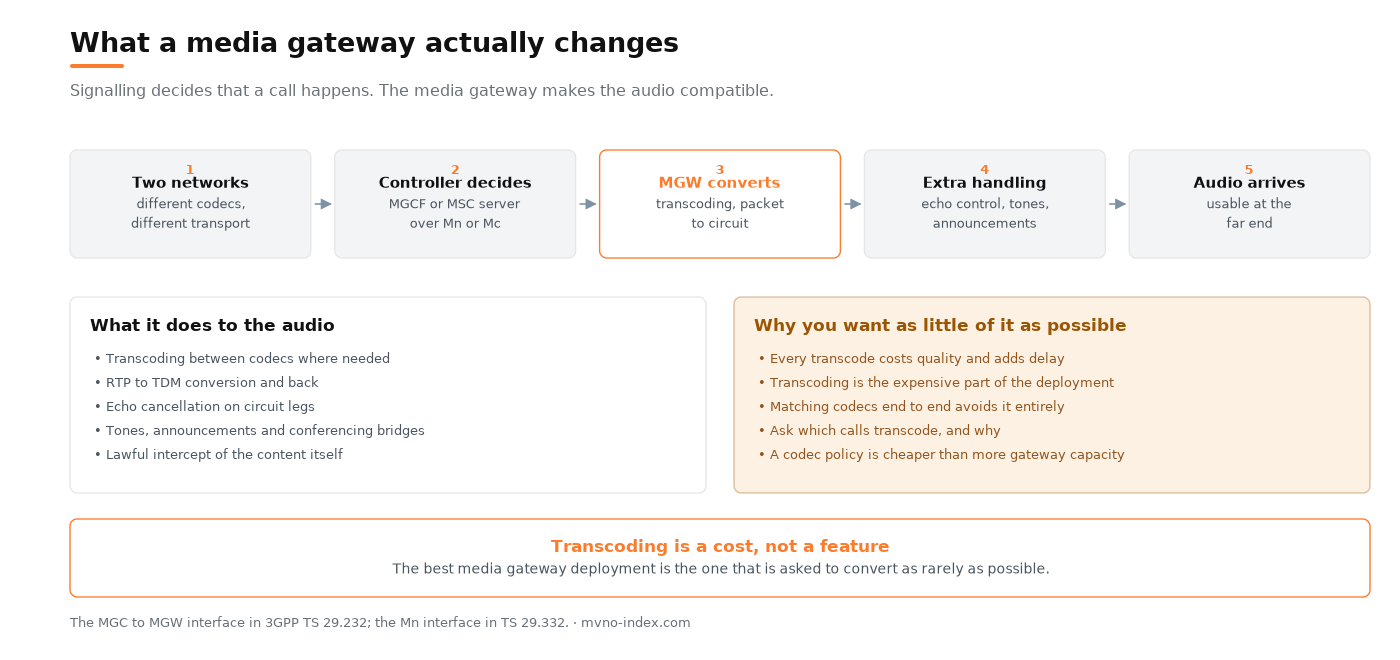
H.248 is widely used for control in the relevant telecom gateway architectures, with profiles and packages appropriate to the role. Mn is the reference point between an MGCF and IMS media gateway. Other gateway variants use the control and bearer interfaces defined for their own architecture.
The interface between the controller and the gateway is specified in 3GPP TS 29.232, and the Mn interface towards an IM media gateway in TS 29.332.
Packet media commonly uses RTP and associated control information where applicable. Circuit-side connectivity and supported codecs depend on the product. Request a complete interface and codec matrix, including licensed capacity and limitations when features are combined. A maximum port count measured without transcoding may not represent the capacity available for your real calls.
MGW Ownership for MVNOs and IoT Companies
How to need less gateway capacity
| Measure | Effect |
|---|---|
| Agree a common codec with interconnect partners | Removes transcoding on those routes entirely |
| Prefer the same codec on both legs of a call | The gateway can pass the media through untouched |
| Ask which call types transcode, and why | You cannot reduce what you have not measured |
| Review the codec policy when adding a partner | Each new interconnect can reintroduce transcoding |
| Check device codec support in your range | A device that only speaks one codec forces conversion |
Why Own an MGW?
An operator may own media-gateway capability when it needs direct control of a bearer interworking point or a specific voice architecture. This can improve visibility into media quality and allow gateway placement close to relevant traffic. The decision should be linked to actual interconnect and service requirements.
Many MVNOs can obtain media handling from a managed IMS or carrier service. An IoT provider may need it for voice-enabled equipment or a legacy communication path, but data-only devices do not create an automatic requirement. Define the supported call types and media formats before requesting gateway quotations, and consider whether a managed service meets the same need.
Advantages and Disadvantages of MGW Ownership
Advantages:
-
Direct control can provide detailed information about packet loss, resource use and codec processing. This can shorten investigations into poor audio and help validate interconnect changes. Gateway placement can also be aligned with the chosen transport design, subject to available network connections and operational support.
-
Ownership may allow the operator to retain a necessary legacy interface while modernising other components. That can make a staged migration practical. However, the gateway should be part of a documented transition plan, with a clear explanation of which dependency it preserves and when that dependency can be removed.
Disadvantages:
-
Media workloads can require substantial processing and carefully engineered transport. Transcoding capacity, packet throughput and simultaneous call limits may differ significantly. An attractive headline capacity can become misleading if the real codec mix consumes far more resources than the supplier's demonstration scenario.
-
Legacy physical interfaces can also add hardware and support obligations. Include spares, facilities, transport and specialist expertise in the business case. Compare these costs with a managed interconnect using the provider-selection guide, and ask each provider to price the same traffic profile and failure capacity.
Organizational Impact of MGW Ownership
Voice operations need tools that inspect the media path as well as signalling. A useful incident record identifies whether audio fails in one direction or both, which codecs were used and whether loss or delay changed during the call. This evidence is more actionable than a report that the call connected but sounded bad.
Engineering teams should maintain a representative media test set. Include conversational speech, silence, DTMF, announcements and any fax or specialised media the service explicitly supports. Do not assume that support for one media type proves another. Some legacy applications need dedicated qualification and may be unsuitable for a proposed packet path.
Security teams must protect both control and media resources. Restrict administrative and controller access, isolate the intended network paths and monitor unusual allocation patterns. Encryption requirements depend on the architecture and service, so state them explicitly. An IP media stream should not be presumed protected merely because another control interface uses secure transport.
Commercial teams should define quality and capacity commitments in measurable terms. Codec support, concurrent sessions and the conditions used for performance testing belong in the service specification. Explain how capacity changes during maintenance or site failure. Customers buying a voice service need an outcome they can test, rather than a gateway model number with an unspecified port count.
Redundancy and High Availability
MGW resilience is demanding because active media resources may be tied to a running instance or physical bearer. A second gateway can provide spare capacity without preserving every call already using the failed unit. Ask suppliers to distinguish continuity of established calls from the ability to accept new calls after recovery.
Test failure of the gateway, its controller and the transport path independently. Confirm how stale resources are cleared and whether the controller can re-establish a consistent view. Resource audits and recovery procedures must avoid connecting the wrong terminations or leaving ports unavailable after calls have ended.
Plan capacity for the loss of a site using the actual codec and feature mix. If surviving gateways need to transcode more calls than normal, their usable capacity may be lower than expected. Include peak simultaneous calls and packet-processing load in the test, and measure speech quality while the surviving platform carries the additional traffic.
Impact of 4G, 5G, and 6G on the MGW
Media Gateways in the 4G Era
VoLTE uses packet-based IMS voice, but calls may still cross legacy interconnects. Media gateways can support that boundary where required. They are not necessarily present on every VoLTE media path, and an all-IP route with compatible media can avoid some forms of legacy conversion.
Media Gateways in 5G Voice
VoNR also uses IMS-based voice in supported deployments. A 5G subscriber can still call a destination reached through older networks, so gateway requirements follow the end-to-end route. The User Plane Function carries 5G user traffic, but it is not simply a replacement for a telephony media gateway's codec and bearer-interworking role.
6G and Long Term Media Planning
Future access networks may change where and how media is handled. Current gateway purchases should be based on the interfaces and services that must work today, with a defined support horizon. Seek migration flexibility and access to configuration, while avoiding unsupported promises that a legacy gateway will automatically meet every future multimedia requirement.
Frequently Asked Questions about the Media Gateway (MGW)
What does a media gateway do?
It carries and processes media between network domains under control from the relevant call-control function. Depending on its role, it can terminate bearer resources, adapt transport, handle tones and transcode codecs. The exact capabilities should be specified for the intended mobile or IMS architecture.
How does an MGW differ from an MGCF?
The MGW handles the media and bearer resources. The MGCF provides signalling interworking and controls an IMS media gateway. A supplier can package them together, but the two functions have different workloads and recovery requirements. Both need to be included in a complete interworking test.
Does every gateway transcode every call?
No. Transcoding is required only where the selected path and codec capabilities make it necessary. Some calls can use compatible media without conversion. Capacity planning should reflect the expected proportion of transcoded calls and the processing cost of the actual codec combinations.
Is an MGW the same as a UPF?
No. The UPF forwards user traffic in the 5G Core and performs its assigned packet-handling functions. A telephony MGW handles media-specific bearer interworking under call control. Both can carry traffic associated with a voice service, but their architectural responsibilities are different.
Why can signalling work while audio fails?
Signalling and media use different paths and resources. Incorrect media addresses, blocked traffic, codec mismatches or gateway-resource faults can affect audio after call setup succeeds. Test both directions of media and inspect the actual bearer path rather than treating a successful answer response as proof of voice quality.
What determines usable MGW capacity?
Relevant factors include simultaneous calls, packet rate, codec mix, transcoding and other enabled features. Hardware or virtualisation configuration also matters. Request capacity evidence for your actual traffic profile and the reduced platform available after a failure, instead of relying only on a maximum port figure.
What should a media-gateway trial include?
Test speech quality, both audio directions, DTMF and the specific media services included in your offer. Add realistic packet loss, delay and load. Verify controller compatibility, resource cleanup and failure recovery, and record which active calls survive versus which require a new call attempt.
Summary
The MGW handles media and bearer interworking, while a separate function controls the relevant call procedures. Its performance depends on codecs, transport conditions, resource handling and the surrounding architecture. An MVNO should buy or outsource this capability according to its actual voice and interconnect requirements.
Specify the media services and traffic profile before comparing platforms. Use the MVNO Index solution provider directory to shortlist partners and request a trial that proves audio quality, realistic capacity and recovery under the conditions your customers will encounter.
Cross-Generation Services