The MGCF: Where an IMS Call Meets the PSTN
The Media Gateway Control Function (MGCF) is the translator between IMS and the circuit-switched telephone network. It converts SIP into ISUP or BICC and back again, and instructs a media gateway over H.248 which circuits and IP streams to connect for each call. It deals with signalling only: the voice itself never passes through it.
The Media Gateway Control Function (MGCF) provides call-control interworking between IMS and circuit-switched networks. It translates the relevant signalling between SIP on the IMS side and protocols such as ISUP or BICC on the circuit-switched side. It also controls an IMS media gateway so that the corresponding bearer connection can be established.
The MGCF handles control, while the media gateway handles the media. This distinction is essential when specifying a voice platform. An MVNO may need MGCF capability for a legacy interconnect, or obtain that interworking as a managed service. A network using suitable all-IP interconnection does not automatically need a dedicated MGCF for every external call.
On this page
- History and Evolution of the Media Gateway Control Function
- Core Utility and Functionality of the MGCF
- What is the MGCF Used For?
- Key Functions of the Media Gateway Control Function
- Technical Integration and Data Model
- Integration with Other Systems
- Technical Data Model and Key Interfaces
- MGCF Ownership for MVNOs and IoT Companies
- Why Own an MGCF?
- Advantages and Disadvantages of MGCF Ownership
- Organizational Impact of MGCF Ownership
- Redundancy and High Availability
- Impact of 4G, 5G, and 6G on the MGCF
- MGCF in 4G Voice Networks
- MGCF in 5G Voice Networks
- 6G and Interconnect Migration
- Frequently Asked Questions about the Media Gateway Control Function (MGCF)
- Summary
History and Evolution of the Media Gateway Control Function
IMS introduced IP-based multimedia session control into an environment containing extensive circuit-switched telephony. Operators needed calls to work across both systems during a long transition. The MGCF supplied a defined control function for that interworking, allowing IMS sessions to connect with the procedures used by legacy telephone networks.
Separating control from media processing also allowed the two workloads to be deployed and scaled differently. A signalling controller does not need the same resources as a device that terminates circuits or processes voice codecs. Commercial products may combine these roles, but the logical separation remains useful for capacity planning, fault diagnosis and supplier comparison.
Core Utility and Functionality of the MGCF
Two planes, two components
| MGCF | IM-MGW | |
|---|---|---|
| Handles | Signalling | Media |
| Translates | SIP to ISUP, and back | Codecs, and packet to circuit |
| Interface between them | Mn | Mn |
| Scales with | Call attempts | Concurrent calls and transcoding load |
| A fault here shows as | Calls that fail to set up | Calls that connect but have no audio |
What is the MGCF Used For?
Imagine an IMS subscriber calling a destination reached through a circuit-switched interconnect. The network must translate the call-control exchange and arrange a compatible media path. The MGCF performs the relevant signalling interworking and directs the media gateway to establish the bearer resources needed for the call.
The reverse direction also matters. An incoming legacy call must be represented correctly to the IMS environment, including its progress and eventual release. Interworking quality depends on more than whether a ringing tone is heard. Number presentation, early media, answer supervision and release causes all influence what the customer experiences and what downstream systems record.
Key Functions of the Media Gateway Control Function
Signalling translation maps the supported SIP and circuit-switched call-control procedures. The mapping must preserve the meaning of call progress and failure as accurately as the applicable standards and network profiles allow. A simplistic conversion can produce misleading responses, such as treating a network failure as an ordinary busy destination.
Media-gateway control allocates, connects and releases the appropriate bearer resources. The MGCF needs a consistent view of what the gateway has created. If a control message times out, the system must avoid leaving resources allocated indefinitely or assuming a connection exists when the gateway did not establish it.
Codec and bearer coordination connects the information in session descriptions with the capabilities of the media gateway and legacy side. The MGCF directs the relevant control process; the gateway performs media conversion or transcoding where required. Supported codec lists should therefore be checked across both components.
Call-state handling keeps the two sides aligned through answer, cancellation and release. Operational records support troubleshooting and charging correlation. The MGCF is not the telephony application server and should not be presented as the component that implements every subscriber feature or decides retail call pricing.
Technical Integration and Data Model
Integration with Other Systems
The MGCF connects to the IMS signalling environment and to the relevant circuit-switched call-control path. A Breakout Gateway Control Function, or BGCF, can participate in deciding how a session leaves IMS towards a circuit-switched destination. The MGCF then performs the assigned interworking and media-gateway control responsibilities.
The media gateway supplies the bearer conversion and resource handling. Signalling-gateway functionality may also be required for the chosen transport arrangement. These are distinct roles even when delivered by one vendor. Ask the supplier to draw the complete path and identify each component included in the price.
Border functions can remain relevant for IP interconnection and network protection. A Session Border Controller is not automatically a substitute for MGCF functionality, although products may combine features. Use the core network elements overview to keep the control, border and media responsibilities separate during design discussions.
Technical Data Model and Key Interfaces
The MGCF maintains call state and the associations between signalling on each side and resources in the media gateway. That state is time-sensitive and procedural. It is different from the long-term subscriber profile or commercial billing record, even though identifiers and events may be correlated with those systems.
Where an IMS call meets the old telephone network.
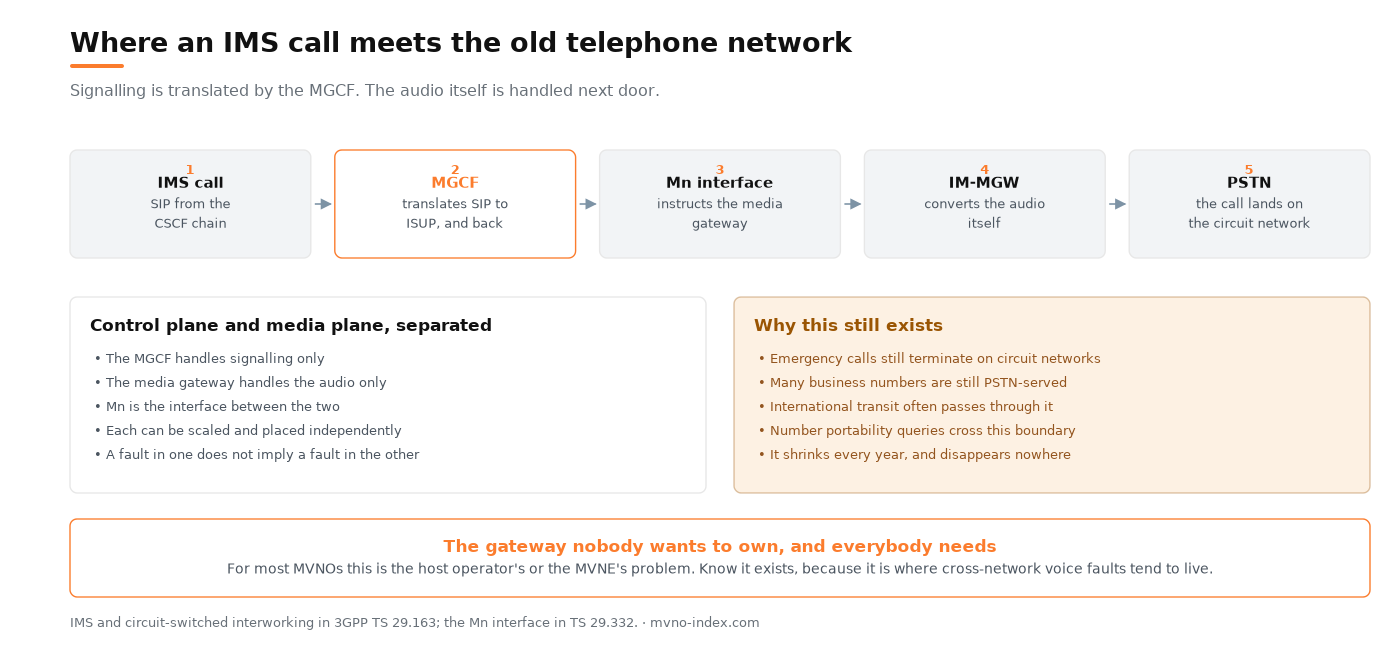
Mg describes the SIP relationship between the MGCF and CSCF in the relevant architecture. Mj supports the BGCF-to-MGCF relationship. Mn connects the MGCF to the IMS media gateway using the applicable H.248 profile. ISUP or BICC is used for the corresponding circuit-switched call-control side, depending on the network arrangement.
3GPP TS 23.228 describes the IMS architecture, TS 29.163 addresses IMS and circuit-switched interworking, and TS 29.332 specifies the relevant media-gateway control relationship. Require the vendor to identify supported profiles and options. A claim of SIP plus H.248 support does not demonstrate compatibility with your actual interconnect partner.
MGCF Ownership for MVNOs and IoT Companies
Why this interworking still exists
| Reason | Why it will not disappear soon |
|---|---|
| Emergency calls | Still terminate on circuit-switched networks in many markets |
| Business numbers | A large installed base is still PSTN-served |
| International transit | Often crosses a circuit boundary somewhere on the route |
| Number portability queries | Cross the same boundary |
| Legacy equipment | Alarm lines, lifts and terminals outlive every migration plan |
Why Own an MGCF?
An MVNO may operate MGCF capability where its chosen voice architecture requires direct control of a circuit-switched interconnect. This can provide visibility and configuration control for a specific legacy dependency. It should be justified by a real traffic path, rather than included automatically because the business operates IMS.
Many operators can obtain the required interworking from a carrier or managed voice provider. For an IoT company, the requirement usually arises only where voice services or specialised legacy communication remain part of the product. First establish the destination networks and interconnect arrangements, then decide whether direct ownership improves control enough to justify the operating cost.
Advantages and Disadvantages of CSCF Ownership
Advantages:
-
Direct control can help an operator tune and investigate interworking with a particular partner. Detailed traces on both signalling sides can reveal where call progress, number presentation or release behaviour changes. This is useful when a managed carrier exposes only a generic failure result and the service requires more precise diagnosis.
-
Ownership can also allow coordinated changes between the control and media layers. However, the benefit depends on retaining staff with the necessary protocol expertise. Compare this model with a provider that supplies equivalent testing support and operational evidence under a managed interconnect agreement.
Disadvantages:
-
Legacy interworking has many edge cases. A small percentage of affected calls can still produce a large support burden, especially when failures concern early media or specific destination networks. The effort to maintain interconnect profiles and test changes continues after the initial deployment.
-
The investment can also become stranded as partners retire circuit-switched connections. Include the media gateway, transport and signalling costs in the business case, together with a migration plan. Check the wholesale agreement and carrier contracts for responsibilities, retirement notices and the conditions for moving to an all-IP interconnect.
Organizational Impact of MGCF Ownership
Voice engineering teams need a shared understanding of both signalling environments. They must be able to interpret call progress and release causes on each side and explain the mapping. A trace tool that shows only the IMS half of the transaction may leave the root cause hidden in the legacy network.
Operations teams need procedures for faults that affect particular routes or call types. Monitor outcomes by interconnect and destination group where appropriate. Keep controlled test numbers for cases such as busy, unanswered, rejected and announced calls. Successful ordinary calls provide too little coverage for a reliable interworking service.
Finance and revenue-assurance teams should verify answer supervision and call-duration records. Incorrect mapping can produce disagreements about when charging begins or ends. Reconcile gateway, controller and carrier evidence for representative scenarios before launch, including calls that terminate during early media or fail after resources have already been allocated.
Security teams must protect control interfaces and configuration changes. An unauthorised routing change or excessive call attempt rate can affect both availability and cost. Review access to the media gateway as well as the MGCF. For managed services, require a clear explanation of who can change interworking profiles and how those changes are audited.
Redundancy and High Availability
MGCF resilience needs to preserve or safely recover the relationship between call state and media resources. A standby controller that can accept new calls may not be able to recover every active call. Ask the supplier to distinguish those outcomes and describe how gateway resources are cleaned up after an unplanned controller failure.
Test the loss of the controller, the media gateway and the signalling path separately. Each failure can leave the other components in a different state. Recovery should avoid duplicate allocations, stuck circuits and calls that appear active after the media has stopped. Include the interconnect partner in tests where its behaviour influences recovery.
Capacity should be assessed using both call attempts per second and simultaneous active calls. Short failed calls can create high control load without large media occupancy. Long calls can fill media resources with relatively few new attempts. Price and test the system against both patterns, including the load remaining after one site fails.
Impact of 4G, 5G, and 6G on the MGCF
MGCF in 4G Voice Networks
VoLTE uses IMS, while many destinations and interconnects have historically involved circuit-switched networks. MGCF capability can bridge those environments. Its presence is determined by the interconnect path, not by an assumption that every VoLTE call needs conversion to a legacy circuit.
MGCF in 5G Voice Networks
IMS-based VoNR can still reach destinations through legacy interworking where required. The MGCF's role remains associated with that boundary. Moving the originating subscriber from LTE to 5G does not itself remove the legacy destination or change every external carrier connection. Review the complete route before deciding to retire interworking capacity.
6G and Interconnect Migration
Future access generations do not guarantee that all external telephone networks will use identical interfaces. Nevertheless, a current MGCF investment should be tied to documented interconnect requirements and a realistic retirement horizon. Prefer a proposal that explains the all-IP migration path and protects access to configuration and diagnostic information during transition.
Frequently Asked Questions about the Media Gateway Control Function (MGCF)
What is the main function of the MGCF?
It performs call-control interworking between IMS and circuit-switched networks and controls the associated IMS media gateway. It translates relevant signalling procedures and coordinates bearer resources. The actual speech conversion is performed by the media gateway, not by the MGCF's control role.
How does the MGCF differ from the MGW?
The MGCF controls the call and gateway resources. The MGW carries and processes the media according to that control. The functions can be packaged together, but their performance, failure behaviour and interfaces should still be evaluated separately in a supplier proposal.
Does every IMS deployment need an MGCF?
No. The need depends on the interworking and interconnect architecture. An operator may use all-IP connections or obtain legacy interworking from another provider. Map the actual traffic path before buying dedicated capability, and confirm which party handles any remaining circuit-switched conversion.
Is a BGCF the same as an MGCF?
No. The BGCF participates in breakout routing decisions for relevant IMS sessions. The MGCF performs the assigned signalling interworking and controls the media gateway. They can cooperate in the same call path, but they describe different logical responsibilities.
Does the MGCF transcode voice?
The MGCF coordinates control and bearer requirements. Transcoding, where required and supported, is a media-gateway operation. Compare the codec capabilities and available processing capacity of the gateway as well as the controller's ability to request and manage the relevant resources.
Why is early media important in testing?
Announcements and tones can occur before a call is answered. Incorrect interworking can suppress them, create silence or affect answer supervision. Test realistic early-media scenarios with the intended carrier, rather than judging the platform only by calls in which both parties answer immediately.
What should I ask an MGCF supplier to prove?
Request interoperability with the intended gateway and carrier, including unsuccessful calls, early media and release handling. Test controller failure during active calls and verify resource cleanup. Require a complete scope covering signalling, media and transport dependencies, with clear capacity and support commitments.
Summary
The MGCF provides the control bridge between IMS and circuit-switched telephony. It translates relevant signalling and directs media-gateway resources, while the gateway handles the bearer. Its value to an MVNO depends on the interconnects and legacy services the business actually needs.
Compare direct ownership with managed interworking, and validate the difficult call cases before launch. The MVNO Index solution provider directory can help identify voice-platform and carrier partners for a scoped proposal and interoperability trial.
Cross-Generation Services