The OTA Server: Changing a SIM That Is Already in the Field
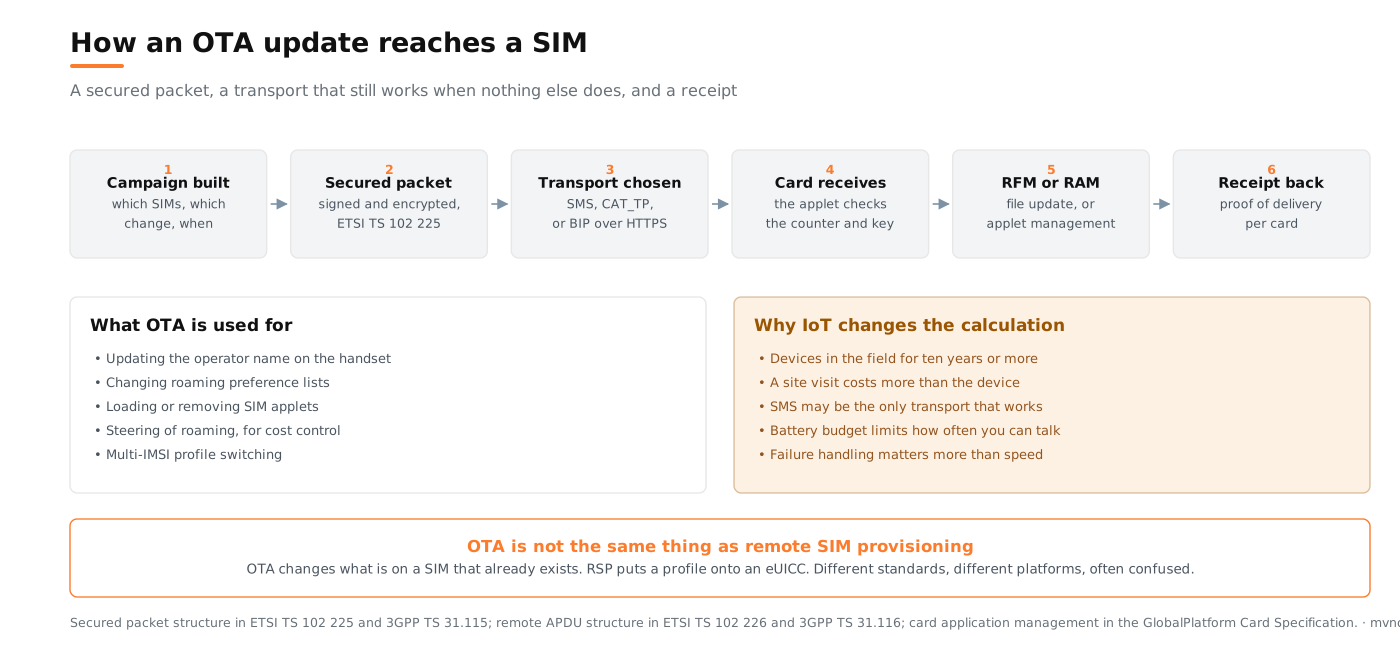
An OTA (Over-the-Air) server changes what is on a SIM that is already in the field. It wraps an instruction in a secured packet, sends it over SMS or an IP bearer, and the card applies it. Updating files, managing applets or switching roaming preferences, without anyone touching the device. It is not the same thing as remote SIM provisioning, which puts a whole profile onto an eUICC.
The OTA Server (Over-the-Air) is a vital and often underestimated platform component within the infrastructure of any mobile operator, MVNO, or IoT company that manages a base of SIM cards, eSIMs, or iSIMs. Understanding its purpose is essential for any operator aiming to remotely manage, update, and secure subscriber identities and SIM-based applications without the need for physical SIM replacement or manual intervention. The OTA Server acts as the secure, centralized management platform that communicates directly with the SIM card embedded in a subscriber's device, transmitting encrypted commands and data payloads over the live mobile network. It is the foundational system that enables operators to manage their SIM estate at scale, update network credentials, load new applications, and enforce security policies across millions of active subscribers, all remotely and in real time. For any operator serious about operational efficiency, subscriber satisfaction, and future-proofing their SIM strategy, deploying or sourcing a capable OTA Server is not optional; it is essential.
On this page
- History and Evolution of the OTA Server
- Core Utility and Functionality of the OTA Server
- What is the OTA Server Used For?
- Key Functions of the OTA Server
- Technical Integration and Data Model
- Integration with Other Systems
- Technical Data Model and Key Interfaces
- OTA Server Ownership for MVNOs and IoT Companies
- Why Own an OTA Server?
- Advantages and Disadvantages of OTA Server Ownership
- Organizational Impact of OTA Server Ownership
- Redundancy and High Availability
- OTA Server in the Context of eSIM and IoT
- Impact of 4G, 5G, and Beyond on the OTA Server
- OTA Server Continuity Across Network Generations
- 5G and 6G Architecture Implications
- Frequently Asked Questions about the OTA Server
- Summary
History and Evolution of the OTA Server
The concept of Over-the-Air management for SIM cards emerged in the mid-1990s alongside GSM networks, initially driven by the need to update roaming parameters and service settings without recalling physical SIM cards from subscribers. Early OTA platforms relied on the Short Message Service (SMS) channel as the primary transport bearer, using a protocol stack defined by ETSI and later 3GPP under the SIM Application Toolkit (SAT) and Remote File Management (RFM) / Remote Application Management (RAM) specifications. As mobile networks and SIM technology evolved through 3G, 4G, and into the era of eSIM and iSIM, the OTA Server grew from a basic parameter-update tool into a fully-featured, multi-bearer, multi-application lifecycle management platform, now central to Remote SIM Provisioning (RSP) and large-scale IoT deployments.
Core Utility and Functionality of the OTA Server
Transport options, and when each one applies
| Transport | How it works | When you would use it |
|---|---|---|
| SMS (binary, class 2) | The secured packet is carried in one or more SMS | Always available, works on 2G. Slow for large payloads |
| CAT_TP | A session protocol over a bearer, for larger payloads | Applet loading on cards that support it |
| BIP over HTTPS | The card opens an IP channel through the device | Fast and cheap, but needs a data session and a cooperative device |
| Push via SMS, data via BIP | SMS wakes the card, the payload goes over IP | The common compromise in the field |
What is the OTA Server Used For?
The OTA Server is the definitive remote management platform for SIM-based subscriber identities and applications. Its primary purpose is to establish a secure, encrypted, and authenticated communication channel directly with the SIM card inside a subscriber's device, enabling the operator to send commands, push data, update files, and manage applications running on the SIM without any physical action required from the subscriber or field technician. This capability is indispensable for operators managing large SIM estates, particularly IoT and M2M deployments where devices are installed in remote or inaccessible locations such as smart meters, vehicles, or industrial sensors. Beyond IoT, it is equally critical for consumer MVNOs that need to update network access parameters, push new service profiles, or respond to security incidents across their active subscriber base instantly.
The OTA Server is also the backbone for operators adopting eSIM technology and SGP.32 Remote SIM Provisioning, enabling full profile download, swap, and deletion workflows across devices that have no removable SIM. Any operator considering how to start their MVNO or IoT business must evaluate their OTA strategy from day one, as it directly impacts their ability to serve subscribers efficiently at scale.
Key Functions of the OTA Server
Let us investigate the core functions of the OTA Server to understand its critical role in modern network and SIM management operations:
- Remote File Management (RFM): The OTA Server can read, write, and update files stored in the SIM file system (EF and DF files), allowing operators to modify network parameters such as preferred network lists, MSISDN values, and service table entries without issuing a new physical SIM card.
- Remote Application Management (RAM): Operators can use the OTA Server to install, update, activate, deactivate, and delete JavaCard applets and SIM-based applications on the subscriber's SIM over the air, enabling new services or security patches to be deployed remotely.
- Key Management and Security Domain Administration: The OTA Server manages the cryptographic keys and Security Domains on the SIM, enabling secure channel establishment and ensuring that only authorized commands from trusted parties are accepted by the card.
- Batch Campaign Management: It enables operators to execute large-scale, targeted update campaigns across specific segments of their SIM estate simultaneously, for example, updating all SIMs in a particular region or device category, with scheduling, retry logic, and campaign tracking built in.
- IMSI and Profile Management: The OTA Server can manage Multi-IMSI configurations and, in the context of eSIM, coordinate with a Subscription Manager platform to download, enable, disable, and delete operator profiles on compliant devices.
- SMS-PP and SMS-CB Transport: Traditional OTA communication uses SMS Point-to-Point (SMS-PP) and Cell Broadcast (SMS-CB) as the transport bearer, routed via the Short Message Service Center (SMSC) and working in combination with the Home Location Register (HLR) or Home Subscriber Server (HSS) for subscriber lookup and routing.
- HTTPS and BIP (Bearer Independent Protocol): Modern OTA servers support BIP-based transport, enabling the SIM to open a data channel directly to the OTA platform over the mobile data network (using GPRS, LTE, or 5G), allowing for larger payload transfers than SMS permits.
- Audit Logging and Campaign Reporting: The OTA Server maintains detailed logs of all OTA operations, including command delivery confirmations, failure reasons, and retry outcomes, providing operators with a complete audit trail for compliance, troubleshooting, and SIM lifecycle management.
- Notification and Callback Handling: The platform can receive status reports and proactive commands from the SIM itself, enabling two-way communication for diagnostic, reporting, and event-triggered automation workflows.
Technical Integration and Data Model
Integration with Other Systems
The OTA Server does not operate in isolation; it is a deeply integrated platform that connects to multiple systems within the operator's Business Support System (BSS), Operational Support System (OSS), and core network. Understanding its integration points is critical for architects evaluating how to fit the OTA Server into their overall platform landscape.
The OTA Server connects directly to the operator's SIM inventory and subscriber management database to identify and address individual SIM cards. It interfaces with the SMSC to dispatch and receive OTA SMS payloads. It relies on the HLR or HSS to retrieve routing information and confirm subscriber status before initiating OTA campaigns. For eSIM-enabled deployments, it integrates with the Subscription Manager Data Preparation (SM-DP+) and Subscription Manager Discovery Service (SM-DS) platforms as part of the SGP.32 RSP architecture. It also integrates with the Online Charging System (OCS) and BSS layer for campaign cost tracking and subscriber service change workflows. For IoT deployments using BIP transport, it interacts with the data plane through the Packet Data Network Gateway (PGW) or equivalent 5G functions.
Technical Data Model and Key Interfaces
RFM and RAM: two different jobs
| Feature | RFM: Remote File Management | RAM: Remote Applet Management |
|---|---|---|
| What it changes | Files on the card | Applications on the card |
| Typical use | Operator name, roaming list, service numbers | Loading, installing or deleting an applet |
| Risk if it fails | A wrong setting, usually reversible | A half-installed applet, sometimes not |
| Standard | ETSI TS 102 226 / 3GPP TS 31.116 | The same, plus GlobalPlatform card management |
| Who usually does it | The MVNO or its MVNE | Often the SIM vendor, under instruction |
The OTA Server operates on a structured data model based on the GSMA and 3GPP specifications for Remote File Management (TS 102.226) and Global Platform standards for Remote Application Management. Its key interfaces and data structures include:
SIM Inventory Database: Contains the ICCID, IMSI, transport keys (OTA keys), and current SIM profile state for every managed SIM in the estate, used to address and authenticate every OTA operation at the card level.
OTA Key Hierarchy: A layered set of cryptographic keys (KIC, KID, KIK) derived from the root keys personalized onto the SIM at manufacturing, enabling end-to-end encryption and integrity protection of every OTA command sent to the card.
Campaign Management Engine: Stores campaign definitions, targeting criteria, scheduling parameters, retry policies, and progress tracking data, enabling operators to design, execute, and monitor OTA campaigns across millions of SIMs simultaneously.
Transport Layer Interfaces: Northbound API interfaces (typically REST or SOAP/WSDL) allow the BSS and OSS to trigger OTA operations programmatically. Southbound interfaces connect to the SMSC (using SMPP or SS7) or to the BIP data channel endpoint.
Audit and Reporting Tables: Store timestamped records of every command, delivery status, card response, and error code for compliance, billing reconciliation, and troubleshooting purposes.
OTA Server Ownership for MVNOs and IoT Companies
Why Own an OTA Server?
For a Full MVNO or an IoT company managing a significant SIM estate, owning or licensing a dedicated OTA Server is one of the most strategically important decisions an operator can make. Without direct OTA capability, the operator is entirely dependent on its MVNE, MVNA, or host MNO to execute every SIM update request, resulting in delays, loss of control, and potential exposure of subscriber data to a third party. Owning the OTA platform means the operator retains full control over its SIM estate, can respond immediately to security incidents, execute service changes on its own timeline, and build proprietary SIM-based applications that differentiate its offer in the market. For IoT operators running connected devices in sectors such as healthcare, logistics, or utilities, the ability to remotely update device credentials and service parameters without field intervention is not merely a convenience; it is a fundamental operational requirement that directly affects cost structures and service reliability.
Operators building on eSIM technology or deploying Multi-IMSI SIM solutions will find that owning the OTA layer is a prerequisite for delivering the subscriber switching and profile management capabilities that these technologies promise. Reviewing how to select the right solution provider is an important step when evaluating which OTA platform best fits the operator's scale and roadmap.
Advantages and Disadvantages
Advantages:
- Full Control over the entire SIM estate and all remote update operations, with no dependency on a third party for execution timelines or access permissions.
- Rapid Security Response by enabling the operator to immediately revoke, update, or replace compromised keys and credentials across the entire affected SIM population.
- Service Agility through the ability to push new network parameters, load new applets, and activate new services on demand, without submitting change requests to an MVNE or host MNO.
- eSIM and IoT Readiness by providing the foundational layer for scalable Remote SIM Provisioning, profile lifecycle management, and BIP-based communication for connected devices.
- Proprietary Application Deployment allowing operators to install custom SIM Toolkit applications that create differentiated subscriber experiences, such as loyalty services, security features, or enhanced roaming controls.
- Reduced Long-term Operational Costs by eliminating the need for physical SIM replacement and minimizing field service activity for parameter and credential updates.
Disadvantages:
- High initial investment in platform licensing, infrastructure, and the specialist expertise required to operate a production OTA environment securely.
- Operational complexity requires teams with deep knowledge of SIM security domains, OTA key management, and GSMA/3GPP provisioning specifications.
- The OTA Server must be tightly integrated with the SIM personalization process from the outset, meaning OTA keys must be loaded at SIM manufacturing time, which requires careful coordination with the SIM vendor.
- Ongoing compliance obligations with GSMA security accreditation requirements, particularly for operators managing eSIM platforms under the SGP.02 or SGP.32 framework.
- Scaling the platform for very large IoT deployments requires significant engineering investment in campaign throughput, transport channel management, and delivery monitoring.
Organizational Impact of OTA Server Ownership
Analyzing the impact of integrating an OTA Server across the key dimensions of an operator's organization:
- Operational Impact: The OTA Server introduces a new operational discipline within the organization focused on SIM lifecycle management. Teams must be trained and equipped to design and execute OTA campaigns, manage key ceremonies, monitor campaign delivery rates, and handle exception cases where SIM cards are unreachable or reject OTA commands. Standard operating procedures must cover routine update cycles as well as emergency response scenarios such as large-scale key compromise. The OTA Server becomes a shared platform used by network operations, security, product, and customer care teams, making governance and access control policies essential from day one
-
Financial Impact: Owning an OTA Server involves both capital expenditure on platform licensing and infrastructure and ongoing operational expenditure for support contracts, security audits, and key management ceremonies. However, the financial case for ownership is strong at scale: the cost of physically replacing SIM cards across even a few hundred thousand subscribers vastly exceeds the cost of operating an OTA platform, and the ability to remotely update credentials eliminates the recurring cost of field service interventions for IoT deployments. MVNOs evaluating the financial planning for their mobile brand should include OTA platform costs as a line item from the planning stage.
-
Security Impact: The OTA Server is one of the most security-critical components in an operator's platform stack. It holds or accesses the root OTA keys that protect the integrity of every subscriber's SIM card. A breach of the OTA key management infrastructure could allow an attacker to impersonate the operator and send malicious commands to SIM cards. Operators must implement hardware security modules (HSMs) to protect root keys, enforce strict role-based access controls over campaign creation and key management, and conduct regular third-party security audits. Compliance with GSMA SAS-UP (Subscription Management Security Accreditation) or equivalent frameworks is strongly recommended for operators running eSIM platforms.
-
Technical Impact: The OTA Server must be deployed as a highly available, scalable platform capable of processing high volumes of concurrent OTA transactions, particularly during large campaign execution windows. It must integrate cleanly with the SIM vendor's personalization platform to receive OTA key data at SIM issuance, and it must maintain synchronization with the HLR/HSS for real-time subscriber status. For IoT operators using BIP transport, the platform must support session management for concurrent device connections over mobile data channels, adding complexity that requires dedicated network and platform architecture consideration.
Redundancy and High Availability
The OTA Server is a mission-critical platform for any operator that relies on it for security incident response, eSIM profile management, or large-scale IoT device management. Downtime of the OTA platform means the operator loses the ability to remotely manage its entire SIM estate, which in an active incident scenario could have severe consequences for subscriber security and service continuity. Achieving robust redundancy and high availability for the OTA Server requires deploying clustered, active-active server instances with shared or synchronised SIM inventory and key management databases. Geographic redundancy across two or more data centers is the standard approach for production environments, ensuring that a single data center failure does not interrupt OTA operations. Campaign execution queues must be persisted and replicated so that in-flight campaigns can resume automatically after a failover event without duplicating or losing command deliveries. The transport layer interfaces to the SMSC and BIP endpoints must also be configured with redundant connections and automatic failover to maintain uninterrupted delivery capability. Given the security sensitivity of the platform, the high availability architecture must be designed so that failover never bypasses key management controls or security domain access policies.
OTA Server in the Context of eSIM and IoT
This section is added because the OTA Server plays a distinctly expanded and strategically important role in both the eSIM and IoT domains, beyond its traditional function in physical SIM management. Visitors to MVNO Index who are evaluating or building eSIM or IoT businesses will benefit from understanding this directly.
For operators deploying eSIM technology under the GSMA SGP.22 (consumer) or SGP.32 (IoT) frameworks, the OTA Server's role merges with the Remote SIM Provisioning (RSP) infrastructure. The ability to download a complete operator profile onto an eSIM-enabled device, switch between profiles without physical intervention, and delete profiles upon contract termination is entirely dependent on secure OTA communication between the SM-DP+ platform and the eUICC embedded in the device. Operators entering the eSIM space must ensure that their OTA Server or RSP platform fully supports the relevant GSMA specifications and can interoperate with the device ecosystem they target.
For IoT and M2M operators, the OTA Server becomes even more critical because IoT devices are typically deployed for multi-year lifecycles in locations where physical SIM replacement is impractical or prohibitively expensive. The ability to update operator credentials, switch network profiles via Multi-IMSI management, push firmware or application updates to SIM-based applications, and respond to network changes over the air is what makes large-scale IoT deployments commercially viable. IoT business models explored on MVNO Index, including logistics and transportation, healthcare, and utilities MVNOs, all depend on reliable OTA capability as a core operational function.
Impact of 4G, 5G, and Beyond on the OTA Server
OTA Server Continuity Across Network Generations
The OTA Server is, by design, a generation-agnostic platform. Its communication with the SIM card is secured at the application layer, meaning the underlying network transport (2G SMS, 4G LTE data, or 5G NR) is largely transparent to the OTA protocol itself. An OTA command encrypted with the SIM's OTA keys and transported over an SMS payload will function identically whether the device is connected to a 2G, 4G, or 5G network. This makes the OTA Server one of the most durable components in an operator's infrastructure, requiring evolution in its interfaces and transport capabilities rather than wholesale replacement as network generations change.
5G and 6G Architecture Implications
The migration to 5G and the gradual sunset of legacy 2G and 3G networks does have meaningful implications for OTA Server design. As SMS-based transport relies on circuit-switched or SMS-over-IMS infrastructure, operators must ensure their OTA platforms are capable of delivering OTA payloads via BIP over packet data connections as the primary transport bearer in 5G-only network environments. The 5G Core's shift to a cloud-native, service-based architecture also encourages OTA platform vendors to offer cloud-native, containerized OTA server deployments that can scale dynamically and integrate via REST APIs with the broader 5G ecosystem. Looking toward 6G, the increasing importance of iSIM and deeply embedded secure elements will further elevate the role of OTA management platforms as the primary interface for operator control of subscriber identity in a world where the SIM is no longer a removable card but an integral component of the device's chipset. Operators who invest in a capable, standards-compliant OTA platform today will be well positioned to manage their subscriber base across current and future network generations without platform replacement.
Frequently Asked Questions
What is the primary function of an OTA Server?
The primary function of the OTA Server is to provide a secure, encrypted platform for remotely managing SIM cards and eSIMs across an operator's subscriber base, enabling file updates, application management, and profile management without physical SIM replacement.
What transport methods does an OTA Server use to communicate with a SIM?
The two main transport methods are SMS-PP (Point-to-Point) via the SMSC and BIP (Bearer Independent Protocol) over a mobile data channel. Modern OTA platforms support both, with BIP preferred for eSIM and IoT deployments requiring larger payloads.
Why is an OTA Server important for IoT operators?
IoT devices are often installed in remote or inaccessible locations for multi-year lifecycles. The OTA Server enables operators to update credentials, switch network profiles, and manage SIM-based applications without field intervention, making large-scale IoT deployments operationally and commercially viable.
What is the relationship between the OTA Server and eSIM?
For eSIM deployments, the OTA Server's functions merge with the Remote SIM Provisioning (RSP) platform, enabling full profile downloads, switches, and deletions on eSIM-enabled devices in accordance with GSMA SGP.22 and SGP.32 specifications.
What is the difference between RFM and RAM in OTA?
Remote File Management (RFM) refers to reading and writing files in the SIM file system, such as updating network parameters. Remote Application Management (RAM) refers to installing, updating, or deleting JavaCard applets and applications running on the SIM.
Does a 5G network change how OTA works?
The OTA protocol itself is network-generation agnostic, but 5G networks that phase out traditional SMS require OTA platforms to support BIP-based data channel transport as the primary delivery mechanism. Cloud-native OTA deployments become more relevant in 5G environments.
Can an MVNO without its own OTA Server still perform SIM updates?
Yes, but only by submitting requests to its MVNE, MVNA, or host MNO, who controls the OTA platform. This results in slower response times, reduced control, and potential data sharing with a third party, making it a significant operational limitation for operators at scale.
Summary
The OTA Server (Over-the-Air) is the centralized, secure remote management platform that enables any mobile operator, MVNO, or IoT company to manage its entire SIM estate without physical card replacement or field intervention. For a Full MVNO or IoT operator, owning or controlling a dedicated OTA Server is a strategic imperative that delivers operational independence, security control, and the agility to deploy new services and respond to incidents at the speed modern mobile businesses demand. It is the enabling layer for eSIM adoption, Multi-IMSI management, SGP.32 Remote SIM Provisioning, and commercially scalable IoT deployment. Operators evaluating their BSS and OSS stack and core network elements must place the OTA Server at the centre of their SIM strategy planning. The investment in platform, expertise, and integration pays dividends across the entire subscriber lifecycle, from initial SIM issuance through to decommissioning, and it scales from a few thousand consumer SIMs to many millions of connected IoT devices. In a world moving rapidly toward embedded SIM technology and cloud-native networks, the OTA Server is one of the most enduring and highest-value components an operator can own.
Cross-Generation Services