The IP Packet Exchange: How Operators Reach Each Other
The IP Packet Exchange (IPX) is the private interconnect network operators use to exchange signalling, voice and data with each other. It carries SS7 and Diameter, GTP tunnels for roaming data and IMS interconnect for voice. With a service level, an accountable provider and a settlement process attached, none of which the public internet offers.
The IP Packet Exchange (IPX) is a critical and foundational interconnect infrastructure that enables secure, managed, and quality-assured exchange of voice, data, signaling, and multimedia traffic between mobile operators worldwide. Understanding its purpose is essential for any MVNO, IoT operator, or MVNE that needs to deliver seamless international services to its subscribers. The IPX operates as the global backbone for inter-operator IP communications, replacing the legacy GRX (GPRS Roaming eXchange) with a fully converged, multi-service IP network that supports roaming, voice interconnect, signaling exchange, and data services under a single, commercially structured framework. It is defined and governed by the GSMA and is the backbone infrastructure that makes international roaming work reliably for your subscribers when they travel abroad. If you are building a mobile brand with international ambitions or managing IoT devices that operate across borders, the IPX is an infrastructure layer you need to understand thoroughly before you commit to a connectivity strategy or sign a wholesale agreement.
On this page
- History and Evolution of the IP Packet Exchange
- Core Utility and Functionality of the IPX
- What is the IPX Used For?
- Key Functions of the IP Packet Exchange
- Technical Integration and Data Model
- Integration with Other Systems
- Technical Data Model and Key Interfaces
- IPX Access for MVNOs and IoT Companies
- Why Access the IPX?
- Advantages and Disadvantages of IPX Access
History and Evolution of the IP Packet Exchange
The IPX emerged in the mid-2000s as the GSMA-defined successor to the GRX, which had been the primary roaming data exchange network since the early days of GPRS. As mobile data traffic grew rapidly and operators needed to exchange not only roaming data but also VoIP, LTE signaling, and multimedia services, the GRX's limitations became clear. The IPX was formally defined in GSMA IR.34 and introduced a commercially structured, quality-differentiated inter-operator IP network capable of carrying the full range of services that 4G (LTE) and beyond would demand. Its architecture established a tiered, bilateral commercial model between IPX providers that remains the backbone of global mobile interconnect infrastructure today.
Core Utility and Functionality of the IPX
What crosses the IPX, per generation
| Generation | Signalling | User traffic |
|---|---|---|
| 2G and 3G | SS7 over SIGTRAN (MAP, CAP) | GTP over GRX for data |
| 4G | Diameter (S6a, S9, Gy) | GTP tunnels, home-routed or local breakout |
| IMS voice | SIP over the Inter-IMS NNI | RTP media, with quality guarantees |
| 5G | HTTP/2 between SEPPs, with N32 security | GTP-U, with the UPF placed home or visited |
What is the IPX Used For?
The IP Packet Exchange (IPX) is the definitive managed IP transit network for inter-operator mobile services. Its primary purpose is to provide operators with a single, secure, and quality-controlled network connection through which they can exchange multiple service types with hundreds of other operators worldwide, without the need to build individual bilateral IP connections with each partner. The IPX achieves this by functioning as an interconnected community of certified IPX providers, each maintaining bilateral commercial and technical agreements (Bilateral Agreements or BA) with one another. When your subscriber roams onto a foreign network, the traffic, signaling, and charging data that flow between your core network and the visited operator's network travel over this IPX infrastructure.
This makes the IPX indispensable for any operator that delivers roaming services, exchanges Diameter or SS7 signaling with foreign partners, delivers VoLTE or voice over interconnect to international destinations, or operates IoT devices across multiple countries. Connecting to an IPX provider gives you a single managed gateway to the global inter-operator community, with contractual service level guarantees on latency, packet loss, and availability that a standard public internet connection can never provide.
Key Functions of the IP Packet Exchange
Examine the core functions of the IPX to understand its role in modern mobile interconnect operations:
- Data Roaming Transport: The IPX carries GTP (GPRS Tunneling Protocol) tunnels between the visited network's Serving Gateway and your home network's Packet Data Network Gateway (PGW) or User Plane Function (UPF), enabling your subscribers to use mobile data while roaming abroad.
- Signaling Exchange: The IPX transports inter-operator signaling traffic, including Diameter signaling between home and visited networks for LTE authentication, mobility management, and policy updates. The Diameter Routing Agent (DRA) at the network border connects to the IPX to route these inter-operator Diameter messages. For legacy 2G and 3G services, SS7 signaling carried via the Signaling Transfer Point (STP) also traverses the IPX.
- Voice Interconnect (VoLTE Roaming and International): The IPX carries SIP-based VoLTE roaming traffic (S8HR and LBO architectures) and international voice interconnect between operators. The Session Border Controller (SBC) at your network border provides the secure SIP gateway into the IPX for voice traffic.
- SMS Interconnect: The IPX transports inter-operator SMS signaling and delivery, including the SS7-based MAP protocol messages that flow through the Short Message Service Center (SMSC) for international message delivery.
- LTE Roaming Signaling (S6a/S6d): The IPX carries the Diameter S6a interface traffic between visited network MMEs and the home network Home Subscriber Server (HSS) or Unified Data Management (UDM), enabling subscriber authentication and profile retrieval during international roaming.
- 5G Roaming (N-series interfaces): In 5G, the IPX transports the HTTP/2-based N-series interface traffic between 5G core network functions across operator boundaries, enabling seamless 5G roaming as defined in the GSMA 5G roaming guidelines.
- Fraud and Security Filtering: Certified IPX providers implement signaling firewalls and anomaly detection on the traffic they carry, providing an additional layer of protection against SS7 and Diameter-based attacks that target inter-operator signaling interfaces.
- Quality of Service (QoS) Differentiation: Unlike the public internet, the IPX enforces contracted QoS levels for different traffic types, ensuring that voice and signaling traffic receive appropriate priority and that latency and packet loss remain within defined thresholds.
- Hubbing and Transit: The IPX enables hubbing, whereby an IPX provider acts as a transit hub between two operators that do not have a direct bilateral connection, enabling global reach without the need for thousands of individual direct peering agreements.
- IoT Connectivity Support: For IoT MVNOs deploying devices across multiple countries, the IPX provides the managed connectivity layer that carries IoT device data sessions and signaling between home and visited networks, underpinning Multi-IMSI Connectivity strategies.
Technical Integration and Data Model
Integration with Other Systems
The IP Packet Exchange does not sit inside your core network; it is the external interconnect fabric to which your border network elements connect. Understanding these integration points is essential for any operator planning their international connectivity architecture.
Your network connects to the IPX through a certified IPX provider via a managed IP connection, typically delivered as a dedicated circuit or MPLS link to the IPX provider's point of presence. On the border of your core network, several elements interface directly with the IPX. The Diameter Routing Agent (DRA) or Service Communication Proxy (SCP) routes inter-operator Diameter and 5G HTTP/2 signaling messages across the IPX. The Session Border Controller (SBC) terminates and re-originates SIP sessions for VoLTE roaming and international voice interconnect. The Signaling Transfer Point (STP) handles SS7-based signaling for legacy 2G and 3G roaming and SMS interconnect. The PGW or UPF terminates the GTP user plane tunnels for roaming data sessions.
The IPX provider maintains the bilateral agreements and routing with all other IPX providers and operators in the community, meaning your single connection to an IPX provider grants you reachability to a global network of hundreds of mobile operators. Integration with your BSS is also important: roaming data records and inter-operator charging data (TAP files for legacy, NRTRDE for near-real-time fraud detection) flow over or alongside the IPX connection and feed directly into your billing and Telecom Expense Management processes.
Technical Data Model and Key Interfaces
The IPX operates as a managed MPLS-based IP network with strict QoS class markings applied to different traffic types. Key interfaces and protocols that traverse the IPX include:
- GTP-U (User Plane): Carries subscriber data sessions between visited and home network gateways (S-GW to PGW for 4G, or N9 interface for 5G).
- GTP-C (Control Plane): Carries session management signaling between gateways for the establishment, modification, and termination of roaming data sessions.
- Diameter (S6a, S9, Rx, Gy): Carries inter-operator authentication, policy, and charging signaling between HSS, MME, PCRF, and OCS elements across operator boundaries.
- SIP (Session Initiation Protocol): Carries VoLTE roaming and international voice session signaling between operators' IMS cores and SBCs.
- SS7/MAP: Carries legacy 2G and 3G signaling for voice roaming, SMS, and location updates between HLR and visited network MSCs.
- HTTP/2 (5G N-series): Carries 5G core network function communications across operator boundaries for 5G roaming scenarios, routed via the SCP or a Security Edge Protection Proxy (SEPP).
- TAP/NRTRDE Files: Transferred billing records that flow alongside the IPX connection to support inter-operator roaming settlement and near-real-time fraud detection.
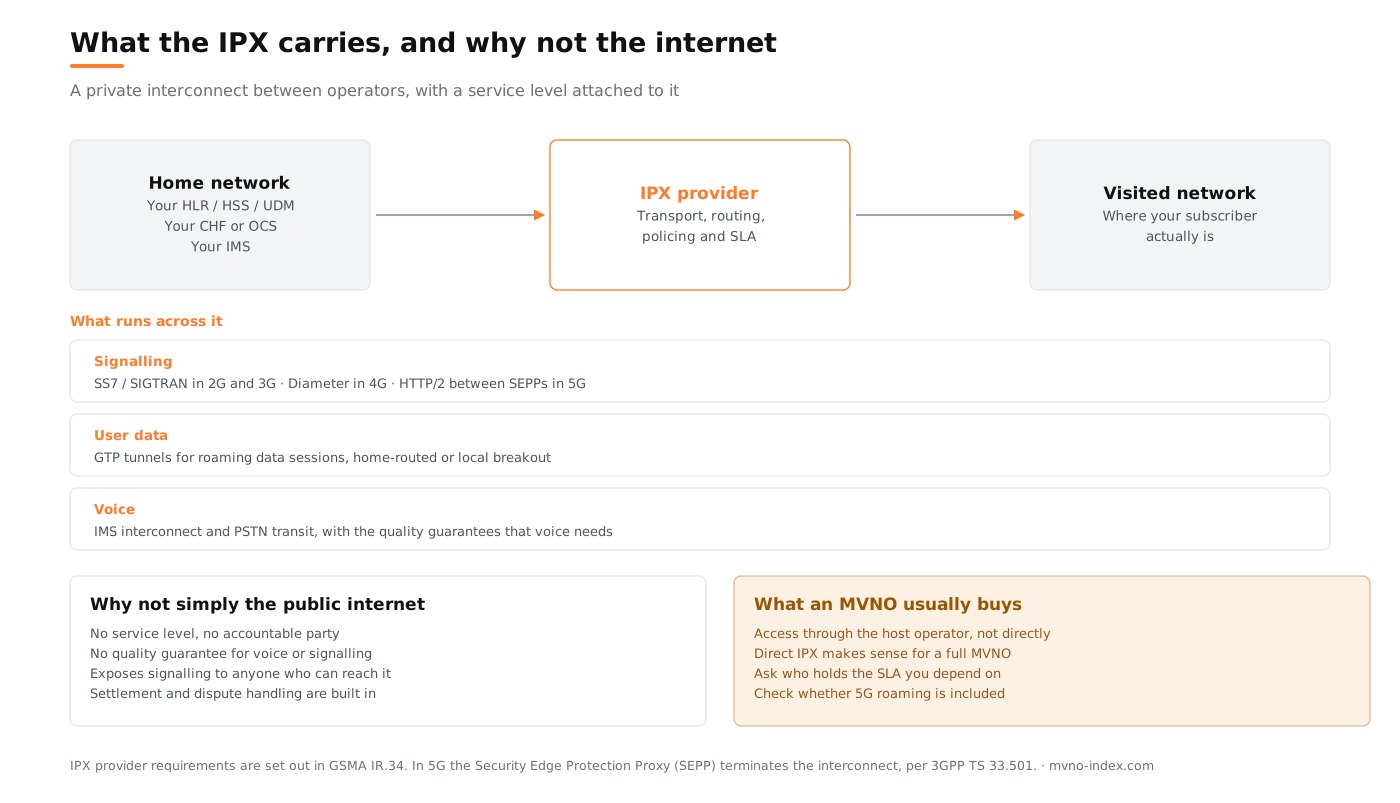
What the IPX carries between a home and a visited network, and why not the public internet.
IPX Access for MVNOs and IoT Companies
Three ways an MVNO reaches the IPX
| Route | What you get | What you give up |
|---|---|---|
| Through the host operator | Their interconnect, their footprint | Control, visibility and margin |
| Through an MVNE or hub | Wide reach without negotiating per country | The hub's margin, and a dependency |
| Direct IPX contract | Your own SLA and your own routing choices | Cost, and the operational work to run it |
Why Access the IPX?
For a Full MVNO or an IoT operator, securing direct or indirect access to the IPX is a decisive step toward delivering genuine international services. Without IPX connectivity, your ability to offer roaming to your subscribers depends entirely on your host MNO's roaming agreements and their willingness to extend those to your subscribers under the terms of your wholesale agreement. This dependency limits your control over roaming quality, pricing, and the breadth of your international footprint.
By connecting directly to an IPX provider, a Full MVNO gains the ability to negotiate its own roaming agreements with visited networks, manage its own signaling and data exchange, and route international traffic according to its own commercial and quality priorities. For IoT companies managing Multi-IMSI or eSIM deployments across many countries, IPX connectivity is the enabler of reliable, low-latency device connectivity at scale, without dependence on a single host operator's roaming footprint. Lighter-weight MVNOs can access IPX services indirectly through their MVNE or host MNO while still benefiting from the global reach the network provides.
Advantages and Disadvantages
Advantages:
- Global Reach through a Single Connection: One managed connection to an IPX provider grants access to hundreds of partner operators worldwide, eliminating the need to build individual bilateral IP connections.
- Controlled Quality of Service: Contracted QoS levels ensure that voice, signaling, and data traffic meet defined latency, jitter, and packet loss thresholds, delivering a superior experience compared to public internet routing.
- Multi-Service Support: A single IPX connection carries voice, data, signaling, SMS, and 5G inter-operator traffic, reducing infrastructure complexity and cost.
- Security and Fraud Protection: IPX providers apply signaling firewalls and anomaly detection, reducing exposure to SS7 and Diameter signaling attacks that are prevalent on unprotected inter-operator interfaces.
- Roaming Independence: Direct IPX access enables a Full MVNO to build its own international roaming footprint, reducing commercial dependency on the host MNO for roaming agreements.
- IoT Scalability: Supports global IoT deployments with the managed connectivity backbone needed for reliable cross-border device operation.
Disadvantages:
- Direct IPX connectivity requires commercial agreements with an IPX provider and entails ongoing costs for circuit, transit, and hubbing fees.
- Establishing direct roaming agreements with visited networks requires GSMA membership, IR.21 profile maintenance, and dedicated roaming operations expertise.
- The operational complexity of managing signaling borders, DRA/SCP configuration, and SBC interconnects demands specialist inter-operator interconnect knowledge.
- Smaller MVNOs with limited international subscriber volumes may find indirect IPX access through their MVNE or host MNO to be more cost-effective than direct connectivity.
- Bilateral agreement negotiation with individual partner operators is a time-consuming commercial process that requires a dedicated roaming and interconnect team.
Organizational Impact of IPX Access
Connecting to the IPX has significant consequences across your commercial, technical, and operational functions:
-
Operational Impact: Managing an IPX connection requires a dedicated interconnect and roaming operations function. Your team must maintain IR.21 roaming profiles, monitor signaling and data exchange quality with partner networks, manage TAP file processing and bilateral settlement, and respond to inter-operator incidents affecting roaming service quality. Integration of IPX-derived data into your OSS for monitoring and your BSS for billing and settlement is essential from day one.
-
Financial Impact: Direct IPX access involves CapEx for border network elements (DRA, SBC, STP) and OpEx for IPX provider fees, circuit costs, and roaming operations staffing. The financial return comes from the ability to offer competitive international roaming tariffs, negotiate favorable bilateral terms directly with visited networks, and serve Roaming MVNO or IoT customer segments that generate high-value international data and voice revenue. Careful modelling of roaming revenue against interconnect costs is a critical input to your financial plan.
-
Security Impact: The IPX border is a primary attack surface for SS7, Diameter, and GTP-based attacks. Your border signaling elements must implement robust protocol filtering, message validation, and anomaly detection. Selecting an IPX provider with strong built-in signaling firewall capabilities and coordinating with them on threat intelligence is a non-negotiable security requirement. Regular signaling security audits, aligned with GSMA FS.11 and FS.19 guidelines, should be a standing item on your security operations calendar.
-
Technical Impact: The introduction of IPX connectivity requires your core network border elements to be correctly configured for inter-operator operation. Your DRA or SCP must implement topology hiding and correct realm-based routing for external Diameter peers. Your SBC must be configured for VoLTE roaming interworking. Your STP must handle SS7 screening and gateway functions for legacy signaling. All of these elements must be tested end-to-end with each roaming partner before live service launch.
Redundancy and High Availability
The IP Packet Exchange (IPX) is the lifeline for all inter-operator services. An IPX connection failure means your subscribers lose roaming services, inter-operator voice calls fail, and international SMS delivery stops. Redundancy and High Availability (HA) are therefore non-negotiable design requirements for any operator that takes its international service commitments seriously.
Implement redundant IPX connections, either through dual connections to the same IPX provider at geographically separate points of presence, or through connections to two different IPX providers for maximum resilience. Your border network elements, including the DRA, SBC, and STP, must be deployed in active-active cluster configurations with automated failover so that a single element failure does not interrupt inter-operator traffic. Monitoring of IPX link quality, signaling message rates, and GTP session volumes should be continuous, with automated alerting on degradation before it impacts subscriber experience. Define clear escalation procedures with your IPX provider for inter-operator incidents, including agreed response times and communication protocols that align with your own service level commitments to subscribers.
IPX and the MVNO Roaming Strategy
For any mobile brand that positions international connectivity as part of its value proposition, the IPX is the foundational infrastructure layer underpinning that strategy. Roaming MVNOs that offer travel SIM products, Ethnic MVNOs serving communities with strong international calling needs, and IoT operators managing globally distributed device fleets all depend on the IPX to deliver their core service promise.
Your IPX strategy must be aligned with your roaming partner strategy. The number of bilateral roaming agreements you can support, the countries in which you offer coverage, the quality of service you can guarantee to roaming subscribers, and the competitive pricing you can offer all depend on the quality and breadth of your IPX connectivity and the bilateral agreements that sit behind it. Before you commit to an IPX provider, evaluate their global partner community, their QoS track record, their signaling security capabilities, and their experience supporting the specific service types your business model requires. If you are still in the planning phase, review the different types of MVNOs to determine how central international connectivity is to your specific business model and size your IPX investment accordingly. You can also find Connectivity solution providers and Wholesale providers on MVNO Index who operate in the IPX and roaming space.
Impact of 4G, 5G, and 6G on the IPX
IPX in the 4G Era
The IPX was designed to support 4G (LTE) roaming from the outset. It carries the GTP user plane tunnels for LTE data roaming (S8 interface), the Diameter S6a signaling for LTE authentication between visited MME and home HSS, and the SIP-based S8HR VoLTE roaming architecture. The Evolved Packet Core border elements, including the PGW, DRA, and SBC, all connect to the IPX to deliver these functions. The IPX also carries the PCRF interactions over the S9 interface that enable home-routed policy control for roaming subscribers.
IPX in the 5G Architecture
In 5G Core (5GC) deployments, the IPX evolves to carry HTTP/2-based 5G N-series interface traffic between operator networks. The Security Edge Protection Proxy (SEPP), which works alongside the SCP, provides the secure gateway for 5G control plane messages across the IPX. The UPF takes over from the PGW for user plane data sessions. The UDM replaces the HSS for subscriber data, and the AMF handles mobility management for 5G roaming subscribers. GSMA has published dedicated 5G roaming guidelines (IR.90, NG.113) that define how the IPX carries these new interfaces. The potential of 5G for MVNOs is closely linked to the readiness of the IPX community to support 5G roaming at scale.
6G and Beyond
As the industry moves toward 6G, the IPX is expected to evolve further toward a fully cloud-native, intent-driven inter-operator exchange fabric. API-based service exposure, AI-driven traffic optimization, and automated bilateral agreement management are among the capabilities being discussed for the next generation of inter-operator interconnect. The fundamental role of the IPX, providing a managed, quality-assured, and commercially structured backbone for global inter-operator services, will however remain the cornerstone of mobile interconnect architecture for the foreseeable future.
Frequently Asked Questions
What is the main function of the IPX?
The IPX is the global managed IP interconnect network that enables mobile operators to exchange voice, data, signaling, and multimedia traffic with each other under contractual quality of service guarantees. It is the primary infrastructure enabling international roaming, VoLTE interconnect, and inter-operator signaling.
What is the difference between the IPX and the public internet?
Unlike the public internet, the IPX is a private, managed MPLS-based network with strict QoS enforcement, contracted service levels, and a community of certified operators. Traffic on the IPX is routed under bilateral commercial agreements, ensuring predictable performance and security controls that the public internet cannot provide.
What is the difference between IPX and GRX?
The GRX (GPRS Roaming eXchange) was the predecessor to the IPX, designed primarily to carry GPRS roaming data. The IPX supersedes GRX by supporting a much broader range of services including VoLTE, Diameter signaling, SIP voice, SMS, and 5G inter-operator traffic, all under a single commercially structured framework.
Do MVNOs need direct IPX access?
Not all MVNOs require direct IPX access. Light MVNOs and MVNE-hosted operators can access IPX services indirectly through their host MNO or MVNE. Full MVNOs with their own roaming agreements and core network infrastructure benefit significantly from direct IPX connectivity to control their own international service delivery.
Which core network elements connect to the IPX?
The primary border elements that connect to the IPX include the DRA or SCP for signaling, the SBC for VoLTE voice, the STP for SS7 signaling, and the PGW or UPF for user plane data.
How does the IPX support IoT?
For IoT operators managing devices across multiple countries, the IPX provides the managed connectivity layer that carries device data sessions and control signaling between home and visited networks, underpinning Multi-IMSI and eSIM deployment strategies at global scale.
What is the role of the SEPP in 5G IPX?
The Security Edge Protection Proxy (SEPP) is the 5G network function that protects the inter-operator N32 interface, which carries 5G control plane messages across the IPX. It works alongside the SCP to provide topology hiding and message-level security for 5G roaming signaling.
Summary
The IP Packet Exchange (IPX) is the global, managed inter-operator IP backbone that makes international mobile services possible. It is the infrastructure that carries roaming data sessions, inter-operator voice, Diameter and SS7 signaling, SMS interconnect, and 5G inter-network traffic between hundreds of mobile operators worldwide, under contractual quality and security guarantees that the public internet cannot match. For a Full MVNO or IoT operator with international ambitions, securing the right IPX connectivity is one of the most commercially and technically consequential decisions you will make. It determines the quality of your subscribers' roaming experience, the breadth of your international footprint, your exposure to signaling security threats, and the competitiveness of your international pricing.
Evaluating your IPX needs starts with a clear view of your business model, your target subscriber segments, and your planned international footprint. Whether you are building a Roaming MVNO, deploying IoT at global scale, or simply ensuring your subscribers enjoy reliable service when they travel, the IPX is the infrastructure layer that delivers on that promise. Explore the Connectivity and Wholesale solution providers on MVNO Index to identify the right IPX and roaming partners for your business.
Cross-Generation Services