The Telephony Application Server: Where a Call Becomes a Product
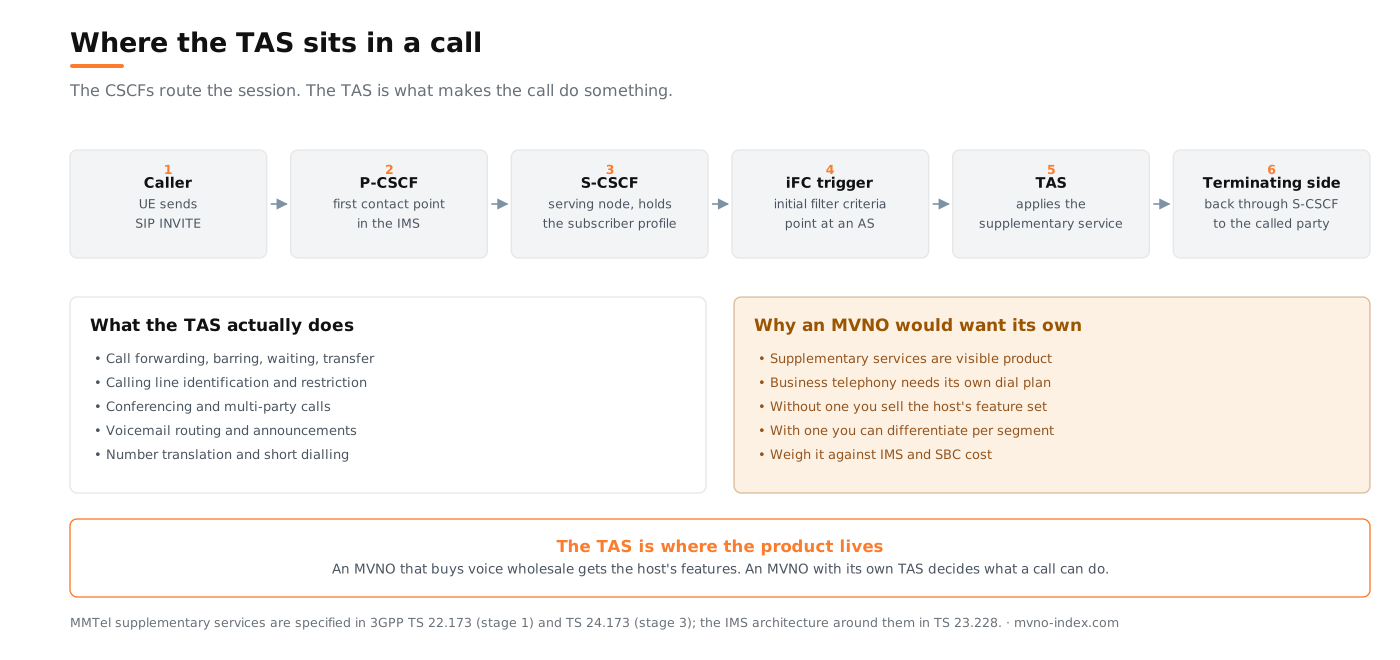
The Telephony Application Server (TAS) is the IMS component that applies telephony logic to a call: forwarding, barring, waiting, transfer, conferencing and caller identification. The CSCFs route the session; the TAS is what makes the call behave. It is invoked by the S-CSCF through initial filter criteria in the subscriber profile.
The Telephony Application Server (TAS) is a critical and foundational component within the IP Multimedia Subsystem (IMS) architecture that powers VoLTE (Voice over LTE), VoWiFi (Voice over Wi-Fi), and 5G voice (VoNR) services in modern mobile networks. Understanding its purpose is essential for any operator or Full MVNO that aims to deliver native, high-quality voice and supplementary telephony services over an all-IP core network. The TAS acts as the central SIP application server and telephony feature engine within the IMS, executing the call logic that governs every voice and video call your subscribers make and receive. It is the intelligent node responsible for delivering standard telephony features such as call forwarding, call barring, conference calling, and voicemail integration, while also enabling advanced supplementary services like Rich Communication Services (RCS) and Fixed Mobile Convergence (FMC). If you are building or operating a mobile brand that owns its IMS voice infrastructure, understanding and selecting the right TAS is a fundamental step you cannot afford to overlook.
On this page
- History and Evolution of the Telephony Application Server
- Core Utility and Functionality of the TAS
- What is the TAS Used For?
- Key Functions of the Telephony Application Server
- Technical Integration and Data Model
- Integration with Other Systems
- Technical Data Model and Key Interfaces
- TAS Ownership for MVNOs and IoT Companies
- Why Own a TAS?
- Advantages and Disadvantages of TAS Ownership
History and Evolution of the Telephony Application Server
The Telephony Application Server emerged with the standardization of the IP Multimedia Subsystem (IMS) by 3GPP in the early 2000s, designed to replicate and extend the supplementary services of the legacy circuit-switched telephony world in a fully packet-switched environment. As operators began deploying VoLTE networks from around 2012 onwards, the TAS became the mandatory application layer for delivering call features over 4G (LTE) cores. Its role has expanded continuously into 5G as the authoritative telephony logic engine, underpinning VoNR and advanced communication services that go far beyond what the old Legacy Core (2G/3G) Mobile Switching Center could ever offer.
Core Utility and Functionality of the TAS
The supplementary services a TAS provides
| Service | What the subscriber experiences | Standardised as |
|---|---|---|
| Call forwarding | Unconditional, on busy, on no reply, on unreachable | CDIV |
| Call barring | Outgoing or incoming calls blocked by rule | CB |
| Calling line identification | Number shown, or withheld | CLIP / CLIR |
| Call waiting and hold | A second call while the first is active | CW / HOLD |
| Call transfer | Passing a call to a third party | ECT |
| Conferencing | Three or more parties in one session | CONF |
| Message waiting | The voicemail indicator on the handset | MWI |
What is the TAS Used For?
The Telephony Application Server (TAS) is the definitive execution engine for telephony feature logic in an IMS-based mobile network. Its primary purpose is to process SIP (Session Initiation Protocol) signaling messages and apply the correct service logic to every call or session event. When a subscriber initiates a voice call over VoLTE or VoWiFi, the SIP INVITE message is routed through the IMS core and reaches the TAS, which then determines which services apply to that subscriber and that call leg. The TAS queries subscriber profile data stored in the Home Subscriber Server (HSS) or the Unified Data Management (UDM) to retrieve the active feature set for that user, then executes the appropriate application logic in real time.
This makes the TAS the single most important node for defining the subscriber experience of voice services. Without a TAS, your IMS core can establish basic bearer sessions, but it cannot deliver the rich set of telephony features that subscribers expect. Owning and configuring a TAS gives a Full MVNO complete authority over which features its subscribers receive, how those features behave, and how they are monetized.
Key Functions of the Telephony Application Server
Examine the core functions of the TAS to understand its critical role in modern IMS-based voice networks:
- Supplementary Service Execution: The TAS executes the full suite of GSMA-defined telephony supplementary services, including call forwarding (unconditional, on busy, on no reply, on not reachable), call barring, call waiting, call hold, and multi-party conference calling.
- SIP Application Server Logic: As a SIP Application Server (AS) within the IMS architecture, the TAS terminates and re-originates SIP dialogs to inject service logic, inspect message content, and modify routing decisions mid-session.
- Originating and Terminating Service Handling: The TAS handles both the originating side (when a subscriber places a call) and the terminating side (when a subscriber receives a call), applying the correct set of active services for each call leg independently.
- Initial Filter Criteria (iFC) Processing: The TAS evaluates the iFC rules provisioned in the subscriber's profile on the HSS/UDM to determine which application servers (including itself) must be invoked for a given SIP request. This mechanism governs the entire IMS service chain.
- Emergency Call Handling: The TAS supports emergency session routing, ensuring that calls to emergency numbers are correctly identified and routed with the highest priority, irrespective of the subscriber's active barring or restriction profile.
- Voicemail Service Integration: The TAS manages call diversion to a Voicemail platform, triggering the correct forwarding condition (busy, no reply, unreachable) and providing the signaling bridge between the calling party and the voicemail system.
- Roaming and Interworking Support: The TAS participates in roaming scenarios, applying home-network service logic when subscribers are using services abroad, ensuring feature consistency for roaming MVNOs and their users.
- RCS Service Enablement: Advanced TAS deployments act as a platform layer for enabling Rich Communication Services (RCS), including enhanced messaging, file transfer, and video sharing, by serving as the SIP application logic layer for these enriched sessions.
- Charging Trigger Points: The TAS can generate charging records or interact with the Online Charging System (OCS) to apply real-time charging logic for specific telephony features or premium services.
- Centralized Policy Application: The TAS applies operator-defined service policies, such as restrictions on international calling or premium rate number barring, centrally for all subscribers, reducing the need for device-level enforcement.
Technical Integration and Data Model
Integration with Other Systems
The Telephony Application Server does not operate in isolation. It is deeply integrated into every layer of the IMS core and connects to multiple adjacent systems across the core network. Understanding these integration points is essential before you deploy a TAS in your own network:
The TAS communicates with the P-CSCF (Proxy Call Session Control Function), I-CSCF (Interrogating CSCF), and S-CSCF (Serving CSCF) using the SIP protocol over the ISC (IP Multimedia Service Control) interface. The S-CSCF is the node that invokes the TAS based on the iFC rules stored in the HSS/UDM. The TAS queries the HSS or UDM via the Sh or Cx interface (over Diameter or HTTP/2 in 5G) to retrieve subscriber profile data, including active feature configurations. For charging, the TAS interfaces with the OCS via the Ro interface and the Offline Charging System (OFCS) via the Rf interface to generate call detail records. It also interacts with the Session Border Controller (SBC) at the network border for interworking with the PSTN and with external SIP trunking providers.
For policy-aware calls, the TAS may interact with the Policy and Charging Rules Function (PCRF) in a 4G environment or the Policy Control Function (PCF) in a 5G environment to apply QoS policies to voice bearers. It also connects to Voicemail platforms, Interactive Voice Response (IVR) systems, and Over the Top (OTT) service enablement platforms, making it the central hub of the operator's voice and communication service layer.
Technical Data Model and Key Interfaces
The TAS employs a structured subscriber data model that maps each IMPU (IP Multimedia Public Identity) and IMPI (IP Multimedia Private Identity) to a set of active service profiles and feature configurations. Each subscriber profile contains an ordered list of iFC rules that define which application servers must be triggered and in which priority order for originating and terminating calls. Key interfaces used by the TAS include:
- ISC Interface (SIP): The primary interface between the S-CSCF and the TAS, used to invoke application service logic for each SIP session.
- Sh Interface (Diameter/HTTP2): Used to query and subscribe to subscriber data stored in the HSS or UDM, including service profiles and feature activation status.
- Ro Interface (Diameter): Used for event-based online charging interactions with the OCS, enabling real-time charge control for specific telephony features.
- Rf Interface (Diameter): Used to submit accounting records to the OFCS for offline call detail record generation.
- Mr Interface (SIP): Used to interact with the Media Resource Function (MRF) for conference bridge, announcement, and tone generation services.
- Ut Interface (HTTP/XCAP): Used by subscriber devices or self-care portals to provision and modify active supplementary service settings, such as call forwarding destinations.
TAS Ownership for MVNOs and IoT Companies
Own TAS, hosted TAS, or the host operator's
| Option | What you control | Typical fit |
|---|---|---|
| Host operator's voice | Nothing beyond the tariff | Light and thin MVNOs |
| MVNE-hosted TAS | Your own feature set, on shared infrastructure | Most MVNOs with a business proposition |
| Your own TAS | Dial plans, numbering, service logic, release pace | Full MVNOs and business-focused operators |
| TAS plus your own IMS | Everything, including interconnect | Rare, and only with real voice volume |
Why Own a TAS?
For a Full MVNO, owning a dedicated Telephony Application Server (TAS) is the definitive step toward controlling your own voice service layer. Consider that every telephone feature your subscribers experience, from a simple call divert to a business-grade conference call, is executed by the TAS. Owning this node means you are no longer dependent on your host MNO to provision, modify, or extend your telephony feature set. You can introduce new services, modify existing behavior, build bespoke business telephony products, and integrate voice features directly with your BSS and OSS platforms on your own schedule.
For Business MVNOs in particular, the TAS is a revenue-generating asset. Business subscribers demand features such as PBX-style call routing, hunt groups, auto-attendants, and call recording. A TAS that you own and operate enables you to build and price these features as managed services, creating differentiated offerings that command higher ARPU than a basic voice resale arrangement. It also supports Fixed Mobile Convergence (FMC), allowing you to deliver a single converged telephony service across mobile and fixed networks under one subscriber identity.
Advantages and Disadvantages
Advantages:
- Complete Control over all telephony feature logic, service profiles, and call routing behavior.
- Service Differentiation through the ability to build and deploy proprietary or enhanced supplementary services unavailable from a standard host MNO arrangement.
- Direct Integration with your own BSS, OCS, and provisioning systems, enabling automated feature activation and real-time service management.
- Revenue Generation from business telephony features, RCS enablement, and converged FMC services.
- Full Ownership of Subscriber Experience for voice, ensuring your brand delivers a consistent, high-quality service regardless of the underlying access network.
- Independence from the host MNO's feature roadmap, timelines, and pricing for supplementary service changes.
Disadvantages:
- High initial investment in IMS-capable, carrier-grade application server software and infrastructure.
- Operational complexity requiring deep expertise in SIP, IMS architecture, and VoLTE/VoWiFi protocol stacks.
- Ongoing maintenance and upgrade costs for a mission-critical, real-time system in the direct path of every voice call.
- Interworking complexity when integrating with legacy PSTN and interconnect partners via the SBC.
- Requires tightly coordinated integration with the HSS/UDM, OCS, and CSCF nodes, demanding significant network integration expertise.
Organizational Impact of TAS Ownership
Integrating a TAS into your network infrastructure has consequences across your entire organization that must be planned for carefully:
- Operational Impact: Requires engineering and operations teams with deep expertise in SIP protocol behavior, IMS call flows, and VoLTE troubleshooting. Service provisioning workflows must be automated to synchronize subscriber feature profiles between the TAS and the HSS or UDM. Call quality monitoring, SIP trace analysis, and real-time alerting on session failure rates are essential operational disciplines for any team running a live TAS. Integration with your customer care tooling is necessary to allow agents to view and modify active telephony feature settings per subscriber.
- Financial Impact: TAS ownership involves CapEx for software licensing and compute infrastructure, plus OpEx for specialist IMS engineering talent and platform maintenance. The financial return comes from the ability to sell differentiated voice and communication services at higher margins, particularly for Business MVNO and Quad Play MVNO propositions where advanced telephony features are a core part of the product.
- Security Impact: The TAS handles real-time SIP signaling that carries subscriber identity and call metadata. It is a target for SIP-based fraud, toll fraud, and denial-of-service attacks. Robust SIP firewall policies, signaling anomaly detection, and tight integration with the SBC as a protective border element are essential. Authentication of all SIP peers and encryption of signaling and media using TLS and SRTP must be enforced across all interfaces.
- Technical Impact: The TAS must be deployed as a horizontally scalable, carrier-grade network function with sub-second response times for all service logic decisions. It must handle concurrent session volumes that scale with subscriber growth and peak calling hours without degradation. Integration with your BSS is critical to ensure that feature activations, deactivations, and changes provisioned through self-care or customer service are reflected instantly in the TAS subscriber profile.
Redundancy and High Availability
The Telephony Application Server (TAS) sits in the direct signaling path of every voice call in your network. A TAS failure means subscribers cannot make or receive calls. This makes Redundancy and High Availability (HA) non-negotiable requirements for any production deployment.
Deploy the TAS in a fully redundant, active-active cluster configuration, distributing call processing across multiple TAS instances using SIP-aware load balancing. Geographic redundancy across two or more data centers is standard practice, with session state synchronization between sites ensuring that an active call is not dropped if one node or one entire site becomes unavailable. All stateful session data, including active call leg context and mid-call feature state, must be continuously synchronized across all TAS instances so that failover is seamless and transparent to the calling subscriber.
Implement rigorous health monitoring with automated failover mechanisms. Define and test recovery time objectives (RTO) and recovery point objectives (RPO) that align with your service level agreements. For Full MVNOs committed to delivering carrier-grade voice quality, a five-nines (99.999%) availability target for the TAS platform is the industry benchmark you should design toward.
The TAS and Value Added Services
One of the most compelling reasons to invest in a Telephony Application Server is its role as an enabler of Value Added Services (VAS) beyond basic telephony. The TAS is the platform from which a mobile brand can build a differentiated and revenue-generating communication service portfolio.
Interactive Voice Response (IVR) services are directly integrated with the TAS, allowing you to deploy self-service call routing, automated attendants, and information services that are triggered as part of the normal call setup flow. Voicemail and Visual Voicemail services are orchestrated by the TAS, which manages the diversion conditions and SIP signaling bridge to the voicemail platform. RCS deployments leverage the TAS as the SIP application layer for enriched communication sessions, enabling you to offer branded messaging, file sharing, and video calling features that compete directly with OTT applications. For Quad Play MVNOs, the TAS is the convergence point that unifies mobile and fixed voice services under a single subscriber identity and a single feature set, unlocking bundled service propositions that drive loyalty and reduce churn. If you want to understand the full potential of value added services for your mobile brand, explore the VAS overview on MVNO Index.
Impact of 4G, 5G, and IoT on TAS
TAS in the 4G IMS Architecture
The TAS was designed as an integral component of the IMS architecture, which was deployed at scale alongside 4G (LTE) networks to deliver VoLTE. In this environment, the TAS operates as an S-CSCF-linked SIP Application Server, invoked via the ISC interface based on iFC rules provisioned in the HSS. It interacts with the PCRF for QoS control and with the OCS for real-time charging on voice sessions. The SBC provides the secure border between the TAS-driven IMS core and external PSTN interconnects.
TAS in the 5G Architecture
In 5G Core (5GC) deployments, the IMS architecture and the TAS remain central to delivering Voice over New Radio (VoNR). The TAS interfaces shift to accommodate 5G network functions: the UDM replaces the HSS for subscriber data, the PCF handles policy control, and the SMF manages session establishment. The TAS itself, as a SIP-layer application server, remains largely protocol-stable, but modern TAS platforms are evolving toward cloud-native, containerized deployments that align with the microservices architecture of the 5G core. Integration with the Service Communication Proxy (SCP) for HTTP/2-based control plane interactions is an emerging requirement for fully cloud-native TAS implementations.
6G and Beyond
In the 6G era, the TAS is expected to evolve into a fully cloud-native, AI-driven communication application layer. The fundamental role, executing application logic for real-time communication sessions and delivering personalized service experiences, will remain unchanged. However, the execution environment will be fully distributed, intent-driven, and capable of self-optimizing service logic based on subscriber behavior patterns and network conditions. The principles you apply when deploying a TAS today lay the foundation for the communication service platforms of the next decade.
Frequently Asked Questions
What is the main function of the TAS?
The primary function of the TAS is to execute telephony feature logic and supplementary services for IMS-based voice calls over VoLTE, VoWiFi, and VoNR. It processes SIP signaling to apply features such as call forwarding, call barring, call waiting, and conference calling in real time.
How does the TAS differ from the S-CSCF?
The S-CSCF (Serving Call Session Control Function) is the core SIP routing and session control element of the IMS. The TAS is a SIP Application Server invoked by the S-CSCF via the ISC interface to execute specific service logic. The S-CSCF routes and controls the session; the TAS applies the feature and business logic.
Which networks require a TAS?
Any mobile operator or Full MVNO that deploys IMS for VoLTE, VoWiFi, or VoNR requires a TAS to deliver supplementary telephony services. Without a TAS, only basic session establishment is possible.
Can a TAS be used for business telephony services?
Yes. The TAS is the ideal platform for delivering business telephony features such as PBX-style routing, hunt groups, auto-attendant, and call recording. It is a core enabler for Business MVNOs that want to compete with enterprise PBX and UCaaS providers.
What is the relationship between the TAS and the SBC?
The Session Border Controller (SBC) operates at the network border to protect the IMS core, handle NAT traversal, and provide PSTN interworking. The TAS operates inside the IMS core to execute service logic. They are complementary: the SBC secures and terminates external SIP sessions; the TAS applies the subscriber's telephony feature profile to those sessions.
Does the TAS support RCS services?
Yes. A TAS can serve as the SIP application layer for RCS (Rich Communication Services) deployments, enabling enhanced messaging, file sharing, and video calling as part of the operator's native communication service portfolio.
What is the 5G equivalent of the TAS?
The TAS remains the telephony application layer in 5G IMS deployments for VoNR. There is no direct functional replacement in the 5G core; instead, the TAS evolves into a cloud-native application server that interfaces with 5G network functions such as the UDM, PCF, and SCP.
Summary
The Telephony Application Server (TAS) is the central, authoritative application layer for all telephony feature logic in an IMS-based mobile network. It is the node that transforms a basic VoLTE bearer into a full-featured telephony service, executing call forwarding, barring, waiting, conference, voicemail integration, and a wide range of advanced supplementary services for every subscriber on every call. For a Full MVNO with its own IMS infrastructure, owning and operating a TAS delivers complete control over the subscriber voice experience, full independence from the host operator's feature roadmap, and a powerful platform for building differentiated, revenue-generating communication products, particularly for Business MVNO and Quad Play propositions.
This decision demands substantial investment in carrier-grade SIP and IMS expertise, tightly integrated BSS and OSS connectivity, and a robust high-availability deployment architecture. The TAS remains a fully relevant and essential network function in both 4G and 5G environments, and its role as the programmable intelligence layer for real-time communication services will only grow as operators move toward cloud-native, AI-augmented service delivery in the 5G and 6G eras. If you are evaluating solution providers for your IMS or TAS deployment, explore the Core Network Elements solution providers listed on MVNO Index.
Cross-Generation Services