The Three CSCFs, and What Each One Decides
The Call Session Control Function (CSCF) is the SIP control layer of IMS, divided over three roles. The P-CSCF is the device's first point of contact over Gm, the I-CSCF decides which S-CSCF should serve the subscriber, and the S-CSCF registers that subscriber against the HSS over Cx and triggers application servers through the initial filter criteria. Every VoLTE and VoNR call is set up by these three.
The Call Session Control Function (CSCF) is a set of logical functions that handle SIP signalling within the IP Multimedia Subsystem, or IMS. The main roles are the Proxy CSCF, Interrogating CSCF and Serving CSCF. Together, they support functions such as registration, session routing and the invocation of application services.
CSCF is therefore a family of responsibilities rather than necessarily one server. These functions help enable services such as Voice over LTE and Voice over New Radio, alongside other IMS and mobile-core components. For an MVNO, understanding the separate roles makes it easier to compare an IMS platform, investigate registration problems and decide how much of the voice architecture to operate directly.
On this page
- History and Evolution of the Call Session Control Function
- Core Utility and Functionality of the CSCF
- What is the CSCF Used For?
- Key Functions of the Call Session Control Function
- Technical Integration and Data Model
- Integration with Other Systems
- Technical Data Model and Key Interfaces
- CSCF Ownership for MVNOs and IoT Companies
- Why Own CSCF Functions?
- Advantages and Disadvantages of CSCF Ownership
- Organizational Impact of CSCF Ownership
- Redundancy and High Availability
- Impact of 4G, 5G, and 6G on the CSCF
- CSCF in 4G Voice
- CSCF in 5G Voice
- 6G and Future Communication Services
- Frequently Asked Questions about Call Session Control Function (CSCF)
- Summary
History and Evolution of the Call Session Control Function
IMS introduced a standardised framework for multimedia services using IP-based signalling. It separated session control from application logic and the underlying access network. CSCF functions became central to that design, allowing operators to route sessions and invoke services without using the circuit-switched MSC as the native IMS control point.
Large-scale VoLTE deployment made these functions familiar within mobile voice networks. They remain relevant for IMS-based voice over other access arrangements, including suitable Wi-Fi and 5G deployments. The access and core integration can evolve while the IMS signalling roles continue. This continuity is useful, but it does not eliminate the need to qualify new devices, policy interactions and roaming procedures.
Core Utility and Functionality of the CSCF
The three CSCFs side by side
| P-CSCF | I-CSCF | S-CSCF | |
|---|---|---|---|
| Name | Proxy | Interrogating | Serving |
| Where it sits | At the network edge | At the border of the home network | In the core of the home network |
| First seen by | The device | Another network, or the P-CSCF | The I-CSCF |
| Decides | Whether this device may talk to us | Which S-CSCF should serve this subscriber | What happens to the session |
| Holds the profile | No | No | Yes |
| Triggers services | No | No | Yes, through filter criteria |
What is the CSCF Used For?
An IMS-capable device needs to register its communication identity and establish a signalling relationship with the network. When the user places or receives a call, SIP messages must reach the appropriate service and destination. CSCF functions provide the relevant registration and routing responsibilities within that process.
The voice media itself normally follows a separate path. A successful SIP exchange can coexist with a media problem, so CSCF health does not prove that audio works. The wider core network elements overview helps distinguish session control, subscriber data, application services and media handling.
Key Functions of the Call Session Control Function
The Proxy CSCF, or P-CSCF, is the device's first IMS signalling contact. It forwards relevant signalling and performs the security and policy-related functions assigned to its role. Implementations may combine it with access-border capabilities, but the logical P-CSCF role should still be distinguished from every feature of a commercial Session Border Controller.
The Interrogating CSCF, or I-CSCF, helps route incoming IMS signalling and supports locating or selecting the appropriate serving function through the subscriber architecture. It provides a network entry role for relevant procedures. It is not a general replacement for all security or interconnect functions at the operator boundary.
The Serving CSCF, or S-CSCF, handles central registration and session-control responsibilities for the user. It uses the relevant service profile and invokes application servers according to configured criteria. These criteria connect a user's session with services such as telephony features implemented by a Telephony Application Server.
Charging-related event generation and operational visibility support the wider service, according to the implementation and architecture. The CSCF does not inherently own the customer's balance, implement every supplementary service or transcode speech. Keeping these boundaries clear prevents an IMS platform specification from placing unrelated requirements on the wrong component.
Technical Integration and Data Model
Integration with Other Systems
Subscriber-data integration supplies the identities, authentication information and service profile needed for IMS registration and service handling. The Home Subscriber Server is central in established IMS architectures. Modern converged products may combine subscriber functions, but 5G access does not automatically remove the IMS subscriber interfaces already in use.
Application servers provide service logic beyond basic routing. The S-CSCF can invoke them according to the user's initial filter criteria, commonly called iFC. A Telephony Application Server may provide supplementary calling features, while other application servers support other services. Test the invocation rules as well as the server itself.
Policy, border and media integrations complete the voice environment. A Session Border Controller can provide access or interconnect capabilities depending on its deployment. Media gateways and interworking functions may be needed for legacy destinations. The resulting service depends on coordinated behaviour across these components, not simply a working S-CSCF process.
Technical Data Model and Key Interfaces
Relevant information includes IMS public and private identities, registration bindings, serving-function assignment and service-profile data. The S-CSCF uses the appropriate information to process registration and route sessions. This differs from the radio registration managed by the mobile access core: a device can be attached for data while its IMS registration has failed.
The three CSCFs and what each one is for.
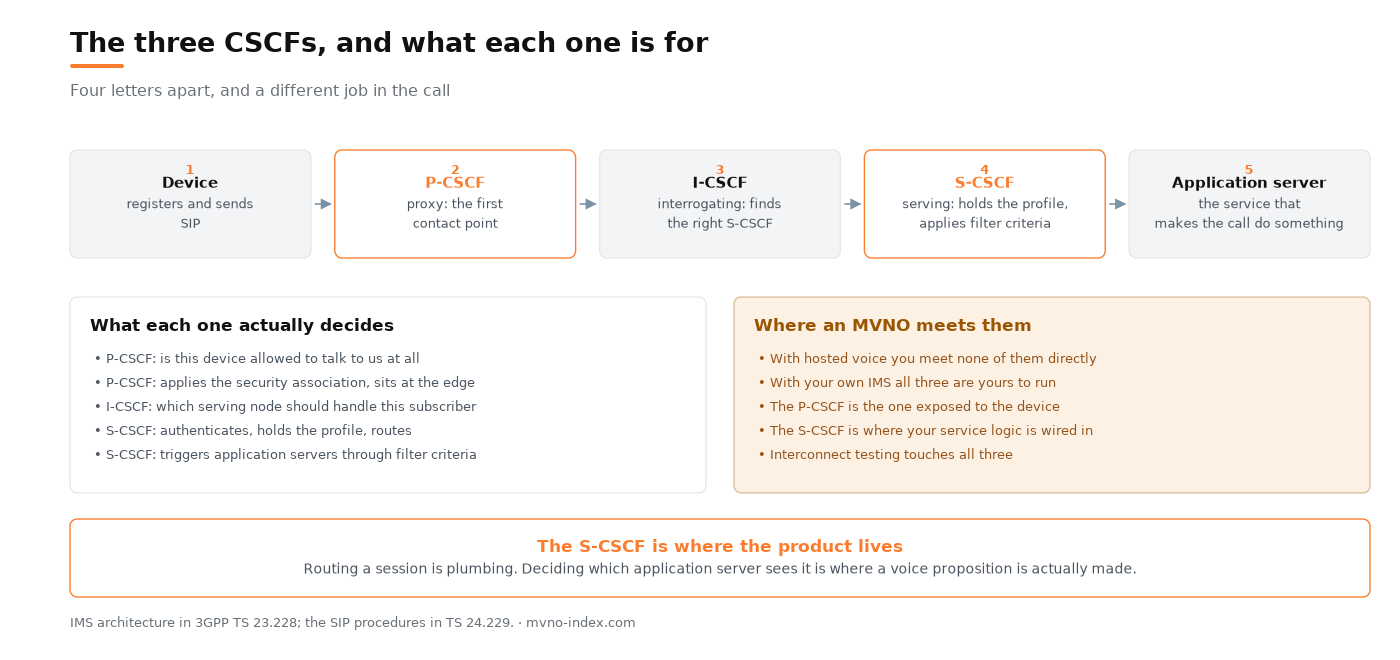
SIP provides the principal IMS session-signalling protocol. Gm describes the device-to-P-CSCF relationship, while Mw connects CSCF functions. Cx supports the established Diameter relationship with the HSS. ISC connects the S-CSCF with application servers. Other interfaces support policy and interworking according to the selected deployment.
The IMS architecture that defines these three roles is specified in 3GPP TS 23.228, and the SIP and SDP procedures they implement in TS 24.229.
Ask suppliers for a call-flow package covering registration, outgoing calls, incoming calls and application-server invocation. Include the exact device and interconnect profiles to be supported. Broad SIP compatibility is insufficient if the platform does not implement the IMS procedures and service options required by the operators and devices involved.
CSCF Ownership for MVNOs and IoT Companies
Which CSCF you meet, and when
| Your arrangement | What you operate | What you still have to know |
|---|---|---|
| Voice bought from the host | Nothing | Where to report a fault, and what they can see |
| MVNE-hosted IMS | Configuration, not the functions | How your service logic is wired to the S-CSCF |
| Your own IMS | All three | Interconnect testing touches every one of them |
| Business voice as a product | All three, plus the application servers | This is where the proposition actually lives |
Why Own CSCF Functions?
An MVNO may operate its own IMS core to control voice architecture, service integration and the subscriber experience more directly. CSCF capability is part of that investment. A managed IMS service can also provide these functions while allowing the MVNO to retain defined commercial and operational control.
For an IoT company, the need depends on whether the product uses IMS communication services. A data-only device fleet does not require an owned CSCF simply because it uses 4G or 5G access. Define voice, messaging and device requirements first, then decide whether a dedicated IMS environment or a host service is the better fit.
Advantages and Disadvantages of CSCF Ownership
Advantages:
-
Control of IMS session routing can help an operator integrate its chosen application services and interconnect arrangements. It can provide detailed visibility into registrations and failed sessions, which is valuable when developing a differentiated voice product. The benefit depends on access to the required host and device configuration as well as the core software.
-
Ownership can also make testing and change schedules easier to align with a product roadmap. However, an IMS service spans several components, so CSCF ownership alone does not provide unrestricted feature control. Compare offers according to the full service chain and the rights to modify its configuration.
Disadvantages:
-
IMS interoperability work can be extensive. Devices, roaming partners and interconnects may behave differently while remaining broadly compatible with the same standards. Your team needs repeatable tests and experienced support for registration, SIP behaviour and application-server interactions.
-
The operating commitment extends beyond software hosting. Voice incidents affect customers immediately, and a configuration error can affect a large population. Include device qualification, security, resilience and interconnect testing in the business case. Confirm the host responsibilities in the wholesale agreement before purchasing a separate IMS core.
Organizational Impact of CSCF Ownership
Customer care should distinguish mobile-network registration from IMS registration. A customer can browse the internet but be unable to make an IMS call. Support tools should show the relevant registration state and failure category, allowing agents to direct the case to device provisioning, subscriber configuration or network operations as appropriate.
Engineering teams need controlled service-profile and iFC changes. An incorrect criterion can send calls to the wrong application server or prevent a feature from being invoked. Maintain test subscriptions for common service combinations and validate both originating and terminating calls after changes.
Security teams should review the exposed signalling path, administrative access and trust relationships. Protection may be distributed across the P-CSCF, border functions and underlying infrastructure. Do not assume that an SBC elsewhere in the network protects every internal interface or administrative action. Document the actual boundary and ownership of each control.
Commercial teams need to connect platform capabilities with supported retail features. A basic IMS registration and call demonstration does not establish voicemail integration, conferencing, emergency-service behaviour or every business-telephony feature. Require a service matrix that identifies the responsible application or network component and the acceptance test for each included feature.
Redundancy and High Availability
CSCF resilience needs to account for different kinds of state. Registration information, session-related state and application interactions may have different recovery requirements. A second server can accept new registrations without automatically preserving every active call. Ask suppliers to separate these outcomes in their availability claims.
Test the failure of each logical role, including discovery and routing to alternatives. Include an unavailable HSS or application server, because these dependencies can prevent service while the CSCF processes remain healthy. Observe device re-registration behaviour and the load created when a large population reconnects.
Measure registration success, call setup and established-call outcomes during failure. A platform-level uptime percentage does not show whether incoming calls reach a subscriber after failover. Use end-to-end voice tests and verify that the media and application paths also remain usable. Recovery should be judged by the service the customer experiences.
Impact of 4G, 5G, and 6G on the CSCF
CSCF in 4G Voice
VoLTE uses IMS for voice service over LTE access. CSCF functions provide the relevant SIP registration and session-control roles, while the EPC and radio network provide connectivity and bearer support. Correct policy and device integration are required to turn these components into a working mobile voice service.
CSCF in 5G Voice
Voice over New Radio also uses IMS in supported 5G deployments. The CSCF roles remain relevant while access and policy integration reflect the 5G system. Do not assume the HSS or Diameter-based IMS interfaces disappear merely because the subscriber uses 5G access. Examine the implemented IMS and subscriber architecture explicitly.
6G and Future Communication Services
Future network evolution may change parts of the communication architecture. Current procurement should focus on delivered IMS capabilities, compatibility and maintainable upgrades. Preserve service profiles and integration documentation so that future migration can reproduce the customer features that matter, without depending on undocumented routing rules or vendor-specific assumptions.
Frequently Asked Questions about Call Session Control Function (CSCF)
What are the three main CSCF roles?
The P-CSCF is the device's first IMS signalling contact. The I-CSCF supports relevant entry, selection and routing procedures. The S-CSCF performs central registration and session-control responsibilities and invokes application services. A vendor may combine these logical roles in one platform or deploy them separately.
Does the CSCF carry the voice audio?
Its primary role is SIP signalling and session control. Voice media normally travels through a separate bearer path, potentially involving border or media functions. This is why a call can establish successfully while audio fails, and why acceptance testing must examine both signalling and media.
How does the S-CSCF differ from a TAS?
The S-CSCF manages registration and session routing and invokes application services according to the relevant profile. A TAS provides telephony application logic such as supplementary calling features. The functions cooperate, but purchasing one does not automatically include every capability of the other.
Is a CSCF the same as an SBC?
No. The CSCF roles belong to IMS session control, while an SBC provides border capabilities according to its deployment. A product may combine a P-CSCF with SBC functions. Ask the supplier to identify the logical roles and interfaces included rather than relying on the product category.
Does an MVNO need its own CSCF for VoLTE?
It needs access to a complete IMS voice service, but that service can be operated by a host or managed provider. Ownership depends on the desired control and operating model. Compare the full service scope, including devices, subscriber provisioning and interconnects, before deciding.
Are CSCF functions still used for VoNR?
Yes, IMS-based VoNR continues to use the relevant IMS session-control functions. The surrounding access and core integration must support the 5G service. A 5G data connection alone does not prove that IMS registration, voice policy and device configuration are working.
What should a CSCF supplier demonstrate?
Request registration, both call directions, application-server invocation and failure recovery using representative devices. Include subscriber-profile changes and unavailable dependencies. Check end-to-end audio as well as SIP signalling, and require clear evidence of how the platform handles mass re-registration after an outage.
Summary
CSCF functions provide the registration and SIP session-control roles at the centre of IMS. Understanding P-CSCF, I-CSCF and S-CSCF responsibilities helps an MVNO specify a complete voice service and avoid confusing session routing with application features or media handling.
Map the target services and operating responsibilities before choosing an IMS platform. Compare providers through the MVNO Index solution provider directory and request demonstrations that cover real devices, service features and recovery across the complete voice path.
Cross-Generation Services