
Winning the Digital Household Through Subscription Bundles and Broadband Partnerships
For more than two decades, success in the MVNO industry has been measured by a familiar set of metrics: subscriber growth, net additions, ARPU, and churn.
The playbook was straightforward. Launch a compelling mobile proposition, acquire subscribers efficiently, and grow market share. This approach created some remarkable success stories and proved that operators didn’t need to own network infrastructure to build valuable telecommunications businesses.
However, the market has changed. Consumers can compare mobile plans in seconds. Network quality differences are narrowing. Unlimited plans have become commonplace. Mobile connectivity itself is increasingly viewed as a utility rather than a differentiator.
As a result, the next phase of MVNO growth will not be determined by how many SIMs are sold. It will be determined by how much of the household’s digital life is managed.
The Evolution of MVNO Value Creation
The MVNO industry has already gone through several phases of evolution diagram below structures this into 3 phases.
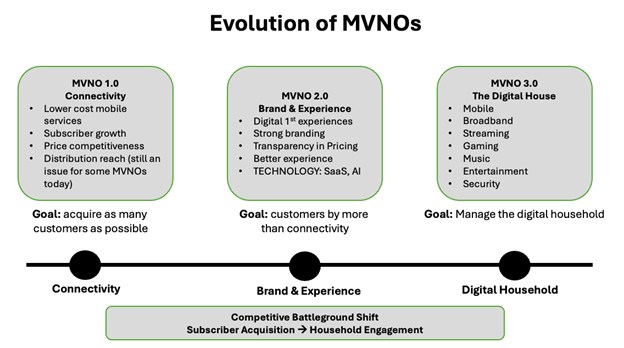
MVNO 1.0: Connectivity
The first generation focused on delivering mobile services at a lower cost than traditional operators.
MVNO 2.0: Brand and Experience
The next generation focused on digital experiences and brand differentiation.
MVNO 3.0: The Digital Household
The next evolution is already emerging. Instead of asking:
“How many subscribers do we have?”
MVNOs should be asking:
“How many aspects of the household’s digital life do we manage?”
Think For MVNO 3.0:
"A household purchases mobile, fiber broadband, Disney+, Xbox Game Pass, cloud backup, and identity protection through a single provider.”
The Household Opportunity
Consider a typical household’s monthly digital spending.
|
Service Category |
Typical Monthly Spend |
|
Mobile Services |
$80 |
|
Home Internet |
$70 |
|
Streaming Services |
$40 |
|
Gaming Services |
$20 |
|
Cloud Storage |
$10 |
|
Security Services |
$15 |
Collectively, many households spend over $200 per month managing their digital lives.
Most MVNOs participate in only one category.
Mobile!
This means operators are competing for a fraction of the available household wallet while leaving significant value on the table.
The opportunity is not simply to acquire more customers.
The opportunity is to deepen relationships with existing customers by becoming a trusted platform for multiple digital services.
Why Subscription Bundling Matters
Consumers increasingly suffer from subscription fatigue and often don’t know how many they have factors such as:
- Multiple providers.
- Multiple bills.
- Multiple applications.
- Multiple support channels.
- Managing digital services has become unnecessarily complex.
This creates an opportunity for MVNOs to evolve into subscription aggregators.
Imagine a single proposition that combines:
- Mobile connectivity
- Streaming entertainment
- Family safety services
- Cloud storage
- Identity protection
- Gaming subscriptions
Delivered through:
- One application and a fully digital experience
- One bill
- One customer relationship
- One aggregated partner to handle the complexity
The value proposition shifts dramatically. The conversation is no longer about gigabytes or unlimited data.
It becomes about convenience, simplicity, and value. In many ways, the MVNOs becomes a curator of digital services rather than simply a seller of connectivity.
Why Broadband Changes Everything
If subscription bundling expands wallet share, broadband anchors the household relationship. Home broadband sits at the center of modern digital life. It powers:
- Entertainment
- Remote work
- Education
- Smart home devices
- Security systems
- Gaming
Historically, many MVNOs viewed broadband as an adjacent product opportunity. In reality, broadband may be the most strategic product in the portfolio. By partnering with Fiber and Fixed Wireless Access (FWA) providers, MVNOs can move from being a mobile provider to becoming a complete connectivity provider.
Importantly, this can be achieved without the capital investment associated with building network infrastructure (partnering is the key to achieve this, margins are lower but you’re already providing the customer more value).
The winning strategy may not be ownership.
It may be orchestration.
The Rise of the Household Platform
The most successful MVNOs of the next decade may resemble digital platforms more than traditional telecom operators. Their role will be to assemble and manage ecosystems of services that solve household needs.
A future household bundle could include:
Connectivity
- Mobile
- Fiber Broadband
- FWA Broadband
Entertainment
- Streaming Services
- Gaming Platforms
- Music Services
Productivity
- Cloud Storage
- Collaboration Services
Security
- Identity Protection
- Device Security
- Smart Home Monitoring
All managed through a single digital experience. Consumers increasingly want simplicity.
The provider that can simplify the complexity of digital life will create meaningful differentiation in an increasingly commoditized market.
A New Metric: Household Share of Wallet
For years, operators have focused on customer acquisition metrics. The next strategic KPI may be Household Share of Wallet.
Rather than asking:
“How many subscribers do we have?”
Operators should ask:
“How much of the household’s digital spend do we participate in?”
A household purchasing mobile service alone may generate modest revenue.
A household purchasing mobile, broadband, entertainment, and security services creates significantly greater value and significantly stronger retention.
The relationship becomes deeper. The switching costs become higher. The lifetime value increases.
Most importantly, the operator becomes more relevant to the customer’s daily life.
Why MVNOs Are Uniquely Positioned to Win
Large operators often carry the burden of legacy systems, organizational complexity, and long product development cycles. MVNOs have a different advantage.
They can:
- Move faster
- Form partnerships quickly
- Experiment with bundles
- Target niche segments
- Launch new propositions rapidly
This agility may prove more valuable than infrastructure ownership. The future winners may not be the operators that own the largest networks.
They may be the operators that own the strongest customer relationships.
Key Take Away
The first generation of MVNOs disrupted pricing.
The second generation disrupted customer experience.
The third generation has an opportunity to redefine the role of the operator entirely.
The future is not simply about connectivity. It is about becoming the trusted platform through which households manage connectivity, entertainment, security, and digital services. The next phase of MVNO growth won’t be measured by how many SIMs they sell. It will be measured by how much of the household’s digital life they manage.

Last blogs from Mark Prudhoe
View all →-
February 5, 2026
The 5 Things US MVNOs Must Get Right in 2026
Modern MVNOs no longer differentiate on network access alone. While coverage, wholesale rates, and launch speed remain important, long-term success increasingly depends on how well the…
-
December 4, 2025
What If Segmentation Disappeared? How AI Is Redefining MVNO Strategy
What if the cornerstone of MVNO strategy—market segmentation—suddenly disappeared? Inspired by Marvel’s "What If...?", this article explores an alternate timeline where Artificial Intelligence redefines the telco…
-
August 25, 2025
Powered by Brands vs. MVNOs When to Test, When to Own
Powered by Brands vs. MVNOs: When to Test, When to Own. The mobile landscape is filled with opportunity for brands seeking to enter wireless...