
5G Standalone has been hailed bringing a wider breadth of 5G functionality into networks; the full flexibility of a 5G SBA (software-based architecture) core enables many different forms of service and network customisation which were not possible with the EPC-based 5G NSA architecture. This could potentially enable many different use cases, supporting network segmentation, QoS (Quality of Service) enhancements and other features which can be leveraged to better utilise the networks.
Much of this possibility to date is contained within national markets, as although there are over 90 5G SA networks launched globally, with almost 200 MNOs investing in 5G SA launches, very few 5G SA roaming agreements are in place. This means that MNOs’ attempts to monetise 5G SA need to be focused on the national scale.
Figure 1: 5G SA Deployments
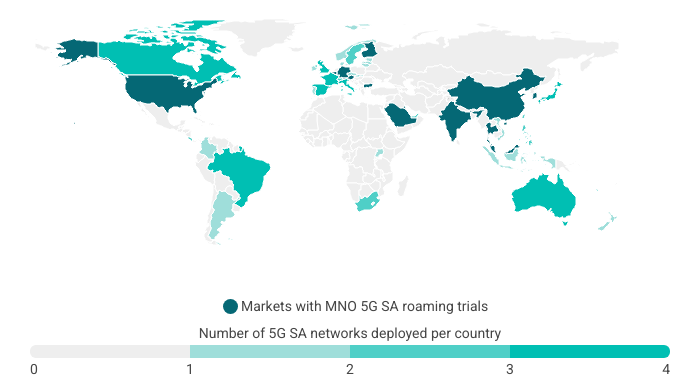
Source: Kaleido Intelligence 5G SA Tracker, Q1 2026
MVNOs sidestep much of this problem as they are frequently focused on national markets. This is still a very immature portion of the B2B market, but leveraging MVNOs could be a way for MNOs to use these capabilities to provide a greater level of network monetisation, and move away from data-only pricing.
The Wholesale Impact
With this ability to offer more bespoke and varied network services, MVNOs can become first-order customers for MNOs offering 5G SA features. This will have an impact primarily on SLAs; MVNOs will be able to offer more customised network features to their subscribers, particularly around network speeds and with bounded latency.
With these capabilities available, we do expect a degree of upselling of connectivity between MNOs and MVNOs. While wholesale data pricing may not itself be impacted, the ability to specify network characteristics will shift the monetisation model beyond pure data; engaging in per-subscriber charging for slice access, or per call to network APIs, will become more common. This could increase the cost to MVNOs, which may harm the value proposition of some; however, 5G SA’s opportunities are rarely aimed at the lowest cost segment, so this should not be much of an issue.
The Enterprise Opportunities
Network Slicing
One of the biggest features that 5G SA can bring to networks is that of network slicing and a degree of guaranteed QoS for particular devices on a 5G SA network. While fully deterministic latency on public 5G networks is not currently possible, bounded probabilistic latency and ranges of throughput can be used to inform these agreements.
This is typically something that would support enterprise connectivity, rather than consumer as such; the stability of network slices is rarely a consistent consumer requirement, whereas it can help to guarantee service levels for enterprise connectivity. This can then inform SLAs delivered by MVNOs to enterprise customers. This may be a limited opportunity, however; many MNOs offer this form of connectivity directly to enterprises, and may not in the first instance wish to offer similar to MVNOs. MVNOs wanting to take advantage of this market need to convince MNOs that they can supply more enterprise traffic through slicing. This requires a close relationship with enterprises, meaning the most successful MVNO users here are likely to be those with an existing relationship to the end user enterprises.
Network APIs
Thanks to initiatives like CAMARA and GSMA Open Gateway, making requests to cellular networks for specific network parameters to be adjusted for certain connections or certain locations is becoming more common across different markets.
For enterprises, these can be used in a similar way to network slicing, and with less need for complex network architecture. This will depend on the availability of specific APIs for the services; where 5G SA is present but APIs are not, network slicing will have a competitive advantage for some time. However, this will gradually erode, as network APIs make network adjustments simpler to achieve without dedicated slicing in the network.
The main use cases here are typically dependent on QoD and a variety of verification APIs to ensure that a particular connection has the rights to whatever service level it is claiming in its API call. The QoD element is often dependent on 5G SA architecture as it relies on 5GC components for policy control. It should be noted, however, that
The Impact of Roaming
The lack of 5G SA roaming means that relatively few international MVNOs are prepared to support it on a large scale for public networks, although some could do so in a private network context. This gives local IoT MVNOs an opportunity to deliver 5G SA services in a way that will be less possible once roaming agreements become more commonplace. However, should larger IoT MVNOs be able to secure local SIM profiles and IMSIs, they will also be able to offer national 5G SA deployments.
The Consumer Opportunities
Network APIs
The bulk of consumer opportunity is dependent on network APIs at this stage. The early emphasis on fraud and verification from APIs can replace a variety of verification mechanisms for CSPs in their operations, most immediately one-time password SMS messages. These can potentially reduce outgoings for MVNOs, particularly those from fintech brands that require additional security measures as part of their typical operations.
Where QoD APIs are available, premium connectivity can be offered, particularly for MVNOs who provide event- or location-based services in addition to connectivity. The premium services here can be provided during an event or as part of an experience (eg bundled with ticketing through a sports team app for fans who watch the game), ensuring a continuity of service level for users willing to pay. More data is rarely the request here, but rather a better quality of experience, which will in turn bring different revenue models for retail MVNOs. It should be noted that this is highly dependent on the nature of the MVNO, as to whether these quality enhancements will be appealing to the target demographic. Many use cases here will be transient rather than offering strong recurring revenue (eg event-based QoD), which will limit the uplift that APIs can provide when considered on a ARPU basis.
Beyond Mobile Connectivity
As can be seen above, the possibilities of 5G SA connectivity usage are starting to broaden into areas not historically available to MVNOs. We are seeing this already with some offering FWA (Fixed Wireless Access) broadband as part of a service bundle, made possible thanks to network slicing to have guaranteed bandwidth. This is dependent on the largesse of host MNOs, but with more customisable bearers available to MVNOs, we expect that more flexible and monetisable use of connectivity through 5G SA can open up new opportunities for MNO and MVNO alike.

Last blogs from James Moar
View all →-
May 15, 2025
The Many Meanings of Enterprise Connectivity for MVNOs
The Many Meanings of Enterprise Connectivity for MVNOs. Enterprise connectivity is a large market, if not the largest market in the world...
-
November 11, 2024
How travel eSIMs can bring more players into the Connectivity Value Chain
How travel eSIMs can bring more players into the Connectivity Value Chain. Network operator roaming charges are somewhat infamous for their cost in many countries, and…
-
July 22, 2024
MNO View of MVNOs – threat, partner, or sales channel?
MNO View of MVNOs – threat, partner, or sales channel? MNOs have something of a complicated relationship with MVNOs; while they can bring more customers into…