5G Network Slicing
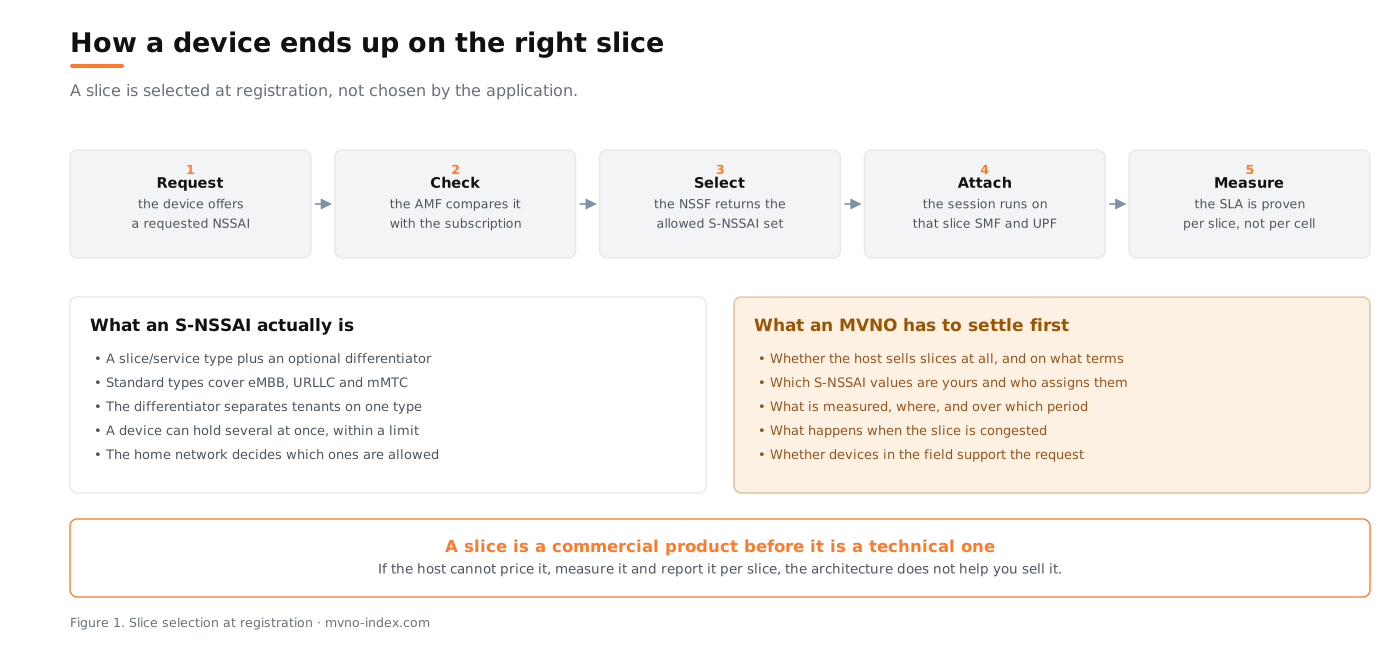
Network slicing divides one physical 5G network into logical networks that are selected per device and run with their own policy, capacity and measurement. A device offers a requested NSSAI at registration, the network checks it against the subscription, and the slice selection function returns the slices the home network allows. For an MVNO the question is rarely technical: it is whether the host sells slices, prices them and reports on them separately.
5G network slicing enables logically distinct networks with defined capabilities and characteristics to be provided using a shared infrastructure. A slice can support a particular service requirement or customer group while using selected shared or dedicated resources. The degree of separation and the delivered performance depend on the actual design, configuration and operating agreement.
For an MVNO or IoT provider, slicing is a potential way to offer a more specifically defined connectivity service. It is not automatic access to guaranteed performance, nor does a slice identifier prove that resources are reserved throughout the path. Begin with the customer requirement, establish the host's available capabilities and verify the complete service before making a commercial promise.
On this page
- History and Evolution of Network Slicing
- Core Utility and Functionality of Network Slicing
- What is Network Slicing Used For?
- Key Functions of a Slice Service
- Technical Integration and Data Model
- Integration with Other Systems
- Technical Data Model and Key Interfaces
- Ownership for MVNOs and IoT Companies
- Why Buy or Manage a Slice Service?
- Advantages and Disadvantages of Network Slicing
- Organizational Impact of Slicing
- Redundancy and High Availability
- Impact of 4G and 5G and Future Networks
- Related Capabilities in 4G Networks
- Network Slicing in 5G Deployments
- Long Term Slice Services
- Frequently Asked Questions about 5G Network Slicing
- Summary
History and Evolution of Network Slicing
Networks have long used techniques to separate traffic and apply different treatment to services. 5G slicing brings a more explicit architectural framework for distinct logical networks with relevant functions and characteristics. It can combine separation and service selection across the network, but it still depends on how resources and policies are implemented.
Industry work such as the GSMA Generic Network Slice Template helps describe service attributes consistently. These descriptions support commercial and technical discussions by making requirements more explicit. They do not replace a deployment design or acceptance test. A buyer still needs to know which attributes the supplier can deliver and under what conditions.
Core Utility and Functionality of Network Slicing
The three standard slice types, and what each one is for
| Slice/service type | Designed around | Typical use | What it costs you |
|---|---|---|---|
| eMBB | Throughput | Video, fixed wireless, busy venues | Capacity, which is the scarce thing |
| URLLC | Latency and reliability | Control loops, remote operation | Dedicated resources, so a high price |
| mMTC | Device density | Large sensor fleets | Little bandwidth, but signalling load |
| A custom value | A tenant boundary | Separating two customers on one type | Operational overhead at the host |
What is Network Slicing Used For?
Slicing can support services with different requirements on a shared network. An enterprise application may need a defined coverage area, traffic profile or separation model, while another service has different priorities. The supplier can use a slice-based design where it is appropriate to those requirements and supported by the network and devices.
The commercial starting point should be a customer problem. For example, a buyer may need more predictable connectivity for a supported operational application during busy periods. Specify the application conditions and required result before choosing slicing as the solution. Other mechanisms or a private network may be more suitable, depending on the environment and control required.
Key Functions of a Slice Service
Slice selection associates supported devices and sessions with the appropriate slice information under the network's procedures. In 5G, S-NSSAI identifies relevant slice information using a slice or service type and an optional differentiator. Selection functions and subscription information support this process, but selection alone does not establish the performance experienced by an application.
In the 5G Core the work is divided between named functions. The Access and Mobility Management Function receives the requested NSSAI when the device registers, the Network Slice Selection Function decides which S-NSSAI values that subscription is allowed, and each permitted slice then runs through its own Session Management Function and User Plane Function. Knowing which function does what is how you read a host operator's answer about where a slice actually ends.
Resource and policy handling determine how the intended service is delivered. Parts of the radio, transport and core environment may be shared or dedicated according to the design. Ask which resources are isolated, which are shared and how contention is managed. The same word isolation can otherwise hide very different technical arrangements.
Lifecycle management maintains the service as demand and conditions change. Configuration, monitoring and capacity planning need to remain aligned with the commercial attributes. A slice created successfully on launch day can still fail to meet its purpose later if traffic grows, coverage changes or an external dependency becomes congested.
Technical Integration and Data Model
Integration with Other Systems
The 5G Core architecture provides relevant functions for subscription, access, session and policy handling. A slice-based service also needs suitable access and transport support. Review the complete path from device to application. A well-configured core cannot by itself remove a bottleneck in an external network or application server.
Device compatibility is essential. The intended devices and software must support the procedures and configuration required by the service. Application traffic must also be associated with the intended connectivity path. Ask the supplier to demonstrate the actual device and application combination rather than presenting a network-only test with a different terminal.
An MVNO may need provisioning, billing and reporting changes to sell the service. Customer entitlements, activation states and service attributes should be reflected in its commercial systems. The wholesale agreement must establish access rights and responsibilities; ordinary wholesale 5G access should not be assumed to include a dedicated enterprise slicing offer.
Technical Data Model and Key Interfaces
Maintain clear relationships between customer contracts, subscriptions, slice information and service attributes. A technical identifier is not a complete commercial product definition. The MVNO needs to know which customers are entitled to the service, where it applies and how changes are requested. Preserve the effective dates of those entitlements for support and billing.
Slice selection happens at registration. The application never chooses.
Service attributes should include measurable conditions where relevant, such as area, capacity and performance objectives. Define the measurement points, load assumptions and exclusions. An application response-time target differs from a network transport measurement. Without an agreed boundary, the buyer and supplier can each produce correct numbers that describe different things.
Write the measurement point into the contract in the same sentence as the number. A latency figure measured at the radio interface and the same figure measured at the application are different commitments, and only one of them is what your customer experiences.
Monitoring should connect technical observations to the contracted service. Report whether the intended population can access the slice and whether the relevant performance measures are being met. Include visibility into rejected or incomplete activation requests. A dashboard showing that a slice exists does not establish that every entitled customer can use it successfully.
Ownership for MVNOs and IoT Companies
What to settle before you sell a slice
| Question | Why it decides whether the product exists |
|---|---|
| Does the host sell slices at all | Many do not yet, whatever the marketing says |
| Which S-NSSAI values are yours | Without your own, you cannot separate customers |
| What is measured, and where | A latency figure without a measurement point is not a commitment |
| What happens under congestion | Priority between slices is where the promise breaks |
| How is it reported to you | You cannot sell a service level you cannot evidence |
| Do the devices support it | A slice nothing in the field can request is not a product |
Why Buy or Manage a Slice Service?
An MVNO may use a supported slice service to address an enterprise requirement that a general mobile offer cannot meet adequately. It can package connectivity with application integration and support, provided the underlying rights and capabilities are available. The business case should explain why the customer will pay for the defined outcome and what delivery costs it creates.
An IoT provider should evaluate slicing against the actual workload. A low-frequency sensor may gain little from a specialised service, while another application may have stronger requirements. Consider private networking and other connectivity options as well. The right choice depends on location, device support, mobility and the degree of operational control required.
Advantages and Disadvantages
Advantages:
- Slicing can provide a structured way to define different services on shared infrastructure. This may help a provider align technical treatment with a particular customer requirement without building a completely separate network for every offer. The benefit depends on the supplier's implementation and the ability to manage the resulting services reliably.
- Explicit service attributes can also improve commercial discussions. Buyers can ask for a defined area, traffic profile and measurement method rather than a vague premium connection. This makes comparison and acceptance more meaningful. The provider should show how the proposed design supports those attributes and what happens when demand exceeds the agreed conditions.
Disadvantages:
- Slicing adds configuration and lifecycle complexity. Device support, subscription entitlements and network policies must agree. An apparently small commercial change can require coordination across several functions and organisations. Include provisioning and support effort in the price rather than assuming the service is merely a new label on an existing tariff.
- Shared infrastructure still creates potential dependencies. Power, transport, computing and management failures may affect several slices. Isolation claims should therefore be examined carefully. A service can have logical separation without physically independent resources, and dedicated resources can still depend on shared operational systems. Request a precise explanation of the intended protection.
Organizational Impact of Slicing
Product teams should translate customer needs into attributes the network provider can support and measure. Avoid selling a technical architecture as though it were a business outcome. A customer buying dependable application connectivity needs to understand the scope, conditions and support arrangement in practical terms, including what remains outside the service boundary.
Operations needs a view that connects customer incidents to the relevant slice and underlying dependencies. A fault may affect one service population or several at once. Agree how the MVNO receives this information and who coordinates diagnosis. Customer care should not have to infer slice status from a generic network-availability notice.
Finance should define the charging basis clearly. A service might be priced through setup, recurring capacity, subscriptions or usage, depending on the offer. Model the complete cost and the consequences of growth or underuse. A minimum capacity commitment can create exposure even when the number of connected devices is lower than forecast.
Supplier evaluation should use an application-relevant trial. Include the intended devices, locations and traffic, with competing load where that is part of the requirement. Compare the result with a suitable baseline service. The solution provider selection guide can help structure the commercial comparison and required evidence.
Redundancy and High Availability
Slice resilience depends on the resources and functions it uses. Document which dependencies are shared and how failure affects the customer population. A logically separate slice may still lose service when a common transport path fails. The recovery design should match the promised service attributes rather than rely on the existence of multiple logical networks.
Test failures with active applications and representative load. Observe session behaviour, recovery time and any change in service treatment after restoration. Ask whether traffic falls back to another service and whether that behaviour is acceptable to the customer. An available fallback may preserve connectivity while providing different performance or separation characteristics.
Monitoring and commercial reporting also need resilience. If the measurement system fails, the provider should identify the gap rather than present incomplete data as proof that targets were met. Agree how incidents and disputed performance are investigated. Reliable evidence is particularly important when the service is sold through explicit performance commitments.
Impact of 4G and 5G and Future Networks
Related Capabilities in 4G Networks
LTE networks can separate and prioritise traffic through their supported mechanisms, but these should not be described as identical to every aspect of 5G slicing. Compare the actual service outcome and architecture. A customer requirement may be met without a 5G slice, while another may depend on capabilities unavailable in the existing offer.
Network Slicing in 5G Deployments
5G slicing requires the relevant network, device and operational support. A 5G coverage indicator does not prove that a particular slice service is available. Confirm the deployment mode and supported commercial offer, then test the end-to-end behaviour. Availability in one location or customer segment should not be assumed elsewhere without evidence.
Long Term Slice Services
Future networks may extend service-management capabilities, but current purchasing should focus on supported attributes and a credible upgrade process. Preserve product definitions and measurement history as the implementation evolves. This allows the provider and customer to assess whether a change improves the service rather than merely changing its technical description.
Frequently Asked Questions
Is a network slice a separate physical network?
Not necessarily. It is a logical network arrangement that can use shared and dedicated resources according to the design. Ask which resources and dependencies are separate rather than inferring physical independence from the word slice.
Does slicing guarantee low latency?
No. Performance depends on the complete path, load and configuration. A supplier can make a defined commitment within a stated scope, but it must be engineered and measured. The slice identifier alone does not establish application response time.
Can every 5G device use every slice service?
No. Device capabilities, configuration, subscriptions and network support must align. Test the intended devices and applications. General 5G compatibility is not sufficient evidence for a particular commercial slicing service.
Is slicing the same as a private network?
No. A private network describes a service and architectural arrangement for a defined organisation or group. Slicing can contribute to some public-network-integrated private designs, but private networking and slicing are not interchangeable terms.
Can an MVNO sell network slices independently?
Only within its technical capabilities and commercial rights. It may need a specific host arrangement and supporting platform integration. Verify the available service scope before including slicing in a customer proposal.
What should isolation mean in a contract?
The contract should identify the resources, traffic and administrative boundaries concerned. It should also describe shared dependencies and failure behaviour. A broad isolation claim is insufficient when the customer needs a specific security or performance property.
What should a slicing trial demonstrate?
It should demonstrate entitlement, device access and application behaviour under representative load and failure conditions. Verify the measurement boundary and reporting. Compare results with the promised attributes before accepting the service or setting the retail price.
Summary
5G network slicing can support more specifically defined connectivity services on shared infrastructure. Its commercial value depends on a real customer requirement, compatible devices and a design that delivers measurable attributes across the intended path.
Compare network and integration partners through the MVNO Index provider directory. Request a documented service scope and representative trial before committing to capacity or promising a slicing-based customer outcome.
General Information