Private Networking: Three Models, One Question
Private networking serves one organisation, site or user group with an agreed level of control, and it can be built in three shapes. Everything on site, which keeps running when the wide area network does not; local radio with a shared core, which keeps part of that benefit; or a slice or private access point name on the public network, which is easiest to buy and least independent. What has to keep working during an outage decides which one fits.
Private networking provides connectivity for a defined organisation, site or user group with an agreed level of control and separation. The term covers several technologies. In an MVNO and IoT context, it commonly refers to private cellular networks using LTE or 5G. A complete solution includes devices, radio coverage, core functions, transport and the applications that use the connection.
The business case starts with a requirement that the existing network does not meet adequately. That might involve site coverage, mobility, operational control or a particular application workload. A private network is not automatically the best answer to every connectivity problem. Compare it with public mobile, Wi-Fi and wired alternatives against the same measurable customer outcomes.
On this page
- History and Evolution of Private Networks
- Core Utility and Functionality of Private Networking
- What is a Private Network Used For?
- Key Functions of a Private Cellular Network
- Technical Integration and Data Model
- Integration with Other Systems
- Technical Data Model and Key Interfaces
- Ownership for MVNOs and IoT Companies
- Why Own or Manage a Private Network?
- Advantages and Disadvantages of Private Networking
- Organizational Impact of Private Networking
- Redundancy and High Availability
- Impact of 4G and 5G and Future Networks
- Private LTE Networks
- Private 5G Networks
- Long Term Private Network Planning
- Frequently Asked Questions about Private Networking
- Summary
History and Evolution of Private Networks
Enterprises have long operated private wired and wireless networks for internal communications. Private cellular adds a different access and management model, with device identities and radio capabilities suited to relevant mobile and industrial requirements. LTE deployments established many of these uses, while 5G introduced additional architectural options and supported capabilities.
In the 5G architecture, non-public networks can be standalone or integrated with a public network. These categories describe architectural relationships rather than a universal purchasing model. A provider may operate substantial parts of either arrangement. The guide to mobile cores and private networks offers context for comparing the access and core responsibilities.
Core Utility and Functionality of Private Networking
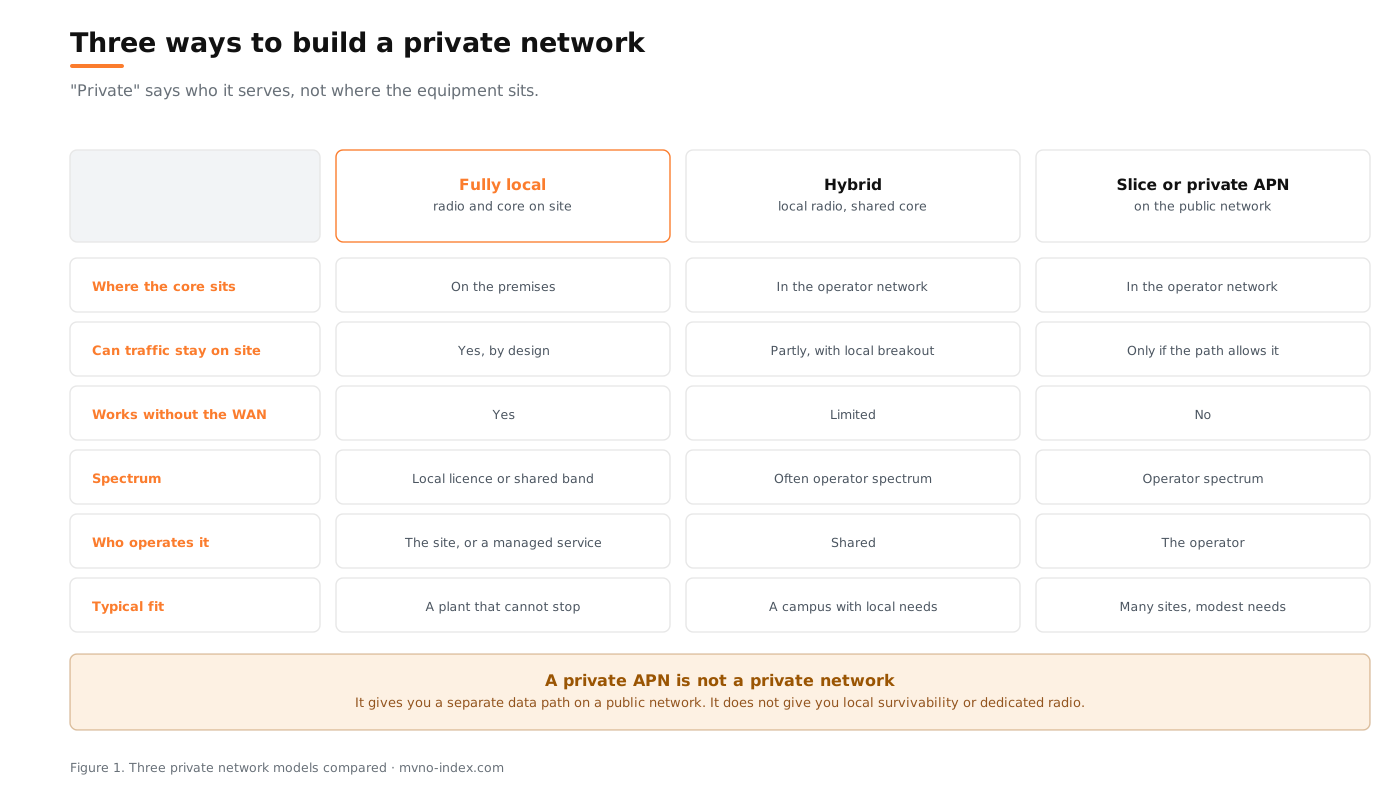
Three ways to build it, compared on what differs
| Feature | Fully local | Hybrid | Slice or private APN |
|---|---|---|---|
| Where the core sits | On the premises | In the operator network | In the operator network |
| Can traffic stay on site | Yes, by design | Partly, with local breakout | Only if the path allows it |
| Works without the wide area network | Yes | Limited | No |
| Spectrum | Local licence or shared band | Often operator spectrum | Operator spectrum |
| Who operates it | The site, or a managed service | Shared | The operator |
| Typical fit | A plant that cannot stop | A campus with local needs | Many sites, modest needs |
What is a Private Network Used For?
A private cellular network can connect equipment, workers and applications within an agreed area and service scope. Relevant uses may include mobile industrial assets, enterprise devices and operational monitoring. The required throughput, mobility and availability vary significantly between these applications, so the design should follow the workload rather than the broad industry label.
Control can be valuable when the organisation needs to manage device access, traffic paths or changes more directly. However, control also creates responsibilities. Someone must maintain the system, approve updates and respond to failures. The buyer should decide which responsibilities it wants to retain and which it wants a managed provider to perform.
Key Functions of a Private Cellular Network
Radio access provides coverage and capacity for the intended devices. A site survey should examine the actual environment, including structures, machinery and movement. Coverage that appears adequate in an empty building may change when equipment, stock and people are present. Validate both downlink and uplink requirements, especially where devices send substantial data.
Core functions manage relevant subscription, access and session procedures. Their location and operating model influence control, connectivity and recovery. A local user-plane path may keep specified application traffic on site, but this does not prove that every control or management dependency is local. Ask for a clear diagram showing what depends on external services.
Management and application integration make the network useful. Device onboarding, monitoring and troubleshooting need practical workflows. Applications must receive the expected traffic and meet their own processing requirements. A network performance result should be related to the actual task, such as completing a supported transaction or maintaining communication while an asset moves.
Technical Integration and Data Model
Integration with Other Systems
A private network connects to enterprise applications, identity processes and operational systems. It may also require public-network integration for mobility outside the site. Define these boundaries early. A service that works within a campus does not automatically provide the same behaviour beyond it, and public-network access does not necessarily preserve every private service characteristic.
Spectrum access is a deployment prerequisite. The permitted bands and authorisation route depend on the country and arrangement. Confirm the applicable requirements with the relevant provider and authority before selecting equipment. Do not assume that a private-network product can be deployed on any available frequency simply because it supports that band technically.
Spectrum is the part that varies most between countries and the part an enterprise buyer is least equipped to resolve alone. Confirm the authorisation route before anything else in the design is fixed, because it decides which bands the devices must support and therefore which devices can be bought at all.
The IoT network overview helps place connectivity choices alongside device and application needs. For a private deployment, the physical environment matters as much as the logical design. Power, transport, equipment locations and maintenance access should be included in the site plan and supplier scope.
Technical Data Model and Key Interfaces
Maintain an inventory linking authorised devices, subscriptions, equipment and locations. Record the applications each device needs to reach and the relevant service policies. This supports controlled onboarding and helps operations distinguish a device that has lost permission from one experiencing a radio or application fault.
Three private network models, compared on what actually differs.
Define interfaces between the network and enterprise systems with clear ownership. Addressing, routing, name resolution and security policies must agree across the boundary. A device can attach successfully yet fail to reach its application because a firewall or route is incorrect. Acceptance testing should follow the complete path rather than stopping at network registration.
Performance requirements need a measurement boundary. Latency measured inside the radio network is different from response time between a device and an application. Specify where tests begin and end, under what load and with which devices. This makes supplier proposals comparable and prevents a narrow laboratory result from being mistaken for an application guarantee.
For context beyond a single deployment, the GSMA North America white paper on private networks sets out how mobile operators themselves approach these deployments, which is useful when you are deciding whether to build, buy a managed service, or partner.
Ownership for MVNOs and IoT Companies
What an MVNO can realistically offer here
| Role | What it requires | What it earns |
|---|---|---|
| Connectivity only | An existing wholesale agreement | A modest recurring fee per device |
| Connectivity plus SIM management | A provisioning platform | More, and a stickier relationship |
| Managed service with partners | Integration and field capability | The largest share, and the most risk |
| Full private deployment | Radio, core, spectrum and operations | Rarely viable without a specialist partner |
Why Own or Manage a Private Network?
An enterprise may choose ownership where it needs substantial control and has the skills to operate the service. A managed model may be preferable when the business wants a defined outcome with less infrastructure responsibility. Compare the operating commitments and lifecycle costs, including support outside normal working hours and the process for adding devices or sites.
An MVNO or IoT provider can participate through connectivity, core services, device management or a complete managed offer. Its role should match its capability and commercial rights. Selling a private-network service requires more than reselling SIMs: site design, installation and operational coordination may become essential parts of the customer promise.
Advantages and Disadvantages
Advantages:
- A properly designed private network can provide a service tailored to a particular site and device population. The organisation can align coverage and capacity with its own operational priorities. It may also obtain more direct visibility into network behaviour, making it easier to relate faults and changes to the applications that depend on connectivity.
- Private deployment can support deliberate traffic handling and integration with local systems. These choices may help meet specific operational or data-handling requirements. The benefit must be demonstrated in the proposed architecture. Local equipment, private addressing and restricted access describe different properties and should not be treated as interchangeable evidence of complete isolation.
Disadvantages:
- The buyer takes on infrastructure and lifecycle obligations, directly or through a supplier contract. Radio design, device compatibility, maintenance and recovery all require attention. Costs may be difficult to justify for a small or simple workload that an existing network already supports adequately. Compare alternatives before committing to a dedicated deployment.
- Deployment complexity can also extend beyond the technology. Site access, production schedules and enterprise security reviews may affect installation. Devices may need specific hardware or configuration. A commercially attractive network proposal can therefore understate the total project if application changes, device replacement and internal implementation work are excluded.
Organizational Impact of Private Networking
Private networks often bring information technology and operational teams into the same project. Their priorities may differ: one may focus on change control and security, while another needs continuous production and predictable maintenance. Establish a joint operating process so neither side discovers the other's requirements only after installation.
Assign ownership of devices and credentials. Equipment may be purchased by different departments, but access to the network needs a consistent lifecycle. Define how a new device is authorised, how a lost device is removed and how responsibility changes when an asset moves between sites. Good inventory reduces both security exposure and troubleshooting effort.
Procurement should request a complete service scope. Include surveys, installation, core and radio components, application integration, training and support. Ask what is required from the customer and what happens if site conditions differ from the initial assumptions. A clear division of work makes the implementation schedule more credible.
Run a pilot in representative operating conditions. Test the actual devices while machinery, people and traffic are present, and include mobility where it matters. Compare the result with the existing network or another feasible option. Use the solution provider selection guide to evaluate evidence and complete costs.
Redundancy and High Availability
Resilience should follow the consequence of service loss. Some monitoring devices can tolerate delayed delivery, while other workflows may need an alternative process immediately. Define the required behaviour with the application owner. A network availability target is useful only when it corresponds to an understood operational need.
Test power, transport, radio and core failures separately. Confirm which services continue if the site loses external connectivity. Local traffic may survive in one design while authentication, management or application dependencies still require an external path. The supplier should demonstrate the proposed behaviour rather than infer it from the physical location of the equipment.
Recovery planning should include spare equipment, maintenance access and trained staff. A failed component in a restricted industrial area may take longer to replace than the technical installation time suggests. Agree realistic restoration procedures and test them. The cost of resilience should be visible in the proposal, together with the capacity available during an outage.
Impact of 4G and 5G and Future Networks
Private LTE Networks
Private LTE can support suitable enterprise and IoT workloads where the device ecosystem, spectrum and service requirements align. Evaluate it against the actual application rather than treating it as automatically obsolete. The important question is whether the complete supported deployment meets the required performance and lifetime at an acceptable cost.
Private 5G Networks
Private 5G can support relevant non-public-network architectures and additional capabilities, depending on implementation and device support. Standalone NPN and public-network-integrated NPN describe different relationships to public network functions. Select the model around control, mobility and operational requirements, then verify the specific capabilities included in the supplier's product.
Long Term Private Network Planning
Plan upgrades and device replacement over the expected asset lifetime. Preserve configuration records and usable management data so the service can evolve without losing operational knowledge. Future network generations should be evaluated through defined requirements and supported migration paths, rather than used as a reason to postpone a suitable current solution indefinitely.
Frequently Asked Questions
Is a private network always a private 5G network?
No. Private networking includes wired, Wi-Fi and cellular approaches. In cellular deployments, LTE and 5G are both relevant depending on requirements. Define the intended technology and operating scope rather than relying on the broad term alone.
Is a private APN the same as a private cellular network?
No. A private APN can provide a particular data-access arrangement over a public network. It does not by itself establish dedicated on-site radio infrastructure or a standalone private network. Compare the actual architecture and service properties.
Does all traffic stay on site?
Only if the architecture and application paths provide that behaviour for the relevant traffic. Control, management and external application dependencies may still leave the site. Request a diagram and verify the data paths during acceptance.
Can existing devices use the network?
Possibly, if they support the required bands, subscriptions and network features. Test the intended devices and software versions. General cellular capability does not prove compatibility with every private-network configuration.
Can an MVNO provide a managed private network?
It can participate where it has the necessary capabilities and arrangements, often with specialist partners. The proposal should identify responsibility for spectrum, site design, installation, core operation and application integration.
What should a supplier trial prove?
It should prove coverage, capacity, device compatibility and application performance under representative conditions. Include failures and recovery, and verify the proposed operating process. Compare the result and lifecycle cost with realistic alternatives.
Does private networking guarantee low latency?
No. Performance depends on radio conditions, transport, core placement and the application path. Define the measurement boundary and load, then test the complete service against the actual operational requirement.
Summary
Private networking is valuable when a defined organisation needs connectivity characteristics that justify a dedicated or specially integrated service. The result depends on the complete device, radio, core and application design, together with a credible operating model.
Shortlist partners through the MVNO Index provider directory. Request a site-specific proposal and representative pilot before selecting the architecture, ownership model and long-term support arrangement.
General Information