Open API Standards for MVNO and IoT. Three API Standards, Three Different Problems
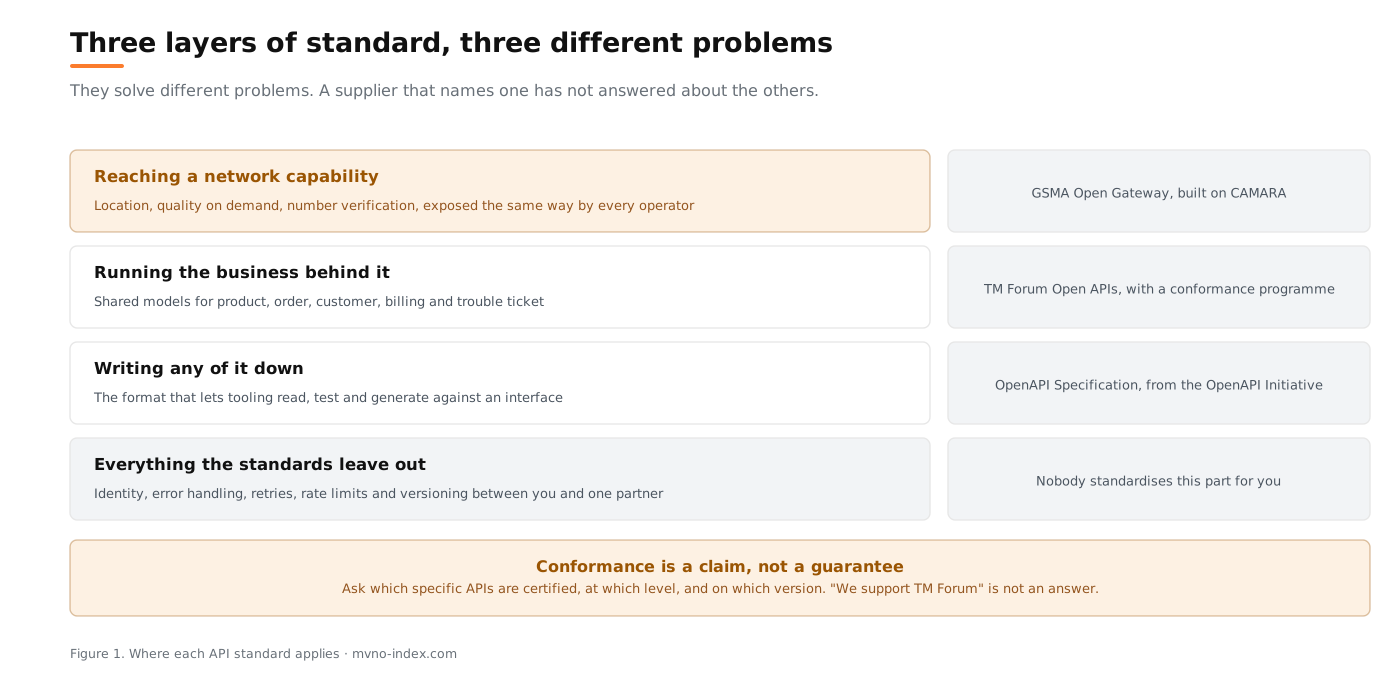
Open API standards for MVNO and IoT come in three families that are regularly confused for one another. TM Forum Open APIs define shared models for the business layer, while GSMA Open Gateway, with CAMARA, defines a common way to reach a network capability such as location or quality on demand. The OpenAPI Specification is neither of those: it is the machine-readable format the other two are written in, and what remains after all three is your own integration work.
An application programming interface, or API, defines how software requests information or actions from another system. Open API standards provide shared specifications that can make those interactions easier to understand and implement across suppliers. For MVNO and IoT businesses, they can support ordering, service management and controlled access to network capabilities.
Open does not mean anonymous, free of charge or automatically interoperable. A usable integration still requires compatible versions, agreed data meanings, authorisation and commercial access. Select standards according to the business interaction you need, then test the complete workflow. The presence of an API catalogue is a starting point for evaluation, not proof that two platforms will work together without adaptation.
On this page
- History and Evolution of Telecom APIs
- Core Utility and Functionality of Open APIs
- What are Open APIs Used For?
- Key Functions of Relevant Standards
- Technical Integration and Data Model
- Integration with Other Systems
- Technical Data Model and Key Interfaces
- API Ownership for MVNOs and IoT Companies
- Why Use Standardised Interfaces?
History and Evolution of Telecom APIs
Telecom systems have long exchanged information through defined interfaces, but many business integrations relied heavily on supplier-specific designs. Shared API specifications aim to reduce repeated interpretation and development work. They provide common language for interactions while allowing implementations to remain separate products with their own capabilities and operating constraints.
Several standards communities address different layers. TM Forum covers many business and operational interactions. 3GPP defines interfaces within the mobile architecture and relevant exposure functions. CAMARA develops common network API definitions in an ecosystem associated with GSMA Open Gateway. These efforts are related, but they are not interchangeable catalogues of the same services.
Core Utility and Functionality of Open APIs
Three standards, three different jobs
| Standard | What it standardises | Who publishes it | What it does not cover |
|---|---|---|---|
| TM Forum Open APIs | Business and operational objects | TM Forum | What the data means in your business |
| GSMA Open Gateway | Reaching a network capability | GSMA, with CAMARA | Whether your host exposes it |
| OpenAPI Specification | How an interface is described | OpenAPI Initiative | Anything about the content itself |
| Nothing | Identity, errors, retries, versioning | You and your partner | This is the part that takes the time |
What are Open APIs Used For?
An MVNO may use APIs to retrieve products, submit orders, activate subscriptions and obtain service status. An IoT provider may use them to manage fleets, receive events or integrate connectivity into an application. The API makes an interaction programmable, while the surrounding business process determines who may perform it and what the result means.
The MVNO Index article on APIs in telecom provides useful business context. For procurement, start with a specific journey, such as activating a device and confirming usable connectivity. Identify every interface involved and the party responsible for the final result. A standardised ordering request does not automatically complete network provisioning.
Key Functions of Relevant Standards
TM Forum's catalogue includes APIs for product and service management. Examples include TMF620 for product catalogue management, TMF622 for product ordering, TMF638 for service inventory and TMF641 for service ordering. These identifiers help buyers discuss a defined interface family, but the version, supported operations and implementation scope still need to be stated.
GSMA Open Gateway provides a framework for common network APIs, with CAMARA contributing developer-facing specifications. These can support applications that request selected network information or capabilities. Availability depends on the provider, geography and commercial arrangement. An MVNO must establish its rights to use or resell a capability rather than assuming host-network access includes the API service.
The OpenAPI Specification has a different role: it describes HTTP APIs in a machine-readable form. An interface described using OpenAPI is not automatically a standardised telecom service or an open-source product. Distinguish the description format, the business specification and the actual implementation when comparing supplier claims.
Technical Integration and Data Model
Integration with Other Systems
API integration connects customer channels, business systems and network processes. A product order may create several service actions, each with its own status and timing. The receiving application needs to understand whether a request was rejected, accepted for processing or completed. Build the customer experience around these real states instead of treating every successful HTTP response as completed service delivery.
Network exposure is another layer. A 5G Core may provide capabilities through functions such as the NEF, while an application-facing commercial API can add authentication, developer onboarding and service packaging. Ask the provider to explain the mapping and dependencies. A northbound API does not remove the need for compatible underlying network support.
Legacy platforms may require adapters. An adapter can be a sensible integration choice, but its behaviour and maintenance need an owner. Document where the standard model is translated into proprietary data or workflows. Otherwise the apparent standard interface can hide dependencies that reappear during upgrades or supplier migration.
Technical Data Model and Key Interfaces
Shared schemas help align field names and structures, but data meaning must also agree. Product, service, resource and customer are different entities. An MVNO should know which identifier is stable across systems and how relationships are represented. A technically valid request can still create the wrong commercial outcome if the parties interpret the object differently.
Three standards, three different problems, and the part none of them covers.
Versioning should be explicit. Record the specification version, supported operations and any extensions used. Ask how breaking changes are announced and how long previous versions remain available. An integration that relies on undocumented fields can fail even when the provider believes it is making a compatible update to the standard portion.
Treat a conformance claim as a question rather than an answer. TM Forum runs a conformance programme that certifies named APIs at a stated level and version, so ask which specific APIs are certified, at which level, and against which release. "We support TM Forum" describes an intention, not a tested interface.
Security includes authentication, authorisation and appropriate access to each object and operation. A valid credential should not grant access to another customer's subscriptions merely because their identifiers are known. Use scoped permissions and test account boundaries. The correct controls depend on the architecture, but authorisation needs to be checked at the service level, not only at login.
API Ownership for MVNOs and IoT Companies
What to ask when a supplier claims standards support
| Claim | The follow-up question |
|---|---|
| We support TM Forum Open APIs | Which ones, at which conformance level, on which version |
| Our API is OpenAPI compliant | May we have the description file before we sign |
| We support Open Gateway | Through which host, and in which markets |
| Versioning is handled | How much notice before a breaking change |
| It is secure | What a valid credential may and may not reach |
| Integration is straightforward | How long did the last customer actually take |
Why Use Standardised Interfaces?
Standardised interfaces can reduce the amount of supplier-specific interpretation and make integrations easier to document. They can also help a buyer compare implementations using common terminology. The commercial value depends on the actual overlap between products. If every essential operation relies on a different proprietary extension, the standard may cover only a small part of the required journey.
An IoT company may use APIs as its primary operating channel, especially for fleet actions and application integration. It therefore needs dependable bulk operations, event handling and diagnostic information. An MVNO selling through digital channels has similar needs for ordering and activation. Evaluate the service around those workloads rather than around the number of available endpoints.
Advantages and Disadvantages
Advantages:
- Common specifications can make requirements clearer and reduce repeated design work. Developers can use familiar concepts, and suppliers can provide documentation and test tools against a known model. This can shorten parts of integration, particularly where the products implement the relevant standard consistently and the business process is already understood.
- Standards can also support a more practical exit strategy. A replacement product with compatible interfaces may reduce the amount of surrounding software that needs to change. Data and process differences still require analysis, so portability should be tested with actual transactions and exports. A shared API name alone is not evidence of a low-cost migration.
Disadvantages:
- Different versions, optional features and extensions can limit interoperability. A supplier may support only selected operations or impose constraints absent from a general specification. Ask for a detailed implementation statement and test it. Broad claims of standards compliance can conceal gaps that matter greatly to the intended product.
- APIs also create operational dependencies. Rate limits, outages and delayed events can affect customer journeys. A standard interface does not guarantee a service level or a particular throughput. Include capacity, support and change terms in the commercial agreement, especially where the API becomes the only practical route to operating a large device fleet.
Organizational Impact of API Adoption
Product and technical teams should define the business meaning of each journey together. Developers can implement a request correctly while the commercial team expects a different result. Agree states, error handling and customer communications before production use. This is particularly important when one retail action triggers several asynchronous supplier operations.
Maintain an interface inventory with owners, versions and dependencies. Record where credentials are stored and who rotates them, and identify the teams affected by a change. This makes it easier to assess an upstream notice or investigate an incident. An integration should not depend on one developer remembering an undocumented behaviour from its original launch.
Supplier evaluation should include conformance evidence where available, but also a complete workflow test. Certification can establish a defined scope of testing; it does not prove every business combination or proprietary extension. Ask what was certified, against which version, and how the intended deployment differs from that tested configuration.
Request a sandbox that supports realistic failures and events. Test invalid data, duplicate requests, timeouts and unavailable dependencies. Include a case where the operation completes but the response is lost. These scenarios show whether the integration can recover safely and whether the supplier's documentation is sufficient for day-to-day operation.
Redundancy and High Availability
API clients need controlled retry behaviour. Repeating a request immediately and indefinitely can overload a recovering service or create duplicate actions. Use the documented approach to idempotency and backoff where supported, and preserve a reliable transaction identifier. The desired outcome is one correctly completed business action, even if several network attempts were required.
Event delivery needs similar care. Notifications can arrive late, out of order or more than once, depending on the service contract. Applications should reconcile their state with the authoritative system rather than assuming every notification is unique and perfectly ordered. Ask how missed events can be recovered after an outage.
Monitor customer outcomes as well as interface availability. A reachable endpoint may accept orders that never progress. Track completion time, failure rate and unresolved states across the workflow. Agree escalation evidence with the supplier so operational teams can investigate using the same identifiers and timestamps.
Impact of 4G and 5G and Future Networks
APIs in 4G Services
Business APIs can automate ordering, charging and service management regardless of the access generation. An MVNO can improve LTE customer journeys without waiting for a new core architecture. The key requirement is a supported connection between the business operation and the underlying systems that deliver it.
APIs in 5G Services
5G service-based architecture and exposure capabilities create additional integration possibilities. Application-facing access still depends on implementation, authorisation and commercial scope. Review network API business opportunities as a starting point, then validate the specific capability, market availability and customer benefit before pricing a product.
Long Term Interface Planning
Prefer documented lifecycle policies and manageable extensions over vague promises of universal future compatibility. Standards evolve, and a business needs a funded process for adoption. Preserve test cases and interface ownership so upgrades can be assessed through customer outcomes rather than handled as emergency technical changes.
Frequently Asked Questions
Are TM Forum APIs and CAMARA APIs the same?
No. They address different interaction domains, although a complete service may use both. Identify the business or network operation required and select the relevant specification rather than treating every telecom API as interchangeable.
Does open mean anyone can use the API?
No. Open specifications can coexist with paid, authenticated and restricted services. Commercial rights, account permissions and applicable data requirements still govern use. Confirm access before designing a product around a particular capability.
Is OpenAPI the same as an open telecom standard?
No. OpenAPI is a format for describing HTTP APIs. A proprietary interface can use that format. Review the underlying service specification and implementation scope separately from the documentation technology.
Does certification guarantee interoperability?
It provides evidence within its stated scope. Versions, extensions and business workflows can still differ. Check the certification details and test the intended integration before treating it as complete proof of production compatibility.
Can an MVNO expose its host's network capabilities?
Only where the technical arrangement and commercial rights allow it. Establish the available APIs, subscriber scope and permitted use. Ordinary wholesale access does not automatically include every network exposure service.
What is the most important failure test?
A useful test is an operation that completes while its response is lost. It reveals whether retries create duplicates and whether the client can discover the true final state. Other failure cases remain important for the specific workflow.
What should an API supplier proposal specify?
Require versions, operations, extensions, limits, event behaviour, security responsibilities and support terms. Include a realistic sandbox and acceptance tests for the complete customer journey, with change and migration arrangements documented.
Summary
Open API standards help MVNO and IoT businesses describe and integrate services more consistently. Their value depends on compatible implementation, clear data meaning and reliable operation across the complete workflow.
Compare integration and platform partners through the MVNO Index solution provider directory. Request implementation evidence and a practical trial using your required journeys before committing to a supplier or API-based product.
General Information