The NSSF: How a 5G Network Slice Gets Selected
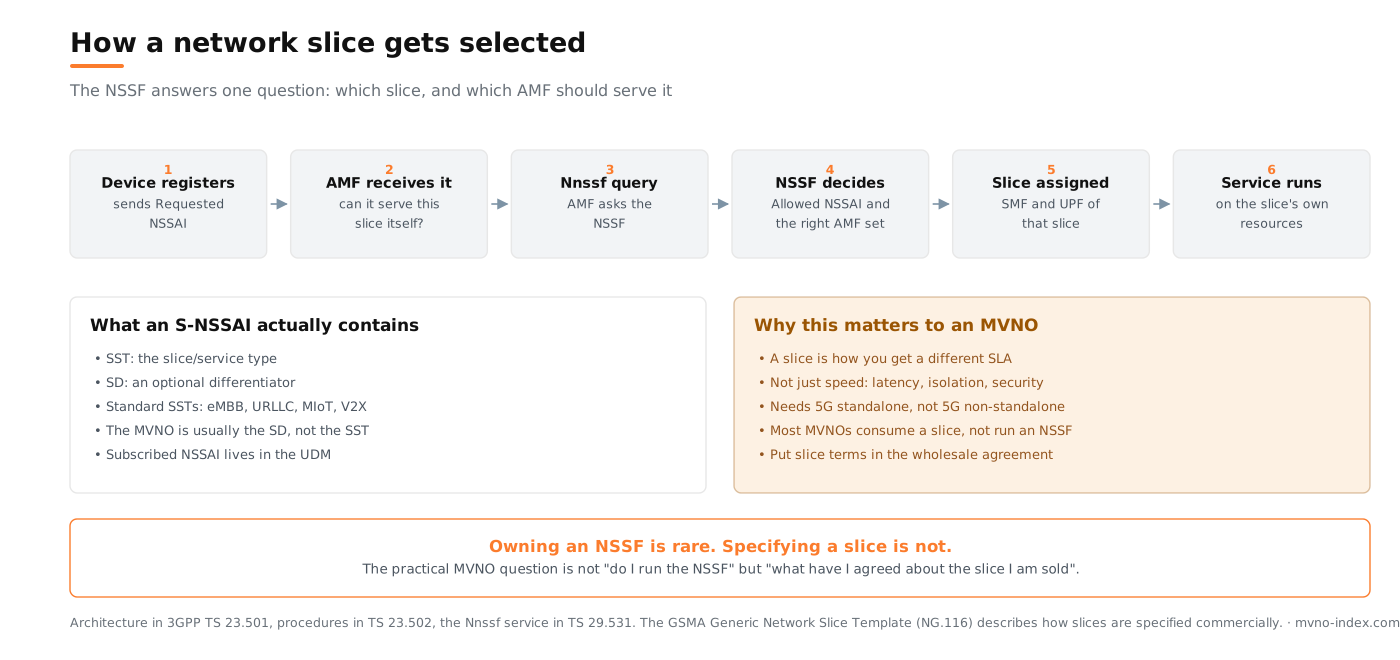
The Network Slice Selection Function (NSSF) decides which network slice serves a device and which AMF should handle it. When a device registers with a Requested NSSAI, the AMF asks the NSSF, and the NSSF returns the Allowed NSSAI together with the AMF set that can serve it. It is the component that turns one physical 5G network into several logically separate ones.
The Network Slice Selection Function (NSSF) is a foundational and strategically significant network function within the architecture of the 5G Core (5GC). Understanding its purpose is essential for any operator, MVNO, or IoT company that intends to leverage the most commercially transformative capability that 5G introduces: network slicing. The NSSF acts as the intelligent selection engine that determines which network slice or set of network slices a given subscriber or device should be assigned to, based on the requested slice attributes, the subscriber's subscription profile, the operator's slicing policies, and the current availability of slice resources across the network. It is the component that makes network slicing operationally real, translating the commercial promise of differentiated, guaranteed-quality connectivity into a technically precise, automated, and scalable assignment process. For any operator planning to offer differentiated service tiers, dedicated IoT connectivity, enterprise private network services, or latency-sensitive applications over 5G, deploying and controlling a capable NSSF is not optional; it is the gateway to monetizing the full potential of their 5G investment.
On this page
- History and Evolution of the NSSF
- Core Utility and Functionality of the NSSF
- What is the NSSF Used For?
- Key Functions of the Network Slice Selection Function
- Technical Integration and Data Model
- Integration with Other Systems
- Technical Data Model and Key Interfaces
- NSSF Ownership for MVNOs and IoT Companies
- Why Own an NSSF?
- Advantages and Disadvantages of NSSF Ownership
- Organizational Impact of NSSF Ownership
- Redundancy and High Availability
- Impact of 5G Evolution and 6G on the NSSF
- NSSFs Role in Maturing 5G Deployments
- 6G Architecture Implications
- 6G and the Future of Charging
- Frequently Asked Questions about the NSFF
- Summary
History and Evolution of the Network Slice Selection Function
The NSSF was introduced as a formally specified network function with the release of the 3GPP 5G system architecture standard (3GPP TS 23.501) in Release 15, published in 2018, which defined the complete 5G Core Service-Based Architecture (SBA). Its introduction was a direct response to the multi-service, multi-tenant demands that 5G was designed to address, demands that the flat, undifferentiated architecture of 4G LTE's Evolved Packet Core could not satisfy. Prior to the NSSF, there was no standardized mechanism to dynamically assign a subscriber or device to a logically isolated, resource-guaranteed network instance. Subsequent 3GPP releases, particularly Release 16 and Release 17, progressively enhanced the NSSF's capabilities, adding support for more granular slice differentiation, roaming slice selection, and tighter integration with the broader 5G Core function ecosystem.
Core Utility and Functionality of the NSSF
What an S-NSSAI actually identifies
| Field | Meaning | Standard values |
|---|---|---|
| SST: Slice/Service Type | The kind of service the slice is built for | 1 = eMBB, 2 = URLLC, 3 = MIoT, 4 = V2X |
| SD: Slice Differentiator | Optional, separates tenants within one SST | Operator-defined: this is usually where the MVNO sits |
| Requested NSSAI | What the device asks for | Sent at registration |
| Allowed NSSAI | What the network grants | Returned by the NSSF through the AMF |
| Subscribed NSSAI | What the subscription permits | Held in the UDM |
What is the NSSF Used For?
The Network Slice Selection Function is the definitive routing authority for slice assignment within a 5G Core network. Its primary purpose is to evaluate incoming registration and session requests from devices and determine which network slice or combination of slices the device should be assigned to for that session. A network slice is a logically isolated, end-to-end virtual network instance that runs on a shared physical infrastructure but provides its own dedicated set of network functions, resources, and quality of service guarantees. Different slices can be configured for entirely different purposes: one slice might be optimized for ultra-low-latency vehicle-to-everything (V2X) communication, another for high-throughput mobile broadband, and another for low-power, low-bandwidth IoT and M2M connectivity.
The NSSF makes the slice assignment decision by evaluating the Requested Network Slice Selection Assistance Information (NSSAI) provided by the device against the subscriber's Subscribed NSSAI stored in the Unified Data Management (UDM), the operator's slice availability and policy data, and any roaming or inter-PLMN constraints that apply. It returns an Allowed NSSAI to the Access and Mobility Management Function (AMF), which then uses that information to route the subscriber's session to the correct slice instance. This process is what makes it possible for a single physical 5G network to simultaneously serve a consumer streaming video, an autonomous vehicle requiring sub-millisecond response times, and a smart meter transmitting a few bytes per hour, each with precisely the resource allocation and quality guarantee their use case demands.
For operators exploring what 5G can deliver for their mobile brand, the NSSF is the component that transforms 5G network slicing from a theoretical architecture concept into a commercially deployable service differentiation tool. Operators considering how to start their MVNO or IoT business on a 5G-capable platform should evaluate NSSF control and slice access as a core element of their host network or platform agreement.
Key Functions of the Network Slice Selection Function
Let us investigate the core functions of the NSSF to understand its critical role in 5G network operations and service differentiation:
- Slice Selection and NSSAI Determination: The NSSF evaluates the device's Requested NSSAI, the subscriber's Subscribed NSSAI, and the operator's slice availability and policy rules to determine the Allowed NSSAI that defines which slices the subscriber may use during the current registration period.
- AMF Set Selection: Beyond slice selection, the NSSF can recommend or select the appropriate AMF set that serves the determined network slices in the subscriber's current location, ensuring that the AMF managing the subscriber's session is capable of serving all the slices assigned to that subscriber.
- Slice Availability Management: The NSSF maintains awareness of which network slices are currently available and where, enabling it to make accurate, real-time selection decisions that respect current resource availability rather than assigning subscribers to slices that are congested or unavailable in their location.
- Roaming Slice Mapping: For roaming scenarios, the NSSF maps the slices available in the visited network to the equivalent slices defined in the home network's subscription, enabling consistent slice-based service delivery even when a subscriber is using another operator's network.
- Policy-Based Slice Assignment: The NSSF enforces operator-defined policies that govern slice access, such as restricting specific slices to enterprise subscribers, priority customers, or specific device categories, enabling commercial differentiation between subscriber tiers.
- Interaction with the NRF: The NSSF works in close coordination with the Network Repository Function (NRF) to discover and verify the availability of network function instances associated with each slice, ensuring that slice assignments are grounded in the current state of the network function registry.
- Support for Multiple Simultaneous Slices: The NSSF can assign a single subscriber or device to multiple simultaneous network slices, each identified by a distinct Single Network Slice Selection Assistance Information (S-NSSAI) value, enabling complex multi-service device profiles such as an IoT gateway that requires both a low-latency control plane slice and a high-throughput data slice simultaneously.
- Inter-PLMN Slice Coordination: In multi-operator environments, the NSSF manages the translation and coordination of slice identifiers between different Public Land Mobile Networks (PLMNs), supporting roaming agreements and wholesale slice access arrangements between operators.
- Audit and Logging: The NSSF maintains detailed logs of all slice selection decisions, supporting operational troubleshooting, compliance reporting, and analytics on slice utilization patterns across the subscriber base.
Technical Integration and Data Model
Integration with Other Systems
The NSSF is a cloud-native network function embedded within the 5G Core's Service-Based Architecture, and it communicates with other network functions using standardized HTTP/2-based APIs defined in 3GPP specifications. Its integration points are precisely defined and span several of the most critical functions in the 5G Core ecosystem.
The NSSF's primary integration is with the AMF, which queries the NSSF during registration procedures to obtain the Allowed NSSAI and, where applicable, an AMF set recommendation for the subscriber. It integrates with the UDM to retrieve the subscriber's Subscribed NSSAI, which defines the slices the subscriber is contractually permitted to access based on their plan. It works alongside the NRF for network function discovery and slice instance availability verification. It interacts with the Network Data Analytics Function (NWDAF) for analytics-driven slice selection in advanced deployments. For policy-driven slice assignment, it connects with the Policy Control Function (PCF) to ensure that slice access decisions align with the subscriber's active policy rules. The Service Communication Proxy (SCP) mediates communication between the NSSF and other NFs in deployments that use indirect communication, providing load balancing, routing, and security enforcement across the service-based interface.
Technical Data Model and Key Interfaces
The NSSF operates on a well-defined data model and uses the standardized 5G Core service-based interface protocols:
How a network slice gets selected, from Requested NSSAI to an assigned SMF and UPF.
- Nnssf_NSSelection Service: The primary northbound API service exposed by the NSSF, used by the AMF to request slice selection during UE registration. The request carries the Requested NSSAI, the subscriber's SUPI or GPSI, and the access type, and the response returns the Allowed NSSAI, Configured NSSAI, and optionally an AMF Set or AMF pointer.
- Nnssf_NSSAIAvailability Service: Used by AMFs to notify the NSSF of the NSSAI slices available in their serving area, enabling the NSSF to maintain an accurate, real-time view of slice availability across all AMFs in the network.
- Slice Policy Database: An internal database storing operator-defined slice assignment policies, including subscriber tier mappings, device category rules, geographic slice availability constraints, and priority handling rules for conflicting slice requests.
- NSSAI Mapping Tables: Data structures that map Requested S-NSSAI values from devices to the operator's internal Subscribed S-NSSAI values, and for roaming scenarios, map home network S-NSSAI values to equivalent visited network S-NSSAI values.
- NF Service Registration Interface: The NSSF registers its own services with the NRF and queries the NRF to discover other network function instances, following the standard 5G Core NF registration and discovery pattern.
NSSF Ownership for MVNOs and IoT Companies
What to agree about a slice you buy
| Point | Ask the host operator | Why it matters |
|---|---|---|
| Which SST and SD are you given | A named S-NSSAI, in writing | Without it you cannot test anything |
| Latency and throughput targets | Numbers, with a measurement method | "Slice" without numbers is a label |
| Isolation | Shared or dedicated UPF? | Decides whether another tenant can affect you |
| Coverage | Which areas and which radio sites | A slice is not available everywhere the network is |
| Roaming | Does the slice survive abroad? | Usually it does not: plan for the fallback |
| Change control | Who may change the slice profile, and how fast | You carry the SLA to your customer |
Why Own an NSSF?
For a Full MVNO operating on a 5G Core platform, owning or controlling an NSSF is the prerequisite for independently offering network slice-based service differentiation to subscribers and enterprise customers. Without control of the NSSF, the MVNO cannot define its own slice assignment policies, cannot offer proprietary slice-based service tiers, and is entirely dependent on the host MNO's slicing architecture and commercial terms for any slice-related service it wishes to offer. This represents a fundamental constraint on the MVNO's ability to compete in the enterprise, IoT, and premium consumer segments that 5G slicing is designed to serve.
For IoT and M2M operators, NSSF control enables the creation of dedicated IoT slices with precisely calibrated resource guarantees, latency profiles, and security boundaries that are essential for mission-critical IoT applications in sectors such as healthcare, logistics and transportation, and utilities. Business MVNOs targeting enterprise customers will find that the ability to offer guaranteed, isolated network slice connectivity is a compelling differentiator that commands premium pricing and long-term contract commitments. Operators reviewing their 5G potential and evaluating solution providers should explicitly assess NSSF access and slice policy control as a negotiation point in any host network or platform agreement.
Advantages and Disadvantages
Advantages:
- Full Slicing Control enabling the operator to independently define, manage, and monetize network slices tailored to specific subscriber segments, enterprise customers, or IoT use cases without dependency on a host MNO's slice catalogue.
- Enterprise and IoT Revenue Potential by offering contractually guaranteed, logically isolated network slices to business customers and IoT operators, commanding premium pricing that flat-rate consumer plans cannot justify.
- Service Differentiation at Scale through the ability to operate multiple simultaneous slice types, each optimized for a specific application profile, on a shared physical 5G infrastructure.
- Roaming Slice Management enabling consistent slice-based service delivery for subscribers roaming onto partner networks, in line with roaming agreements and wholesale slice arrangements.
- Policy Agility allowing the operator to instantly update slice assignment policies to reflect new product launches, promotional offers, or emergency prioritization scenarios without changes to the radio or transport network.
- 5G Architecture Completeness ensuring the operator's 5G Core is fully standards-compliant and capable of supporting the complete range of 5G use cases defined in 3GPP specifications, future-proofing the platform investment.
Disadvantages:
- High initial complexity in designing and implementing a slice architecture that accurately maps to the operator's commercial service portfolio and technical capabilities across radio, transport, and core.
- Operating an NSSF requires specialist expertise in 5G Core SBA architecture, NSSAI management, and cloud-native network function lifecycle management that goes beyond the skills required for 4G core operations.
- The commercial value of NSSF ownership is only realized when the underlying 5G network infrastructure supports genuine network slicing end to end, including the radio access network, transport, and core, which requires significant investment across all layers.
- For MVNOs operating as light MVNOs or Enhanced Service Provider MVNOs without their own 5G Core, NSSF ownership is not currently relevant, as slice control requires direct participation in the 5G Core architecture.
- Integration complexity across the AMF, UDM, PCF, NRF, and SCP requires careful API management and ongoing configuration discipline as the network function ecosystem evolves with each 3GPP release update.
Organizational Impact of NSSF Ownership
Analyzing the impact of integrating an NSSF across the key dimensions of an operator's organization:
-
Operational Impact: Owning an NSSF introduces a new and specialized operational domain focused on slice lifecycle management. Operations teams must design, configure, and maintain slice definitions that accurately reflect the operator's commercial service portfolio, monitor slice resource utilization to detect and resolve congestion before it affects service quality, and manage the NSSAI mapping tables as new devices, plans, and roaming agreements are introduced. Because the NSSF is in the critical path for every 5G registration procedure, its operational health must be continuously monitored within the network operations center alongside other core 5G functions such as the AMF and SMF.
-
Financial Impact: The financial case for NSSF ownership is built on the revenue potential of slice-based service differentiation rather than cost reduction alone. Operators that can offer guaranteed-quality enterprise slices, dedicated IoT connectivity slices, and premium consumer service tiers are positioned to capture revenue streams that are structurally unavailable to operators that cannot differentiate at the network level. Operators building their financial plan for their mobile brand should model slice-based revenue scenarios alongside the platform and integration investment required, recognizing that the return timeline is tied to the pace of enterprise and IoT customer acquisition rather than immediate cost savings.
-
Security Impact: The NSSF enforces the boundaries between network slices, making it a security-critical component whose integrity is essential for maintaining the isolation guarantees that enterprise and IoT customers depend on. A misconfigured NSSF could allow a subscriber to access a slice they are not authorized for, potentially breaching the isolation boundary of a dedicated enterprise or mission-critical IoT slice. Strict access controls over NSSF configuration interfaces, comprehensive audit logging of all slice selection decisions, and regular security review of slice assignment policies are essential operational disciplines. The cloud-native deployment model of the NSSF also means that container and API security practices must be applied consistently, in line with the broader security posture of the 5G Core platform.
-
Technical Impact: The NSSF must be deployed as a cloud-native, horizontally scalable network function capable of processing high volumes of concurrent slice selection requests with the sub-second response times that 5G registration procedures require. It must integrate seamlessly with the full set of 5G Core network functions via the service-based interface, maintain real-time awareness of slice availability across all AMFs, and support software updates and configuration changes without service interruption, using the rolling upgrade patterns standard in cloud-native telecom deployments. The OSS must be extended to include slice lifecycle management workflows, and the BSS must be capable of representing slice-based products in its product catalogue and mapping subscriber plan attributes to NSSAI values that the NSSF can consume.
Redundancy and High Availability
The NSSF is a critical dependency for every 5G registration procedure in the network. If the NSSF is unavailable or returns incorrect slice selection responses, devices may fail to register on the correct slice, may be denied registration entirely, or may be assigned to a default slice that does not meet their service requirements. For enterprise and IoT customers relying on dedicated slices for mission-critical applications, NSSF unavailability is not a minor inconvenience; it is a service outage with potentially severe contractual and operational consequences.
Achieving the redundancy and high availability that a production NSSF deployment demands requires deploying multiple active instances of the NSSF behind a load balancer, distributed across independent availability zones or data centers. The NSSF's slice policy database and NSSAI availability state must be replicated in real time across all active instances to ensure consistent slice selection decisions regardless of which instance handles a given request. Geographic distribution across at least two data centers provides protection against single-site failures, and automated failover must be configured to redirect AMF queries to a healthy NSSF instance within the latency tolerance of the 5G registration procedure. The SCP plays an important supporting role in high-availability NSSF deployments by providing load balancing, service discovery, and failover routing for NSSF service requests from AMFs and other network functions. Health monitoring of the NSSF must be integrated into the operator's network operations center with automated alerting and defined escalation procedures for any degradation in slice selection response time or accuracy.
Impact of 5G Evolution and 6G on the NSSF
NSSF's Role in Maturing 5G Deployments
The NSSF was introduced in 3GPP Release 15 as the foundational slice selection mechanism for 5G Standalone networks. Subsequent 3GPP releases have progressively extended its capabilities to support more complex slicing scenarios, including enhanced roaming slice mapping, finer-grained slice differentiation within a single subscriber session, and tighter integration with network analytics functions for demand-driven slice selection. As operators transition from 5G Non-Standalone (NSA) deployments, where the 4G LTE core is still used for control plane functions, to full 5G Standalone deployments with a native 5G Core, the NSSF moves from a future-planning item to an active, day-to-day operational component that must be managed with the same rigor as the AMF, SMF, and UDM.
6G Architecture Implications
Looking toward 6G, the network slicing paradigm is expected to evolve significantly. 6G architectures under early research and standardization discussion anticipate even more dynamic, intent-driven network slice creation and management, where slices are instantiated and torn down automatically in response to application demands rather than pre-provisioned as static configurations. In this context, the NSSF's role is likely to evolve into a more intelligent, AI-driven slice orchestration function that works in close coordination with network analytics and automation platforms to make real-time slice assignment decisions based on live network state, predicted demand, and application-layer quality requirements. Operators who invest in understanding and operating the NSSF today will be well positioned to adopt the more advanced slice management capabilities that 6G will introduce, as the fundamental concepts of subscriber-to-slice mapping, policy-based assignment, and cross-network slice coordination established by the NSSF in 5G will remain central to 6G network management.
Frequently Asked Questions
What is the primary function of the NSSF?
The primary function of the NSSF is to determine which network slice or set of network slices a subscriber or device should be assigned to during 5G registration, based on the requested slice attributes, the subscriber's subscription profile, and the operator's slice availability and policy rules.
What is a network slice in 5G?
A network slice is a logically isolated, end-to-end virtual network instance running on shared physical 5G infrastructure, configured to deliver a specific set of performance characteristics, resource guarantees, and security properties tailored to a particular use case or subscriber category.
What is NSSAI and why does it matter?
NSSAI stands for Network Slice Selection Assistance Information. It is the identifier set that describes which slices a device is requesting, which slices a subscriber is subscribed to, and which slices are permitted in the current network location. The NSSF uses NSSAI values to make and communicate slice assignment decisions.
Which 5G Core functions does the NSSF interact with most closely?
The NSSF interacts most closely with the AMF, which queries it for slice selection during registration, the UDM, which holds the subscriber's subscribed NSSAI, the NRF, which provides network function discovery, the PCF for policy alignment, and the SCP for mediated service communication.
Is the NSSF relevant to MVNOs that do not yet operate a 5G Core?
Not directly. NSSF ownership and operation requires participation in a 5G Standalone Core network. However, MVNOs planning their 5G strategy should understand the NSSF and negotiate slice access and policy control terms with their host MNO or platform provider as part of their long-term platform agreements.
Can one physical 5G network support multiple simultaneous slices?
Yes. A single 5G physical infrastructure can support multiple simultaneous network slices, each identified by a distinct S-NSSAI value, with independent resource pools, quality of service profiles, and security boundaries. The NSSF manages the assignment of subscribers and devices to these slices.
What is the difference between the NSSF and the PCF?
The NSSF is responsible for determining which slice a subscriber should use, based on subscription and availability. The PCF is responsible for defining and enforcing the policy rules that govern how resources are used within a session, including within a specific slice. They are complementary functions that work together to deliver both correct slice assignment and appropriate in-slice resource management.
Summary
The Network Slice Selection Function (NSSF) is the authoritative slice assignment engine at the heart of the 5G Core, determining in real time which network slice each subscriber and device is permitted to use based on subscription profile, operator policy, and live slice availability. For a Full MVNO or IoT operator building on 5G Standalone infrastructure, controlling the NSSF is the prerequisite for delivering the network slicing capabilities that differentiate 5G from all previous network generations and that unlock the premium enterprise, IoT, and mission-critical service revenue streams that 5G is designed to enable. It integrates tightly with the AMF, UDM, NRF, PCF, and SCP within the 5G Core's Service-Based Architecture, and it requires cloud-native deployment, real-time high availability, and careful BSS and OSS integration to deliver its full commercial value. Operators evaluating their 5G potential, reviewing core network elements, or selecting their solution providers should place NSSF access and slice policy control at the centre of their 5G platform strategy. In a competitive market where the ability to offer guaranteed, differentiated, and isolated connectivity is the defining commercial advantage of 5G, the NSSF is the network function that makes that advantage real.
5G Core (5GC)