
What the market learned about channel sequencing, product readiness, and the conflict nobody plans for.
There is a pattern in travel eSIM distribution. Brands build the eSIM product, open an API for resellers, get listed on marketplaces – before the offer can sell on its own.
The product can now be bought in more places. But that only answers one question: where can someone buy it? Not whether they have heard of you. If they trust you. Not whether a partner can convince them to choose you, instead of another travel eSIM.
Getting people to actually buy is a different job. SEO, paid search, affiliates, influencers, app store presence – that is acquisition. That is what builds demand and recognition. Distribution only extends reach.
When eSIM brands skip this, partners end up doing work they were never meant to do. Selling an offer that has not proved itself. Explaining things the product should answer on its own. Handling problems that should have been fixed before any partner was involved.
In eSIM distribution, it is rarely the commission that is the problem. It is the order in which you expand.
What each Channel actually demands from your Product
Every channel demands something different from your product and earns you something different for the next stage.
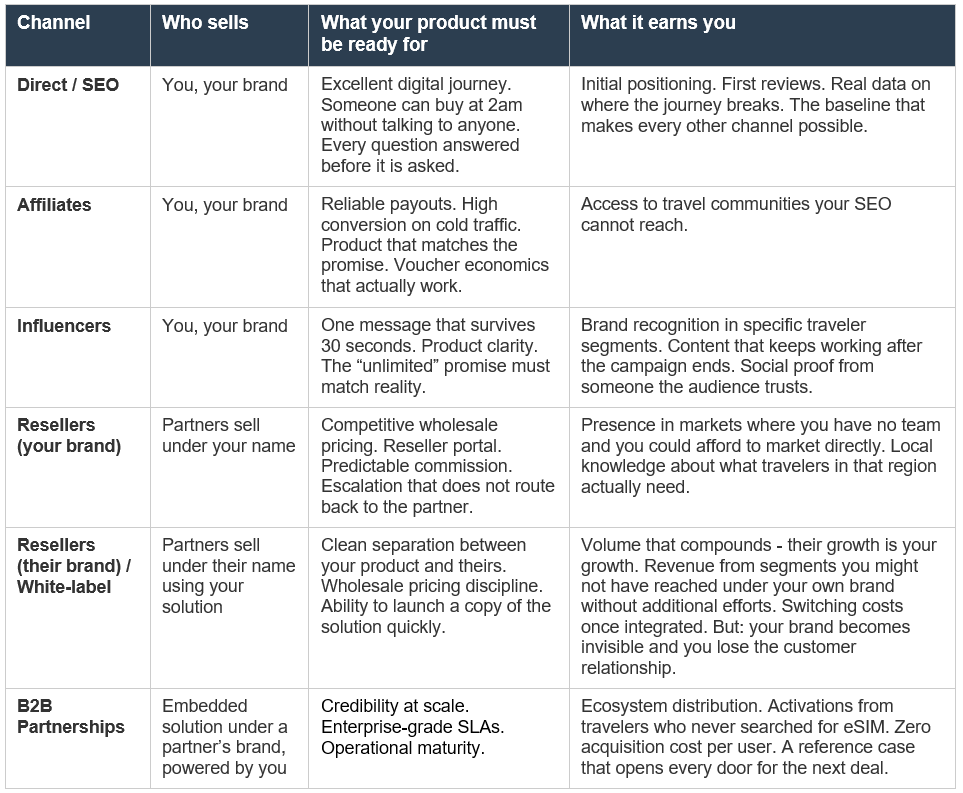
“The real question is always: who sells, under whose brand, and who owns the customer.”
Why Channel Sequencing Decides Who Scales
The travel eSIM brands that built strong indirect channels started with one model. Proved it worked. Only then added the next. The ones that tried everything at once ended up with nothing working well.
Stage 1: Direct + SEO. Prove the product converts. Get first users who will help you to improve your solution. Build the first reviews.
Stage 2: Affiliates + influencers. Extend reach through other people’s audiences. Product must be mature enough to survive recommendation without you having to explain the small print.
Stage 3: Resellers. Open the product to third parties. This is the moment you decide: do they sell under your brand, or under theirs? That decision shapes everything that follows.
Stage 4: B2B Partnerships. Embed connectivity into platforms – fintechs, airlines, corporate travel tools, even city governments. Requires everything the first three stages earned you.
Most brands that stalled tried to launch reseller program before their direct funnel was ready to convert.
There is an operational reason this sequence matters. Stage 1 is where you stress-test the solution. You find the problems before a partner does. You do not know if the MNO is throttling you in Mexico unless someone uses the product there.
“Every stage teaches you something you need for the next one. Skip one and you pay for it later.”
Affiliates and Influencers: Two Different Channels
Most people treat affiliates and influencers as the same thing. They are not. The mechanics are completely different.
Affiliates are transactional. They open the door to the local communities. The buyer gets a discount code, tests the product, maybe comes back. The affiliate gets a one-time kickback. What matters is whether your product converts when that traffic arrives.
And factor in the real cost. One-time commission is only part of the affiliate cost. The discount is your cost as well, and if the customer has questions or hits a problem, that does not sit with the affiliate. It comes back to you.
Influencers are about trust. They lend their reputation to your brand. Usually it is a one-time thing – they get a fixed fee, they mention you once, and they move on. So you get one shot. Product clarity is non-negotiable. If your offer needs a paragraph to explain, it will not survive a YouTube sponsorship. And “unlimited” has to match reality. If your product lets their audience down – the promise sounds big but there are catches in the small print, the speed is throttled more than expected – you risk bad reviews. It happens fast.
The Reseller Decision: Your Brand or Theirs
This is where most indirect channel strategies either work or fall apart. Not at the signing stage. After it. The brand never clearly decided what kind of indirect channel it actually wants.
Look at the biggest players. Holafly has chosen own-brand distribution – partners sell under the Holafly name. Airalo plays both sides: own brand, but also white-label. However, it is Airalo that we hear about. Both strategies work. But they require different pricing, different support, and different expectations about who owns the customer.
There is also another type. Local agents who sell fibre, TV, and mobile alongside other products – common in countries like Poland. These were physical shops. Most have moved online now. They carry multiple brands, and your eSIM competes for attention on their shelf alongside everything else.
An agent sells what pays well and causes the least trouble. If that is not you, it is someone else.
What shifts reseller behaviour: remove friction. Every step you eliminate from their day is worth more than a percentage point of margin. A platform where they see what sold and what they earned. Agreement templates. Clear commission models. Predictable payouts.
When Distribution Becomes Your Biggest Problem
Most travel eSIM brands arrive at Stage 4 still running Stage 1 – selling direct, running affiliates, supplying resellers and white-labelling at the same time. One price list for everything. Competing with your own partners whether you realise it or not.
Every brand that scales through partners eventually faces two decisions. Most make them too late.
First: brand. A reseller can sell under your brand or under their own. White-label means you step back with your own brand. Each model works. But running all three in the same market with the same pricing creates conflict. Decide which model you want before your partners decide for you.
Second: pricing. Who controls the end-user price – you or the partner? Do you fix it for all resellers, or do they have freedom to set their own? Is there room for volume discounts as they grow? Do you understand what their expectations are about margins? If they do not have space to be competitive with their end-user pricing, they will not commit.
Before You Build the Channel
Sign partners before your product converts on its own and you are paying someone else to discover your problems.
Before opening Stage 3:
- Your customer journey has been tested and you know that your product converts without human intervention.
- You have been doing friendly user tests on enough markets to know where the product actually works – and where it does not. You know where you are competitive and you make use of this info.
- You know what goes wrong, where, and how often. Your support is not firefighting every day. You have a human support team available in the right time zones.
- You have done the pricing math. Your wholesale rates leave enough margin for the reseller and are competitive against local alternatives. You benchmarked it before launching, not after.
- You have decided whether partners sell under your brand or theirs. Not both at full ambition.
If two or more are not in place, you are not ready. You are scaling the problem, not the business.
Where This Is Heading
The next wave of travel eSIM growth is not only about better marketing and distribution. It is about non-telcos owning the customer journey and making connectivity invisible as an embedded solution.
So the real question is not whether to build more channels. It is whether you are building a brand or becoming infrastructure. Both can make money. Trying to do both is where most brands get stuck.
Which stage are you actually at – and which one are you pretending to be at?

Guest Blogs are written by carefully selected Experts. If you also want to create a Guest blog then Contact us.