Wholesale Models, and Who Carries the Risk
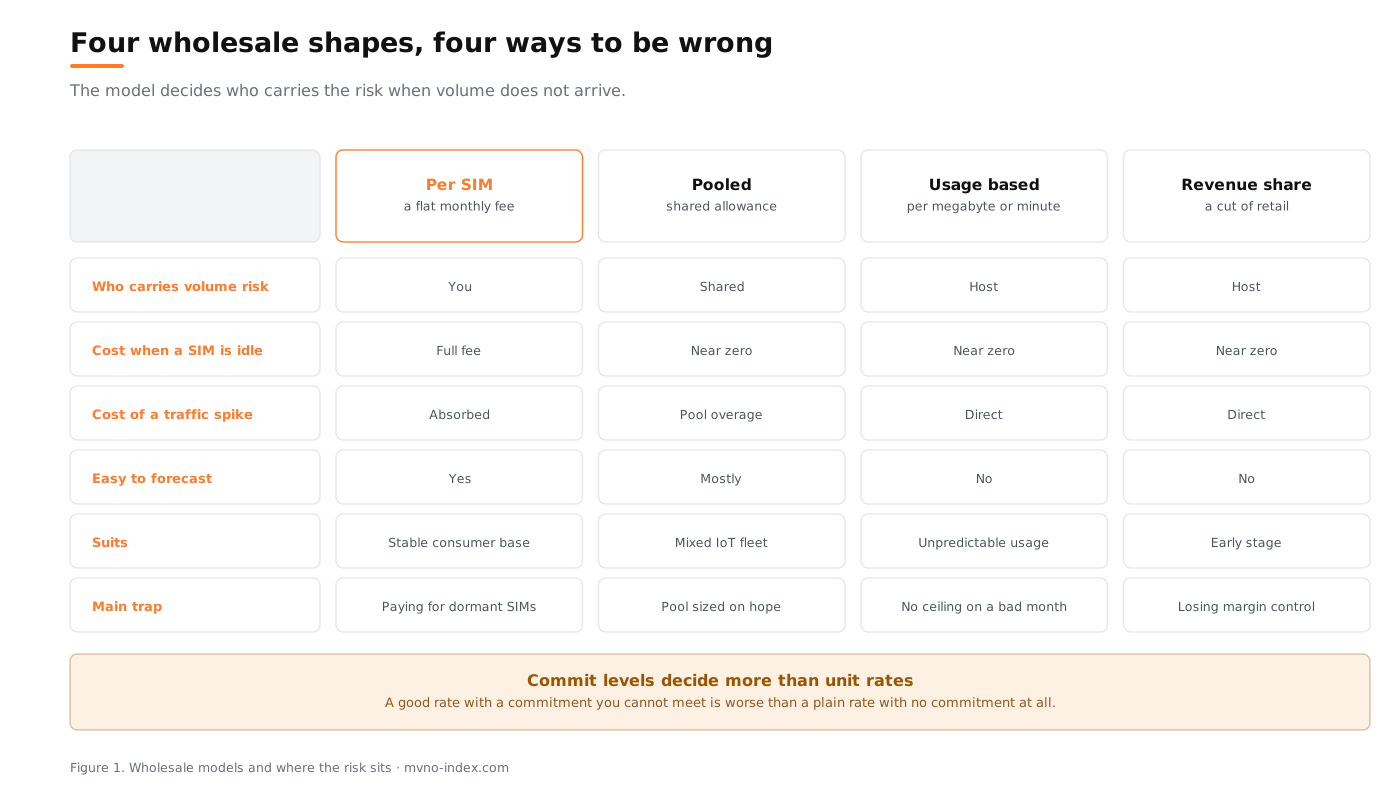
A wholesale model decides who absorbs the cost when volume does not arrive. A flat fee per SIM is easy to forecast and expensive when SIMs sit idle; a pooled allowance spreads a mixed fleet but has to be sized honestly; usage-based pricing removes the floor and the ceiling at once; revenue share postpones the risk at the cost of margin control. The unit rate matters less than the commitment attached to it.
A wholesale model defines how an MVNO or IoT provider buys the network and related services it resells or incorporates into a customer solution. It includes the charging unit, commitments, service rights and division of responsibility. Two offers with the same advertised price per gigabyte can produce very different total costs once their other terms are applied.
The right model fits the intended traffic, customer lifecycle and operating capability. Consumer subscriptions, travel products and long-lived IoT devices create different risks. Compare proposals using realistic usage distributions and growth scenarios, then test how each model behaves when demand is lower or costs are higher than expected.
On this page
- History and Evolution of Wholesale Models
- Core Utility and Functionality of Wholesale Models
- What is a Wholesale Model Used For?
- Key Functions of Common Pricing Models
- Technical Integration and Data Model
- Integration with Other Systems
- Technical Data Model and Key Interfaces
- Wholesale Ownership for MVNOs and IoT Companies
- Why Choose a Particular Commercial Model?
- Advantages and Disadvantages of Wholesale Models
- Organizational Impact of Wholesale Model Selection
- Redundancy and High Availability
- Impact of 4G and 5G and Future Networks
- Wholesale Models for 4G Services
- Wholesale Models for 5G Services
- Long Term Commercial Planning
- Frequently Asked Questions about Wholesale Models
- Summary
History and Evolution of Wholesale Models
Mobile wholesale arrangements have evolved from relatively simple resale towards varied combinations of access, technical enablement and managed services. An MVNO may contract directly with an MNO or obtain access through an aggregator. An IoT provider may combine several connectivity relationships to support devices in different countries and operational environments.
As retail offers became more bundled, wholesale pricing did not always move in the same direction. A customer may pay one predictable monthly fee while the provider pays variable usage and roaming charges. Understanding this mismatch is central to a sustainable offer. The MVNO wholesale agreement guide provides context for the wider commercial arrangement.
Core Utility and Functionality of Wholesale Models
Four models, and who carries which risk
| Per SIM | Pooled | Usage based | Revenue share | |
|---|---|---|---|---|
| Volume risk sits with | You | Shared | The host | The host |
| Cost of an idle SIM | The full fee | Near zero | Near zero | Near zero |
| Cost of a traffic spike | Absorbed | Pool overage | Direct | Direct |
| Easy to forecast | Yes | Mostly | No | No |
| Suits | A stable consumer base | A mixed IoT fleet | Unpredictable usage | An early-stage launch |
| The usual trap | Paying for dormant SIMs | A pool sized on hope | No ceiling on a bad month | Losing control of margin |
What is a Wholesale Model Used For?
The model allocates commercial risk between buyer and supplier. Usage pricing places more of the cost variation with the buyer as traffic grows. A commitment gives the supplier more predictable revenue but exposes the buyer if demand falls short. Neither is inherently better. The choice should reflect the quality of the forecast and the resources available to absorb uncertainty.
The model also determines how easily the buyer can design retail products. A plan priced per connection may support predictable subscription economics, while a traffic-based model may suit variable usage. Service restrictions and included capabilities matter alongside price. A cheap input has little value if it cannot support the product the business intends to sell.
Key Functions of Common Pricing Models
Usage-based pricing charges for measured consumption, such as data, messages or call duration. It can align cost with activity, but the details matter. Billing increments, minimum session charges, destination categories and rounding can change the effective price. Ask for sample calculations using the expected traffic pattern rather than comparing only the nominal unit rate.
Bundle and pooled models provide an allowance under specified rules. Pooling can help when customers have different usage levels, but the eligible population and overage treatment must be clear. An allowance may apply per SIM, per account or across an agreed portfolio. Unused volume may expire, and some traffic categories may sit outside the pool.
Commitment and revenue-share models create different exposures. A minimum spend can secure commercial terms but remains payable under its agreed conditions even if sales disappoint. Revenue share ties charges to a defined retail revenue base. Clarify discounts, refunds, taxes and included services so the percentage has an unambiguous commercial meaning.
Ask for the shape of a bad month before you ask for the rate. A model that is ten per cent cheaper per unit and carries a commitment you miss by a quarter is more expensive than the plain one, and the gap shows up in the month you can least afford it.
Technical Integration and Data Model
Integration with Other Systems
Wholesale charging needs reliable records from the supplying networks and platforms. The buyer must connect those records to its subscriptions, tariffs and customer invoices. A managed provider may perform some of this work, but the buyer still needs enough information to verify the outcome and investigate disputes.
Retail controls depend on the timeliness of wholesale information. A spending alert or data limit can only react to the information and control paths available. Delayed records, especially across partners, may create charges after an apparent threshold has been reached. Test the actual behaviour and describe limits accurately in the customer offer.
The operating chain may include an MNO, MVNA and MVNE. Review the differences between these roles and identify which party supplies access, billing and support. One invoice does not necessarily mean one organisation controls every service dependency or can resolve every fault directly.
Technical Data Model and Key Calculations
Store the contract version, effective dates, applicable rate categories and subscription mappings. Retain the original usage evidence and the adjustments applied to it. Historical reconciliation should use the terms that applied at the time, rather than today's rate card. This becomes important when a customer changes plan or an upstream agreement is amended.
Four wholesale shapes, and where the risk sits in each.
Consider an illustrative commitment of EUR 10,000 per month with measured charges of EUR 7,000. If the contract applies the commitment as a minimum bill, the effective monthly cost is EUR 10,000 before other fees. The unused EUR 3,000 is economically relevant even though it does not appear in the nominal unit rate. Actual agreements can apply different mechanics, so model the wording precisely.
For bundles, calculate cost across the distribution of usage rather than only the average. Two groups with the same total traffic can produce different charges under per-SIM allowances if one contains many heavy users and many almost-idle users. A portfolio pool may behave differently again. Use representative records to compare the proposed structures.
Wholesale Ownership for MVNOs and IoT Companies
What to pin down besides the rate.
| Term | Why it decides the real price |
|---|---|
| Minimum commitment and ramp | The rate is conditional on volume you may not reach |
| What counts towards the commitment | Gross or net, and whether roaming is included |
| Shortfall treatment | Payable, carried forward, or renegotiated |
| Rate review triggers | Who may reopen the price, and on what grounds |
| Term and notice | A long term with a short notice is a different deal |
| What happens to your base at exit | Portability of subscribers and numbers |
Why Choose a Particular Commercial Model?
An MVNO should choose according to its retail offer, expected scale and operating capability. A direct agreement may provide useful control but require commitments and integration work. An aggregated service may simplify access and administration. Compare the total obligations and flexibility of each arrangement instead of assuming one channel is always cheaper.
IoT providers need lifecycle terms that fit testing, inventory, active service and retirement. A SIM may remain unused for months before installation, and a deployed sensor may transmit only occasionally. Ask when recurring charges begin and what suspension means commercially and technically. The cheapest active-device rate can be outweighed by charges on stored or dormant stock.
Advantages and Disadvantages
Advantages:
- Usage pricing can support early experimentation when traffic is uncertain and the buyer wants costs to follow activity. Bundles or per-connection models can make retail forecasting more predictable. Commitments may support commercial negotiation when demand is sufficiently established. Each benefit should be evaluated against the customer's actual usage and the contract's full fee structure.
- A well-designed model also makes growth decisions clearer. The business can estimate the contribution of a new segment, destination or service before launch. Transparent records and pricing rules help commercial teams identify when an offer needs adjustment, rather than discovering the problem only after several months of unexpected wholesale invoices.
Disadvantages:
-
Simple headline prices can hide complexity. Activation charges, platform minimums, roaming categories and exceptional usage may materially affect the bill. Some costs arise outside the connectivity agreement, including payment fees, support and technical integration. A complete retail business case should include these even when the wholesale supplier does not invoice them.
-
Long commitments can become difficult when the product changes. Conversely, a highly flexible arrangement may carry a higher price or fewer customised capabilities. Evaluate the value of flexibility explicitly. A business with uncertain demand may rationally accept a higher unit rate to avoid a large minimum obligation it cannot yet forecast confidently.
Organizational Impact of Wholesale Model Selection
Finance and product teams should share one model of the contract. The retail plan should be tested against the wholesale rules before launch, including unusual but plausible usage. A promotion that attracts heavy consumption can change the economics even if the average subscriber count meets expectations. Review behaviour by segment after launch and update the forecast.
Operations needs to understand the events that affect charging. Activation, suspension and cancellation may have different effective times across systems. A delayed cancellation can create ongoing wholesale charges after the customer has stopped paying. Establish reconciliation and exception handling so these gaps are detected and resolved systematically.
International IoT services require country-specific commercial and operational review. Roaming permissions, local requirements and access availability can affect whether the intended deployment is supportable. Do not assume that a list of countries proves every device may remain connected indefinitely in each one. Obtain explicit confirmation for the intended use and a process for handling changes.
When requesting proposals, provide the same scenarios to each supplier. Include a low-growth case, the expected case and a higher-usage case. Ask for sample invoices, rate definitions and all recurring or one-time charges. Use the solution provider selection guide to compare the resulting complete offers.
Redundancy and High Availability
Commercial resilience includes the ability to keep serving customers when an upstream service is unavailable or changes. Alternative suppliers may help, but the technical design must support their use. SIM identities, profiles, routing and device capabilities can limit how quickly traffic can move. A backup rate card alone is not a working continuity plan.
Billing resilience requires recoverable records and clear reconciliation after outages. Buffered usage may arrive in a burst and change previously estimated costs. Agree how corrections are handled and when a period is considered final. The buyer should be able to distinguish late valid usage from duplicated records before paying or rebilling a customer.
Review the consequences of contract termination, upstream withdrawal and supplier failure. Maintain usable exports and identify the steps required to migrate customers or devices. Long-lived IoT fleets need particular attention because physical replacement may be expensive. Price migration assistance and transition periods before they become urgent requirements.
Impact of 4G and 5G and Future Networks
Wholesale Models for 4G Services
LTE-based products can combine data, voice and messaging costs that behave differently. Confirm which services and access arrangements are included, especially where legacy fallback is changing. Model the supported customer experience rather than assuming that a data allowance represents a complete mobile service.
Wholesale Models for 5G Services
5G access and advanced capabilities may have separate commercial conditions. Slicing, exposure APIs or enterprise service levels should be priced and specified explicitly where available. Do not assume a generic 5G tariff includes every capability described in a network architecture or in the host operator's retail material.
Long Term Commercial Planning
Choose review and change provisions that reflect the expected life of the product. Device fleets and enterprise contracts may last longer than the initial wholesale term. Build reasonable migration and repricing assumptions into the business case. Future network labels are less useful than clear obligations for support, notice and service continuity.
Frequently Asked Questions about Wholesale Models
What is the best wholesale model for an MVNO?
It depends on the retail product, usage pattern, scale and risk tolerance. Compare complete costs under several realistic scenarios. The lowest unit price is not necessarily the best offer once commitments and additional fees are included.
How does pooled data work?
An agreed group shares an allowance under defined rules. The contract determines eligible connections, traffic categories, overage and expiry. Test the pool against representative usage because its value depends on how consumption is distributed.
What is a minimum commitment?
It is a contracted obligation that may require a minimum spend or volume over a defined period. Its exact mechanics vary. Model the amount payable when actual demand falls short and establish when the obligation begins.
Is revenue share simpler than usage pricing?
It can simplify some calculations, but only if the revenue base and included services are clear. Discounts, refunds, taxes and bundled products can complicate the result. Require a worked example using the intended retail offer
Why are IoT lifecycle terms important?
Devices may be tested, stored, deployed and suspended over long periods. Charges can arise before useful commercial service begins. Matching the wholesale states to the deployment lifecycle helps avoid paying an active-service price for unused inventory
Can spending limits eliminate all unexpected charges?
Not necessarily. Controls depend on record timing, network enforcement and the traffic involved. Ask how late usage and roaming are handled, then describe the control accurately rather than promising an absolute cap without evidence.
What should a wholesale proposal include?
Request service scope, complete rate rules, commitments, billing examples, support responsibilities and migration terms. Provide realistic traffic and growth scenarios so competing suppliers quote against the same business requirements.
Summary
MVNO and IoT wholesale models determine how traffic, scale and lifecycle behaviour become costs. A sustainable choice aligns the pricing structure with the retail offer and makes responsibilities, restrictions and downside exposure understandable.
Compare partners through the MVNO Index solution provider directory. Request complete scenario-based proposals and validate the charging records before committing to a model or launching the corresponding customer tariff.
General Information