
If you’d asked an MVNO founder ten years ago what really mattered, the answer would probably have been coverage, wholesale rates, and launch speed.
Still important. Always will be.
But today, spend time inside an MVNO and the conversation quickly shifts to different questions:
Why do customers drop off after activation?
Why does support not see what marketing just promised?
Why does something “simple” take three systems and a spreadsheet to fix?
That’s where CRM stops being theoretical and becomes very real.
The network gets you live. CRM keeps you alive.
Most MVNOs don’t compete on the network itself. They compete on experience — how easy it is to join, how clear things feel, and how well the business responds when something goes wrong.
Those experiences are shaped long before a support ticket is logged. They’re shaped by how well systems talk to each other — and CRM is usually where that conversation starts.
An example: what “end-to-end CRM” actually looks like
Let’s make this concrete.
A customer clicks on a campaign, signs up, activates a SIM, uses data, hits a billing issue, and chats to support.
In a modern MVNO, that journey might look like this behind the scenes:
- CRM holds the customer profile, lifecycle stage, and engagement history
- Billing / charging system tracks usage, balances, and invoices
- Provisioning platform activates services on the network
- Marketing automation triggers onboarding emails, nudges, and offers
- Support tools handle tickets, chats, and resolutions
None of these systems replace the others. They all do what they’re good at.
What matters is how they’re connected.
The architecture (without the headache)
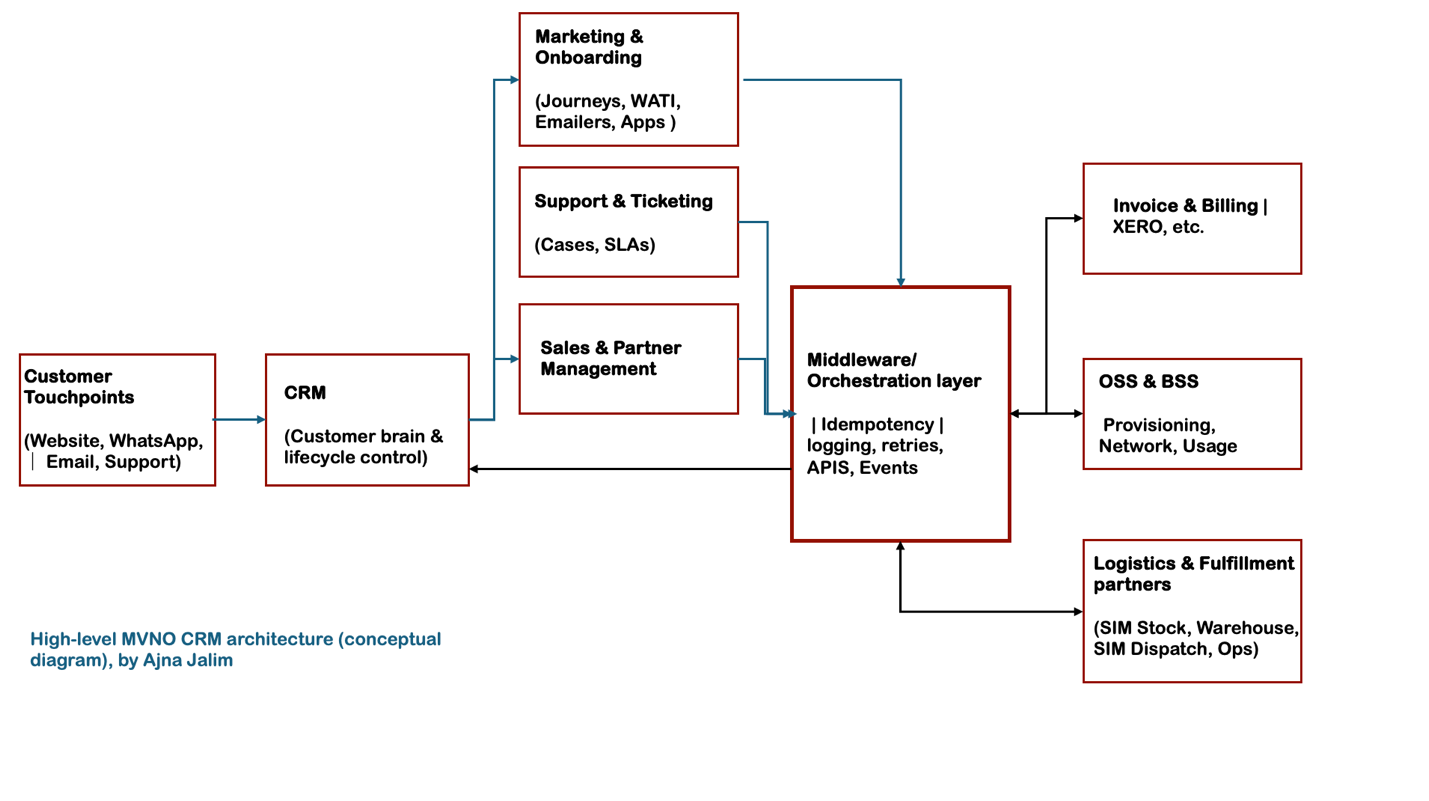
In most modern MVNOs, CRM sits at the centre, but it doesn’t directly hard-code everything.
Instead, systems are typically connected through a middleware or integration layer — often using APIs and event-driven messaging.
Think of it like this:
- CRM is the brain that understands the customer
- OSS/BSS, billing, and provisioning systems are the specialists
- Middleware is the translator and traffic controller between them
When something happens in one system (activation, usage threshold, failed payment), an event is sent through the middleware layer. CRM picks it up and decides what should happen next.
That might mean:
- triggering a welcome journey
- flagging a churn risk
- alerting support before the customer complains
- updating multiple systems automatically
Nothing fancy for the customer — but a big deal operationally.
Why this matters more than people expect
Without this orchestration, MVNO teams often end up compensating manually:
CSV exports.
One-off fixes.
“Just email support and they’ll sort it.”
It works… until it doesn’t.
With an integrated CRM architecture, teams can trust that:
- everyone is looking at the same customer
- actions in one system are reflected everywhere else
- automation replaces operational friction
This is where CRM quietly becomes infrastructure.
A more realistic picture of a modern MVNO stack
To really understand why CRM matters so much, it helps to look at what a typical MVNO is actually running day to day.
Most MVNOs aren’t built on one neat platform. They’re built on many specialised systems, each solving a very specific problem.
Here’s a simplified (but very real) example.
A day in the life of a growing MVNO
Imagine a consumer-facing MVNO selling physical SIMs and eSIMs, both online and through partners.
Behind the scenes, they might be running:
- A website and checkout where customers sign up, choose a plan, and pay
- Onboarding and messaging tools (for example WhatsApp-based onboarding using platforms like WATI) to guide activation
- OSS/BSS platforms handling provisioning, number allocation, usage, and network events
- Billing and invoicing software (often something like Xero or a dedicated billing engine)
- Logistics and shipping systems managing SIM stock, couriers, and delivery status
- Customer ticketing and support tools for chat, email, and incident tracking
- Payroll and finance systems for internal operations
- Marketing automation tools for campaigns, lifecycle messaging, and retention
Each of these systems is good at what it does. None of them, on their own, understands the whole customer.
That’s where CRM earns its place.
Where CRM actually sits in this ecosystem
In a setup like this, CRM becomes the central layer that knows who the customer is and where they are in their journey.
It doesn’t replace:
- OSS/BSS
- billing engines
- logistics platforms
- finance systems
Instead, it connects to them.
- When a SIM is shipped, the logistics system updates the middleware.
- When activation completes, the OSS/BSS sends an event.
- When usage spikes or payment fails, billing triggers a signal.
Those signals flow through a middleware or integration layer and land in CRM — where decisions can be made.
The middleware layer: the unsung hero
Most modern MVNOs rely on a middleware layer (iPaaS, custom APIs, or event buses) to connect everything cleanly.
This layer:
- translates data between systems
- ensures updates happen in near real time
- prevents hard dependencies between platforms
Think of it as the traffic controller that keeps systems decoupled but coordinated.
Without it, teams end up wiring point-to-point integrations that break the moment something changes.
What orchestration looks like in practice
With this architecture in place, CRM can orchestrate real-world outcomes, such as:
- Triggering onboarding messages once a SIM is delivered
- Alerting support when a high-value customer fails activation
- Pausing marketing campaigns for customers with open billing issues
- Flagging churn risk based on usage drops or missed payments
- Keeping finance, support, and marketing aligned without manual handovers
From the customer’s perspective, it feels simple.
From the business’s perspective, it’s anything but — unless CRM is doing its job properly.
Why MVNOs don’t “just add another tool”
This is why MVNOs quickly discover that adding more tools doesn’t solve complexity, it amplifies it.
What scales is coordination, not software count.
It’s also why many MVNOs lean on CRM and RevOps specialists, not to add complexity, but to untangle it.
Comment “Know more” if you want a few solid expert recommendations.
The quiet advantage of getting this right
MVNOs that invest early in an integrated, CRM-led architecture gain something subtle but powerful:
clarity.
- Teams trust the data.
- Journeys feel intentional.
- Problems surface earlier.
And as the business grows, complexity doesn’t spiral, it’s absorbed by the system.
That’s the real reason modern MVNOs aren’t built on networks alone.
They’re built on how well everything works together around the customer.
From subscribers to signals
Once CRM is wired into the wider MVNO stack, something interesting happens.
Customers stop being static records and start becoming signals:
- behaviour
- intent
- risk
- opportunity
That’s what allows MVNOs to act earlier, communicate better, and design experiences that feel intentional rather than reactive.
Built on CRM, not just networks
Networks will always be the foundation. But they’re no longer the differentiator.
The MVNOs pulling ahead today are the ones that treat CRM as the connective tissue of the business, linking systems, teams, and customer moments into something coherent.
In that sense, modern MVNOs aren’t just built on networks.
They’re built on how well everything connects around the customer.

Guest Blogs are written by carefully selected Experts. If you also want to create a Guest blog then Contact us.