
This year marks the 20th anniversary of Mobile World Congress being hosted in the beautiful city of Barcelona and believe it (or not because I scarcely can) it’s my 15th year attending this undeniably important event.
MWC is absolutely a vibe – whether it’s your vibe or not – it holds a power over the industry that is impossible to ignore.
“Mobile World Congress provides an unparalleled platform to transform digital connections into high-impact, face-to-face collaborations where the raw exchange of ideas fuels the next wave of industry innovation.” – James Body of Telet
I personally LOVE the vibe and once you have been as many times as I have the muscle memory kicks in the moment you land at El Prat. The consistency of the sameness makes the logistics of the whole week so much easier. The same shuttle routes, the same badge queues, the same halls that somehow manage to feel both enormous and claustrophobic at the same time.
And while that consistency is beneficial for keeping my steps below 30,000/day (thank you Mark Birchall and Tradefair for use of the UK Hospitality room in Hall 7 – you are a lifesaver).
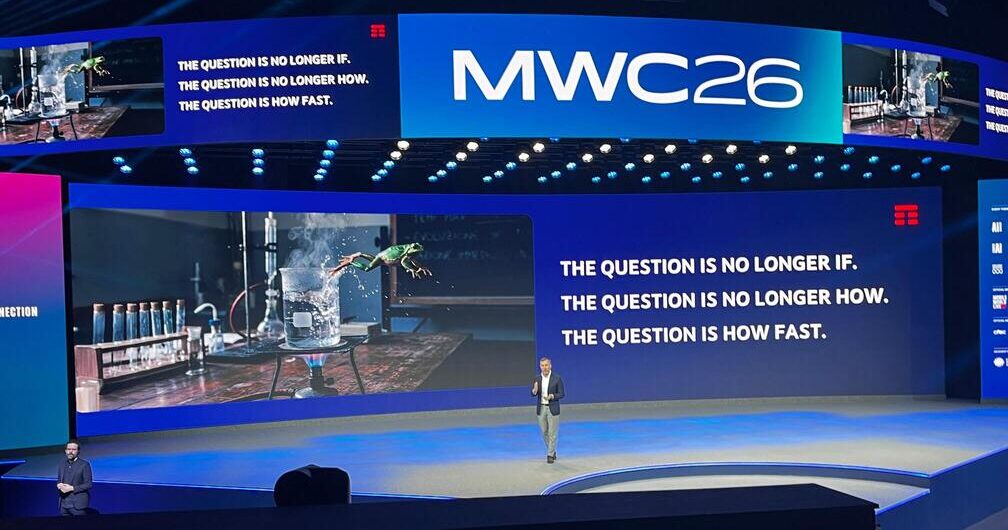
More of the same is not what I expect from the core content of the show.
Don’t get me wrong…it is fun to see the Honor Robot phone but it is not more than a glorified prototype with no real user specs i.e. battery life, cost, ect. And perhaps some people believe that the interface of the future is going to be a connected contact lens but I, for one, am sure that I will NOT be using my tongue (as suggested by the team at Xpanceo) as gesture control.
So how do you distinguish the real from the hype??
Because more than ever, this year considering the state of the world and the real-time impact it had on the event…the hype just seems hollow. Just more of the same razzel-dazzel distraction employed by the GSMA to make you feel like you saw something new when in truth valuable layers of the ecosystem, such as network virtualization (MVNOs) continue to be largely ignored. But that is what I said last year and who wants to say the same thing over and over. So, in thinking about what I wanted to share with you all in this MWC Special Edition, I decided I would do something different.
I went directly to the source. Industry veterans and insiders in the MVNx ecosystem whose companies, despite all odds, have survived the past 20+ years of industry growth and asked them to share their thoughts with me and not the press release version. The real version – the truth of what it means to be an MVNx within the halls of MWC. These are people who survived the consolidation waves, the regulatory battles, the rise and fall of dozens of MVNO models. They know where the bodies are buried (mainly because they helped dig some of the graves) and collectively there is more than two centuries of experience between them.
I presented several questions for discussion and what came back was more useful than anything I heard about MVNOs from any stage in Barcelona.
1. The Evolution: From Reseller to… What Exactly?
The first thing I wanted to know was simple: how has the MVNO industry actually changed since the first MVNO was launched in 1999?
Mikael Schachne, CRO Enterprise at BICS (Proximus Group) and one of the Top 100 Most Influential in Roaming and Interconnect, did not hesitate. In his view, “…the transformation has been radical — from simple resale to embedded digital ecosystems spanning eSIM, IoT, AI-powered customer engagement, and API-driven platforms.” This sentiment of growth was echoed by Hamish White of Mobilise who noted in his MWC26 wrap-up, “…the MVNO model is undergoing a genuine renaissance, driven by digital-first propositions and eSIM-native architectures.”
The number of eSIM providers at the show could have been seen as confirmation of this conclusion. However, the most common response I received offered a sharply different view: “In principle it really hasn’t changed that much. The tools are better, sure. The acronyms are shinier. But the …fundamental power dynamic — MVNOs dependent on MNOs for access, pricing, and technology pass-through — remains largely intact.”
It’s an uncomfortable truth but one that screams out (albeit silently) from the halls of La Fira, year after year.
Artem Kirillov, COO and Business Development Director at MTX Connect — a full MVNO operator out of Luxembourg with 25+ years in IT and Telecom — put numbers to it. “There are now over 2,000 light MVNOs globally, but only around 90 full MVNOs — and fewer than 20 that operate as truly global full MVNOs. That is a ratio that should give everyone pause.”
Daniel Preiskel, Senior Partner at Preiskel & Co LLP in London with 30+ years in telecoms law and Chairman of the iMVNOx Association, added a structural observation: Over the past 25+ years MVNOs have been affected by other major changes in the industry “…the smartphone revolution effectively killed voice-based and brand-based MVNOs, shifting everything to data. The evolution is real, but it is deeply uneven — and for most, it is still happening on someone else’s terms.”
2. The Survival Question: What Does It Actually Take to Last?
As I have shared before, the stats for MVNO survival are pretty dismal – with fewer than 15% of MVNOs surviving to maturity before being sold for parts by exhausted investors. So I asked: what separates the survivors?
Schachne gave a measured, strategic answer: “...regulatory compliance, genuine differentiation, scalable and flexible systems, and the smart use of AI and automation.” Shanks Kulam, of eSIMGo put it another way, “To survive, having a low barrier of entry, quick integration +via API or web app white-label, and not as a stand alone rather a compliment to an existing offering with existing users, is key to making a long-term sustainable B2C offering.”
Fair enough. But the most common response I got cut straight to the point: “…most of the ones that survived were bought by an MNO.”
Preiskel framed it with characteristic legal precision: “…an MVNO must survive long enough, and build enough subscriber value, to become an attractive acquisition target. That is not a criticism — it is the commercial reality of an industry where, as 1GLOBAL’s latest market analysis confirms, the by-volume reseller model is officially obsolete.”
Let that sit for a moment. The most reliable MVNO exit strategy is being absorbed by the very entity with whom you were supposed to compete.
Seems less like a competitive market strategy and more like a start-up incubation layer for the MNOs. A growth strategy where, if the MVNO fails, the only risk to the MNO is essentially wooden dollars and if they succeed, the host operator can easily acquire a whole new customer base.
All for pennies on the dollar.
So when cost of acquisition per customer is a key valuation metric and incubating an MVNO (either full or lite) requires such little effort. When an MVNO strategy allows the MNO to earn margins during the growth phase and then write off the total acquisition cost against profits, is this truly competition?????
Correct me if I am wrong but to me it seems like the snake eating its own tail.
3. What’s new this year for MVNOs at MWC? More of the same
As Cellusys noted in their MWC26 recap, key themes of fraud prevention and network security dominated but the long-term structural concerns of virtual operators barely registered.
It is not a problem alignment, there were many strategic opportunities in this year’s programming to include MVNOs in the conversation. Mark Castle, CRO at Globalgig and founding member of the iMVNOx Association with nearly 30 years in mobile communications, noted that “..while SGP.32 and IoT eSIM were the big talking points this year. MNOs launched these initiatives without any meaningful MVNO consideration.”
SGP.32 — the GSMA specification enabling remote SIM provisioning for IoT and consumer eSIM at scale — could have perhaps been the most significant technical development for MVNOs at MWC’26. But Castle’s observation highlights a very LONG-term challenge echoed by many of our contributors.
“MNOs are rolling this out on their own terms, with no obligation to extend wholesale access to MVNOs. It is the same pattern we have seen with every new technology cycle. The innovation arrives, the MNOs deploy it, and MVNOs are left scrambling for access months or years later, if they get it at all.”
This is the collaboration-versus-competition argument in its purest form. Hamish White has argued that MNOs need to get their wholesale strategy right to capitalize on the MVNO growth channel. Cell C and other MNOs including BICS have garnered results over the years which prove the MVNO model works when operators choose collaboration. But without regulatory teeth behind the expectation, “choosing collaboration” remains exactly that — a choice. And one that most MNOs have shown little inclination to make.
Which brings me back, unfortunately and unwillingly to the sameness of what I wrote last year.
In 2025, the MVNO Summit at MWC (in its 3rd year) occupied 0.0625% of the total programming time. This was true again in 2026. Multiple contributors confirmed that the Summit continues to feel like an afterthought — a Wednesday afternoon sideshow at the far end of La Fira, well after most decision-makers have packed their bags. So if I am seeing it in the exhibition halls, and if the industry veterans are confirming it, and if even the GSMA’s programming allocation tells that same story – at what point do we stop calling this a missed opportunity and start calling it a deliberate one?
The conclusion – MVNOs may now be in the room but we still have NOT been invited to the table.
Which continues to harm consumers. According to Eduardio Tapia at Qualoo, “One of the biggest issues facing the industry is that customer experience is still too often treated as a brand promise rather than an operational discipline. Too much time is spent marketing quality and not enough proving it. When real-world mobile performance is inconsistent, whether due to coverage, congestion, poor routing, network misconfiguration, or other underlying network deficiencies, and QoE is not properly measured, MVNOs often suffer commercially even when the root cause sits with the host network. But the people who suffer most are the users, who have the least control over any of it. In a world where connectivity underpins banking, education, work, healthcare, and communication, it should be treated as a basic necessity, not just a marketing claim.”
If MVNOs had a seat at the table than perhaps we could actually begin to address some of these more pressing issues
4. The Structural Reality: MNO Dominance & Regulatory Question
Of all my questions, this one seemed to strike to the heart of the issue and brought comments from every single contributor – regardless of geography, background, or commercial interest.
The bottom line – industry veterans still see MNO dominance as the defining constraint on the MVNO industry. It is the gravity well from which nothing escapes.
Several of my contributors laid out four specific key issues that remain today.
- unfavourable wholesale pricing,
- restricted access to new technologies,
- regulatory frameworks that favour incumbents
- the constant threat of MNOs launching or acquiring competing MVNOs and turning them into sub-brands.
Schachne acknowledged the tension but framed it as potentially collaborative — arguing that “… MNOs who embrace MVNO partnerships can unlock new revenue channels”. Cell C’s wholesale MVNO operation in South Africa is the proof point: revenue up 13% year-on-year, driven specifically by MVNO partnerships vs their retail unit which is only up 2.6% year over year.
Kirillov again highlights the data: “..of the roughly 96 full MVNOs operating in Europe, approximately 50 exist primarily because of regulatory mandates. Strip away the regulation, and you strip away half the full MVNOs.”
Preiskel, drawing on three decades of telecoms law, articulated what he calls the “two masters” problem: “…MVNOs are simultaneously dependent on MNOs for network access and expected to compete against them in the retail market. It is, as he put it, a structurally conflicted position that no amount of business planning can resolve without regulatory intervention.”
The launch of the MVNO Consortium at MWC 2026 was a notable development — a collective attempt to give MVNOs a louder voice. Whether it becomes more than a press release remains to be seen. But the intent signals something important: the industry is tired of waiting for the incumbents to make things happen. Of course, I have some thoughts on how difficult it can be to rally MVNOs to a common cause considering that most of these executives are strapped for both cash and time – but I wish the Consortium luck.
I am sure they will need it.
5. The Identity Crisis: What Actually Counts as an MVNO?
Is a “rose by any other name” still an MVNO??? Kirillov was the sharpest voice here, and one I tend to agree with: “…the industry is awash with eSIM providers calling themselves MVNOs who are, in his words, nothing more than app-based marketplaces reselling QR codes. They have no SLA with the end user. No network infrastructure. No regulatory standing. They are, effectively, digital middlemen wearing an MVNO badge.”
As Alertify’s MWC 2026 analysis highlighted, travel connectivity has become the new battleground, with a growing power struggle between traditional MVNOs, eSIM aggregators, and MNO-backed digital brands. The consensus among my contributors reinforced this challenge: “…too many MVNOs believe that travel eSIM alone will be enough to sustain a business. It will not. The margins are thinning, the competition is intensifying, and without genuine network-level differentiation, they are building on sand.”
6. The Unpriced Frontier: NTN and Direct-to-Device Satellite
What was most interesting to myself and to several of our contribtuors what the overwhelming presence of NTN operators. Direct to Device Satelitte or Non-Terrestrial Networks were everywhere — on panels, in demos, embedded in the eSIM conversation. Sanjay Kalra’s MWC reflections echoed this, noting that satellite-plus-terrestrial hybrid connectivity has emerged as a strategic priority across the industry.
But here is my question — the one nobody at MWC seemed willing to ask: what are economics? Who pays? And at what price point does satellite connectivity reach the average consumer? Because if the history of roaming charges has taught us anything, it is that the telecoms industry has a remarkable talent for deploying extraordinary technology and then trying to figure out how or rather who should pay for it. This conundrum was represented in real time by the GSMA programming. In one hall you had Airbus & Aalyria talking about a federated consortium to access NTN networks while at the same time in a closed door session the MNOs were meeting to address the growing issue of how they are going to pay for the 5G networks.
My fear is that again we will see advanced connectivity priced in a way that increases the inequality gap rather than closing it. Making these technologies available only to those who can afford it – when we still as an industry have a great responsibility to connect those 3billion people on this planet who still are unconnected. Perhaps, NTN is the next step in connecting the edge. Or, more likely, it is shaping up to be the next frontier for roaming. To me it seems more like putting the cart before the horse. More of the same HYPE without any substance.
CONCLUSION:
After hearing from the combined voices of these Industry Veterans with over a century of combined experience in telecommunications, the uncomfortable truth is clear: MVNOs are more relevant than ever — but the industry structure actively works against them.
MWC 2026 celebrated connectivity innovation across four days and thousands of exhibitor hours. The MVNO Summit got its 150 minutes. The eSIM revolution was everywhere — and yet the companies best positioned to deliver it to consumers remain locked in the same structural constraints they faced a decade ago.
Every one of my contributors — from Schachne’s optimism about embedded digital ecosystems, to our anonymous veteran’s blunt assessment that nothing has changed, to Kirillov’s taxonomic precision, to Preiskel’s legal acumen, to Castle’s front-line commercial reality — pointed to the same conclusion.
The MVNO industry has the talent, the technology, and the market demand.
What it STILL does NOT have is fair access.
And until that changes, perhaps I will have to write the same thing year after year about MVNOs x MWC.

Guest Blogs are written by carefully selected Experts. If you also want to create a Guest blog then Contact us.