
Introduction: The coverage illusion
For decades, connectivity strategy has been driven by a simple assumption: if there is network coverage, services will follow. Yet coverage alone does not guarantee continuity, affordability, or business viability, especially outside dense urban centres.
As 5G, private networks, and industry-specific connectivity models mature, a new question emerges:
How can MVNOs create differentiated, resilient services without owning physical networks?
The answer increasingly lies in Device-to-Device (D2D) and Non-Terrestrial Networks (NTN), not as niche add-ons, but as foundational enablers of next-generation MVNO business models.
The need for D2D / NTN in the 5G & private network era
5G promised ultra-low latency, massive device density, and network slicing. Private networks promised deterministic performance for enterprises. Yet both share a common limitation: they remain geographically bounded.
D2D and NTN extend these paradigms by:
- Allowing devices to collaborate directly when network infrastructure is unavailable or degraded
- Providing persistent reach beyond terrestrial boundaries, including oceans, airspace, borders, and remote terrain
- Enabling service continuity, not just access continuity
From an MVNO perspective, this is critical. MVNOs are no longer just resellers of access they are becoming service aggregators, experience brokers, and vertical solution providers. D2D and NTN provide the missing reach and resilience layer needed to serve those roles.
In private 5G deployments—ports, mines, factories, campuses—D2D enables local autonomy, while NTN ensures backhaul independence and emergency fallback, creating a unified service fabric rather than isolated islands.
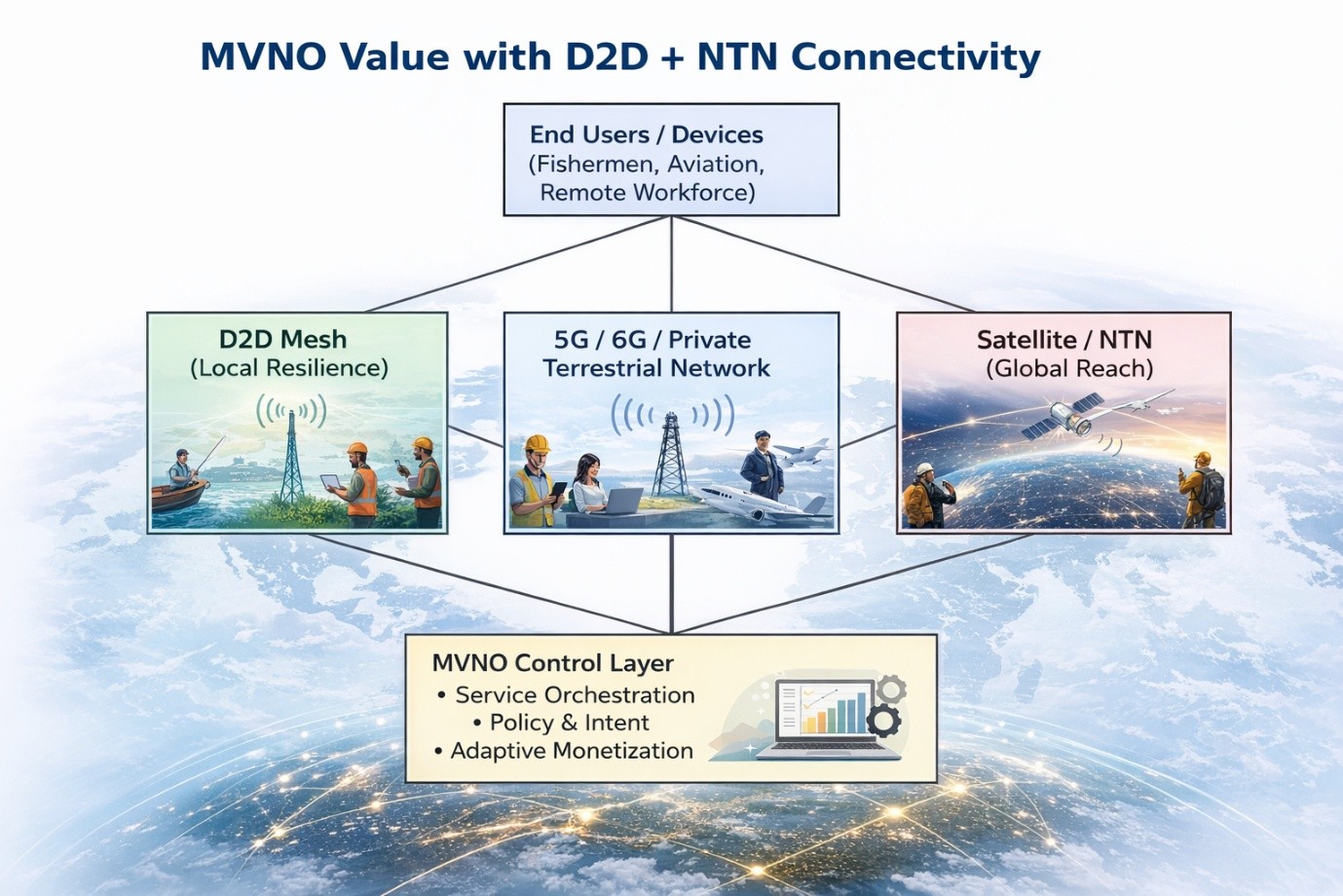
Fig #1: MVNO value with D2D and NTN connectivity
Merging business and technology
A powerful emerging concept is the regionalization of Radio Access Technologies (RATs)—where different access types dominate based on geography, mobility, and regulatory constraints. Consider aviation:
- Aircraft move across multiple sovereign airspaces
- Terrestrial coverage is intermittent or non-existent
- Latency, safety, and compliance requirements vary by phase of flight
Here, NTN becomes the primary access, while regional terrestrial RATs take over near airports and controlled airspace. For MVNOs, this unlocks regional service constructs:
- Per-flight connectivity bundles
- Safety-prioritized traffic classes
- Predictive switching based on route, altitude, and weather
The same model applies to maritime corridors, border regions, deserts, and mountainous terrain—where no single RAT is sufficient, but a choreographed combination is.
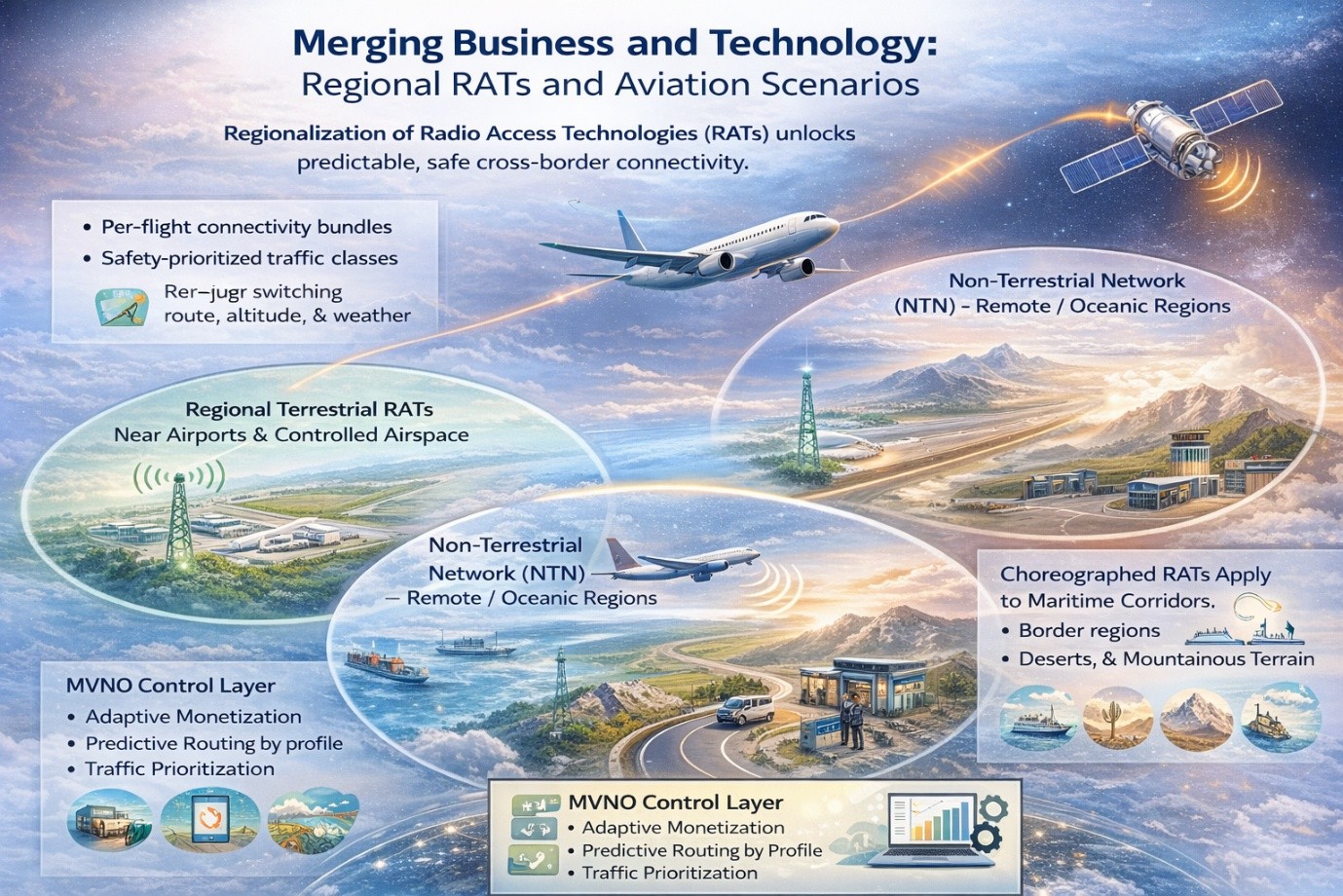
Fig #2: Merging business and technology
New avenues for MVNOs in B2B scenarios
D2D and NTN fundamentally shift MVNO economics and positioning in B2B markets. Instead of competing on price alone, MVNOs can offer:
- Continuity-as-a-Service for logistics, maritime, utilities, and aviation
- Outcome-based connectivity (uptime, safety, compliance), rather than GB-based plans
- Federated service orchestration across public networks, private networks, and satellite
Regional challenges that demand a new model
Following use cases illustrate the need for D2D and NTN better than fishing communities. Fishermen often operate:
- Beyond terrestrial coverage
- In cost-sensitive environments
- Under strict safety and regulatory mandates
Connectivity gaps directly impact safety, livelihood, and compliance. In such scenarios:
- NTN provides wide-area reach
- D2D enables local coordination between vessels
- Intelligent switching ensures cost optimization near shore
- Weather-aware decisioning preserves reliability during adverse conditions
For MVNOs, this represents a socially impactful yet commercially viable opportunity—one that blends connectivity, policy, and experience into a single service offering.
MVNOs at the centre of the next connectivity shift
D2D and NTN are not merely network technologies—they are strategic enablers for MVNO transformation. As networks evolve toward autonomy, intent-driven orchestration, and ecosystem collaboration, MVNOs are uniquely positioned to:
- Abstract network complexity
- Federate multiple access domains
- Deliver continuity where traditional operators struggle
- Serve verticals that demand more than coverage
The future of connectivity will not be defined by who owns the network—but by who can compose, orchestrate, and monetize connectivity intelligently. For MVNOs, D2D and NTN are not optional. They are the gateway to relevance in the 5G, private network, and post-5G world.

Guest Blogs are written by carefully selected Experts. If you also want to create a Guest blog then Contact us.