
A recent MVNE selection shows how AI can help a lean founding team move faster but it also highlights how easily an early idea can become a platform requirement.
I have spent more than 15 years building, launching, and growing wireless companies, and I can confidently tell you that building a sophisticated MVNO with a lean team has never been easier. In this article, I will walk you through a recent MVNE selection process, what I observed while using AI to support the work, how I corrected it, and what could have happened if the behavior had gone unnoticed.
But let's start at the beginning. You want to build an MVNO. Maybe you have identified a customer segment that traditional wireless brands do not serve well. Maybe you operate a subscription business and believe mobile could strengthen the customer relationship and reduce churn. Or perhaps you have an audience, distribution advantage, or brand that gives you a credible reason to enter wireless.
You are probably also looking at AI as part of your advantage. Compared with a founder beginning the same work only a few years ago, you can move faster and produce more with fewer people. Your vendors may be making similar investments, creating the possibility of leaner operations, embedded automation, and a simpler path from concept to launch.
Configurable MVNE platforms, digital distribution, eSIM, cloud services, and modern APIs have already lowered many technical and operational barriers. AI adds research and execution capacity that once required far more people, time, and outside support. A small founding team can now study the market, compare competitors, test an offer, document customer journeys, draft requirements, develop an RFP, evaluate vendor responses, and build an initial financial model before every specialized role has been hired.
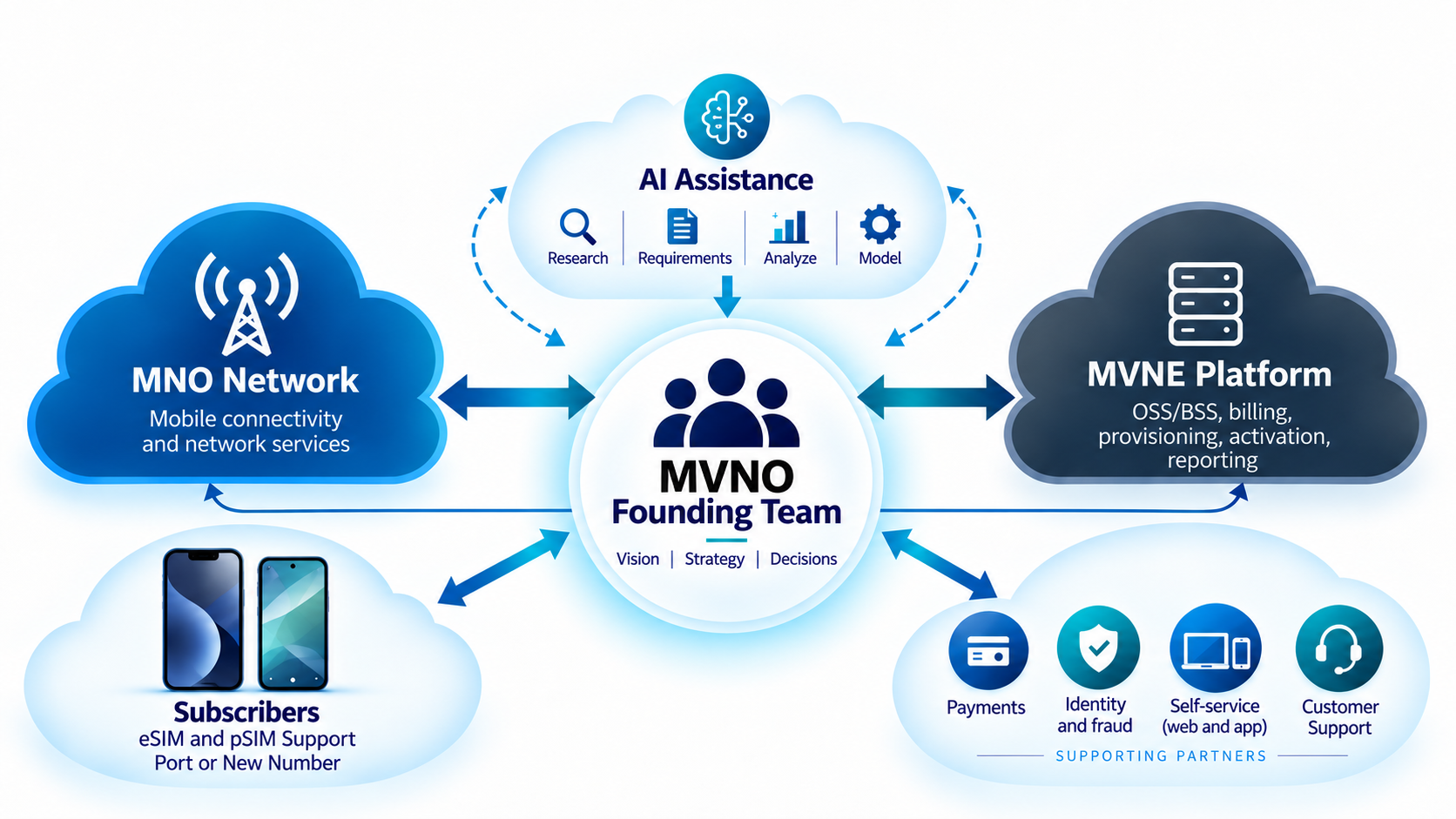
That is a meaningful advantage for a capital-constrained startup. It also creates a new responsibility. When the same AI workspace carries ideas from research into requirements, vendor evaluation, and financial planning, small changes in meaning can travel much farther than anyone intended. The artifacts may improve while the underlying decision quietly changes.
That is the environment in which I recently worked through an MVNE selection process. AI supported the work across requirements, vendor research, response analysis, financial modeling, and the final recommendation. Using it across the full process created real efficiencies. It also allowed a small shift near the beginning to propagate through every artifact that followed. Thankfully, I caught the drift before it influenced a decision that would have been difficult or expensive to reverse.
The MVNE selection begins with requirements
I cannot stress enough how important your business and functional requirements are to your early MVNO development. Unfortunately, the Product Management function that would normally develop and govern those requirements is not represented on many early founding teams.
Requirements translate the founder's vision into the capabilities the business must deliver. They should begin with the intended customer experience and what internal teams need to support the business, not with a preferred vendor's feature list. They should cover the full system: brand awareness, customer acquisition, purchase flow, onboarding, eligibility, devices, porting, SIM fulfillment, activation, plans and promotions, payments, billing, care, fraud, analytics, regulatory obligations, wholesale dependencies, and the ability to evolve or transition the platform later.
In this process, AI was particularly useful for organizing discovery notes, mapping requirements to customer journeys, identifying missing exception paths, drafting acceptance criteria, and exposing contradictions. Those are significant efficiencies. They can allow a lean team to build a more complete view of the business before development and integration decisions make change expensive.
But the review should not stop at whether the artifact was complete and well written. Every important item needs a status and a reason. In my recent example, we asked, “is it required for launch, intended for a later phase, or still being explored?” “Was it a regulatory constraint, a commercial preference, a planning assumption, or an approved business decision?” A requirement earns authority from a deliberate decision, not from the quality of the document in which it appears.
Requirements should drive the RFP
You may be tempted to skip a formal RFP because you already have a vendor introduction, the schedule is aggressive, or every modern MVNE appears to offer the same basic capabilities. That shortcut may save several weeks upfront, but it can create years of platform constraints later. The platform will affect not only whether you can launch with your MVP, but also how easily you can change pricing, introduce promotions, recover failed activations, serve customers, understand performance, improve economics, and eventually change direction.
A good RFP is not procurement theater. It makes the intended business visible and gives each potential partner the same opportunity to explain how it would support that business. It exposes differences a website comparison will miss: what is truly configurable, who controls it, what requires custom development, which functions depend on the underlying MNO, what will be available at launch, how exceptions are handled, and what will be committed in the contract.
AI makes a disciplined RFP achievable for a lean team. It can draft questions from the requirements, normalize vendor terminology, flag incomplete answers, prepare follow-up questions, compare commercial structures, and maintain a traceable evaluation. Demonstrations, references, technical validation, live discussions, and contract review still matter because a vendor's useful answer is rarely a simple yes or no.
The most consequential errors were not hallucinations
I have written before about why hallucination rates may be the wrong benchmark for measuring AI improvement. In my own professional workflows, the costliest failures were rarely invented facts. They were subtle shifts in meaning: an assumption becoming a fact, an outdated decision continuing into a new artifact, or correct information being applied in the wrong context. I described these patterns as inference slippage, obsolete continuity, and context contamination.
My recent MVNE selection showed how those shifts could affect a consequential business decision. An early preference could become a selected operating model. An available capability could become a required architecture. A planning assumption could appear later as a forecast. Because the requirements, vendor evaluation, financial model, and recommendation depended on one another, a change near the beginning could propagate through the entire selection. This type of requirements drift is difficult to detect. An early discussion can become a must-have RFP item while every document in the chain still looks polished and internally consistent.
Consider an autopay discount. A founder might raise it as one option for improving payment success and reducing churn. An AI-generated summary may state that the business will offer it. A requirements draft can then convert that statement into a must-have billing capability. Vendor research may favor MVNEs whose public materials mention the feature while treating silence from others as a capability gap instead of an unanswered question. The scorecard rewards the apparent fit, and the recommendation favors the vendors that survived the earlier filters.
I also saw a related form of drift during a recent market and competitive research project. AI moved one possible competitor into the selected comparison set, then referred to it later as though the team had already approved the choice. The company information was accurate, but the decision history was not. A model-generated recommendation had quietly become a project decision.
Nothing in that chain had to be fabricated. Each artifact can accurately reflect the one before it while moving farther from the original discussion. By the time the change becomes visible, it may already have altered which vendors were considered, how they were scored, and which platform was recommended. That is why teams should review not only whether an AI-assisted artifact is factually accurate, but also whether it preserves the source, owner, and approval status of each consequential decision.
Review the decision inside the artifact
You do not need a large AI-governance program to prevent this. You need to review the decision logic as carefully as the writing, calculations, and formatting. For every important artifact, identify where each material statement originated, what status it holds, who can approve it, and what evidence supports it.
Then look downstream. Would changing the assumption alter the requirements, shortlist, architecture, economics, timing, or customer experience? Could it be reversed after launch, and at what cost? A consequential and difficult-to-reverse decision deserves more scrutiny than an easily changed configuration choice.
For vendor scoring, separate true gates from weighted preferences. Treat missing information as unknown rather than as a confirmed gap. Distinguish a marketing claim from a demonstrated capability and a roadmap statement from a contractual commitment. If one assumption materially changes the recommendation, make that dependency visible before signing.
Before accepting an AI-generated artifact, check six things: its source, status, owner, evidence, downstream impact, and reversibility. Those checks are especially important when the output will influence requirements, vendor eligibility, financial assumptions, or a contractual commitment.
Before you select an MVNE
Before you commit to an MVNE or launch architecture, make sure your team has:
- Defined the target customer, the problem the MVNO will solve, and its key differentiator.
- Chosen the intended operating model, including which functions will remain in-house and which will be outsourced.
- Separated launch requirements from future capabilities, preferences, and ideas that are still being explored.
- Documented the source, owner, and approval status of major requirements and financial assumptions.
- Evaluated multiple MVNEs through a structured RFP based on the same requirements and business scenarios.
- Validated material capabilities directly instead of treating missing public information as a confirmed gap.
- Mapped responsibility for payments, fraud, billing, reporting, customer support, compliance, and other key functions across the internal team, MVNE, and third-party partners.
- Defined the intended device and SIM strategy, including BYOD or device sales and support for eSIM, physical SIM, or both.
- Identified how customers should purchase and activate service, such as through a website, mobile app, on-device eSIM notification, QR code, or assisted-support channel.
- Defined the launch expectations for eligibility, device compatibility, porting, and new-number assignment.
- Used representative customer journeys and exception scenarios to evaluate how each vendor handles failures, retries, recovery, and support escalation.
- Reviewed AI-assisted artifacts for assumptions that became requirements, preferences that became decisions, or estimates that became forecasts.
Experience turns AI capacity into an advantage
Having built wireless products and made platform decisions before AI gives me a useful reference point. I know where ambiguity normally exists, which questions a vendor's first answer should trigger, and where a clean comparison can conceal a meaningful operating difference. A high weighted score cannot compensate for a mandatory gap, and a feature only matters if it supports the business model and can be operationalized after launch.
I have also examined the end-to-end work required to build an MVNO with an eye toward AI automation. The process is too interconnected, dependent on evolving decisions, and full of exceptions to automate as a single workflow today. However, a founding team that starts with proven artifacts from experienced operators can use AI to adapt requirements, customer journeys, RFP materials, decision records, and financial models much faster than starting from scratch.
AI reduces the labor required to build the artifacts. Experience protects the integrity of the decisions moving through them.
That experience does not compete with AI. It makes the tool more valuable. AI reduces the labor required to research the market and build the artifacts. Experience protects the integrity of the decisions moving through them. Together, they allow a smaller team to work with greater breadth and discipline without confusing speed with certainty.
